• Required reading for all forum users!!!

    Welcome!
    Register to access the full functionality of the GSResources forum. Until you register and activate your account you will not have full forum access, nor will you be able to post or reply to messages.

    A note to new registrants...
    All new forum registrations must be activated via email before you have full access to the forum.

    A Special Note about Email accounts!
    DO NOT SIGN UP USING hotmail, outlook, gmx, sbcglobal, att, bellsouth or email.com. They delete our forum signup emails.

    A note to old forum members...
    I receive numerous requests from people who can no longer log in because their accounts were deleted. As mentioned in the forum FAQ, user accounts are deleted if you haven't logged in for the past 6 months. If you can't log in, then create a new forum account. If you don't get an error message, then check your email account for an activation message. If you get a message stating that the email address is already in use, then your account still exists so follow the instructions in the forum FAQ for resetting your password.

    Have you forgotten your password or have a new email address? Then read the forum FAQ for details on how to reset it.

    Any email requests for "can't log in anymore" problems or "lost my password" problems will be deleted. Read the forum FAQ and follow the instructions there - that's what we have one for...

  • Returning Visitors

    If you are a returning visitor who never received your confirmation email, then odds are your email provider is blockinig emails from our server. The only thing that can be done to get around this is you will have to try creating another forum account using an email address from another domain.

    If you are a returning visitor to the forum and can't log in using your old forum name and password but used to be able to then chances are your account is deleted. Purges of the databases are done regularly. You will have to create a new forum account and you should be all set.

What does the Pilot Jet Plug do?

  • Thread starter Thread starter 8trackmind
  • Start date Start date

What does the Pilot Jet Plug do?


  • Total voters
    6
8

8trackmind

Guest
Don't guess...:lol:
If you really do know what it does, please post the answer.
043_Pilot%20jet%20plug%20pointed%20out.jpg
 
Last edited:
Yeah, what the h3ll does that dumb thing do?#-o
I have no idea but I feel I MUST post in every single thread.
 
Last edited:
OH!! that one!!
you DO NEED IT!!

the pilot circut gets it's fuel from the main side.

if you left that plug out it would idle but promply flood as you gave the bike gas, as fuel would be drawn in the pilot opening and through the passage bypassing the main jet.

look closely and you will see the crossover hole between the pilot and the main.

suzuki was cheep and spec'ed their carb as cheep as possible, I have a rack of Mikuni BS34 carbs from a yamaha XS11 and they have screws over the pilot jets instead of those rubber plugs among several other higher quality items.
 
suzuki was cheep and spec'ed their carb as cheep as possible, I have a rack of Mikuni BS34 carbs from a yamaha XS11 and they have screws over the pilot jets instead of those rubber plugs among several other higher quality items.


Can those higher quality items be adapted to Suzuki carbs?
 
Can those higher quality items be adapted to Suzuki carbs?

the higher quality yamaha carbs can be adapted to a suzuki with a bit of work as the intake port spacing on a XS11 is the same all the way across. GS have a wider gap between cylinders 2 and three.

I adapted the detent type choke system (lever on carb side) to the original carbs on my 1100E, the bosse for mounting the lever are on the GS carbs, I just had to tap threads into the bosses and drill the hole for the detent spring and ball.

I would have to measure and see if it is possible to tap and use screws instead of rubber blugs.
should work as the base castings are almost identical. (slight differance at the bleed air jets.
 
Am I missing something? What is the advantage of the "higher quality" screws instead of the rubber plugs? The plugs are held tightly in place by by a metal boss in the float bowl and seem to accompish the same thing. I admit I don't know what the other higher quality items are with the Yamaha version or what difference they would make. Just curious.
 
Don't guess...:lol:
If you really do know what it does, please post the answer.
043_Pilot%20jet%20plug%20pointed%20out.jpg


Don't hold your breath for "the" correct answer. This topic has been beat to death. Nobody truly knows. My speculation is the plugs disallow the introduction of bowl sediment debris into the pilot jet, keeping it from clogging
 
Am I missing something? What is the advantage of the "higher quality" screws instead of the rubber plugs? The plugs are held tightly in place by by a metal boss in the float bowl and seem to accomplish the same thing. I admit I don't know what the other higher quality items are with the Yamaha version or what difference they would make. Just curious.

the rubber plugs deteriorate especially in the presence of alcohol that is now very common (again) it will shrink and seep gas around the sides.

if they are not snug they are leaking, the screw (with sealing washer) does not have this problem.

Clam, he got the correct answer, I do know what it is there for, and the "hole" in the pilot jet is smaller than the main so it can and does get plugged even with the rubber plug
 
the mikuni carburetor has two circuits, main and idle. the pilot bypasses the main circuit so that the correct amount of fuel goes in to the carb throat.
visualize the ratio of fuel to air to rpm as a curve not a straight line. the main cannot create the proper ratio .
"since the engine is operated with the throttle valve almost closed at idle or the slow speed range, the velocity of air flowing through the needle jet is slow.
as a result of this slow air movement a negative pressure strong enough to draw fuel from the needle jet in the main circuit is not created.
therefore the fuel supply during idle is controlled by the pilot outlet and the bypass . when the degree of the throttle valve opening is small (as it would be during idle) fuel metered with the pilot jet is mixed with air adjusted in proper amount by the air screw.
the fuel/air mixture is again mixed with air coming from the bypass and is drawn into the pilot outlet to mix with air flowing through the main bore .
the fuel mixed with air in the optimum ratio at this stage then goes in to the engine.
when the throttle valve opening gets wider, the pilot cannot supply the required fuel and the shortage has to be made up with help from the main circuit.
alot of thought went in to the design and building of this carb.
the pilot plug keeps fuel from the float bowl from flooding the pilot circuit.
 
Ah, this subject again.:smile:
The plugs missing/not missing doesn't change performance or how the fuel goes into the pilot jet.
The main jet and the plugged pilot jet access tower are both submerged in fuel if the float level is correct. The pilot jet gets its fuel through the main jet and then a passage leads to the pilot jet.
At closed or smaller throttle plate openings, the available negative pressure will only allow fuel to be drawn up through the pilot jet circuit. The fuel passes through the main and then the passage and then it goes through the pilot jet. The pilot jet size completely regulates flow at this time. It doesn't matter if the flow originates from the submerged main jet or through the submerged and plugged or unplugged tower that also leads to the pilot jet. The available negative pressure is acting on the pilot jet, which is also the smallest opening to fuel flow in the pilot circuit, except for the by-pass ports that are after the fact in this case.
How could it matter what path the fuel takes before it enters the pilot jet? Through a submerged main or a submerged pilot jet access tower, what difference could there be?
Based on diagrams and how pressure acts on different size jet openings, is how I give this opinion. Actually, it's my understanding of the design more than my opinion.
If I'm wrong, I'd like it explained how the flow would be compromised because the fuel entered an access hole instead of a main jet before entering the pilot jet. The smallest opening in any fuel circuit will always be the only regulator of that circuit. In this case, the pilot jet. Not the main or the access tower.
The rubber plugs are an anti-tamper attempt. Lame, but no more lame than the caps that cover the mixture screws.
 
How about a picture

How about a picture

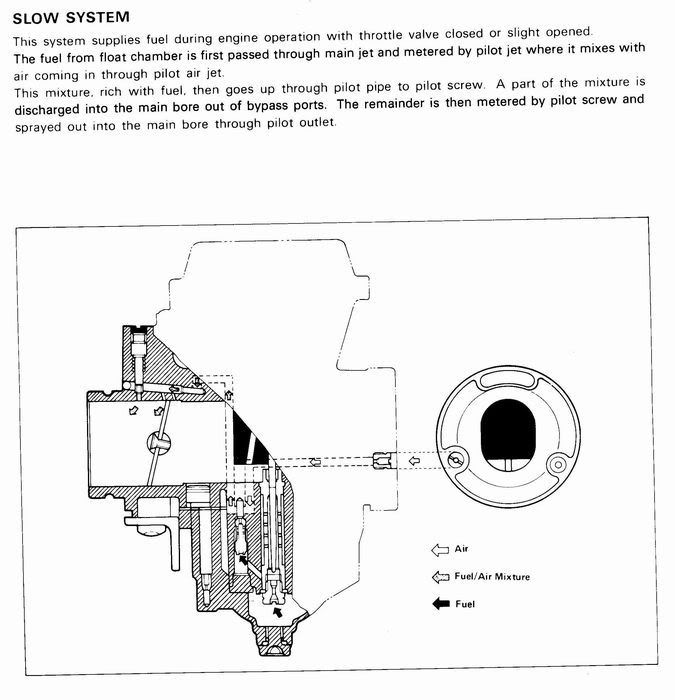
I thought I would add a visual to the discussion.

docu0001.jpg


Ah, this subject again.:smile:
The plugs missing/not missing doesn't change performance or how the fuel goes into the pilot jet.

The rubber plugs are an anti-tamper attempt. Lame, but no more lame than the caps that cover the mixture screws.

I guess I can see the first point, but I have a hard time buying the second. Seems just too lame :neutral:

I consider myself luckiy, in that my rubber plugs are snug as a bug even after 24 years.
 
Last edited:
I thought I would add a visual to the discussion.


I guess I can see the first point, but I have a hard time buying the second. Seems just too lame :neutral:

I consider myself luckiy, in that my rubber plugs are snug as a bug even after 24 years.

When you purchase a brand new set of plugs, they don't fit "snug as a bug", they simply slip in the hole. The casted post in the bottom of the bowl is what keeps the plugs in place.
 
When you purchase a brand new set of plugs, they don't fit "snug as a bug", they simply slip in the hole. The casted post in the bottom of the bowl is what keeps the plugs in place.

I think you misunderstood my meaning "by snug as a bug". My point was that my plugs don't leak, as a response to "the rubber plugs deteriorate especially in the presence of alcohol that is now very common (again) it will shrink and seep gas around the sides." as stated by Focus Frenzy.

I also already pointed out "The plugs are held tightly in place by by a metal boss in the float bowl" in an early post in this thread.

Sorry for the confusion.
 
Last edited:
The only effect I can imagine the plugs having is near WOT. At this point the main jet is the only orifice controlling the flow of fuel. Without the plugs you are adding the flow from the idle jet to the mixture - producing a richer mixture. Maybe more rich than is necessary?

Also think about how the fuel can flow _around_ the main jet and across the connecting port if the plugs are not there. I'm not sure if this actually happens but I'm thinking its possible.
 
The only effect I can imagine the plugs having is near WOT. At this point the main jet is the only orifice controlling the flow of fuel. Without the plugs you are adding the flow from the idle jet to the mixture - producing a richer mixture. Maybe more rich than is necessary?
At WOT the negative pressure acts on the main circuit. Any "added/extra" fuel still being drawn through the pilot circuit is too minimal for concern. The amount of fuel through the pilot circuit also lessens as the throttle opens. Flow through the pilot circuit doesn't stay the same from closed to fully open throttle due to change in negative pressure and what circuit that pressure acts upon. That's why you can increase pilot jet size and notice no difference in main circuit performance. You aren't increasing flow through the pilot jet by removing the plugs and at WOT the pilot circuit has an insignificant effect on performance with or without plugs. At WOT, the pilot circuit is effectively by-passed, just like the main circuit is by-passed at closed throttle. You can even remove the main jet and the bike will idle as it should because negative pressure is acting on the smaller pilot jet hole only.

Also think about how the fuel can flow _around_ the main jet and across the connecting port if the plugs are not there. I'm not sure if this actually happens but I'm thinking its possible.
I'm not sure what you mean here. Fuel can't go "around" the main jet and across the connecting port. Do you mean by-passing the main jet and entering through the unplugged tower? If so, the pilot doesn't care if it gets it fuel from the submerged main jet or the submerged unplugged tower. Both main jet and tower "holes" are far larger than the pilot jet hole, so the pilot jet will still be the regulator regardless of where the fuel comes from. Either through a missing plug or the main jet, the fuel still comes from the bowl. Removing a plug won't flood the pilot circuit.
 
for a bloke who knows bugger all about carbs this is gr8 thread with even gr8er replies....;)


special kudos to Keith for the most comprehensive and well worded techy reply Ive seen.... =D>


ffs - by the end of it I thought I almost understood something about carbs.... but nah - Im still mikanikly tarded...](*,)


keep up the good work8)
 
I'm not sure what you mean here. Fuel can't go "around" the main jet and across the connecting port. Do you mean by-passing the main jet and entering through the unplugged tower? If so, the pilot doesn't care if it gets it fuel from the submerged main jet or the submerged unplugged tower. Both main jet and tower "holes" are far larger than the pilot jet hole, so the pilot jet will still be the regulator regardless of where the fuel comes from. Either through a missing plug or the main jet, the fuel still comes from the bowl. Removing a plug won't flood the pilot circuit.

Thanks for a great explanation on how the idle and pilot work at throttle. I'm really fascinated by carbs and the CV carbs are amazing designs IMHO.

When I said that fuel may bypass the main jet I meant that if you look at the carb diagram, the little channel which connects the idle "tower" with the main "tower" joins the two above the main jet but below the idle jet. I'm thinking once the needle is raised and the main jet is now the restricting orifice, is it possible for fuel to go up the unplugged hole in the idle tower and come around across the channel (in the reverse direction that it would go when the hole is plugged) and go up the main tower. I'm guessing this would only happen at WOT.
 
DIMITRIT, I think you just may have explained the reason for the plug. Sounds like a reasonable theory.
 
Thanks for a great explanation on how the idle and pilot work at throttle. I'm really fascinated by carbs and the CV carbs are amazing designs IMHO.

When I said that fuel may bypass the main jet I meant that if you look at the carb diagram, the little channel which connects the idle "tower" with the main "tower" joins the two above the main jet but below the idle jet. I'm thinking once the needle is raised and the main jet is now the restricting orifice, is it possible for fuel to go up the unplugged hole in the idle tower and come around across the channel (in the reverse direction that it would go when the hole is plugged) and go up the main tower. I'm guessing this would only happen at WOT.


actually it will suck gas bypassing the main jet at anything above a slight cracking of the throttle, not just WOT.
without that plug in place all the bike would do is idle, any attempt to open the throttle would be rewarded with a severe flooding problem.

if it was a anti-tamper plug wouldn't it be something that didn't just fall out when the bowl was removed??
say like a cast/ pressed in aluminum plug like that found over the pilot screw?
 
actually it will suck gas bypassing the main jet at anything above a slight cracking of the throttle, not just WOT.
without that plug in place all the bike would do is idle, any attempt to open the throttle would be rewarded with a severe flooding problem.

if it was a anti-tamper plug wouldn't it be something that didn't just fall out when the bowl was removed??
say like a cast/ pressed in aluminum plug like that found over the pilot screw?

It's not for anti tamper. You need access to the idle jet so you can remove it/clean it. Someone said that there's a riser on the bowl which presses up against the plug to hold it in place. I've never verified this but I do have the rack off the 550 right now so I'll check before they go back on.
 
Back
Top