• Required reading for all forum users!!!

    Welcome!
    Register to access the full functionality of the GSResources forum. Until you register and activate your account you will not have full forum access, nor will you be able to post or reply to messages.

    A note to new registrants...
    All new forum registrations must be activated via email before you have full access to the forum.

    A Special Note about Email accounts!
    DO NOT SIGN UP USING hotmail, outlook, gmx, sbcglobal, att, bellsouth or email.com. They delete our forum signup emails.

    A note to old forum members...
    I receive numerous requests from people who can no longer log in because their accounts were deleted. As mentioned in the forum FAQ, user accounts are deleted if you haven't logged in for the past 6 months. If you can't log in, then create a new forum account. If you don't get an error message, then check your email account for an activation message. If you get a message stating that the email address is already in use, then your account still exists so follow the instructions in the forum FAQ for resetting your password.

    Have you forgotten your password or have a new email address? Then read the forum FAQ for details on how to reset it.

    Any email requests for "can't log in anymore" problems or "lost my password" problems will be deleted. Read the forum FAQ and follow the instructions there - that's what we have one for...

  • Returning Visitors

    If you are a returning visitor who never received your confirmation email, then odds are your email provider is blockinig emails from our server. The only thing that can be done to get around this is you will have to try creating another forum account using an email address from another domain.

    If you are a returning visitor to the forum and can't log in using your old forum name and password but used to be able to then chances are your account is deleted. Purges of the databases are done regularly. You will have to create a new forum account and you should be all set.

What have I done to my brakes??

  • Thread starter Thread starter Mike
  • Start date Start date
M

Mike

Guest
When I bought the bike, I got it from a guy who'd only had it for a couple months. He said the PO only used the rear brake, so they were pretty well shot. I replaced them and when I put everything back together, the brakes don't even slow the wheel down. I tried adjusting the operating arm every direction, but nothing made a bit of difference. I'm not sure what I'm doing wrong and the manual doesn't seem to be much help.
 
Let us assume the drum surface is glazed.
Go then, and get some silicon carbide sandpaper, or equvalent, and sand through the glaze.

You did tighten things to specification,
 
Had you read the post you would realizee the brakes are drumlike in the munificence.

I'm not familiar with his bike nor did he mention they were mechanical, therefore I was correct to assume they were hydraulic especially since that is often the cause.
 
Let us assume the drum surface is glazed.
Go then, and get some silicon carbide sandpaper, or equvalent, and sand through the glaze.

You did tighten things to specification,

I don't even know that the shoes are even touching the drum. I assume that if the surface is glazed, I'd at least hear them touching. Before I replaced the shoes, when I took them apart the first time, it was the same thing. Push the pedal - nothing. That's what makes me think that I didn't get something back right.
 
I'm not familiar with his bike nor did he mention they were mechanical, therefore I was correct to assume they were hydraulic especially since that is often the cause.


Who killed you and replaced you as a tightass school marm?
again my question mark has gone to the francophonie on me.

Oh an yeah I was kidding you you big silly guy you!
 
Who killed you and replaced you as a tightass school marm?
again my question mark has gone to the francophonie on me.

Oh an yeah I was kidding you you big silly guy you!

I like my tight ass hah.
 
I don't even know that the shoes are even touching the drum. I assume that if the surface is glazed, I'd at least hear them touching. Before I replaced the shoes, when I took them apart the first time, it was the same thing. Push the pedal - nothing. That's what makes me think that I didn't get something back right.

I do not know how much the brakes could wear but let us imagine that they were shot.

If this is true then you should see a scribed line on the shaft for the drum brakes cam. this sould align with the lever.
If not then make it do so.

You can then check the foorlever as it may have been rotated a notch to mnake up for the slack caused by worn shoes.
 
Feel the lip of the drum, see if there is something like 1mm of lip, if there is the shoes will not touch when the cam rotates. I don't believe there is any fix for a worn drum on a bike, if it is a spoke rear wheel (most other drum brake bikes I had were) you can get a new hub and put it back together.
If the drum is ok, you can adjust the length of the link rod to tighten up the brakes.
 
If I remember correctly, when adjusting drum brakes, you have to tighten the adjuster nut until it won't turn any more.
The shoes are spring-loaded to spread apart, you need to take up all the slack with the adjuster nut.

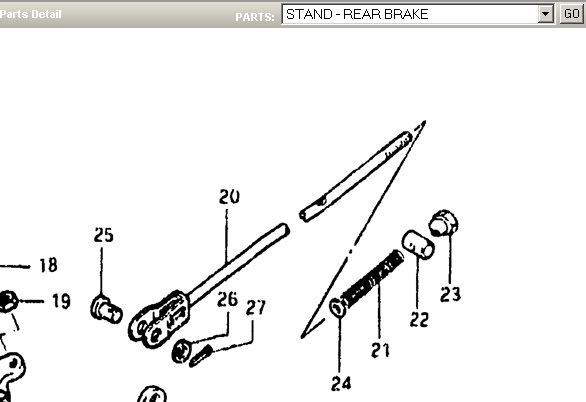
The adjuster nut is #23 in this picture. Tighten it until it won't go any farther, let it fall back to the previous 'notch'.

450drumbrake.jpg


.
 
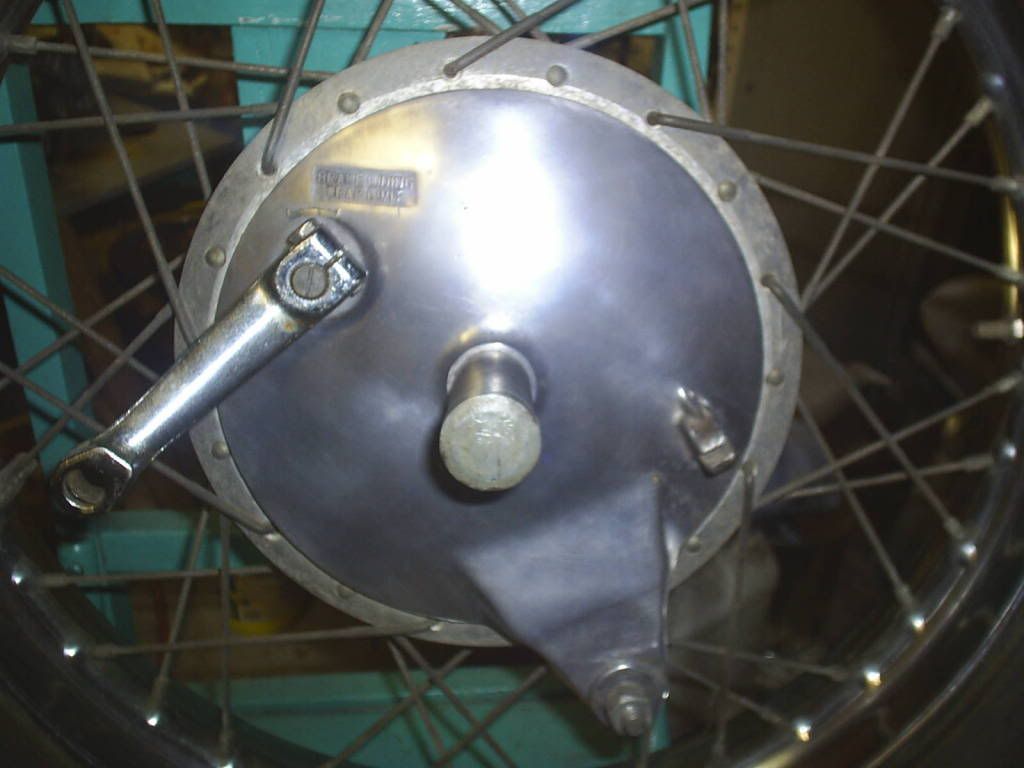
As Jeepman said, align the brake foot pedal on the serrated shaft in the correct position and align the line stamped across the end of the brake cam shaft to the the "Brake Lining Wear Limit" thingo that is cast onto the alloy brake backing plate. Position the rear brake lever as appropriate.

S3010006.jpg


The only way to really have perfect rear brakes if to have the wheel mounted in a lathe and have the brake drum skimmed so the drum ID is perfectly round. Then the brake material is removed from both shoes and over sized linings bonded to the brake shoes. The shoes are then mounted to the brake backing plate as normal with springs, etc. BTW the springs pull the shoes closer together, they don't push them apart.

Then a couple of .010" shim strips are cut and mounted either side of the cam, between the flat of the cam and the end of the shoe. This forces the shoes out (or makes their diameter larger) by .010". This setup is then mounted on a lathe and machined down until it just fits inside the newly machined drum. The .010" shim strips are then removed and the shoe assembly inserted inside the drum. With the shims removed this gives a working clearance between the shoes and the drum.

With this setup the shoe linings get about 98% contact with the drum and exceptional rear braking is the result -- lockup even!!!!!!!

The only other thing that needs to be done is to centralise the rear brake as the rear axle is tightened in place. If the rear brake is not centralised poor braking will be the result.

Hope this helps
 
Last edited:
I haven't done any adjustments on my drum since I assembled it after painting the wheels, and I have exactly the same symptoms as you have, but I do know that my drum and shoes are in spec.

I sanded the drum and the shoes to break the glaze before assembling, but I haven't gotten to paying any attention to things like what Steve, Jeep, and Don have said as yet.

I expect to be able to tighten everything up, adjust the brake lever on the shaft, and have them back as good as they used to be. And yeah, I've had back wheel lockups from the drum before :)
 
. BTW the springs pull the shoes closer together, they don't push them apart.
Quite correct, Don. :oops:

I was thinking about the spreading of brake pads, knowing that we were talking about shoes. :o

What I meant was "the springs act to release the brakes". Other than that, was my memory somewhat correct? :confused:
Do you still tighten the adjuster to take up all the slack, then back off to the last 'notch'?

.
 
Quite correct, Don. :oops:

I was thinking about the spreading of brake pads, knowing that we were talking about shoes. :o

What I meant was "the springs act to release the brakes". Other than that, was my memory somewhat correct? :confused:
Do you still tighten the adjuster to take up all the slack, then back off to the last 'notch'?

.

Don't worry Steve you are only about 1% senile and that is much better than me, I'm down to about 20% at the present time and climbing (falling).

The only reason I know a bit about it is that I have a drum brake on my rear. Otherwise I'd be in the same boat as you trying to recall information from a bygone era.

I adjust the knob on the threaded rod until the brake foot pedal applies the braking effort that suits my riding style, i.e. what feels comfortable. Usually I like the pedal to go dowm about an inch before I apply pressure to the back brake, others will differ.
 
Back
Top