• Required reading for all forum users!!!

    Welcome!
    Register to access the full functionality of the GSResources forum. Until you register and activate your account you will not have full forum access, nor will you be able to post or reply to messages.

    A note to new registrants...
    All new forum registrations must be activated via email before you have full access to the forum.

    A Special Note about Email accounts!
    DO NOT SIGN UP USING hotmail, outlook, gmx, sbcglobal, att, bellsouth or email.com. They delete our forum signup emails.

    A note to old forum members...
    I receive numerous requests from people who can no longer log in because their accounts were deleted. As mentioned in the forum FAQ, user accounts are deleted if you haven't logged in for the past 6 months. If you can't log in, then create a new forum account. If you don't get an error message, then check your email account for an activation message. If you get a message stating that the email address is already in use, then your account still exists so follow the instructions in the forum FAQ for resetting your password.

    Have you forgotten your password or have a new email address? Then read the forum FAQ for details on how to reset it.

    Any email requests for "can't log in anymore" problems or "lost my password" problems will be deleted. Read the forum FAQ and follow the instructions there - that's what we have one for...

  • Returning Visitors

    If you are a returning visitor who never received your confirmation email, then odds are your email provider is blockinig emails from our server. The only thing that can be done to get around this is you will have to try creating another forum account using an email address from another domain.

    If you are a returning visitor to the forum and can't log in using your old forum name and password but used to be able to then chances are your account is deleted. Purges of the databases are done regularly. You will have to create a new forum account and you should be all set.

What's the best way to prep plastic sidecovers for painting??

  • Thread starter Thread starter Guest
  • Start date Start date
G

Guest

Guest
I have a couple of old, mismatched, tired looking plactic sidecovers. I want to just give them a new shiny look with a rattlecan paint job.

What's the best way to remove the pinstripes & prep the plactic??

Will a basic enamel with a clear coat do the trick?? Realize this isn't professional grade stuff, I just want to clean it up for now...

Thanls,

Mike
 
As long as it's not going on the fuel tank it will hold up well enough. Use wet and dry sandpaper to sand through the striping and sand until you start getting into the base coat. It's doubtful after so many years you can get the stripes to just pull off. Start with something in the 200-300 grit range to cut through the stripes then switch off to 600 or finer for final sanding.
 
Thanks Billy,

Soooo, exactly where is , "The edge of God's country" ??

Inquiring minds want to know...


Thanks,

Mike
"At the intersection of stupidity & ignorance" :D
 
It's what the locals in the Texas Hill Country call the area out around Vanderpool, Leakey, Campwood... I actually live in San Antonio.

Ok, know I know - I have some relatives in Denton & Dallas area...

Too damn hot down there for me!! I prefer the changing seasons & temps here in New England !

Regards,

Mike
 
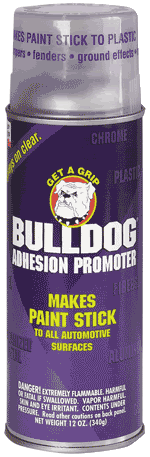
Painting plastics usually requires adhesion promoter, which is like primer, but for plastics. Krylon Fusion has it built in, so no need for it if that's your route.
 
I just sprayed mine last week. I block sanded them with 320 wet. Went over the whole piece with red scotchbrite. Then cleaned it with prep solvent. I used auto paint/primer but I've had good results with spray cans too. Use the adhesion promoter with rattle can paint and prime it before painting to fill any sanding scratches.
 
try taking a razor blade to the pinstripes as they are a pain to sand through. they clog your sand paper and make it very time consuming. start with 80 grit and work your way to 220 before you prime. wet sand between primer coats working to a finer sand paper. dont over due it the wetsanding is best done once you have laid colour down. continue like that. my paintjobs have come out brilliantly using this system specifically on plastics. good quality spray bombs are best though.
 
Painting plastics usually requires adhesion promoter, which is like primer, but for plastics.

Good call on the adhesion Promoter. Prep is the key to a good paint job.

bulldog.gif
 
So I've sanded MY mis-matched side covers, removing all striping, decals and paint (and my own fingerprints!). The surface of one of them is pretty roughed up (gouges and deep scratches). Is there a special type of body filler anyone would recommend for these ABS side covers?
Is the Adhesion Promoter referenced in this thread a hi-build product (like a sandable primer), to where one could layer and sand it the desired smoothness?
 
You shouldn't have any problem using a good quality body filler to smooth your side covers out. Rage Gold is a very good product. The "Bondo" brand that you find in hardware stores and such isn't nearly as good. Spend the extra few bux at an auto paint store and get the good stuff. It'll fill 80 grit scratches beautifully, which is good, because you want some "tooth" for the plastic filler to adhere to. Flex agents aren't necessary with today's urethane primers. Spray it with a good high-build, and you should be good to go.
 
You shouldn't have any problem using a good quality body filler to smooth your side covers out. Rage Gold is a very good product. The "Bondo" brand that you find in hardware stores and such isn't nearly as good. Spend the extra few bux at an auto paint store and get the good stuff. It'll fill 80 grit scratches beautifully, which is good, because you want some "tooth" for the plastic filler to adhere to. Flex agents aren't necessary with today's urethane primers. Spray it with a good high-build, and you should be good to go.

Thanks for the input. I'll have to check out the Rage Gold you recommend.
I read in a different thread about someone suggesting sanding the plastic starting with a 180 grit down through a 1200 grit. Would sanding the plastic itself be necessary if I instead use a high build primer to even out the surface then "step-sand" down to a 1000 or 1200? Would the primer fill the lighter sanding scratches?
As for the deeper scratches and the gouges: Do you have any experience with the StraightLine body filler sold by Por-15 (http://www.por15.com/STRAIGHTLINE/productinfo/STL20/)?
 
I think I suggested sanding the parts down with 180. That would be if there was no damage. 80 grit takes the paint off like nobodies business and should be used if you have to fill anything like gouges or really deep scratches with body filler. You could then sand the filler a little with 180 to smooth it out a bit more. I wouldn't go any finer than 180 for the first coats of primer to go over, though. You still need to have some tooth for it to adhere. Then block sanding the primer with 400 grit leaves a nice surface for the paint to adhere to. 1,200 is too fine. That's used on the final clear coats just before polishing.
 
I go to 2000 grip just before polishing. Super smooth. I'm in the process of doing some side covers myself. Didn't use any adhesion promotor though, so I hope there's no problems. I doubt there will be. I used 300 grit to get the pinstripes and all the ahesive off. I tried scraping them off, but they would just chip off bit by bit. Went to 400 before priming. Then, 400 on the primer before hitting it with color. After clearcoat, I started with 800, then 1500, then 2000. They're ready to buff out this evening. I'll post some pics when I'm done.
 
Hey nvr2old, you sound like a pro painter, am I right?,I have spent 20 years in this trade and one thing that I always do with spray cans(rattle cans to you guys) is warm the paint before application.go to a thrift store, buy a saucepan-or take one from the house if you are brave, stupid or married and like to have arguments!!,put the can into it and fill with water until the can is off the bottom of the pot, lift out the can and bring the water to the boil, lift off the heat put the can back in and leave for 10mins. This means that you don't get repetitive stress injury shaking the can. It also allows the paint to flow out of the nozzle more easily and with less spitting which can really mess up a good job.I have painted a lot of bike plastics and the best way to remove the ADHESIVE from the stripes is to sand back to the original surface with 320 wet/dry then use a product called BAR COAT here in the UK which is in all automotive shops, but only for atomiser spray guns not cans,put on one coat of this without rubbing it back, then high build primer usually 3-4 coats flatted down with 600wet/dry, then 4-5 colour coats lightly rubbed down with 1000 wet/dry then 4-5 clear coats. If I use cans the only difference is I tend to put 6-7 coats of primer as comes thinner than I would like.A trick to flatting primer is to spray from a can WITHOUT shaking it a dark colour over the part this makes a splatter effect, when you can no longer see the dark splatters your part should be flat and free from orange peel like surface.Also beware of edges they WILL rub through if you aren't very careful.Johnny
 
thanks for all the helpful advice.
@ ddaniels: those sidecovers turned out very nice. how many primer coats? how many base coats? how long between base coats? how many clear coats did you use? how long between last base and first clear?
 
Hey nvr2old, you sound like a pro painter, am I right?,I have spent 20 years in this trade and one thing that I always do with spray cans(rattle cans to you guys) is warm the paint before application.go to a thrift store, buy a saucepan-or take one from the house if you are brave, stupid or married and like to have arguments!!,put the can into it and fill with water until the can is off the bottom of the pot, lift out the can and bring the water to the boil, lift off the heat put the can back in and leave for 10mins. This means that you don't get repetitive stress injury shaking the can. It also allows the paint to flow out of the nozzle more easily and with less spitting which can really mess up a good job.I have painted a lot of bike plastics and the best way to remove the ADHESIVE from the stripes is to sand back to the original surface with 320 wet/dry then use a product called BAR COAT here in the UK which is in all automotive shops, but only for atomiser spray guns not cans,put on one coat of this without rubbing it back, then high build primer usually 3-4 coats flatted down with 600wet/dry, then 4-5 colour coats lightly rubbed down with 1000 wet/dry then 4-5 clear coats. If I use cans the only difference is I tend to put 6-7 coats of primer as comes thinner than I would like.A trick to flatting primer is to spray from a can WITHOUT shaking it a dark colour over the part this makes a splatter effect, when you can no longer see the dark splatters your part should be flat and free from orange peel like surface.Also beware of edges they WILL rub through if you aren't very careful.Johnny

We do things in a very similar way, Johnny. I've warmed up spray cans for years, too. I've never put them in quite the temperature you're describing, but, you're alive to tell the story, so..:D I've always put them in the kitchen sink in the hottest water I can get from the tap, and even that helps immensely. It does shake up easier, and it definitely flows out better. You can get a nice job with spray cans as evidenced by the red ones pictured, which..BTW, nice job! The only problem is longevity. I know people have had good finished results, but unless the clear is hardened, then the chances of it lasting is pretty slim, especially to any chemicals or errant bird crap. I'd be anxious to try the new 2-part clears available in spray cans, that would certainly help. You know who makes a really good high-fill primer in a spray can? Krylon. It's pretty amazing stuff. I use it on all kinds of small parts and brackets.
 
Back
Top