• Required reading for all forum users!!!

    Welcome!
    Register to access the full functionality of the GSResources forum. Until you register and activate your account you will not have full forum access, nor will you be able to post or reply to messages.

    A note to new registrants...
    All new forum registrations must be activated via email before you have full access to the forum.

    A Special Note about Email accounts!
    DO NOT SIGN UP USING hotmail, outlook, gmx, sbcglobal, att, bellsouth or email.com. They delete our forum signup emails.

    A note to old forum members...
    I receive numerous requests from people who can no longer log in because their accounts were deleted. As mentioned in the forum FAQ, user accounts are deleted if you haven't logged in for the past 6 months. If you can't log in, then create a new forum account. If you don't get an error message, then check your email account for an activation message. If you get a message stating that the email address is already in use, then your account still exists so follow the instructions in the forum FAQ for resetting your password.

    Have you forgotten your password or have a new email address? Then read the forum FAQ for details on how to reset it.

    Any email requests for "can't log in anymore" problems or "lost my password" problems will be deleted. Read the forum FAQ and follow the instructions there - that's what we have one for...

  • Returning Visitors

    If you are a returning visitor who never received your confirmation email, then odds are your email provider is blockinig emails from our server. The only thing that can be done to get around this is you will have to try creating another forum account using an email address from another domain.

    If you are a returning visitor to the forum and can't log in using your old forum name and password but used to be able to then chances are your account is deleted. Purges of the databases are done regularly. You will have to create a new forum account and you should be all set.

When valve clearance cannot be arrived at with thinnest shim ....

Hi there,
I have worked around motors for many years and "stretchy valves" is a new one for me; maybe that was a joke?
Air cooled motors, when pushed for max power, will typically fail in the area of the exhaust valves, and yes, they could drop their head. BUT you said this is on an intake valve, where heat is not usually an issue, unless maybe if the valve is held open / no clearance.
If the head was off / on the bench then the valve could be removed and an amount ground from the end of the stem to get things back in spec;
Good luck
 
Hi there,
I have worked around motors for many years and "stretchy valves" is a new one for me; maybe that was a joke?
Air cooled motors, when pushed for max power, will typically fail in the area of the exhaust valves, and yes, they could drop their head. BUT you said this is on an intake valve, where heat is not usually an issue, unless maybe if the valve is held open / no clearance.
If the head was off / on the bench then the valve could be removed and an amount ground from the end of the stem to get things back in spec;
Good luck
No joke. You've never heard of stretched valve stems?
 
No joke. You've never heard of stretched valve stems?

I have always heard it as a joke, like "Get me 50' of water line" or "Go find some relative bearing grease"

The valve stems get longer because the valves recede into the head.
 
I'm getting old, but I am still learning as well as forgetting....
I gather "valve stretch" is a concern with old air cooled VWs, but I cannot believe that it an issue for our street driven GSs
Must have dreamt that it was an intake, but still would not want anyone to panic re their valve breaking after a rebuild and moving valves between heads, I believe that would be extremely unlikely.
I would expect Suzuki to give a dimension from the spring seat to the top of the valve stem as a reference for machine shops to adjust valve lengths after grinding valve seat and valve faces..
Thankfully no shims in my 1150, so I will go and install a new petcock and rethink a charging concern.
Then go for a ride...
Regards
 
Valves will stretch. Especially the exhaust valve. Valve stretch is checked using a radius gauge between the stem and the valve face back. Or you use a vernier micrometer and measure the lower stem and compare to the upper stem, if it is narrower on the lower half then you have stretch.

This is a check that we do on aircraft engine valves.

Not sure if other engines have a similar check or if they just use height/length, either free or installed. Some stretch is acceptable.

A reduction in shim/valve clearance, depending on the tune of an engine, can be stretch or valve recession into the seat, or valve seat wear.
 
Good morning,
interesting re the radius gauge for the aero engines, I had heard of that, but would that not really be identifying distorted valve heads rather than what I would think of as actual "stretch"? The eventual failure mode likely being the valve head parting company with the stem, but also showing up as reducing valve clearances.
Have a good day
 
Good morning,
interesting re the radius gauge for the aero engines, I had heard of that, but would that not really be identifying distorted valve heads rather than what I would think of as actual "stretch"? The eventual failure mode likely being the valve head parting company with the stem, but also showing up as reducing valve clearances.
Have a good day

The stretch usually takes place where the head meets the stem. As it stretches it gets narrower and the radius changes. Placing the radius gauge there during inspection will reveal the change in radius, therefore the valve gets rejected because of this.

Alot of the aircraft engines use hydraulic lifters, therefore the reduced valve clearances are not seen, they are automatically compensated for by the lifter. The hydraulic lifter has an allowable range during installation, and unless you remove the lifter, bleed it down, reinstall it and measure the "dry" lifter clearance you would not realize it is approaching the minimum allowable clearance. Which would occur if the valve is stretching, tuliping or the seat is receding.

Removal of the lifter may never occur during the life of the engine. Only if the engine does not perform as designed or there is rough operation may this inspection be carried out during trouble shooting.

I have never worked on a bike engine newer than my 83 1100.

Do new bikes have hydraulic lifters today?
 
When doing the head rebuilds, upon disassembly, pick a valve that is in the middle of the shim range. Measure fron the tip of the valve to tjhe bottom of the shim bore where the base sits. Write that number down. After you finish your work, tip the valves all to that dimension. You will find that most are back in the middle of the shim range,
 
That is a good idea .. but can you explain for me where you are measuring :
(I can see that as long as you take a valve in the middle range as long as you measure at the same points it will be ok but
where are you measuring ?

"Measure from the tip of the valve" -
to tjhe
" bottom of the shim bore where the base sits"

the total / overall length is just fine ?
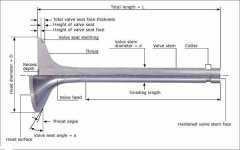
(I attach a picture so we are signing from the same hymnsheet)
 

Attachments

  • Valve terminology.jpg
    Valve terminology.jpg
    18.9 KB · Views: 0
Last edited:
When doing the head rebuilds, upon disassembly, pick a valve that is in the middle of the shim range. Measure fron the tip of the valve to tjhe bottom of the shim bore where the base sits. Write that number down. After you finish your work, tip the valves all to that dimension. You will find that most are back in the middle of the shim range,

What I am interpreting is, measure from the tip of the valve, installed, to the bottom of the shim bucket bore, for a valve which has the mid range shim installed prior to disassembly. Measure the overall length of that valve, then machine all valves to that length, as in dimension "L", as chuck said.

is this what you mean Jay?
 
Hi again,
After seats have been cleaned up and valve faces reground it is unlikely that you can just make all of the valves the same overall length, that is the problem that you are struggling with now.
I believe that they should be measured individually, in their specific position, and then ground to be the same as one that is in the mid range of shim thicknesses. You should measure from any common machined face on the head.
In an earlier post I said:
I would expect Suzuki to give a dimension from the spring seat to the top of the valve stem as a reference for machine shops to adjust valve lengths after grinding valve seat and valve faces..
That is what I was trying to say, and I think that is what the previous poster was also saying?
My apologies if I am wrong, again; at least this is not a panic job..
Regards to all
 
Hi again,
After seats have been cleaned up and valve faces reground it is unlikely that you can just make all of the valves the same overall length, that is the problem that you are struggling with now.
I believe that they should be measured individually, in their specific position, and then ground to be the same as one that is in the mid range of shim thicknesses. You should measure from any common machined face on the head.
In an earlier post I said:
I would expect Suzuki to give a dimension from the spring seat to the top of the valve stem as a reference for machine shops to adjust valve lengths after grinding valve seat and valve faces..
That is what I was trying to say, and I think that is what the previous poster was also saying?
My apologies if I am wrong, again; at least this is not a panic job..
Regards to all

I agree. My post was my interpretation of what Big Jay posted.

After the seats are machined then valve height should be checked and valves machined to bring into mid shim range. However, if there was extreme stretch then the valve would need replacement because you would cut below the top of the keepers.

Hope Big Jay chimes in here.
 
Back
Top