• Required reading for all forum users!!!

    Welcome!
    Register to access the full functionality of the GSResources forum. Until you register and activate your account you will not have full forum access, nor will you be able to post or reply to messages.

    A note to new registrants...
    All new forum registrations must be activated via email before you have full access to the forum.

    A Special Note about Email accounts!
    DO NOT SIGN UP USING hotmail, outlook, gmx, sbcglobal, att, bellsouth or email.com. They delete our forum signup emails.

    A note to old forum members...
    I receive numerous requests from people who can no longer log in because their accounts were deleted. As mentioned in the forum FAQ, user accounts are deleted if you haven't logged in for the past 6 months. If you can't log in, then create a new forum account. If you don't get an error message, then check your email account for an activation message. If you get a message stating that the email address is already in use, then your account still exists so follow the instructions in the forum FAQ for resetting your password.

    Have you forgotten your password or have a new email address? Then read the forum FAQ for details on how to reset it.

    Any email requests for "can't log in anymore" problems or "lost my password" problems will be deleted. Read the forum FAQ and follow the instructions there - that's what we have one for...

  • Returning Visitors

    If you are a returning visitor who never received your confirmation email, then odds are your email provider is blockinig emails from our server. The only thing that can be done to get around this is you will have to try creating another forum account using an email address from another domain.

    If you are a returning visitor to the forum and can't log in using your old forum name and password but used to be able to then chances are your account is deleted. Purges of the databases are done regularly. You will have to create a new forum account and you should be all set.

1979 GS750 (VM26SS) Leaking Float Bowls

LeonAlistar

Forum Apprentice
Super Site Supporter
Hi all,

I bought my '79 GS750(N) back in April and have been plugging away at all the maintenance items recommended by this lovely forum, BikeCliff's references, and in the manual, and have come across my first problem that I couldn't find a definitive answer to on the forum!

The problem:
There is a slow weep of fuel past the float bowl gaskets on at least three of my four carbs. I can tell it is coming from here and not the fuel tee / nipples above because all surfaces of the carb body above this are dry, but a shiny, almost condensation-like film of fuel originates at the top of the bowls, and the gaskets are darkened showing saturation.

Details:
I am not the first owner, and do not know the maintenance history of the bike. That being said, it was with the original owner for most of its life, it mostly sat since at least 1994, and the trunk that was attached contained a variety of empty Suzuki OEM part bags, none of which relate to the carbs (this and the fact that the dealer tag was still on the keys gives me at least a little hope that it's mostly original). ​​​I have completely disassembled my carbs, and methodically cleaned each one individually utilizing the Harbor Freight ultrasonic cleaner w/ distilled water & a splash of Simple Green Pro HD, and carb cleaner to verify flow through all passages & orifices. I utilized the flat edge & the dull point of a dental pick to clean the body gasket mating surfaces, and chased either side of the raised sealing groove to remove any debris built up on either side, respectively. I followed Paul Musser's 2005 VM rebuild guide, replacing all o-rings and gaskets (Thanks Nessism for the o-ring kit), except for the cover gaskets as they're in pretty good shape and came off cleanly. The float bowl gaskets are OEM Suzuki, purchased off of Ebay (unsure of age, the bag looks un-yellowed, but the gaskets are fairly stiff, wish the bag had a date code). All o-rings were installed with a touch of oil to ease installation, but the gaskets were installed dry. The floats were set to the manual's recommended 25-27mm, with most of them being between 25-26mm (which I assume would mean on the lower end of the fuel level). The bowls were attached using the original Philips screws, tightening each bowl in an x-pattern, repeated passes, tightening pretty hard (until it felt the Phillips heads might deform). After reassembly I placed the carbs, level, on a block in a container, to check for leaks. Everything looked good, except the float bowl gaskets.


Did I tighten the bowls too much, possibly warping the carb bodies? Are the OEM gaskets not what they used to be, possibly due to age if NOS? I understand the argument of checking float levels (I plan to) to ensure the fuel level is below the mating surface, but surely the gaskets aren't meant to wick or leak fuel if it's not perfectly level & still (i.e. riding or on kick stand)? Also, I am not getting any fuel coming out of my overflow tubes (which are not clogged).

Any suggestions or assistance is highly appreciated!!

Thanks,

Danny
 
Did you verify that the float needle tang was springing like it should? They often get gunked in, and no longer spring. Another useful thing to do is to use a Q-tip, dipped into Brasso or similar, and polish the inside of the float needle seat. Lastly, upon reassembly, make sure to check the fuel level. Not just check float height. Fuel level can be checked on VM carbs by taking a piece of common vinyl clear tubing, and using a grinder to pencil pointing the end. Then cut it to about 12" long or so, and thread it into the float bowl drain, tightening it as much as possible. Fuel level is what's important, not float height. If you can't get the level where it needs to be, buy some float valves. Keyster brand is good. And maybe even buy new floats. when the floats get old they get heavy and sink in the fuel, increase fuel level and making it hard to adjust.
 
What Ed said, plus those are not Phillips screws. They're JIS
Buy some JIS screwdrivers from Go Fast Innovations and you'll be happier.
There's no reason to make those bolts super tight. They're not keeping fuel in, they're just holding the bowl up.
Your fuel level is too high. Explore what is making that happen.
 
My 77 GS750 has warped carb bodies. I actually use x3 gaskets and set my floats at 25mm instead of 23mm or something like that. Specs aren't in front of me.

However - items mentioned above need to be checked.

If fuel is running out of your overflow tubes on the bottom of the float bowl, you have stuck floats or sinking floats. By brass replacements if needed. Back in the "old days" we had specs and needed scales to weigh the floats.

Born a Hoosier here.
 
Not trying to hijack the thread, but I have the same exact issue on my 79 GS750 also. Same circumstances as well in terms of new Suzuki gaskets, everything cleaned and float heights set (I did the clear tube test as well though). The only difference with me is that I did clean the needle seat with some cleaning compound and my suspicion is that it may have caused a very slow leak between the needle and seat as the carbs did not leak before (even with the crappy original gaskets). After reassembling everything, they did not leak initially (about a week) but eventually they did and I also have a rich running condition that was not cured by dropping the needle or adjusting the fuel screws.
My thinking is that the needle and seat have a slow leak and are filling up the bowls slowly (fuel didn't come out any of the overflow tubes though). To test this theory, I've fitted some secondhand seats without cleaning them with any sort of compound. Only did this yesterday so I'm waiting on results. I'm also waiting on some new needles in case they are the cause of my richness problem, so I'll have a better idea next week when the parts arrive.
 
Last edited:
Thanks for all the feedback & advice everyone!

I can verify that the pins in the float needles travel freely throughout the spring's range, and have enough spring force to support the weight of the float with the carbs upside down with little to no depression of the pin. Interesting note on the floats having reduced buoyant force - they did float in the ultrasonic, I don't hear any sloshing, but gasoline may permeate where water would not, and the plastic portions of the floats do look rather tired.

I do actually have the graduated tube tool that connects to the float bowl drains - given the feedback above, here's my attack plan:

1) check fuel levels & determine if flow stops, or if the rate of fuel level increase suddenly slows but doesn't stop (indicative of a leaking valve I'm thinking?)

2a) If the fuel level stops increasing entirely rather than suddenly slowing but continuing, adjust floats to obtain proper fuel level. If inconsistent, and valves are confirmed to not leak, replace floats.

2b) If the fuel level increase suddenly slows but the level continues to rise, use brasso & a q-tip to polish float seats. Repeat step 1. If successful, do step 2a. If they still leak, replace the float valves.


My question remains though.... What about when the bike is tilted, i.e. on it's kick stand, or when fuel is sloshing around while riding? Wouldn't it leak fuel in those instances if the gasket isn't "leak proof"?

Also, does anyone have a trick to keeping the other bowls from filling so I don't have to dump the other carb bowls full of fuel each time I test one carb with my graduated tube tool?

​​​
 
In answer to your questions, I believe the gaskets must be leak proof - that's the purpose of any gasket.
If you use the clear tube method then you only need to dump fuel from the bowl the tube is attached to i.e. one bowl at a time.
 
Thanks JT-NZ - cool to hear you have the same bike! Looking forward to hearing back in how your float testing goes.

Something that may be worth noting - I looked up replacement float seat gaskets for where they thread into the carb body, and noticed they're salmon colored, making me think they are paper or at least paper bonded to metal. Mine are just metal... Is it possible mine are worn out, and I'm leaking at that gasket?

JT-NZ, do you know if your float seat gaskets are paper or paper bonded to metal, or if they're just metal?
 
... I looked up replacement float seat gaskets for where they thread into the carb body, and noticed they're salmon colored, making me think they are paper or at least paper bonded to metal. Mine are just metal... Is it possible mine are worn out, and I'm leaking at that gasket?

Well noticed :D
That's what makes fuel level measurement crucial, more so than in the past when replacements were like the originals.
The originals were real thin, the metal/alu ones are thicker.
That means the float seats mounted with the thicker gaskets are located lower in the bowl, and the needle will close earlier.
Float height needs to be compensated to achieve proper fuel level.
 
Last edited:
My gaskets were Suzuki NOS and are the "salmon" paper ones. My new needles are due to be delivered on Monday so I should be able to report back soon, once I reassemble everything and test ride it.
 
I've never had need the special screwdrivers. Any tip that fits in there tight will turn them out. I have an extensive collection of Phillips tips, and have ones the fit perfectly into the float bowls screws. I just did that job a few days ago, pulling the carbs on my '83 GS750ES to Heli-Coil the float bowl drain screws. Reusing old gaskets can be problematic though. It's easy to make your own with an Ex-Acto blade, and gasket paper. There is even rubberized paper that works, if you can''t find a gasket.
 
Suzukian, Just say'in, Using a phillips in a JIS screw is like using a pair of cheap plyers on a hex head bolt. They may work, but not even close to as well as the correct tool will work.... You can never know the difference if you never try a JIS.
 
https://photos.app.goo.gl/NGiEFVQAUpZwGpeB8

Hi all,

Got a brief chance over the weekend to bench test fuel in the carbs and measure fuel levels. I used the official tool on carb no. 2 and clear tubing as Ed recommended on the others. As far as where to measure, I measured fuel level from the bottom of each carb body where the float bowl attaches, as appears in the manual, except I read it at the back (airbox side) with the carbs all level in a vice.

I was taught to read at the bottom of the meniscus. At first I had marked the tubing at 2.5mm and 3.5mm, and tried to see if it landed between the marks, but I was getting weirdly low readings on no. 2 using the official tool (see below, I think an air bubble issue) and changed to clear tubing and using the graduated marks on the official tool to read the other tubes.

​#1) 2.5mm measured, no bowl leaks
#2) 3.0mm measured (with clear tubing; 5mm with official tool), notable bowl seep at front & back
​​​​#3) 3.0mm measured, bowl seep at front & back
#4) 3.5mm measured, very slow bowl seep, only noticed around area where pilot fuel screw lives

Fuel level stayed very steady - seems like float valves are sealing. What's confusing to me is that all levels appear in spec, and the one with the highest fuel level is the only one with no signs of fuel seep. Am I measuring wrong? Or should I just snug down the bowl screws and try again? I'm wondering at this point if I should try the softer aftermarket Z1 gaskets mentioned in another thread.

Thanks for your continued feedback!
 
Last edited:
i bought a bunch of gaskets back then.
Carb tops, float bowls and clutch covers, 10 sets.

Liked the idea they are reusable, and they will not stick like the paper types do.
Just open the carbs or clutch and no need to have new ones handy because
one breaks. Or worse, have to wait for days for the mail order to arrive.

So far, not one of them broke or leaks after multiple uses.
 
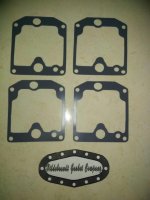
I bought Hildebrandt rubber reusable gaskets years ago, like them a lot !

https://www.ebay.com/itm/295685460297

They are bike lovers, real friendly guys, highly recommend them.
If they don't have the right gaskets you can send them one and they will reproduce it in rubber.

Thanks for the link - for $10, they're ordered! Should be here in the next week or two.

Given that my fuel levels appear stable (at least statically), I'm guessing that either my fuel level readings are inaccurate, my carb bodies are slightly warped, that the paper gaskets I bought leak or wick gas, or some combination of the above. Given that as best as I can tell my fuel levels are OK, my current plan is to move on to installing them in the bike, and checking float levels again with the bike running as depicted in the manual. Maybe once these rubber gaskets come in, if I'm still having issues and the fuel levels appear OK, I'll switch them out and see if it improves. It's a very slow leak, so I won't let that stop me from moving forward with vacuum synching and other maintenance items (i.e., valve clearances).

Thanks all for the help & advice!
 
Another useful thing to do is to use a Q-tip, dipped into Brasso or similar, and polish the inside of the float needle seat.

I used a wooden cotton swab and put it in the drill, worked a treat! Works with 'normal' types too if you snip one end but wooden is better. I can't remember where I learned that (maybe you!) but it fixed the leaks on my CB750. I also gave the float needles a polish, used Mother's. I think that was about the 7th time I had the carb rack off.
 
Back
Top