• Required reading for all forum users!!!

    Welcome!
    Register to access the full functionality of the GSResources forum. Until you register and activate your account you will not have full forum access, nor will you be able to post or reply to messages.

    A note to new registrants...
    All new forum registrations must be activated via email before you have full access to the forum.

    A Special Note about Email accounts!
    DO NOT SIGN UP USING hotmail, outlook, gmx, sbcglobal, att, bellsouth or email.com. They delete our forum signup emails.

    A note to old forum members...
    I receive numerous requests from people who can no longer log in because their accounts were deleted. As mentioned in the forum FAQ, user accounts are deleted if you haven't logged in for the past 6 months. If you can't log in, then create a new forum account. If you don't get an error message, then check your email account for an activation message. If you get a message stating that the email address is already in use, then your account still exists so follow the instructions in the forum FAQ for resetting your password.

    Have you forgotten your password or have a new email address? Then read the forum FAQ for details on how to reset it.

    Any email requests for "can't log in anymore" problems or "lost my password" problems will be deleted. Read the forum FAQ and follow the instructions there - that's what we have one for...

  • Returning Visitors

    If you are a returning visitor who never received your confirmation email, then odds are your email provider is blockinig emails from our server. The only thing that can be done to get around this is you will have to try creating another forum account using an email address from another domain.

    If you are a returning visitor to the forum and can't log in using your old forum name and password but used to be able to then chances are your account is deleted. Purges of the databases are done regularly. You will have to create a new forum account and you should be all set.

1983 Suzuki GS 1100 ESD Tach

  • Thread starter Thread starter Nicholaschase29
  • Start date Start date
I havent had the time to read this whole thing, but my 1100ESD tach is somewhat sketchy at times. Especially it seems when its cold out. At the same speed/throttle position in the same gear it will read at times as much as 6k RPM or as little as 3.5K RPM. It seems less likely to do this when warm, and i have a spare tach unit at my disposal, but id really like to know HOW this thing works, as the shop manual says NOTHING about it, so that in the future i can know HOW to fix a faulty one.

Some advice, when you do disassemble the gauge cluster the odometer reset knob does not pull off. I tried pulling up on the plexiglass case and cracked it :mad:. You need to take the screws out of the white plastic backing that hold the tach and speedo, then pull the white plastic away from the face. If you want to pull the plexiglass off you need to pull the back away then the knob is held on by a clip and a cotter pin.

Confusing I know, but if you look on bikebandit you'll see what i mean. I just want to save you the $60 mistake I made breaking the gauge glass.
 
I havent had the time to read this whole thing, but my 1100ESD tach is somewhat sketchy at times. Especially it seems when its cold out. At the same speed/throttle position in the same gear it will read at times as much as 6k RPM or as little as 3.5K RPM. It seems less likely to do this when warm, and i have a spare tach unit at my disposal, but id really like to know HOW this thing works, as the shop manual says NOTHING about it, so that in the future i can know HOW to fix a faulty one.
"What it appears to be like at this time, without knowing more about the SM014"

At the heart of the tach is a frequency to voltage converter. this F/V converter takes the on/off voltage (pulses) from the negative side of one coil and converts those pulses into a voltage that the tach can read.

I still need to know what the actual gauge does when connected to 3 volts. if it reads 8,000 rpm then the tachometer is nothing more than a glorified voltmeter.

also, someone would need to know the voltage potential the white wire is at, in reference to battery voltage.
I suspect because the trace side of the printed circuit board shows the white as "G" (ground)-- the orange as "V" (voltage)--and the brown as "S" (signal), the white is at +/- 0 volts.

when the voltage of the white is known, and how the meter indicates rpm's, the needed components could be calculated and a replacement board could be etched for the LM2917, built up and offered as a replacement for the factory circuit board.

Time for a poll on who has a defective electronic tach?

***note*** post may be edited again
 
Last edited:
I still need to know what the actual gauge does when connected to 3 volts. if it reads 8,000 rpm then the tachometer is nothing more than a glorified voltmeter.

I'm at school right now, but this weekend I'll get those numbers for you. I'll measure the voltage on the white wire too. I just noticed looking at the back of the board the white wire has a G by it, the Orange wire a V and the brown wire that attaches to the black/yellow wire has an s.

It looks like I had the brown and white wires mixed up and you were right about them.
 
I just noticed looking at the back of the board the white wire has a G by it, the Orange wire a V and the brown wire that attaches to the black/yellow wire has an s.
So did I, but it's hard to edit the post from work, on a timely basis.
 
Time for an update. I attached a AA to the tach input and it read 9500rpms. the battery was new and read 1.628 volts. I don't have a way to input lower voltages than that to the tach.

The other battery i was using before must've been shot. I removed the diode and it read ~0.2 ohms in both directions so i'm trying to find a replacement for it. Radioshack didn't have anything, the numbers on it are, 1Z202 (dot) 1T, but I've don't know if they are numbered like that. I found 1N202's online.

I performed another test on the circuit board, before i removed the diode, running leads directly from battery positive, negative, and coil negative to the inputs on the board. The output from the board measured with my voltmeter was ~.438 volts regardless of the changes i made to RPM. The voltage did jump around a little bit, but it was sporadic.

I'm trying to source a diode at school and will keep you posted on my progress. Feel free to jump in with comments, questions, or suggestions.
 
I've spoken with representatives from Radioshack, Newark, the Milwaukee School of Engineering EE dept, even the US branch of Suzuki and none of them seem to be able to identify my diode.

Printed on the diode is the code 1Z202 (dot) 1T.

Does this code mean something? Can i extract enough information from this to find a part that will perform the same way? Other than the voltage capacity of a diode is there really much difference between them? Could I use one that looks the same?

The representative from Newark seemed to think that the part might be a Zener Diode.

The Suzuki Reps let me know that this part was discontinued in 2002 and he could not offer help because of that. I asked if I could speak to an engineer but I guess all the engineering is done in Japan, and my Japanese is a little rusty.

Can someone please help me know what I should do about replacing this part? I have it off the board and am 99% confident that it is bad.

Thanks guys.
 
Diode

Diode

I have reread the thread and cant really figure out the go ins and go outs. Seems like that board is an intermediary board and noe of the signal are the coil tach signal?

Is the + and - out to the meter? How did you arrive at polarity?

A couple of other things. The schematic is a bit confusing and if you could redraw it would make it easier. I tried but was left wondering if what you had was right.

You have drawn in a diode, but it is oriented to be reverse biased. That implies a zener diode. Did you mean that? If it is just a diode, any guarden variety will likely work. If a zener, it has a specific reverse bias voltage. The only way to figure that out would be to measure one that works or buy several and see what works best on a test bench.

http://hyperphysics.phy-astr.gsu.edu/hbase/Solids/zener.html

A Zener is a cheap reference voltage with a set voltage that you select when you buy it.

I just looked up an axial Zeneor from Digi key as an example and they come in 3.3v 3.6v .3.9v .4.3v .4.7v .5.1v .....

http://www.onsemi.com/pub_link/Collateral/1N5333B-D.PDF

http://search.digikey.com/scripts/DkSearch/dksus.dll?Detail&name=1N5350BGOS-ND

looks like they are about $0.29 a piece. The zener voltage is not likely over 12V and probably somewhere about 1/2 of that. You could but a few, install them and get an idea of what you really need then order that one.(assuming that is the problem). But they are cheap.

Best to figure out if it is a zener though first.

Jim
 
I have reread the thread and cant really figure out the go ins and go outs. Seems like that board is an intermediary board and noe of the signal are the coil tach signal?

Is the + and - out to the meter? How did you arrive at polarity?

A couple of other things. The schematic is a bit confusing and if you could redraw it would make it easier. I tried but was left wondering if what you had was right.

You have drawn in a diode, but it is oriented to be reverse biased. That implies a zener diode. Did you mean that? If it is just a diode, any guarden variety will likely work. If a zener, it has a specific reverse bias voltage. The only way to figure that out would be to measure one that works or buy several and see what works best on a test bench.

http://hyperphysics.phy-astr.gsu.edu/hbase/Solids/zener.html

A Zener is a cheap reference voltage with a set voltage that you select when you buy it.

I just looked up an axial Zeneor from Digi key as an example and they come in 3.3v 3.6v .3.9v .4.3v .4.7v .5.1v .....

http://www.onsemi.com/pub_link/Collateral/1N5333B-D.PDF

http://search.digikey.com/scripts/DkSearch/dksus.dll?Detail&name=1N5350BGOS-ND

looks like they are about $0.29 a piece. The zener voltage is not likely over 12V and probably somewhere about 1/2 of that. You could but a few, install them and get an idea of what you really need then order that one.(assuming that is the problem). But they are cheap.

Best to figure out if it is a zener though first.

Jim
My guess is you're right that it's a zener. Another guess is that the IC on the board is a 5 volt device and the zerer is nothing more than a cheap voltage regulator.

At the time this bike was manufactured, the predominate IC processes were 5v and used ttl logic. I think you can safely say that it's not a 3.3v process. It may be higher than 5v, but not less.

If it is a 5.1v zener you're going to want one that has a max power rating greater than 1.5 watts. The 1n5338 has a power rating of 5 watts and exceeds any requirements that this circuit demands.

The above assumption is that the IC is a 5 volt device. If it isn't, my second guess would be 12 volt. For that you can use a smaller zener, but you may as well go with the same series since it won't hurt anything. Use a 1n3549 in that case. I also doubt it's a 12 volt zener - try 5.1.

If you've been powering up this board without the zener, and it is a 5.1 volt device, you may have toasted the IC if it wasn't already bad.

Note: everyting above is a guess since I have no idea what the IC is. If I knew, it would be an easy fix.
 
Last edited:
It's a Zener.

My reasoning...
(1) it's cathode is hooked from the meter + to the "G" symbol on the trace side of the board.
the white wire connected to the "G" symbol is ground, according to the chassis wiring diagram. it also shows the same orientation on the schematic that was drawn.

(2) the case marking is 1Z201, quite possibly a house marking?. the SM014 is a "ND" device, possibly nippon denso? of which no information could be found about and appears to be proprietary also.

(3) the orange in, on his schematic, is the 12v power for the tach and the SM014. which is connected to the cathode of the "device" in question, providing over volt protection for the meter and the SM014

(4) the "G" (negative) is directly connected to the SM014 at his white in.

the negative side of the tach is only connected to the SM014, so the tach is either voltage or current operated.

trace side... http://i464.photobucket.com/albums/rr10/zacharyalan09/IMG_0334.jpg
schematic... http://www.thegsresources.com/_forum/showpost.php?p=990451&postcount=8


The only things I have questions about, are his resistance reading of .2 ohms in both directions, does the tach indicate voltage or current and at what voltage is the "diode" set to regulate. because of this information I believe it to be higher than 5 volts, more on the order of 17? ish.

using a new "aaa" battery or a resistor in series with the meter might give the answer to how the meter is operated.

***my standard disclaimer*** I'm not an EE, go easy on me.
 
Last edited:
You test a zener for opens and shorts the same way as you do a regular diode.

It could be a zener of 17 volts, however, I wouldn't know what it's function would be. Possibly more weight to keep the front end down?
 
d'Arsonval Movement

d'Arsonval Movement

Rusty

The only things I have questions about, are his resistance reading of .2 ohms in both directions, does the tach indicate voltage or current and at what voltage is the "diode" set to regulate. because of this information I believe it to be higher than 5 volts, more on the order of 17? ish.

Most all meters are basically a needle connected to a light spring and a current creates a magnetic Field to pull on the needle. The more current the further the deflection. So it is a current sensor. You make a volt meter out of it by putting a resistor across it so that you limit the current through the movement to something it can handle.

see references.

http://notes.ump.edu.my/fkee/1313/Lecture%20Notes%2005.ppt#256,1,DC Voltmeters

http://www.tpub.com/neets/book3/7j.htm

I'm in the process of redwaring the schematic now.

Pos
 
would indicate its bad.
redundency, to protect the tach and SM014, because of a non regulating R/R?
Could be, but I doubt it. I've been wrong before, so I'm just giving my opinion.

Modern digital multimeters are basically current sources with a voltage measurement circuit.

I have a GS750ES tach in the garage that I can look at to make some measurements later. It's off the bike but it's a simple process to connect that board to a battery and measure the voltage across the zener.

I'm not sure the darn thing worked prior, so I'll have to check with my son. He 'lets' me work on his motorcycles. ;) Actually to be fair, it's a restoration that's going to be a wedding present, so I have no idea what works and what doesn't until I go over the entire bike.
 
Well, it appears that the 33 ohm resistor on this tach is open. I can't make a voltage measurement until I replace it. My wife is in town today so I'll give her a call and see if she can pick up one.
 
ESD Tach Schematic

ESD Tach Schematic

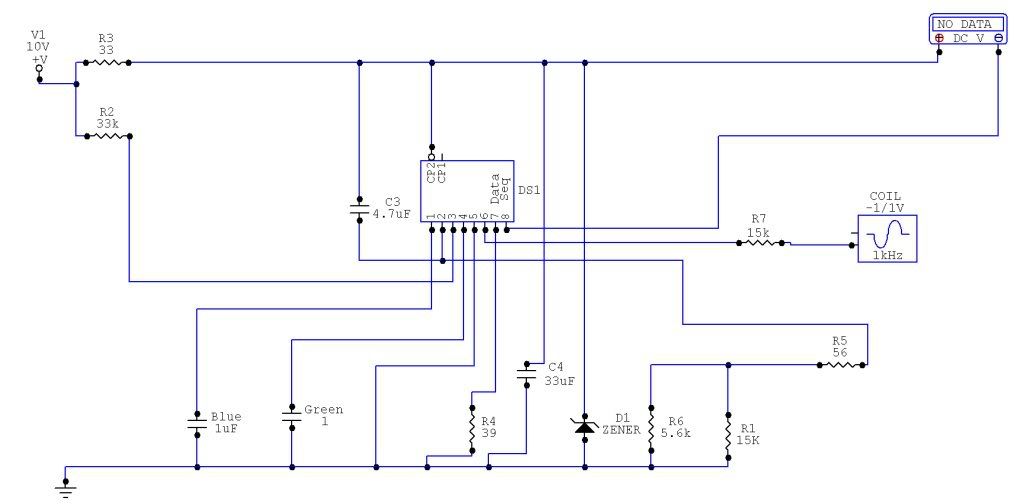
OK here is a schematic that I redrew based on the hand drawn version. I did not check all of it against the layout except to make sure that everything connected to the tach movement was correct. I also conferred with one of the guys here to see what he thought.


The diode is most likely a zener to provide a stable voltage reference to the ND SM014 as well as to the + side of the tach movement. This provides power to the part as well as an actively controlled reference. The 33 ohm, 33 uF paid also provide filtering. The zener is most likely 5 volts as Red suggested before.

The way this appears to work is when RPM is zero, the output on pin #2 (starting from the right) floats high to the +5V supply rail. In this way no current flow through the movement. As the RPM pulses occur, the voltage at pin #2 drops to toward ground causing current to flow and the RPM needle to deflect.

The rest of the circuitry depend on what is in the SM014, but none of that will change how the movement is controlled.

Pos


picture.php
 
The 33 ohm resistor is not 27 watts as was posted earlier. It appears to be a 2 watt part (again just a guess as the markings on these parts are pretty cryptic). This is possibly why it fails. If the assumption is made that the zener is 5 volts and the battery power is 12 volts then 2 watts is enough, as the power dissipation is 1.5 watts. It easy to exceed this rating if the battery power to this unit is above 13.1 volts.

I would suggest that those replacing this resistor upgrade to a 3 watt unit. I'm going to go that route and then try to measure the zener voltage so we can be sure it's a 5 volt device.
 
Red

Red

using the Suzuki manual standard changing range upper limit of 15.5V I get about 3.3 watts (10.5V drop). I guess that explains it's size.

Jim
 
Hey guys,

Looks like you've been working hard on my problem and i appreciate your help.

Posplayer - The plus and minus were fed into the meter, the wires off the board were red and black. As far as the polarity of the diode goes, I just copied the symbol off the back of the board, oriented how it was shown. I don't know how to determine which side is the anode and which is the cathode on the part itself.

Reddirtrider - I haven't powered it up since it has been apart.

I was looking over the diagram that posplayer drew up, it looks good, thanks for taking this seriously for me I'm lost on my own. I was looking at the input 12V wire though and found that where I have the voltage branching in your diagram all the voltage is fed through the 33 ohm resistor. I drew up a new diagram, it is the best i could do, and the 9th pin on the IC is the top pin on my drawing. It might still be hard to read though.

I made this diagram based on my hand-drawn diagram, I did not check it against the back of the board.

Once Reddirtrider has a chance to verify that diode on his board I'll go get a replacement for mine and keep my fingers crossed.

Thanks again guys.

Tach.jpg
 
CAD teeth cutting

CAD teeth cutting

Nicholas,
I looked at the change. The diode is still probably a zener 5V device. I hope Red can confirm when he gets his working.

Pos
 
Back
Top