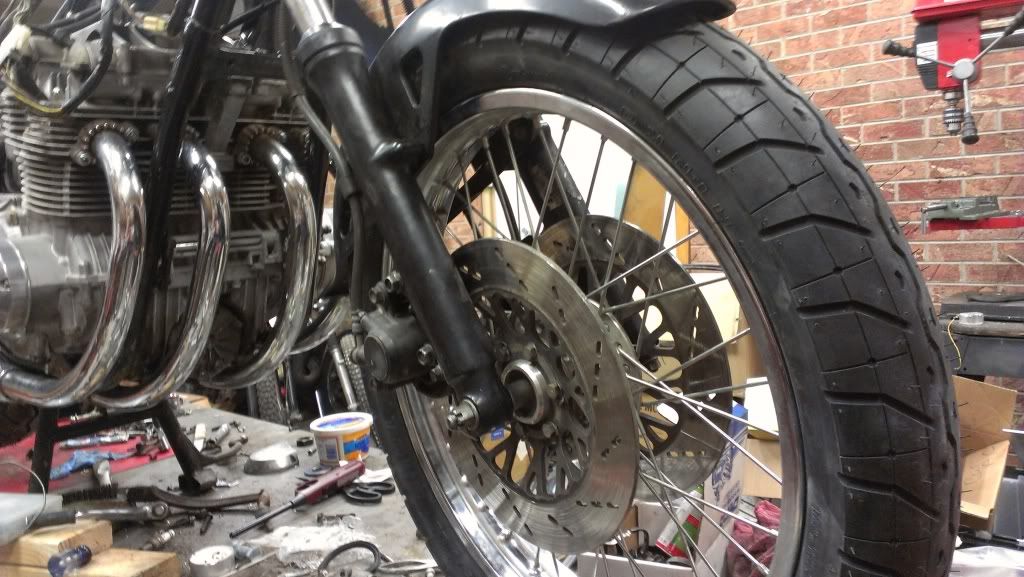
Not to hijack too much here but what is the advantage of a 37mm fork over a 35mm Josh?
Assuming the wall thickness is the same ratio, the simplest benefit is rigidity.
A bigger/thicker fork is going to have more resistance to flex under lateral load.
How much benifit a two mm step up is, I don't know for sure. One of our resident engineers might be able to say. But it was apparently large enough that Suzuki deemed it worthy of fixing their larger, and flagship models with 37mm vs 35mm forks. The other benefit nowadays is that since so many of the popular UJM models used a 37mm fork there are plenty of companies offering upgrade components for these forks and internals. Cartridge emulators for both rebound and compression damping are available for many bikes (I'm not sure that there are compression valves available for ours yet or not) through various manufacturers (which is nice because up until recently only Race-Tech offered emulators and they're somewhat expensive. Now there are a few companies, likely Chinese or assembled in china, that offer cheaper and as effective alternatives). For the street-fighter/cafe racer crowd there are now clip-on bars (actually quite nice ones) being produced where before they were pretty much only doing stuff for 41mm forks and larger. Fork braces, headlamps and headlamp ears etc etc are now being made for this generation of bikes. Likely because the whole cafe thing and this era of bikes has caught fire in recent years where before they were just "old nap bikes" leaning against a wall in someone's garage.
However, the OD of the fork doesn't always equate to being better.
Some of the bikes of the generations after our GSes actually had "softer" forks than what we have because although the outside diameter of the fork was larger, the wall thickness was no greater. Some of the last gen KZs (for instance the KZ1000ST, and 1100ST, their answer to the GS-G models) had at the time "Huge 41mm forks" but they were actually somewhat flimsy. The KZ, being shorter coupled than most GSes, often suffered from "head shake" when putting to spurs to her driving out of an apex. This was caused by both the flexible fork, and the more upright angle of the fork (compared to a GS, which had a longer wheelbase and were in comparison rock solid stable at high speed and quite good at driving out of the corner under heavy acceleration, one of the many reasons that the GSes often won the cycle rag shoot-outs vs Kawasaki. Even though most times the KZ had more peak HP, the GSes tractability made more of its horsepower available in real world situations instead of simple top speed runs)
Anyway, basically the 37mm fork was a better option at the time. Which is why after 1981 models, nearly every GS model 750cc and larger came fitted with them vs 35mm that the 750s and smaller bikes of earlier years were equipped with.
The 82 750 had not only 37mm forks, but also came equipped with the Suzuki Anti-Dive mechanism that the mighty GS1100E, and then the 83 and on GS550, 3rd Gen 750 and 1150s had.
Some people don't like it, some do. I will say when the system is clean, it works quite well, but because the anti dive valves were operated by the brake fluid and were part of the brake system, once the fluid and valves became compromised and dirty, the anti-dive either didn't work well, or (and my personal major complaint about it) became inconsistent. Sometimes it would prevent fork dive on hard braking, sometimes it would not. And myself, I would prefer to know what it's going to do every time. I can deal with the dive, if I know it's going to happen. But when it sometimes happened and sometimes didn't it became more an annoyance than an aid. Many people installed block off plates or simply placed a bolt on the anti-dive valves to cap them off while removing them from the brake system. Many people also complained that the set up caused a "mushy" lever feel that no matter how hard one tried, could not be bled out.