• Required reading for all forum users!!!

    Welcome!
    Register to access the full functionality of the GSResources forum. Until you register and activate your account you will not have full forum access, nor will you be able to post or reply to messages.

    A note to new registrants...
    All new forum registrations must be activated via email before you have full access to the forum.

    A Special Note about Email accounts!
    DO NOT SIGN UP USING hotmail, outlook, gmx, sbcglobal, att, bellsouth or email.com. They delete our forum signup emails.

    A note to old forum members...
    I receive numerous requests from people who can no longer log in because their accounts were deleted. As mentioned in the forum FAQ, user accounts are deleted if you haven't logged in for the past 6 months. If you can't log in, then create a new forum account. If you don't get an error message, then check your email account for an activation message. If you get a message stating that the email address is already in use, then your account still exists so follow the instructions in the forum FAQ for resetting your password.

    Have you forgotten your password or have a new email address? Then read the forum FAQ for details on how to reset it.

    Any email requests for "can't log in anymore" problems or "lost my password" problems will be deleted. Read the forum FAQ and follow the instructions there - that's what we have one for...

  • Returning Visitors

    If you are a returning visitor who never received your confirmation email, then odds are your email provider is blockinig emails from our server. The only thing that can be done to get around this is you will have to try creating another forum account using an email address from another domain.

    If you are a returning visitor to the forum and can't log in using your old forum name and password but used to be able to then chances are your account is deleted. Purges of the databases are done regularly. You will have to create a new forum account and you should be all set.

78 gs400 fuse blowing while riding

angrypants

Forum Apprentice
Past Site Supporter
Hi all
been scanning posts on the subject all morning but thought I'd ask for help before I go blindly chasing the issue

it only has one fuse ... never before today have I had any electrical issues. All blinkers brake lights worked .. I did replace the front brake switch when I did the master cylinder ... no issues at all
the bike has only done 14000 kms I have cleaned some of the connections
mite was covered in dust red Australian country dust lol
the headlight is still wired from the stator - we ride day or night with lights so I've left it like that
never had a battery charge issue I can leave it fir a month and it always starts first go

so about today - this morning I sprayed into the speedo housing with WD40 as there was a humming coming from it ... which was previously temp fixed by this method .. but last time I didn't ride the bike fir a week or two after application

the question is could that have cause a short ? Maybe with the light behind the speedo ??


The background - the fuse blew after I had ridden 4 kms to meet some mates for a ride, stopped had a coffee then set off then as I was moving up through the gears at higher revs the engine stumbled cane back and then the fuse went. Left me stuck on the up hill part of a long bridge with no where to go ... not a great place to stop. I changed the fuse road side and made it the 2km home.

i restarted the bike and it started fine ... idled ok. Went to move off and it blew

i had plenty of fuses so I tried again ... started and blew seconds after , next got 5 m and it blew ... next one got me around the corner and back and it didn't blow. Dejected I went and made pancakes and bacon.

left it for 3 hours figuring if it was the Wd then it would evaporate and I'd be all ok. New fuse and
Started fine, gave it a little rev...ok ... revved it hard and pop.

tried again it was ok at idle for a minute then blew when I gave it a hard rev, maybe related maybe not as earlier one blew at idle .

With key on and not running I tested all the blinkers and brakes high and low beam and combinations of without and nothing happened ... I juggled the horn too

i checked what wires i could see with seat off but tank on, I could not see any wearing or burnt wire .. but there is much more to explore there

one other thing it seemed like the clutch slipped just before the first fuse blow ??? Maybe I grabbed it when the engine stumbled?? Not sure

ok thanks for reading, I hope I have given enough background. I have little idea about electrics but point me im in a direction and give me a plan and I can follow that

Thanks
grant
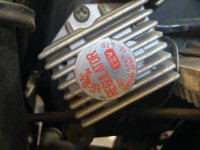
pic of my regulator if that is helpful 86980236-260E-4302-B44B-775948B7857E.jpg
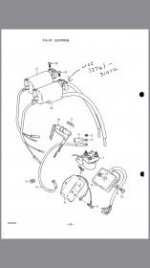
 
I am looking at this diagram
https://onedrive.live.com/?cid=2370...0C6B!1033&parId=2370B62DDF9F0C6B!1030&o=OneUp

Check the system charging voltage. If it's too high it will blow things. Check the condition of the regulator ground.
Revving making it blow makes this my #1 suspect.
If there was a short in the rectifier I would expect that to drain the battery so you might see nothing checking the rectifier resistances but worth a go.
There is probably a procedure in here http://members.dslextreme.com/users/bikecliff/
If you can't get to it, I notice it's loading funny, come back and I'm sure between us the hive can find a generic rectifier testing procedure
After that you are looking at systematically disconnecting things until the fuse survives.
In the long run that headlamp loop has to go and those separate reg and rec units are asking for trouble. They would have to upgrade to get to the level of bad reputation :)
 
i dont have an experience with the bikes that have just the one fuse, but i think my general understanding from other bikes will apply.

with the fuse blowing rather quickly, that will help you use the "eliminating suspects" method of troubleshooting.

try disconnecting the horn(s) and go for a ride, see if you go 2 or 3 times as long without the fuse blowing.
next try the regulator & rectifyer.
next try one brake lever switches. next try the other.
those are my leading suspects of devices that can have intermittent internal problems that cause shorts to ground. actully i dont much suspect the rewgulator & rectifyer, but since you mentioned them.
after that, i think you are pretty much left to looking over the wiring looking for worn through insulation. look where wiring harness goes around the frame (like steering neck) or over/around a flat edge (like near coil mounts) or maybe pinch point from reinstalling tank or seat.
 
Front master cylinder switch eh? Sounds familiar! On my GS450 I had the same issue this spring, blowing the fuse for no apparent reason. I'm running an aftermarket MC and the wiring for the switch had to be patched in since it's a different connector than stock. Turned out one of the contacts was making a ground and my tailight was in an always on condition which put a big load on the system between the light on and the short. You might want to check out the switch, could be a similar situation.
 
The old system of a separate regulator and rectifier was absolute crap and both of mine on my bike and parts bike failed producing an over voltage that damaged my stator and kept blowing headlight bulbs. The integrated R/R that came in 1980 was not much better. Bottom line all shunt systems are crap and archaic. They still exist because they are cheep to manufacture. A lot of us have switched over to the Series R/R systems. They look the same on the outside but work quite differently and are quite forgiving and easy on the electrical system. You are due for an entire inspection of the electrical system and cleaning of all connection points, plugs, switches (especially ignition and kill switch), bullet connectors, fuse holder, bulb sockets, and grounds. Once that is cleaned (DeoxIT is about the best for cleaning and restoring connections) and coated with dielectric grease, You need to install a new R/R (preferable a Series type) and then inspect and replace the stator if necessary. Stator windings turn very dark when they are overheated and damaged. If you do all that you should have a very reliable electrical system. There is absolutely tons of information on this on the site, this is the number one GS series failing, otherwise they are very good bikes
 
Thanks for all the advice - awesome !
I'll work through the suggestions and report back
 
Make up a couple of short leads with alligator clips and tag them onto the ends of the fuse holder. Each lead goes to either end of a test lamp.
Go all over the bike wiggling the wiring loom, pushing and pulling things until the lamp goes on.
You've just found the short to ground.
 
Have you still got the stock original glass fuse on it? They're notoriously bad, and you're much better of replacing it with an inline weatherproof blade holder from Supercheap or wherever.

I've had three situations on my 450 that have caused a blown main fuse, and incidentally these all happened with blade fuses as I swapped the glass fuse holder out many moons ago:

- Overheated fuse due to corrosion in the fuse holder, fuse had obvious signs of almost melting by the time it blew.
- Faulty battery that caused it to blow once RPM's got up enough for the stator to generate enough voltage, obviously with the coils' current draw the total with charging exceeded 15 amps.
- One fuse holder leg had worn/expanded so the fuse was loose in the holder.
 
Have you still got the stock original glass fuse on it? They're notoriously bad, and you're much better of replacing it with an inline weatherproof blade holder from Supercheap or wherever.

I've had three situations on my 450 that have caused a blown main fuse, and incidentally these all happened with blade fuses as I swapped the glass fuse holder out many moons ago:

- Overheated fuse due to corrosion in the fuse holder, fuse had obvious signs of almost melting by the time it blew.
- Faulty battery that caused it to blow once RPM's got up enough for the stator to generate enough voltage, obviously with the coils' current draw the total with charging exceeded 15 amps.
- One fuse holder leg had worn/expanded so the fuse was loose in the holder.


Hi pete,
i haven't had time to test / check anything yet, just moved house and apparently my garage/ workshop is the last place i should be unpacking boxes and setting up , SHE says bed sheets and kitchens a more important:rolleyes:
i was just re reading the suggestions in the hope i can get to it tonight at least for an hour or so.. i did notice you said

"Overheated fuse due to corrosion in the fuse holder, fuse had obvious signs of almost melting by the time it blew."

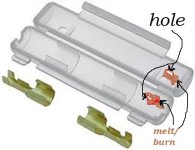
i notice the plastic fuse holder for the glass fuse has a melted hole at one end that wasn't there a few weeks ago, it's just behind at the join of the wire to the clip that holds the end of the glass fuse ( i do have a couple of the mini blade type set ups ready to go, but i liked the look of the old school glass ones and the holder , but if they are trouble i'll turf it ).

question: does that melted part / burn say anything (does the particular end that it melted at tell a story ? , its melted through in small spot on each side but only at one end (i cant recall which end , but looks a bit like the attached marked up pic ).

does that help narrow anything down ?

thanks for your assistance :)

grant
PS I've ordered a 2nd hand seadoo reg rec 710001103 (SH775AA) ....if i don't need it here i have a 78 gs1000 to stick it on :D:D

glass fuse holder.jpg
 
Last edited:
Well, it doesn't tell me anything other than it got too hot at some point :)

The melting I had was of the fuse itself rather than the holder, but either way it says it's been way too hot without blowing at some point which isn't great.

Loose fitting and/or corroded terminals will cause increased resistance which leads to heat, and you really want to avoid that.

Ditching the glass type fuse was one of the very first things I did on the 450... up to you but I've not had much success with them and I know others have had plenty of issues also.
 
I've just picked up 10 fuses so I can begin testing !!
Only once have I found fuses to be good test equipment. A voltmeter will tell you a LOT more.

Grimly's method of using a light bulb as a fuse is interesting. I'll have to try that some time.

.
 
Overheating at the end of a fuse is usually bad contact allowing micro-arcing.
The glass fuses, especially the cheap types, can have a crack in the solder joining the fuse wire to the inside of the cap.
 
hi all,
i haven't had time to really get stuck into this yet, i've just moved house so much of the last two weekends have been unpacking and finally last sunday setting up the garage.. i finished the garage sunday arvo and had a while to "fiddle" ( i really have no idea what i'm doing with electrics).
anyway my first hope was dashed ...that it would have miraculously disappear :rolleyes: .

i noticed
- the fuse ends get hot without the bike running when 1. i put the lights on high and low ,2 put the blinkers on (both sides). NOT when i put either brake on. i didnt let it get get so hot to blow the fuse though but i imagine it would if i left it. is it nowmal to get too hot to hold after 10 seconds? is that an indication of a short
Can i discount the regulator & the rectifier being the problem now?

i tried the horn but didnt have it on for long naturally so cant say much about that

at one point when aimlessly "fiddling" the bike would not start, i mean nothing at the starter, not even a click from the relay.( the inition lights , neutral light were on blinker lights would work ) i wiggled stuff around and pressed horn and then i suddenly got power to the starter. fuse then blew after a 20 seconds at choke idle.

oK so i'm a bit OCD when it come sto doing work on the bike i like to read things many times and have an idea of what i'm doing before i start -- otherwise i put things off ( like my tank sealing , its spooked me worrying about damaging the paint of doing a crap job -- i put that off for 9 months after buying the kit lol.. it was easy in the end). i feel that same hesitation / fear now with this electric issue.

Ok do i have the process correct
1. first call is to clean all connections and switches and ensure all the grounds are good -- i have bought some deoxitd 100s, and i have the dielectric grease.
2. possibly at the same time as 1. disconnect the likely things, test and see if problem persists
3. check the touching points of the harness for wear and exposed wire
4. start at one end and work all the way through the harness

OPk now how exactly do i test ?
- steve mentioned use a voltmeter rather than waiting for fuzes to blow... how does one do that ? do i hook that up to either side of the fuse terminals and look for something? ? then what? im guessing i only touch the terminal to test or i will i burn wires / kill my multimeter.. can you please elaborate steve where do i connect it what do i look for

- as for disconnecting stuff, eliminating causes ? am i just removing bulbs for the lights, or disconnecting the wires that go to the bulbs, ( to prove the issue is not between the battery and the lamp and then reconnecting that wire and then disconnecting the other side to see if the issue is in the lamp fitting ?i imagine i'm doing this with that light in the on position?

- with disconnecting / checking switches what do i do there ? do the same as above?


oh as for testing the ignition switch? how does one do that ? as i can see how i can disconnect that and still have current running through the wires ?


sorry to sound so naive.. its very possible i have read so many different things that i have confused the hell out of myself

thanks i really do appreciate all help

grant
 
Don't have much time for a proper response this morning but a couple of quick things...

No the fuse most definitely shouldn't get hot like that! And without the bike running, yes that sounds like your R/R is not the culprit at this point in time.

To test the ignition switch, the best way is actually with a multimeter, and check the voltage at the battery compared with the voltage coming back out of the switch connector. In my case when I did that initially I was losing something like 2.5V which is huge.

That, however, won't cause your fuse to be hot, that would cause the ignition switch to get a bit warm potentially, but the main issue will be less voltage to your coils etc.
 
Don't have much time for a proper response this morning but a couple of quick things...

No the fuse most definitely shouldn't get hot like that! And without the bike running, yes that sounds like your R/R is not the culprit at this point in time.

To test the ignition switch, the best way is actually with a multimeter, and check the voltage at the battery compared with the voltage coming back out of the switch connector. In my case when I did that initially I was losing something like 2.5V which is huge.

That, however, won't cause your fuse to be hot, that would cause the ignition switch to get a bit warm potentially, but the main issue will be less voltage to your coils etc.

thanks Pete
 
Went out this morning to start hunting found the battery almost dead
there is power going trough the fuse even without the key in
is that normal ?
i has a test light to each end of fuse connections goes brighter with key at on positions and then even brighter in park - normal ?

Ive put the battery on charge and will look through the wiring harness for wear today and go back tonight to use the multi meter and test light
 
Back
Top