• Required reading for all forum users!!!

    Welcome!
    Register to access the full functionality of the GSResources forum. Until you register and activate your account you will not have full forum access, nor will you be able to post or reply to messages.

    A note to new registrants...
    All new forum registrations must be activated via email before you have full access to the forum.

    A Special Note about Email accounts!
    DO NOT SIGN UP USING hotmail, outlook, gmx, sbcglobal, att, bellsouth or email.com. They delete our forum signup emails.

    A note to old forum members...
    I receive numerous requests from people who can no longer log in because their accounts were deleted. As mentioned in the forum FAQ, user accounts are deleted if you haven't logged in for the past 6 months. If you can't log in, then create a new forum account. If you don't get an error message, then check your email account for an activation message. If you get a message stating that the email address is already in use, then your account still exists so follow the instructions in the forum FAQ for resetting your password.

    Have you forgotten your password or have a new email address? Then read the forum FAQ for details on how to reset it.

    Any email requests for "can't log in anymore" problems or "lost my password" problems will be deleted. Read the forum FAQ and follow the instructions there - that's what we have one for...

  • Returning Visitors

    If you are a returning visitor who never received your confirmation email, then odds are your email provider is blockinig emails from our server. The only thing that can be done to get around this is you will have to try creating another forum account using an email address from another domain.

    If you are a returning visitor to the forum and can't log in using your old forum name and password but used to be able to then chances are your account is deleted. Purges of the databases are done regularly. You will have to create a new forum account and you should be all set.

81 GS650L - Charging Voltage at 5,000 RPM?

DaveP

Forum Mentor
I started a thread earlier where I posted the results of my quick charging system test. The results weren't too good:

1. Key-off: 12.9 volts.
2. Key-on 10 seconds w/lights: 12.3 volts.
3. Idle: 13.3+.
4. 2,500 RPM: dropped to 12.9 volts.
5. 5,000 RPM: dropped to 13.2 volts.
6. Key-off: 13.2 volts.

Since then I have cleaned up the wiring between the stator and rectifier by eliminating the harness from two of the wires and three bullet connectors, butt connecting the three wires directly together, and moving the rectifier negative wire from the battery box directly to the negative battery terminal eliminating the bullet connector and the ring terminal connection at the battery box. The negative wire was probably the worst of these with a fairly loose bullet connector. The results were improved except for at 5,000 rpm:

3. Idle: 13.3.
4. 2,500 RPM: dropped to 13.8 volts.
5. 5,000 RPM: dropped to 13.6 volts.
6. Key-off: 13.1 volts.

I then took a look at the 15 amp fuse and the battery bullet connector. Both seemed to be in good shape. Cleaned and used some dielectric grease before putting back together. 5,000 rpm is now at 13.76 volts.

Not sure where to look next or if I need to keep working on this.

Thanks for any advice.

Dave
 
Did you wire the stator directly into the R/R, bypassing the factory wiring? I can't tell from your description.

One other thing to do is put your volt meter on DC and place one probe on the + battery terminal and the other on the connection where the power leaves the R/R. If you get more than .2 volts you are loosing too much voltage and should clean the terminals on the power path back to the battery.
 
One other thing to do is put your volt meter on DC and place one probe on the + battery terminal and the other on the connection where the power leaves the R/R. If you get more than .2 volts you are loosing too much voltage and should clean the terminals on the power path back to the battery.

Ed is referring to the Revised Phase A tests in the Stator pages.

http://www.thegsresources.com/statorpapers4.php

If there are significant drops on either side you can chase them down.

If not they move to Phase B to see if your stator is starting to fail.

The wires between the stator and R/R are not nearly as important as between R/R and battery in increasing the top voltage to closer to 14.5V
 
Also keep in mind that there are "production tolerances", which means that your particular R/R might be set at 13.8 volts, rather than the overwhelming majority, which seem to be set just a bit higher at just over 14 volts.

A charging voltage of 13.8 will certainly charge your battery and you should experience very few problems with it. Technically-speaking, anything over the battery's rest voltage of 12.6 or 12.8 volts (for wet-cell or AGM batteries, respectively) will charge it. The question is "how well and how quickly".

One last thing to think about: how accurate is your voltmeter? While most meters available nowadays are pretty close, we are talking about just a few tenths of a volt here, which might just be inside your meter's accuracy tolerance.

.
 
Also keep in mind that there are "production tolerances", which means that your particular R/R might be set at 13.8 volts, rather than the overwhelming majority, which seem to be set just a bit higher at just over 14 volts.

A charging voltage of 13.8 will certainly charge your battery and you should experience very few problems with it. Technically-speaking, anything over the battery's rest voltage of 12.6 or 12.8 volts (for wet-cell or AGM batteries, respectively) will charge it. The question is "how well and how quickly".

One last thing to think about: how accurate is your voltmeter? While most meters available nowadays are pretty close, we are talking about just a few tenths of a volt here, which might just be inside your meter's accuracy tolerance.

.

From what I have seen on anything modern the tolerance is typically +/- 0.15 V (IIRC but pretty tight nevertheless) centered either at 14.5V or 14.25V. That voltage is selected as it will be the correct voltage to charge a battery and maintain it at above 85% state of charge at C/5.
 
Last edited:
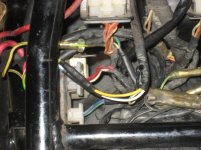
I believe that I did what was suggested in another post to wire the stator directly to the R/R bypassing the wiring harness. I did not add any new wire, just eliminated existing spade and bullet connectors. The negative from the R/R had wire added to reach the negative battery terminal.

IMG_4932.jpg
Y, W/G, and W/B wires connected directly together.

I have an Innova 3320 multi-meter. For DC voltage to 20v range the manual indicates resolution is 10mV.

It is an AGM battery.

I will have to continue with the additional testing.

Thanks,
Dave
 
I believe that I did what was suggested in another post to wire the stator directly to the R/R bypassing the wiring harness. I did not add any new wire, just eliminated existing spade and bullet connectors. The negative from the R/R had wire added to reach the negative battery terminal.

View attachment 46449
Y, W/G, and W/B wires connected directly together.

I have an Innova 3320 multi-meter. For DC voltage to 20v range the manual indicates resolution is 10mV.

It is an AGM battery.

I will have to continue with the additional testing.

Thanks,
Dave

Humor us and measure how much voltage drop that ground wire has at 5K RPM.
 
Took a look again this morning and started with running a new negative wire directly from the R/R to the negative battery terminal. Biggest change was the idle voltage??

3. Idle: 14.2 volts (was 13.3).
4. 2,500 RPM: 13.8 volts (same).
5. 5,000 RPM: 13.9 volts (was 13.8).
6. Key-off: 13.2 volts (was 13.1).

Then I did the voltage drop tests:
Red wire from R/R to positive battery: 0.2 volts
R/R cooling fin (couldn't clip into the wire terminal) to negative battery: 50mV

So my new negative wire is good and the positive lead side is pretty much in spec.

Any more that I can do to improve the positive side?

Any concern with the idle voltage increasing?

Thanks,
Dave
 
All original equipment. I just picked up this bike a couple of years ago. 26,000 miles on it.

Just looked at the 650 service manual spec. Charging output should be 14-15.5 volts at 5,000 RPM, so I am just a bit low of the range.

Dave
 
All original equipment. I just picked up this bike a couple of years ago. 26,000 miles on it.

Just looked at the 650 service manual spec. Charging output should be 14-15.5 volts at 5,000 RPM, so I am just a bit low of the range.

Dave

I would run the Phase B tests, I suspect the stator is damaged. Do both leg to leg and leg to ground.

Apparently the OEM stuff had a much wider voltage setpoint variation, and you are right at the bottom of that range.

Once you see if the stator is showing it's age you can better decide what to do.
 
Last edited:
13.9 volts isn't ideal but you will get down the road pretty well at that rate.
 
13.9 volts isn't ideal but you will get down the road pretty well at that rate.

I fully agree, the main point of my insistence to test further is to try and divine if there are other issues or if something if anything is marginal.

In this case charging at 14V is certainly not going to leave you stranded , but on the other hand it is an indications of something beyond normal stats.
 
Did you use crimp connectors or solder?

(that is why I almost never solder.)

.

Live and learn I guess. Soldering is permanent unless you cut them out and as is obvious should be done after you know the Stator is good.
 
OK, Phase B:

Resistance between stator leads:
Y-G: 0.5-0.7 ohms
Y-B: 0.6-0.7 ohms
B-G: 0.6-0.7 ohms

Resistance between leads and engine case: All 0.L

Lead to Lead AC current: All 89 volts +/- (manual, 80+ volts at 5,000 RPM)

The last test was AC from the stator leads to the negative terminal. This did not come out to 0 volts per lead, instead they are 50 volts at 5,000 RPM. I am not sure why this test would read 0 volts. Other flow charts seem to reference this 50 volt number.
 
OK, Phase B:

Resistance between stator leads:
Y-G: 0.5-0.7 ohms
Y-B: 0.6-0.7 ohms
B-G: 0.6-0.7 ohms


Resistance between leads and engine case: All 0.L
These Are poor tests and don't tell you much at all despite being in the manual.

Lead to Lead AC current: All 89 volts +/- (manual, 80+ volts at 5,000 RPM)

The last test was AC from the stator leads to the negative terminal. This did not come out to 0 volts per lead, instead they are 50 volts at 5,000 RPM. I am not sure why this test would read 0 volts. Other flow charts seem to reference this 50 volt number.

The stator is supposed to be isolated from the chassis ground and battery. So 50 volts, if correct, means the stator is damaged. So much for using an ohmmeter!!!!

The leg to ground tests are just like the ohmmeter tests except the ohmmeter uses a 9V battery while at 5K RPM you use 80 VAC.
 
The stator is supposed to be isolated from the chassis ground and battery. So 50 volts, if correct, means the stator is damaged. So much for using an ohmmeter!!!!

The leg to ground tests are just like the ohmmeter tests except the ohmmeter uses a 9V battery while at 5K RPM you use 80 VAC.

I do not understand the "so much for using an ohmmeter". The test said to use AC Voltage with 100 V range. My multi-meter is auto-sensing. Resistance tests in earlier steps did not show a problem.
 
Back
Top