KiwiAlfa156
Forum Mentor
what's a normal amperage draw for a starter motor? I've tried to find the manufacturer design spec for the OEM motor but haven't had much luck.
Current draw (amperage) is proportional to load, and the load is whatever is required to overcome internal friction and compression and crank the engine at a fast enough to start. So current draw isn't fixed, with cold starting requiring more current than a warm engine with thinner oil and significantly less windage and Hence the CCA measurement of batteries.
If I was confronted with what you are describing, my methodology would be as follows.
- I'd check that the battery was in fact in good condition. A dud battery can still give you a no load reading of 12.5V off the charger, but have no capacity to supply that voltage at a high current draw like that required to start a cold engine. I'd measure the battery voltage across the battery terminals before, during and after cranking, to determine voltage drop and recovery. If it goes below around 10V after 30 sec, or recovers to less than 12V, I'd be getting a new battery. Especially if it starts to smelling like eggs (which my last battery did). I see you've used an auxiliary battery so your problem may be elsewhere, but I'd still do this test to eliminate the battery as one of the causes (your problem might be multi-causal).
- I'd measure the resistance of all the wiring from the positive pole of the battery to the starter motor. So the thick red cable to the starter relay. The lead from the relay to the starter motor. Then I'd measure the resistance from the crankcase to the negative pole of the battery. There is an earth strap that runs from the engine back to the frame and from the frame back to the battery. A bad earth here would effect both the starter and the plugs as both use the engine as a return to the -ve pole of the battery. Good connections at the battery are vital.
- I would also check the resistance between the mounting strap of the starter relay and the -ve pole of the battery. The starter button supplies 12V to the single small gauge wire into the starter relay, through a coil and back to earth through the mounting strap -its a solenoid. A bad earth between the strap and earth, can and does cause slow cranking/no cranking (just a click) and hard starting. This because the coil isn't pulling the relay closed with enough pressure to make a good connection. This is a common problem. I cleaned a starter motor 3 times without improvement before I discovered this little problem.
- If the starter circuit is good and the earths are sweet, I'd pull the starter, disassemble, clean and return. Check the brushes for wear, clean the commutator with the appropriate grit wet and dry. And check that the field magnets are still attached to the inside of the starter housing. These puppies are 40+ years old and they are glued in. I've had two starters where a magnet has come loose, in one case part of it was abraded by the spinning armature and is was a nightmare getting all the magnet filings that had been flung though out the motor out. If you do find a loose one, use a high temperature epoxy glue.
- You might CAREFULLY test the starter motor with 12V MOMENTARILY applied between the +ve pole on the motor and the casing. But beware, without load these things spin up quick with quite a bit of torque reaction.
- All the above should mean your starter is doing what it should be doing and the issue isn't the starter circuit.
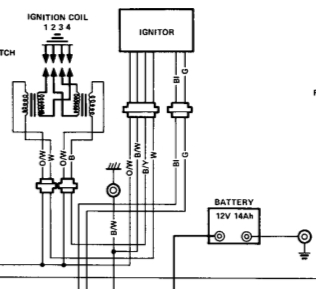
- I'd check that the the correct leads were on the correct plugs. LH coil to 1 and 4, RH coil to 2 and 3. And just as importantly that the coil primary wires are also in the correct orientation. The signal generator sends a AC current that blips when it changes phase to the Ignitor 'black box' which is slight smarter than a pair of dumb relays, in as much as it can fire each relay independently and thus each coil 180? apart and know which one to fire. Here's the wiring diagram to explain
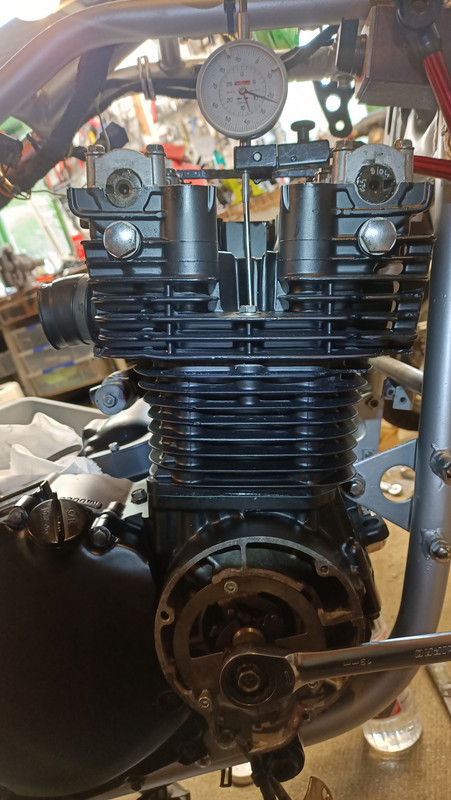
- I'd check the ATU which governs the spark timing advance was operating smoothly, and confirm that TDC was occurring when the "T" mark on the ATU was aligned with pointer line. You can do this roughly with a rod inserted in the plug hole and turning the crank until it reaches maximum height to determine whether its , or use a dial gauge.
- If this is all good and it still would start I'd check compression and pull the cam cover and confirm that the cam timing was correct. the arrows on the cam sprockets where pointing in the correct orientation.
- If it still wasn't starting at this point I'd probably start drinking.
Last edited: