• Required reading for all forum users!!!

    Welcome!
    Register to access the full functionality of the GSResources forum. Until you register and activate your account you will not have full forum access, nor will you be able to post or reply to messages.

    A note to new registrants...
    All new forum registrations must be activated via email before you have full access to the forum.

    A Special Note about Email accounts!
    DO NOT SIGN UP USING hotmail, outlook, gmx, sbcglobal, att, bellsouth or email.com. They delete our forum signup emails.

    A note to old forum members...
    I receive numerous requests from people who can no longer log in because their accounts were deleted. As mentioned in the forum FAQ, user accounts are deleted if you haven't logged in for the past 6 months. If you can't log in, then create a new forum account. If you don't get an error message, then check your email account for an activation message. If you get a message stating that the email address is already in use, then your account still exists so follow the instructions in the forum FAQ for resetting your password.

    Have you forgotten your password or have a new email address? Then read the forum FAQ for details on how to reset it.

    Any email requests for "can't log in anymore" problems or "lost my password" problems will be deleted. Read the forum FAQ and follow the instructions there - that's what we have one for...

  • Returning Visitors

    If you are a returning visitor who never received your confirmation email, then odds are your email provider is blockinig emails from our server. The only thing that can be done to get around this is you will have to try creating another forum account using an email address from another domain.

    If you are a returning visitor to the forum and can't log in using your old forum name and password but used to be able to then chances are your account is deleted. Purges of the databases are done regularly. You will have to create a new forum account and you should be all set.

A Question on Tappet Clearances for the Gurus

  • Thread starter Thread starter Suzuki_Don
  • Start date Start date
S

Suzuki_Don

Guest
When adjusting my valves the other day I checked the intake shim on #1 cylinder with the cam lobe pointing vertical as it should be, the reading was .08mm. As below:
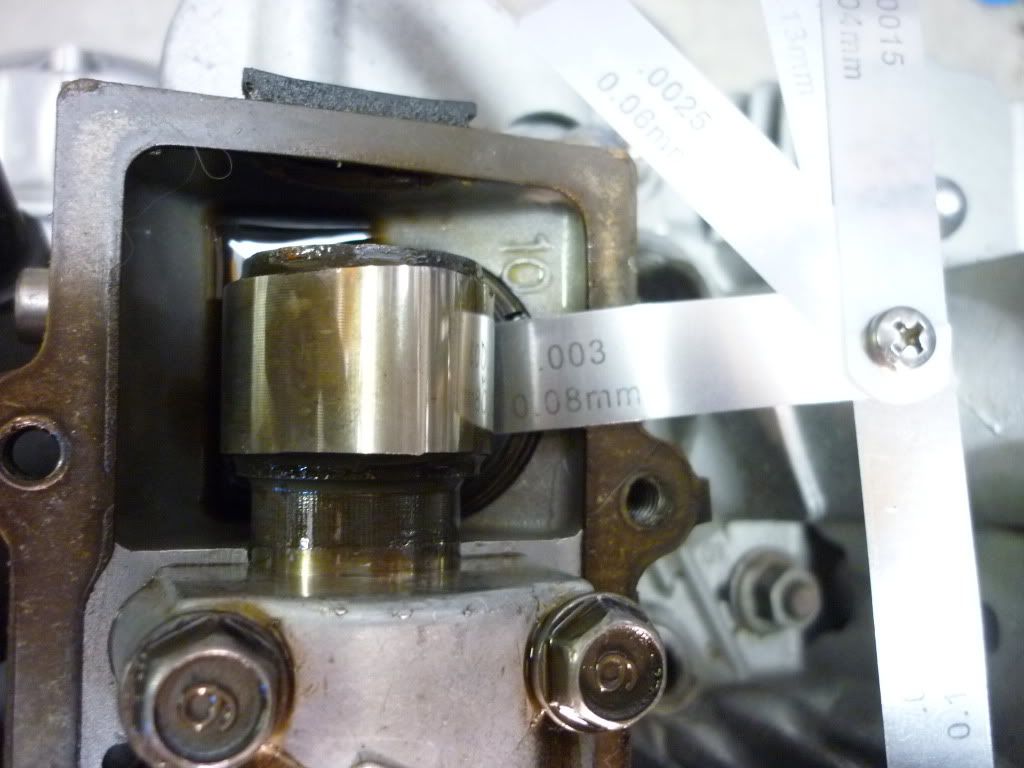
P1030992.jpg


I then rotated the cam lobe so it was pointing in a horizontal direction towards the rear of the motor (towards the intake boot) and rechecked the reading and it was .18mm. As below:
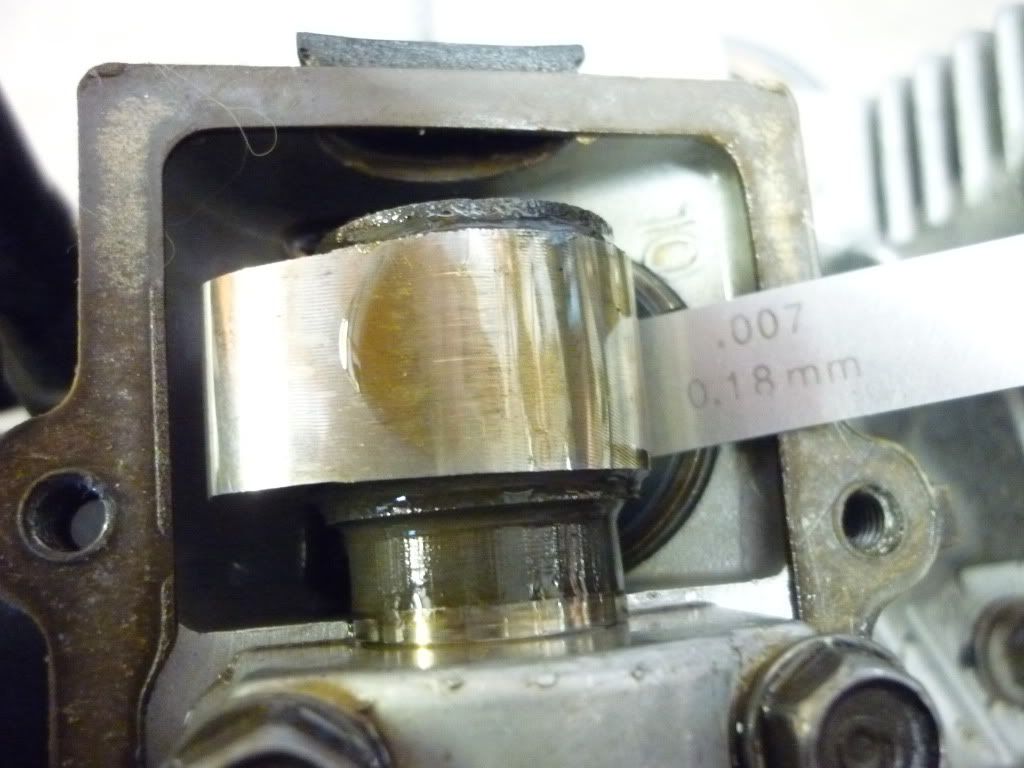
P1030997.jpg


Can someone explain what is going on?

Isn't the base circle of the cam lobe going to be ground the same radius all the way round until the contour changes when it comes to the cam lobe or ramp?

And if there is going to be a .1mm difference between both positions then if there is nil clearance in the position where the clearance is supposed to be checked (lobe pointing up vertically) then there would still be clearance in the other position (lobe pointing rearward in the horizontal position) so the valve would not be held off it's seat with the danger of the valve burning as has been mentioned on here many times.

Does anyone have the answers I desire?

If someone else has their valve cover off and would like to take similar measurements to verify if this is a one off or it is a similar situation on all of our motors.

.
 
Last edited:
Keen to see the answer to this also Don.

I haven't noticed that with mine but wasn't looking for it.

The factory manual explicitly says to measure with the cam lobe either parallel to or perpendicular to the valve cover gasket surface, which therefore implies that there should be two valid positions to measure each valve clearance.

Common sense would suggest that both positions should yield the same measurement... but if they don't... should I now check both positions every time I do a valve clearance check?

And, naturally, do we adjust the shim based on the smallest or largest clearance? I would expect the smallest as that would be the most likely to reduce far enough to impact compression at some point...
 
Thanks Pete for posing MORE questions.

BTW I must mention the bike has been running perfectly, so if there is an issue with running clearances it has not caused any issues with the motor. It runs nice and quiet. Especially after the previous problems I had. Noise related.
 
Haha sorry Don... couldn't help myself :o

I checked my clearances after the first 15 minute run and one had closed up what I felt was a very significant amount, so I'm wondering now if I did actually see something like this without realising it... I won't know for sure for another 4500km's though... nothing changed significantly between then and the 1000km check...
 
Yes Pete, I also noticed the manual says that you can check the cams in either position, vertical or horizontal. Although when it describes how to do the procedure it is exactly the same as in Cliff's explanation which is the way I do it as well.
 
The cam lobe for the adjacent cylinder on that camshaft is down, pushing the spring down and the valve open. The spring's tension is also pushing the cam up in it's journal, the clearance in the journal is large enough to let the camshaft move up a little. So the next cylinder's clearances are effected. Affected?

Using the Suzuki method, there is not any problem getting the proper measurement, as the cams for both cylinders on that side of the engine are not pushing down on their valve when you check the clearance, the camshaft is not being pushed to the top of it's bore.

Does this explain what you are seeing?
 
What is the position of the adjacent cam lobe? If the adjacent valve spring is pushing up on the cam it will skew the cam within the journal clearance and increase the clearance on that valve. Maybe your cylinder head journals are worn somewhat and the camshaft is moving around within the clearance.

Edit: Tom posted while I was typing. Great minds think alike.;)
 
Last edited:
Don, if this is on a four-cylinder bike, the outer exhaust cam lobe (#1 or #4) will be pointing forward, the inner lobe (#2 or #3) will be pointing up. Without moving anything, check BOTH valves. With the cam lobes in this position, neither one is pushing on a valve, skewing the cam's position in the bearing. As you roatate the cam, one lobe or the other is more likely to be pushing on a valve, increasing the clearance on the other valve.

For the intake cam, the positions are to the rear and up. Again, neither one is pushing on a valve.

On the twins, Pete, I have not seen that procedure for so long I have forgotten it, but I would guess that you simply point the lobe away from the valve.

.
 
Hi,

Don, I always think of you as one of the gurus around here. :)

I concur with the previous statements. Position one outside lobe, then measure both clearances on that side.

All the best to you and yours,

Cliff
 
My short answer is this. They measure the lobe heights directly opposite the very tip..thus you measure clearances directly oppposite also. AND if you turn the cam so you can rub your finger around the bottoms youll feel that theres small dimples and even a very pronounced edge where the curvature starts. I say always check as you did in photo 1.
 
My short answer is this. They measure the lobe heights directly opposite the very tip..thus you measure clearances directly oppposite also. AND if you turn the cam so you can rub your finger around the bottoms youll feel that theres small dimples and even a very pronounced edge where the curvature starts. I say always check as you did in photo 1.

And your valve clearances would always be set wrong. Suzuki knew what they were doing when they came up with these procedures.
 
I ALWAYS check the clearance with the lobes pointing up in a straight line with the valves,
and have been doing so for more than 30 years, and none of my bikes runs worth a darn. :rolleyes: :lol:
Who is ADDING dimples to the cam lobes???

Daniel
 
Last edited:
The cam lobe for the adjacent cylinder on that camshaft is down, pushing the spring down and the valve open. The spring's tension is also pushing the cam up in it's journal, the clearance in the journal is large enough to let the camshaft move up a little. So the next cylinder's clearances are effected. Affected?

Using the Suzuki method, there is not any problem getting the proper measurement, as the cams for both cylinders on that side of the engine are not pushing down on their valve when you check the clearance, the camshaft is not being pushed to the top of it's bore.

Does this explain what you are seeing?

What is the position of the adjacent cam lobe? If the adjacent valve spring is pushing up on the cam it will skew the cam within the journal clearance and increase the clearance on that valve. Maybe your cylinder head journals are worn somewhat and the camshaft is moving around within the clearance.

Edit: Tom posted while I was typing. Great minds think alike.;)

Ed and Tom, what you both say makes good sense to me and I can see how that would affect clearance.

Don, if this is on a four-cylinder bike, the outer exhaust cam lobe (#1 or #4) will be pointing forward, the inner lobe (#2 or #3) will be pointing up. Without moving anything, check BOTH valves. With the cam lobes in this position, neither one is pushing on a valve, skewing the cam's position in the bearing. As you roatate the cam, one lobe or the other is more likely to be pushing on a valve, increasing the clearance on the other valve.

For the intake cam, the positions are to the rear and up. Again, neither one is pushing on a valve.

On the twins, Pete, I have not seen that procedure for so long I have forgotten it, but I would guess that you simply point the lobe away from the valve.

.

Steve I think you're right, and after reading Ed and Tom's replies I think I'm safe on the twin from this.

I also don't recall seeing the adjacent cam lobe putting any pressure on a valve.

I won't know for sure until I'm in there again in 3500km's but pretty sure my different clearance between the 15 minute run and 1000km service was a genuine change in the valve seating.
 
Thanks guys, a GOOD explanation and it all makes sense now. Of course I have seen and read these comments before, but the OLD TIMER'S DISEASE kicks in from time to time and there are lapses in the memory bank. A bit like a bad sector on a hard drive in the computer. Anyway it all makes sense now except that the suzuki Manual says you can set the clearances in either position on either camshaft, but that was 35 years ago in the case of my bike and they probably did not allow for wear in the camshaft tunnel.

STEVE: It is a 4-cyl engine. And thanks to TOM and ED - you didn't let me down.

And CLIFF: I am a pseudo guru if that, not one of the legends. There are many of them out there and there always seems to be one on line when I need a bit of extra advice.

Maybe one of them could put together a modern up to date servicing schedule taking into accout modern oils, greases and other products that we have access to now. Tappet adjustments, oil changes, diff servicing, steering head and swing arm greasing, chain maint. etc. with the appropriate mileages.

Anyway thanks again for all the help offered.
 
Last edited:
I ALWAYS check the clearance with the lobes pointing up in a straight line with the valves,
and have been doing so for more than 30 years, and none of my bikes runs worth a darn. :rolleyes: :lol:
Who is ADDING dimples to the cam lobes???

Daniel


You have a learning opportunity here Daniel; your checking method is wrong for the reasons explained. Beyond this point, the choice is yours.
 
Isn't the base circle of the cam lobe going to be ground the same radius all the way round until the contour changes when it comes to the cam lobe or ramp?
It's very possible the base circle it isn't completely round. that may the reason, or part of the reason, for your noticing the .1mm difference in clearance.
 
You have a learning opportunity here Daniel; your checking method is wrong for the reasons explained. Beyond this point, the choice is yours.

Whatever you guys choose to believe is fine with me.
Have any of you actually talked with a camshaft manufacturer and asked them how camshafts are made?
Didn't think so. :rolleyes:

Daniel
 
Whatever you guys choose to believe is fine with me.
Have any of you actually talked with a camshaft manufacturer and asked them how camshafts are made?

Yes.

But that's irrelevant. It's got sod all to do with how the cams are made, it's to do with clearances on the cam journals and how adjacent valve spring pressures can distort the readings. Try it when you next set your valve clearances - you'll see that Mr Suzuki was right.

I think max clearance on the cam caps is .15mm and Don's photo appears to show .1mm of this (not really as you have geometry that comes in to play, I can't be bothered to do the maths but it does show it in action). Bugger - I think I can't remember how to do the maths anyway.
 
Whatever you guys choose to believe is fine with me.
Have any of you actually talked with a camshaft manufacturer and asked them how camshafts are made?
Didn't think so. :rolleyes:

Daniel

Actually there are more than a couple ways different manufacturers make cam shafts. Hell, Pops Yosh used to make his own or re-shape them himself with a file. I don't understand how that's relevant to this conversation, however. It's simple physics. If there is spring pressure on the adjacent lobe, its going to push up on the shaft. This may be less noticeable on the 16v motors because they have more cam caps holding them down, but unless the clearance between the cam and the cap is zero, which would be bad, it's got at least, however minimal, some room to move. I dont understand why this is an argument?
 
Whatever you guys choose to believe is fine with me.
Have any of you actually talked with a camshaft manufacturer and asked them how camshafts are made?
Didn't think so. :rolleyes:

Daniel

Daniel,
I think you are the one that doesn't know very much about camshafts. No worry though, I'll be glad to teach you.:D

In a fantasy world, with a one lobe camshaft, you could position the cam lobe over the bucket in a wide range of positions and as long as the base circle is positioned over the bucket that would be fine for measuring the lash. The "base circle" is truly a circle thus the lash won't change regardless if the lobe was pointing up, forward, or back; as long as the base circle is positioned over the bucket you will get the same lash measurement. In the case of a 4 cylinder GS Suzuki though, we don't have the luxury of multiple acceptable camshaft lobe positions.

The camshaft has clearance all around the journal bearings, from .04-.07mm, so the camshaft can float around a fair bit in this clearance. Suzuki's specified inspection method places adjacent valves (such as E1 & E2) on their base circles at the same time, so neither valve spring is pushing up on the camshaft and skewing it in the journal clearance. When the cams are properly positioned this way, the the most accurate lash reading can be made and the valves should be adjusted together in pairs.

If some unknowing person miss positions the camshafts, with one of the adjacent valves pushing upward on the camshafts skewing it in the journal clearance, a false reading will be taken. For example, suppose a valve has .05mm lash, but someone mispositions the adjacent lobe thus skewing the cam in the journal clearance.05mm, the valve will measure as .10mm instead of the correct .05mm.

Is the light starting to come on now? Hopefully yes.

05-Lobe-lift-diagram.jpg
 
Last edited:
Back
Top