• Required reading for all forum users!!!

    Welcome!
    Register to access the full functionality of the GSResources forum. Until you register and activate your account you will not have full forum access, nor will you be able to post or reply to messages.

    A note to new registrants...
    All new forum registrations must be activated via email before you have full access to the forum.

    A Special Note about Email accounts!
    DO NOT SIGN UP USING hotmail, outlook, gmx, sbcglobal, att, bellsouth or email.com. They delete our forum signup emails.

    A note to old forum members...
    I receive numerous requests from people who can no longer log in because their accounts were deleted. As mentioned in the forum FAQ, user accounts are deleted if you haven't logged in for the past 6 months. If you can't log in, then create a new forum account. If you don't get an error message, then check your email account for an activation message. If you get a message stating that the email address is already in use, then your account still exists so follow the instructions in the forum FAQ for resetting your password.

    Have you forgotten your password or have a new email address? Then read the forum FAQ for details on how to reset it.

    Any email requests for "can't log in anymore" problems or "lost my password" problems will be deleted. Read the forum FAQ and follow the instructions there - that's what we have one for...

  • Returning Visitors

    If you are a returning visitor who never received your confirmation email, then odds are your email provider is blockinig emails from our server. The only thing that can be done to get around this is you will have to try creating another forum account using an email address from another domain.

    If you are a returning visitor to the forum and can't log in using your old forum name and password but used to be able to then chances are your account is deleted. Purges of the databases are done regularly. You will have to create a new forum account and you should be all set.

Attention, carb rebuilders.

Steve

GS Whisperer
I have been working for the past few weeks on getting "Freebie" back on the road. Among the many things done, was a complete carb rebuild, new o-rings, etc. Got the carbs back on the bike yesterday and finally fired it up. I wish I had shot a video of it. Not too much drama in the starting procedure, just some fiddling with the idle speed knob before it finally started.

When it finally settled down, it was OK, but really sounded "funny". Lots of popping back through the carbs, but I had just adjusted the valves, so they were not suspected. Connected the mercury sticks to sync the carbs. They weren't too far off, thanks to a decent bench sync, but, in the process of tweaking the center adjuster, I, of course, turned the screw the wrong way, making the adjustment WAY OFF. The difference went from about 3cm to about 8cm, but the bike got smoother. :-k

Lots of smoke building up in the garage from all the cleaner that I had used on the engine to get the gunk off, so I ventilated the garage and went to bed.

Tonight I went back out for another attempt. Played some more with the sync adjustments, then decided to play with the idle mixture screws, too. I had preset them all to 2.5 turns after the rebuild, just like most of us suggest to all the newbies, "set them between 2 and 3 full turns out from lightly seated". Well, let's just say that it wasn't enough. After playing with all the mixture screws (keep in mind these are CV carbs) for a while and finding the leanest setting before the idle speed dropped, I finally stopped the engine to record the settings.

Imagine my amusement to see what the final settings were:
Carb 1: 3 3/8 turns
Carb 2: 3 turns
Carb 3: 3 turns
Carb 4: 2 turns

Why the differences? I don't know, but that's where it likes to idle well. We'll see how it does on the road when I get the front brakes working properly.

The point of this novel is the importance of the idle mixture adjustment screw settings. While we suggest setting them to 2 or 3 turns after a rebuild, keep in mind that this is only a starting point. You WILL have to tweak them from there. I am going to change my recommendations in the future to say "3 full turns", because it's easier go get it running if it's a little rich, and you can lean it out later. AND, ... also keep in mind that they won't necessarily end up the same number of turns.

Oh, after dialing in the mixtures, I went back and tweaked the sync screws.
The mercury levels are all lined up now and the engine runs smoooooth. :dancing:

.
 
3-3.5 turns seems to be the general rule with Pods in my experience but I live at ground Zero... :D
 
You just did the adjustment that is usually suggested here. Highest RPM method. :D
I've never had the adjustments the same.
 
Well, we're not exactly "Ground Zero", but we're not over 1000', either.

And, this is a stock 850 with stock airbox and filter and (mostly) stock exhaust.

I say "mostly" stock because the crossover was rusted and rotting away so that it was unusable.
I replaced the crossover with two 7-inch sections of 1 1/2" exhaust pipe.
Bascially turned it into the equivalent of a '79 exhaust system.

.
 
My '81 GS1000G has been seeming to run a bit rich still.... and the mixture screws were at 3 turns out. I just took the tank off this last weekend and changed them to 2.5 turns out. It's a bit more reluctant to fire right off, but the weather has been cold.
Even in cold weather though, mine usually fires right off with no choke - but the richness is what I was trying to tinker with.
I'm at 6,100 ft and the jetting is all stock. CV's on other bikes I've had here (KLR, DR650, etc) have always seemed to compensate and run well at elevation without requiring jetting changes.
That may not hold true with these CV's though - #2 cylinder dropped a few days ago (not getting to ride the GS much) and I swapped #1 and #2 plugs, it ran on all four again. Weak spark, maybe....
Rebuilt the petcock and tested it.
New intake o-rings and carb o-rings (float needles fine).

When I get another warm-ish day to take it for a test spin, then I'll get a handle on whether I should go back to 3 turns.
Some days I feel like I miss the dartboard entirely.:D
 
With stock equipment 2.5 turns (between 2 absolute max 3) seems to be about right down here..

Dan :)
 
For some reason...every carb seems to be a little different.
A GOOD carb tune is more a method of:
1. sound
2. smell
3. actuals (using a carb tune or similar)
4. and then the fine adjustments... ;) :)
 
Quite interesting and I think it could possibly be related to the condition of the hole that the pilot screw tip turns into. Distortion of the hole, removal of a broken tip etc.....

Using a different size pilot jet or pilot air jet or one that has been abused or of a different make may also be the reason for the large difference in turns.

I found one main jet made by Solex in a set of BS carbs recently, same number and same size as far as I could tell.:confused:

In actual fact there may be quite a lot of reasons for this and maybe not even carburettor related. Quite a thought provoking post on your final findings.:)
 
For some reason...every carb seems to be a little different.
A GOOD carb tune is more a method of:
1. sound
2. smell
3. actuals (using a carb tune or similar)
4. and then the fine adjustments... ;) :)

The idle adjustments screws on all my carbs are all set a bit different as well...

I think one of the keys to getting the carbs set-up properly is to make sure the engine is completely warmed up before playing with the idle screws.

Plus, as Dave says, the other intangibles such as sound, smell, etc...., are key too. I usually get my ear close to the exhaust outlet, keeping one hand on the bike frame to do the final "very fine adjustment." I listen and feel for smoothness while turning the adjustment scew in very small increments.

Can't say I'm a very good tuner yet, but I get better with each bike. Anyway, it's fun stuff to do & they seem to run very nicely after I'm done.
 
I had preset them all to 2.5 turns after the rebuild, just like most of us suggest to all the newbies, "set them between 2 and 3 full turns out from lightly seated".
i'm rebuilding bs32 carbs in a couple of weeks. when the mix screws are initially set, what determines when to adjust the mix? on my single, it's fairly simple, with a similar start. on it, i back the screw out 2 turns from lightly seated, get warm and back out the screw until the idle rpms stops rising. is this a similar procedure on four carbs?
 
Last edited:
Where did you get the carb re-build supplies?

First off - DON'T BUY THOSE EXPENSIVE REBUILD KITS YOU SEE ON E-BAY... the parts are sub-standard & not needed.

All you really need is a set of o-rings from Robert Barr (a member here):

http://www.cycleorings.com/

And four float bowl gaskets either from a dealer, or e-bay. All the other parts can most likely be re-used (jets & such).

It would also be a good idea to replace all those philips-head screws with SS allen heads as well; there's a place on e-bay that sells kits for around $10.

Pick up a can of carb dip at the auto parts store (comes in a gallon can), along with about 6-8 cans of carb spray cleaner & you're ready to go...

Follow thw carb rebuild instructions on this site & don't be bashfull about asking questions.

Easy as pie ;)
 
Where did you get the carb re-build supplies?

First off - DON'T BUY THOSE EXPENSIVE REBUILD KITS YOU SEE ON E-BAY... the parts are sub-standard & not needed.

All you really need is a set of o-rings from Robert Barr (a member here):

http://www.cycleorings.com/

And four float bowl gaskets either from a dealer, or e-bay. All the other parts can most likely be re-used (jets & such).

It would also be a good idea to replace all those philips-head screws with SS allen heads as well; there's a place on e-bay that sells kits for around $10.

Pick up a can of carb dip at the auto parts store (comes in a gallon can), along with about 6-8 cans of carb spray cleaner & you're ready to go...

Follow thw carb rebuild instructions on this site & don't be bashfull about asking questions.

Easy as pie ;)
Mostly good advice, but why 6-8 cans of spray cleaner? That's just about a lifetime supply for me. I have actually used one single can to do three racks of carbs.


i'm rebuilding bs32 carbs in a couple of weeks. when the mix screws are initially set, what determines when to adjust the mix? on my single, it's fairly simple, with a similar start. on it, i back the screw out 2 turns from lightly seated, get warm and back out the screw until the idle rpms stops rising. is this a similar procedure on four carbs?
Yep, similar procedure. Start with the screws out 3 turns. This will make it easy to start (might not even need the "choke") and will run well enough to warm it up. When the bike is fully warm, adjust each mixture screw. I start by going OUT to see if the engine speeds up at all. If it doesn't, turn it in slowly until the engine starts to slow down, then back it out about 1/4 turn. Continue with all the other screws. Then go back and re-check them in the same order, just to be sure.

I usually like to do a sync check at the same time. I will check the sync, then, while the gauges are still attached, check the mixture, then re-check the sync to make sure it hasn't changed.

.
 
Mostly good advice, but why 6-8 cans of spray cleaner? That's just about a lifetime supply for me. I have actually used one single can to do three racks of carbs..

I seem to burn through mucho cans of carb cleaner spray when I clean a set of carbs...

I usually spray down each carb body & assorted parts before I dip them, mainly because most of the time they look like they've been sitting on the bottom of the ocean for a while - really nasty.

After dipping, I spray out all the crevices, nooks & passages with spray cleaner as well - this also provides visual evidence that those little passages are indeed clear.

I also find the carb spray comes in handy when you need to degrease other items on your bike, e.g., cleans up that cam chain tensioner pretty good when you go to rebuild it...

Anyway, everyone has their own way of doing things & for me, well, I should be buying stock in carb spray :p
 
you have to remember the motor has 4 cylinders that dont ware exactly this could be a big factor as to the different air settings, plus the float height, and needle ware are different in each, it can be tough
 
I usually like to do a sync check at the same time. I will check the sync, then, while the gauges are still attached, check the mixture, then re-check the sync to make sure it hasn't changed.
thanks, i hope i can afford the sync tool before i do this. when i did the intake o-rings last week, i used an ornament hanger from the christmas tree and matched all the throttles with this high-tech improvisation. i know this is not the most complete way
 
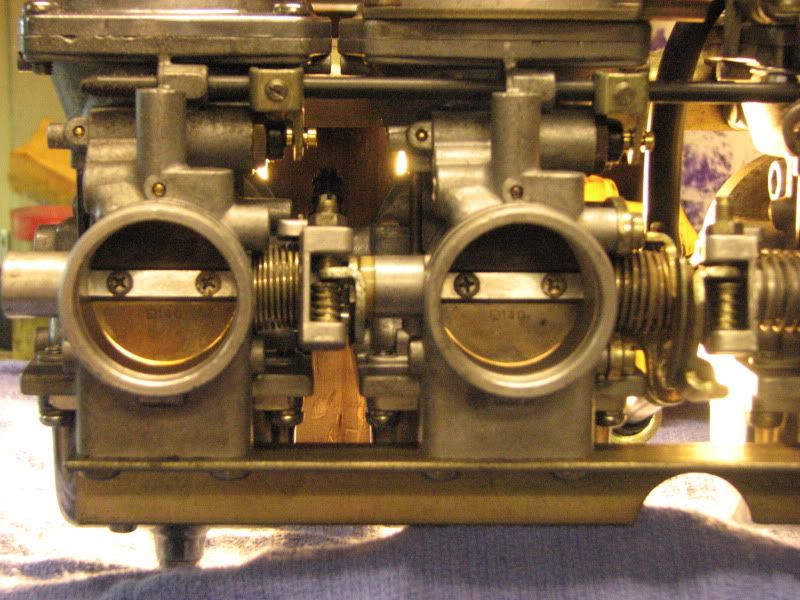
Here is a copy from a post I made in another thread concerning a bench sync:
To get even closer, use LIGHT. I gave up trying to match the drag from one carb to another because I might not have the device placed in exactly the same spot on each carb. By simply holding the carbs up to a light, you can visually inspect the size of the gap under the throttle butterfly. Since I have started doing that, there has been no problem starting a bike, and only minimal tweaking once I connect the gauges.

IMG_3451.jpg

.
 
thanks, i hope i can afford the sync tool before i do this. when i did the intake o-rings last week, i used an ornament hanger from the christmas tree and matched all the throttles with this high-tech improvisation. i know this is not the most complete way

If you are careful, you can get a simple bench sync, BETTER, than most people have their carbs 'balanced'. It isn't perfect, but done carefully, most wouldn't know the difference unless the gauges were applied. Even with the Morgan, as Steve said, it is good practice to run through them at least twice, if your fuZZZZZZy. I am... ;)

The GS bikes are so smoooooooooth with a good tune. :-#
 
Back
Top