• Required reading for all forum users!!!

    Welcome!
    Register to access the full functionality of the GSResources forum. Until you register and activate your account you will not have full forum access, nor will you be able to post or reply to messages.

    A note to new registrants...
    All new forum registrations must be activated via email before you have full access to the forum.

    A Special Note about Email accounts!
    DO NOT SIGN UP USING hotmail, outlook, gmx, sbcglobal, att, bellsouth or email.com. They delete our forum signup emails.

    A note to old forum members...
    I receive numerous requests from people who can no longer log in because their accounts were deleted. As mentioned in the forum FAQ, user accounts are deleted if you haven't logged in for the past 6 months. If you can't log in, then create a new forum account. If you don't get an error message, then check your email account for an activation message. If you get a message stating that the email address is already in use, then your account still exists so follow the instructions in the forum FAQ for resetting your password.

    Have you forgotten your password or have a new email address? Then read the forum FAQ for details on how to reset it.

    Any email requests for "can't log in anymore" problems or "lost my password" problems will be deleted. Read the forum FAQ and follow the instructions there - that's what we have one for...

  • Returning Visitors

    If you are a returning visitor who never received your confirmation email, then odds are your email provider is blockinig emails from our server. The only thing that can be done to get around this is you will have to try creating another forum account using an email address from another domain.

    If you are a returning visitor to the forum and can't log in using your old forum name and password but used to be able to then chances are your account is deleted. Purges of the databases are done regularly. You will have to create a new forum account and you should be all set.

Billet clutch baskets are, well..... Fake?

  • Thread starter Thread starter Paul.S
  • Start date Start date
Maybe it is forged from a billet?

Im pretty sure every cast/forged part starts off as a solid block of raw material aka billet. They then heat the block of material and turn it into a molten state to pour/inject it into a cast. Or in forging, it would be pressed/hammered. That is as far as I know.
 
The word "billet" is a lot like the word "natural" -- people really like buying things with that word attached for some reason, but it has zero actual meaning.

However it was made, that looks like a very nice clutch basket. FWIW, the "rough" finish looks like it might be bead-blasted. Hard to tell from pictures.
 
OK, that is definitely a cast piece, not machined from billet. The finish looks to me like a sand casting. However, billet usually just boils down to "expensive bling", and not necessarily better. I agree with Brian, it's become functionally meaningless marketing baloney.

It's not clear to me how the Falicon part is better than stock, unless it's a better alloy. More wear-resistant or something. Most likely better than a worn-out basket, anyway.

Comparing the Falicon and Hays pics, I'd go for the cast part. Those corner reliefs in the machined part leave some pretty thin walls and a narrower face for the plates to engage.
 
Last edited:
The word "billet" is a lot like the word "natural" -- people really like buying things with that word attached for some reason, but it has zero actual meaning.

However it was made, that looks like a very nice clutch basket. FWIW, the "rough" finish looks like it might be bead-blasted. Hard to tell from pictures.

"Billet" is usually used to describe a part machined from a forged block of material. It's stronger because the grain direction can be chosen to fit the stress.

I was thinking the same thing about it looking like it is bead-blasted. I didn't see any casting part lines.
 
Blocks of material (billets) are not forged. Forging is a process that involves slamming the material in a high pressure forging hammer press. A billet is typically formed by a combination of casting and/or extrusion followed by (possibly) hot forming via rolling to create the desired shape.
 
Blocks of material (billets) are not forged. Forging is a process that involves slamming the material in a high pressure forging hammer press. A billet is typically formed by a combination of casting and/or extrusion followed by (possibly) hot forming via rolling to create the desired shape.

Wrong, Ed. I'm surprised that you aren't aware of the difference. A casting is much weaker than billet of the same material.

Here is a short article that will educate you as to cast vs billet.

http://info.cpm-industries.com/blog/bid/283266/Cast-vs-Billet
 
Last edited:
Blocks of billet are not forged. I'm repeating myself but they are cast or extruded and then (possibly) roll formed. These blocks then can be machined into a useful part. The finished part grain structure will NOT possess the aligned grain of a forged part.
 
Looking at the pic posted, I'd say it's a pressure die casting. Given the surface finish which is way better than a sand casting I'd also pick that it's been properly done with a chilled former for the interior surfaces.
Given a choice between "as machined" billet basket from possibly a good quality 6000 series alloy and a good diecast one, I'd go for the diecasting.
Unless you're running a top fuel dragbike you're not going to need anything better than the good diecasting.
 
Which part did YOU not grasp

This is how I read it....

Advantages of billet:

  • Cost effective in low quantities
  • High degree of precision
  • Very short lead times
  • Structurally the parts are stronger


I form and heat treat aluminum parts all day. 6061 and 2024. 2024 is a stronger metal but not as corrosive resistant as 6061. We have a HAAS Mill and I could actually mow a basket out if I had the program.....


Last edited:
Which part did YOU not grasp, Ed? I understood it just fine.

I would guess he can not grasp how you can't even properly relate the reference your posted. Your article did not mention forging once.

This is not to suggest that the article is necessarily authoritative, just you have read much more into it.
 
There are some nifty youtube videos showing engine blocks and heads being milled out of a huge block (billet) of aluminum. Very cool stuff. I suppose JJ is going to tell us that the block was "forged", even though it was about 3' square to begin with?

I'll take a forged part over a milled from billet part any day if strength and toughness is one of the critical needs. Aircraft landing gear parts are typically forged. The forging process aligns the material grain structure and typically adds toughness (ability to absorb impact forces without failing) as well as ductility (not brittle).

This discussion has gone off the farm now though. I agree with Greg T in his assessment that a quality cast clutch basket is more than strong enough for it's intended usage.
 
We have one small photo of the part, but I'll just point out that the object in the photo could very well have been machined from <<whatever the hell you lot of nitpickers want to call a chunk of aluminum>> then bead blasted. Or it could have been forged or cast then blasted. And blasting can have some strength benefits as well, or allow the part to better retain an oil coating, allow the clutch plates to move a little easier, etc. No way to tell for sure from one small low-quality photo. Frankly, it would be hard to tell for sure how it was made with it sitting on front of you.

The main beef seemed to be that tool marks weren't visible. Well, bear in mind that tool marks are actually defects, but over time people have come to associate the regular tool marks from automated machining with costly custom parts.

That Hays basket has heavy tool marks, which some people like the look of, but if they're deep enough they could cause a problem because the plates might not be able to move smoothly, same as a worn and notched stock basket. I'd much rather have the smooth finish on the Falicon basket.

I'm also trying to figure out why the Hays basket is anodized black -- or is that some sort of hard coating?
 
Last edited:
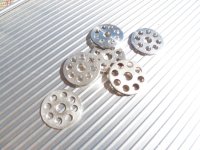
I have billet washers. F.Y.I. lots of spare time and a lathe makes me do silly things :)

100_1369.jpg
 
Since no parting or casting lines are visible, my guess is the Falicon basket is forged and the blasted finish also leads me to believe it's been shot peened. Forging and shot peening (in most cases) usually mean a very durable part.
Clutch baskets aren't exactly precision/close tolerance pieces, a closed die forging can produce a part that needs very little finish machining.

Don't know much about Hays clutches, but MTC hard anodizes their slider baskets. Would assume Hays does the same thing.
 
Back
Top