• Required reading for all forum users!!!

    Welcome!
    Register to access the full functionality of the GSResources forum. Until you register and activate your account you will not have full forum access, nor will you be able to post or reply to messages.

    A note to new registrants...
    All new forum registrations must be activated via email before you have full access to the forum.

    A Special Note about Email accounts!
    DO NOT SIGN UP USING hotmail, outlook, gmx, sbcglobal, att, bellsouth or email.com. They delete our forum signup emails.

    A note to old forum members...
    I receive numerous requests from people who can no longer log in because their accounts were deleted. As mentioned in the forum FAQ, user accounts are deleted if you haven't logged in for the past 6 months. If you can't log in, then create a new forum account. If you don't get an error message, then check your email account for an activation message. If you get a message stating that the email address is already in use, then your account still exists so follow the instructions in the forum FAQ for resetting your password.

    Have you forgotten your password or have a new email address? Then read the forum FAQ for details on how to reset it.

    Any email requests for "can't log in anymore" problems or "lost my password" problems will be deleted. Read the forum FAQ and follow the instructions there - that's what we have one for...

  • Returning Visitors

    If you are a returning visitor who never received your confirmation email, then odds are your email provider is blockinig emails from our server. The only thing that can be done to get around this is you will have to try creating another forum account using an email address from another domain.

    If you are a returning visitor to the forum and can't log in using your old forum name and password but used to be able to then chances are your account is deleted. Purges of the databases are done regularly. You will have to create a new forum account and you should be all set.

Brake Rotors and Threadlock

cowboyup3371

Forum Guru
Past Site Supporter
I couldn't find anything here to contradict my service manual but still wanted to ask. According to the service manual, I don't need threadlocker to put the brake rotors on. However, would it still be a good idea to use some? I ask as the old bolts have some kind of white gunk on them so I assume maybe someone had before.

Thanks.
 
Cowboy, I actually just put anti-sieze on the threads and torque to spec.
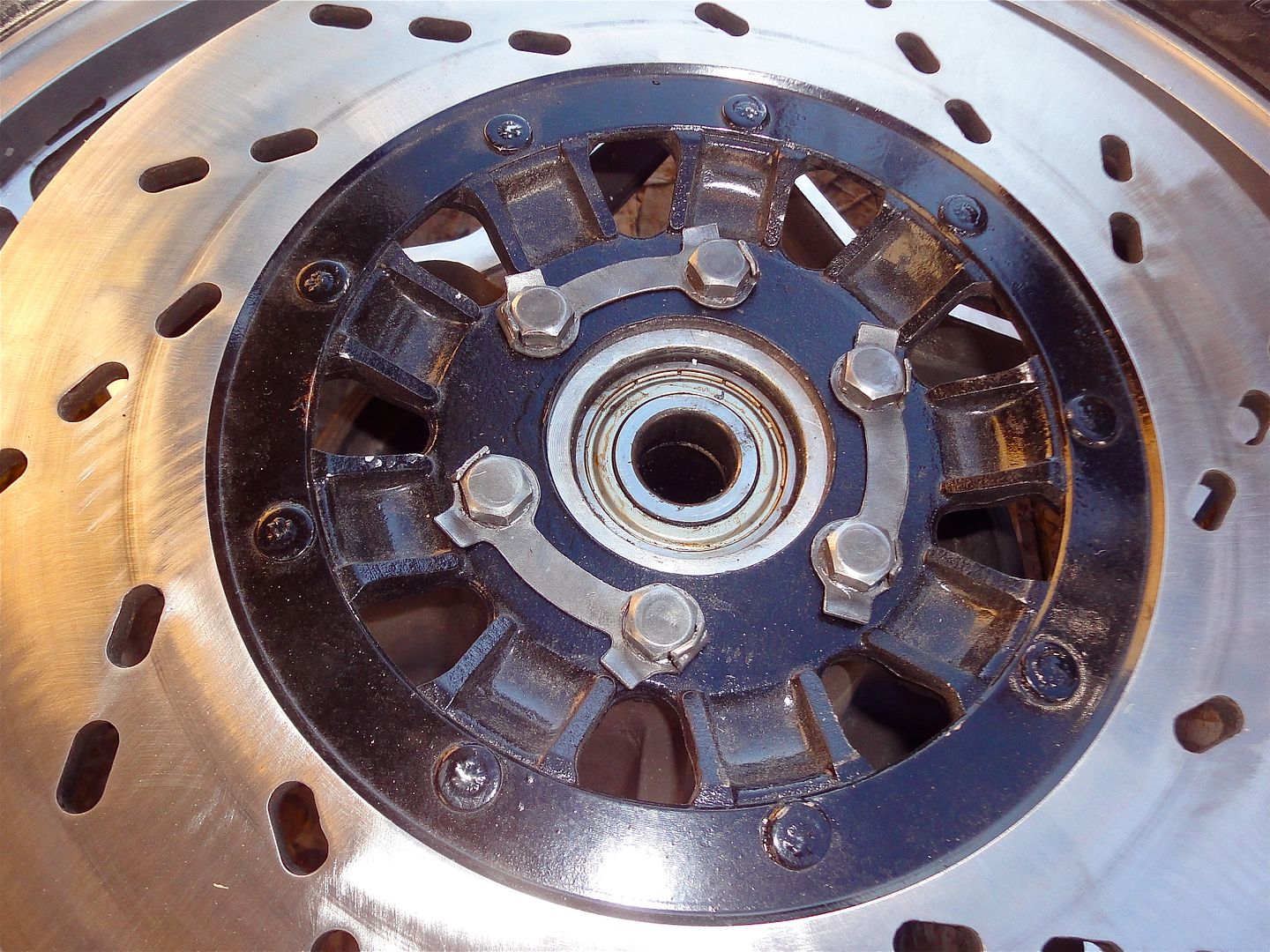
They aren't going anywhere and the locking tabs are more so that you can visually see if they get loose than to hold them in place. ;)
BYW, the white crap is just years of oxidation. Be sure that you use a wire wheel/brush to clean the threads before you apply the anti-sieze.

Daniel
 
Last edited:
+1 Anti- seize will prevent the white oxidation. Don't think I have ever seen a brake disc come loose. And if it did you would see the lock tab being loose when you check the bike out before you ride.
Sprockets, on the other hand, loosen themselves once in a while. Probably there is a lot more vibration from the chain.
 
As I was busy doing the same thing,
I thought that I might take some pic's for you Cowboy. ;)

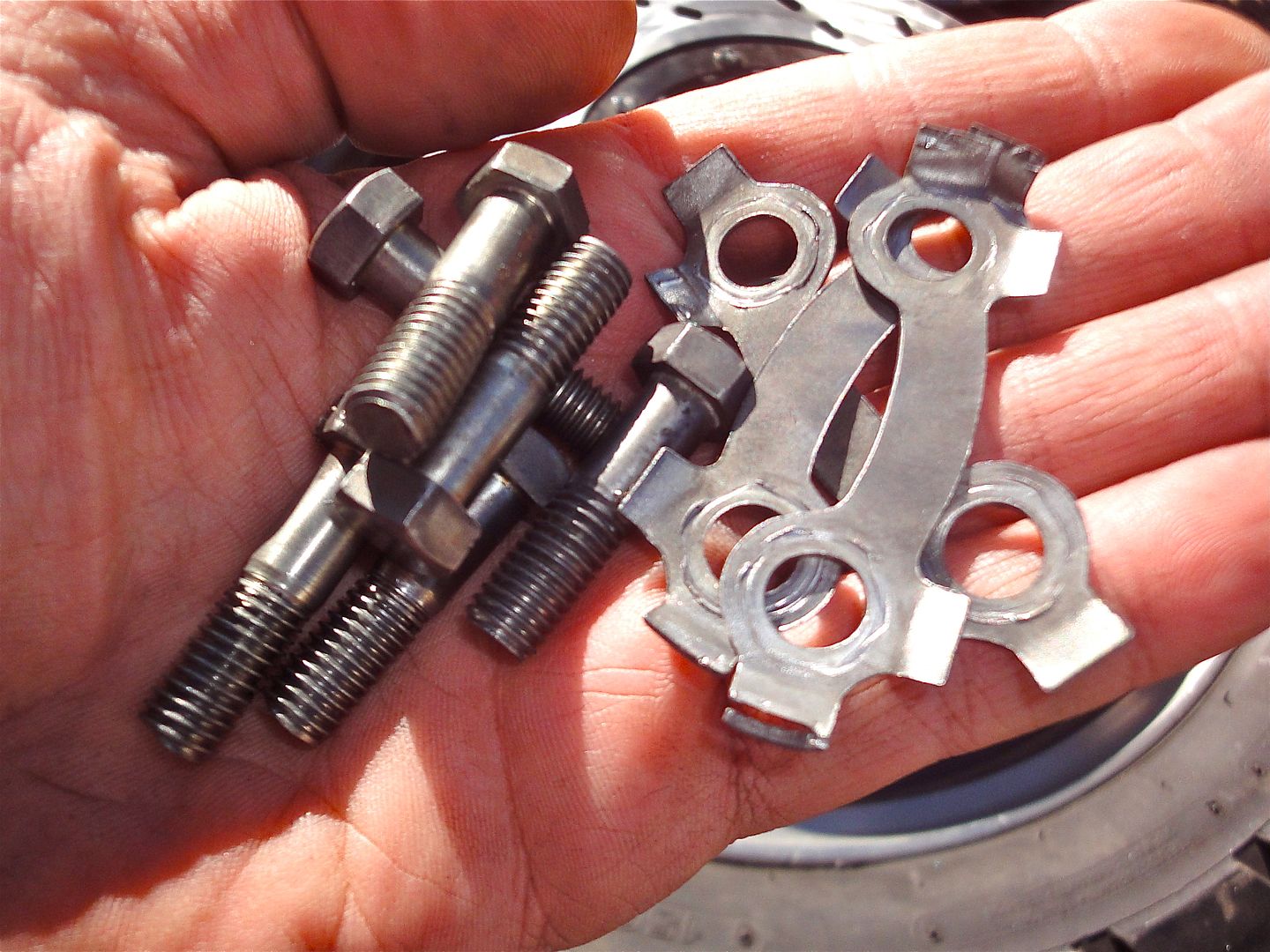
Cleaned up bolts and keepers.

DSC06985.jpg


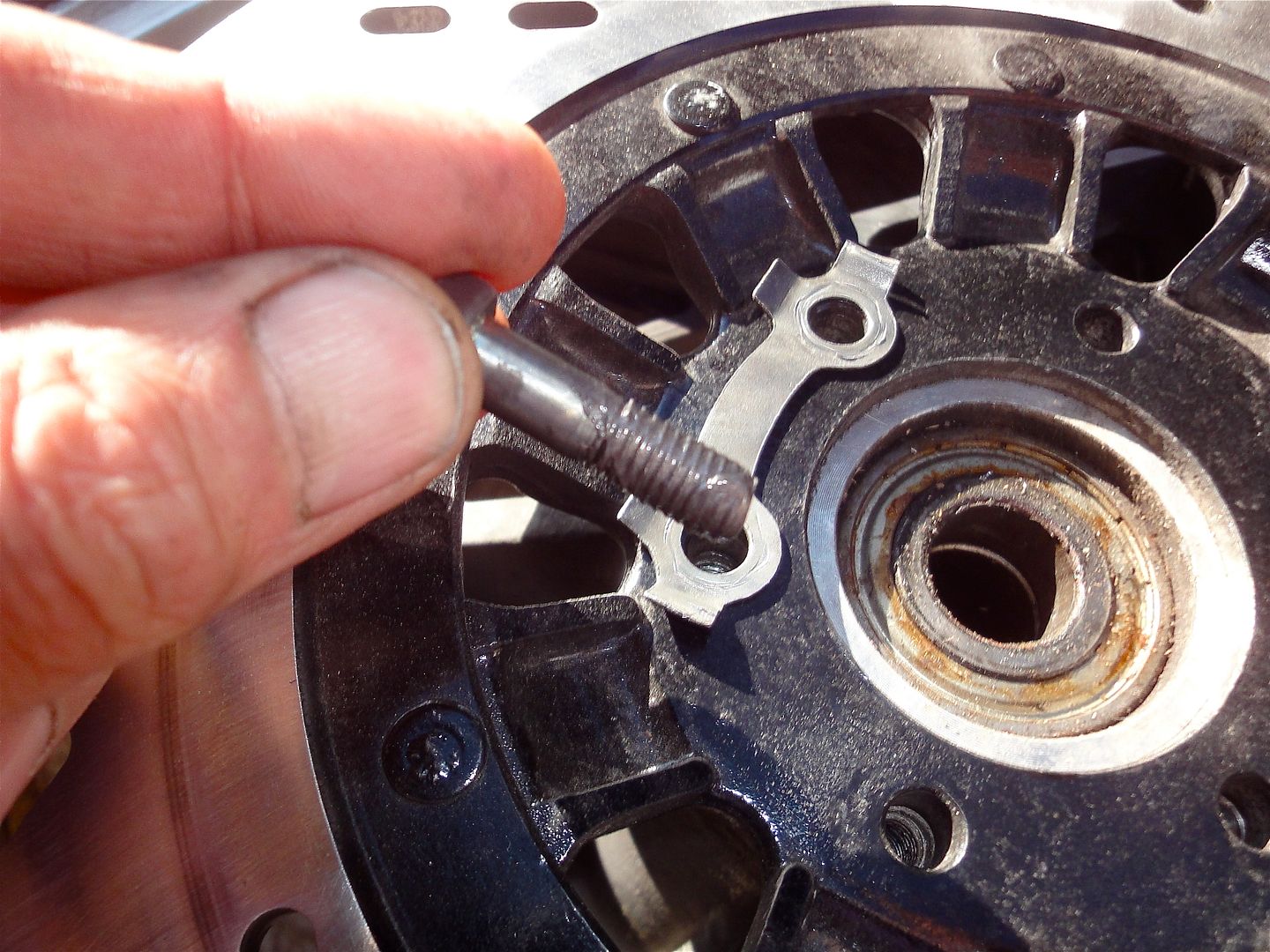
Just enough anti-sieze to fill the threads without having
any extend onto the bottom causing hydro-lock conditions.

DSC06986.jpg


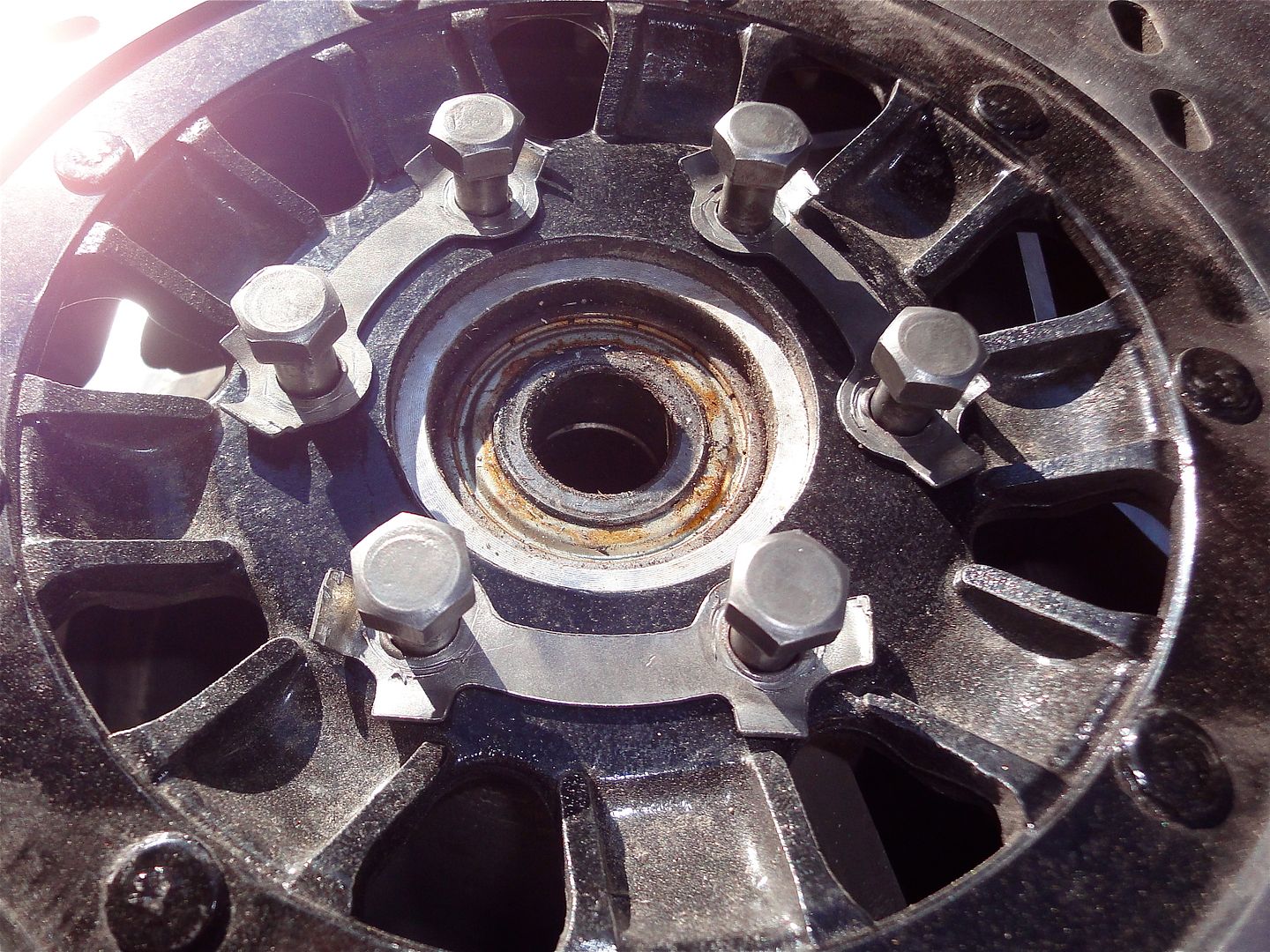
Place ALL of the bolts in place before tightening down.

DSC06987.jpg


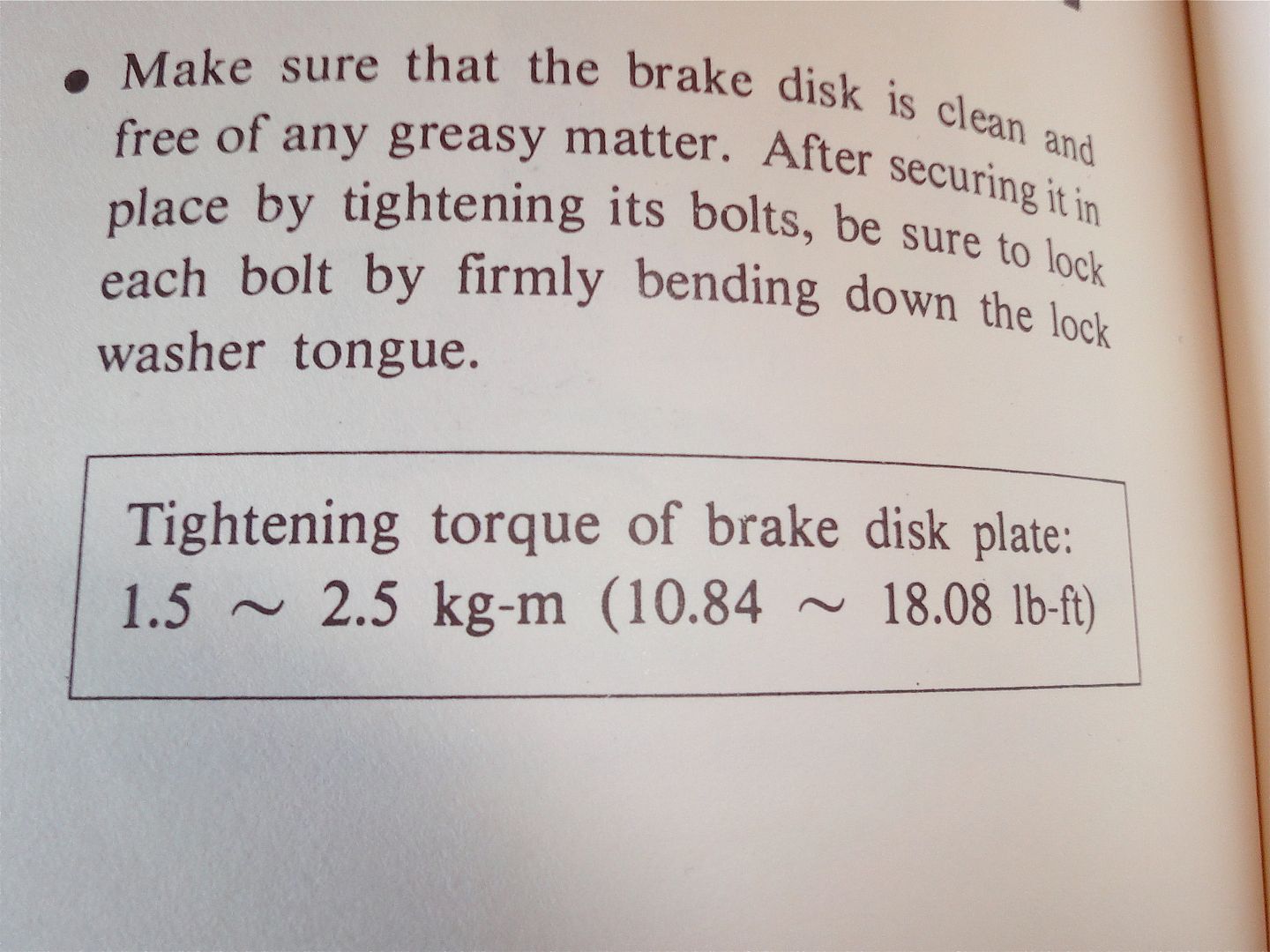
Factory recommendation.

DSC06988.jpg


As I am using anti-sieze, I torqued them to 25 Ft.Lbs.

DSC06989.jpg


Hope that helped. :)


Daniel
 
Um, why would that be necessary?

Most bolts will have a dry and a wet torque value.
As the anti-sieze has less friction (is a little more slippery) than metal to metal,
it is safe to go a wee bit higher as you are still actually at the same torque if it were not lubricated.

For example, go to ARP Fastener's site (the industry standard for high grade bolts/ fasteners) and they
will give you multiple torque specs for their bolts with or without their lubricant.
And another for bolts dipped in motor oil.

Daniel
 
I poked around for a while and never found any examples of multiple torque specs given. Anyhow, if a lubricant is going to influence a torque spec, why would it be higher instead of lower?
 
Loctite recommend reducing torque by 10% in order to treat their product as a lubricant.

It is not advised to go higher because the torque specification is intended to provide sufficient twisting effort to overcome thread friction, clamping surface friction, and to tension the fastener to the desired degree. Anything which reduces friction, given the same torque, will necessarily increase tension. Increasing tension out of the elastic range into yield is not productive.

Torquing to a specified limit is one of the least accurate means of arriving at the desired fastener tension but is convenient and accurate enough for less critical applications. Modern automotive (and many motorcycle) cylinder head tension specifications use "torque to yield method" which is similar to the "torque turn" technnique used for larger and more critical applications for many decades.
 
Loctite recommend reducing torque by 10% in order to treat their product as a lubricant.

It is not advised to go higher because the torque specification is intended to provide sufficient twisting effort to overcome thread friction, clamping surface friction, and to tension the fastener to the desired degree. Anything which reduces friction, given the same torque, will necessarily increase tension. Increasing tension out of the elastic range into yield is not productive.

Spot on.

I don't bother with those locking tabs. All the second hand ones over here are rusted out and the new ones are I think made of platinum. Green Loctite was the favourite over here for many years but nobody ever planned to take the discs off again (can be done but it's the devil). So blue is the way to go now - the bolts don't fall out. There's an awful lot of bikes that come out of the factory without the tabs or similar so they're not worried.
 
The 81 Honda CB750 has no tabs(5 bolts) so they weren't worried abot the bolts backing out.I keep them cause I like the look.
 
So, I will just put a dab of loctite on, torque them to spec, and pull the tabs up again. Thanks fellas.
 
Contrary to popular belief, the biggest advantage to using blue Loctite is that it seals the threads reasonably well and so excludes corrosion which makes the fasteners easier to remove. Excellent product.

Even the "permanent" Loctite releases easily with some heat and none of these products are effective on exhaust temperature fasteners.

We really should do a comprehensive fasteners thread as there is much misunderstanding.

Do yourself a big favor and make absolutely sure of the mouting surfaces for disk and rotor. Even a few thou' of run-out will give you fits in terms of vibration.
 
I'd picked up a suggestion recently regarding prepping mating surfaces of which run-out is critical (like this one). Using a whetstone to clean and smooth both surfaces. Ive tried it and it really cleans them up nicely.
 
Well, I actually sat and thought about what I was doing yesterday and changed my mind on this. I put the antisieze, torqued it down properly, but forgot to close up the locking tabs so I still need to do that.

I'm curious though Norm as to how to check the runout like you are saying? Is it something I will see (as in a bent rotor) or something I should check with a gauge? Where should I make my measurements?
 
Even the "permanent" Loctite releases easily with some heat and none of these products are effective on exhaust temperature fasteners.

That old green Loctite was resistant to heat - it and red hermatite will be the only things left after armageddon. I think that's why they don't make it anymore. The new green stuff (there are 2 or 3 types with different numbers) is not the same as the old stuff.
 
Well, I actually sat and thought about what I was doing yesterday and changed my mind on this. I put the antisieze, torqued it down properly, but forgot to close up the locking tabs so I still need to do that.

I'm curious though Norm as to how to check the runout like you are saying? Is it something I will see (as in a bent rotor) or something I should check with a gauge? Where should I make my measurements?

I'd say to just check the runout of the rotor assembled on the wheel, since checking the rotor off the wheel would require tools most of us don't have in the garage. Get the wheel and rotor assembly mounted on an axle so you can turn the wheel. Set up a dial indicator to read how much the rotor surface undulates as you spin the wheel and rotor assembly. Compare to tolerances that are probably published in the service manuals. Check your wheel runout while you're at it. Or, you could just make sure your mounting surfaces are clean and burr-free and not worry about it until you notice symptoms.

You could probably also reassemble the whole thing, then listen for the brake pads to drag in a pulsing fashion as you gradually apply the brake. If you never hear any pulses, it's all running true.

Or, since you own a GS and have had a high exposure to Steve, you own feeler gages (for valve clearance checking) you could use to check the gap between the rotor and a fixed reference at several points along the rotor. A good reference would be a brake caliper or caliper bracket. Something with a flat regular surface. Be careful not to flex the rotor by stuffing the gages in the gap. You'll get artificially high runout.
 
Always clean the surfaces on the back of the rotor and the hub when installing.
Anything between them will cause a mis-alignment.

Daniel
 
Some excellent suggestions. If you lack a dial gauge, the feeler gauge suggestion may be satisfactory or you could use a crayon to indicate the run out. With care one can hold the pencil or crayon against some reference such as the caliper and position the tip until it just touches the run-out. I have found that repositioning the rotor can aleviate some run-out.

The proof, as they say, is in the pudding so if the brake feels good it is good for your purpose. The two main concerns regarding rotor alignment are: run-out and parallelism. Run-out is the side to side movement of the rotor as would be created if one were to have dropped the bike or used a hammer to hit the side of the rotor so as to bend it to one side. This can also be created by improper mounting as where some material is between the hub surface and rotor.

The second rotor issue is parallelism, or rather lack of such. This is a condition in which the rotor has a variation in thickness such that the two sides of the rotor are not parallel. This is usually a manufacturing issue or caused by improperly mounting a rotor when machining. Other issues are not relevant to the subject at hand.

It is best to mount the rotor to a hub surface which has been checked for run-out and then to check the rotor in place before setting locking tabs and such operations. As for locking tabs, some of the questions in this regards can be addressed by inspecting newer designs as it is sometimes discovered that what seems to be valid is not. An example would be the disappearance of split type lock washers which have disappeared from motor vehicle applications. http://en.wikipedia.org/wiki/Washer_(hardware)#Spring_and_locking_washers

left photo, right hand washer.
 
Back
Top