• Required reading for all forum users!!!

    Welcome!
    Register to access the full functionality of the GSResources forum. Until you register and activate your account you will not have full forum access, nor will you be able to post or reply to messages.

    A note to new registrants...
    All new forum registrations must be activated via email before you have full access to the forum.

    A Special Note about Email accounts!
    DO NOT SIGN UP USING hotmail, outlook, gmx, sbcglobal, att, bellsouth or email.com. They delete our forum signup emails.

    A note to old forum members...
    I receive numerous requests from people who can no longer log in because their accounts were deleted. As mentioned in the forum FAQ, user accounts are deleted if you haven't logged in for the past 6 months. If you can't log in, then create a new forum account. If you don't get an error message, then check your email account for an activation message. If you get a message stating that the email address is already in use, then your account still exists so follow the instructions in the forum FAQ for resetting your password.

    Have you forgotten your password or have a new email address? Then read the forum FAQ for details on how to reset it.

    Any email requests for "can't log in anymore" problems or "lost my password" problems will be deleted. Read the forum FAQ and follow the instructions there - that's what we have one for...

  • Returning Visitors

    If you are a returning visitor who never received your confirmation email, then odds are your email provider is blockinig emails from our server. The only thing that can be done to get around this is you will have to try creating another forum account using an email address from another domain.

    If you are a returning visitor to the forum and can't log in using your old forum name and password but used to be able to then chances are your account is deleted. Purges of the databases are done regularly. You will have to create a new forum account and you should be all set.

Cannot start GS700ES, no spark

  • Thread starter Thread starter Guest
  • Start date Start date
G

Guest

Guest
I got the bike not running, it was sitting for a while, I tested the coils, signal generator, and it has new spark plugs all tested the right resistance. Also tested the kill switch, side stand switch, neutral position switch which they also seem fine. but no spark. Im not sure what to do, I am new to motorcycles and have very little experience, hopefully I can get it running and roadworthy.
 
With the ignition key in the “On” position, do you have voltage at the wire feeding the coils?
(I think it might be an O/W wire, not sure on the GS700.)
 
Last edited:
Ignitor failure on those bikes is somewhat common. Many times the R/R fails, resulting in over charging, and the high voltage kills the ignitor. The ignition advance is built into the ignitor, so that complicates replacement. The following bikes use the same ignitor. That may help you expand your search. Some people go with a Dyna ignition, but I'm not sure what model will fit. A Dyna S is the cheapest, but that assumes you can install a mechanical advancer of a different model bike.

Suzuki Motorcycle 1982 GS850G SIGNAL GENERATOR

Suzuki Motorcycle 1983 GS750ES SIGNAL GENERATOR

Suzuki Motorcycle 1983 GS750E SIGNAL GENERATOR

Suzuki Motorcycle 1982 CRUISER - GS1100G SIGNAL GENERATOR

Suzuki Motorcycle 1985 GS700ES SIGNAL GENERATOR

Suzuki Motorcycle 1985 ES GS700E SIGNAL GENERATOR

Suzuki Motorcycle 1983 GS850G SIGNAL GENERATOR

Suzuki Motorcycle 1983 GS1100G SIGNAL GENERATOR
 
is there any way to test if the ignitor is the issue? by ignitor do you mean the cdi or the signal generator?


i will be buying an electric tester to see if there is voltage at coils but I would assume not if there is no spark.
 
Last edited:
Your bike doesn't have a CDI. You can download a manual here, which will have some ignition system tests you can try. Get the base manual, which is for the 3rd gen 750, and also the 700 supplement. That's how you get the full manual.
https://gsarchive.bwringer.com/
 
by cdi I meant the igniter unit

Considering that you're new to wrenching on your own bike I'd highly suggest taking Nessisms advice by getting a manual and following the test procedures in it. Also, the top newbie mistakes link he provided will also save you a lot of time and frustration.
 
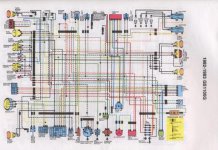
In case the above links fail..look for the 1982 gs1100 to get similar wiring layout…..here’s a typical Suzuki wiring layout. Note that with key “on” ,kill switch in “run” ,12 volt positive is fed to both ignition coils (likely orange/white wire). The ignitor switches each coil negative on/ off to produce spark as it cranks over
 

Attachments

  • photo62249.jpg
    photo62249.jpg
    71.8 KB · Views: 0
Definitely agree I looked through, and it has lots of tests I really appreciate it, right now I'm busy with school, so I can work on it on the weekends.
 
Last edited:
. . . . . . Also tested the kill switch, side stand switch, neutral position switch which they also seem fine. but no spark. . . . . . ..
Somewhat minor point, but, on these 1980s bikes the netural and sidestand have no effect on the ignition.
THe only interlock (assuming ES is like most other GSes) is that have to have the clutch pulled in to operate the starter solenoid (and often that gets bypassed).

Good that you checked the kill switch (but if kill swtich was bad you could not operate the starter solenoid).

And good that you did ohm check of the signal generator.

Now check to see if get good full voltage at the coils (typically the org/wht wire). THere are a lot of wiring and connectors to get power to the coil, and if any bad connections such that voltage drops much below 10 volts, the ignition is not going to work.

Also, would be good to get a manaul (factory or Clymer) so can check other things too.

Oh, wait... have we seen pics of this ES....?

.
 
Last edited:
.....

i will be buying an electric tester to see if there is voltage at coils . . . . ..

You have a 40 year old motorcycle, so it would be a good idea to have a volt meter.
You have a 1980s GS, so, you will need a volt meter.

Hey, wait, you siad you checked kill swtich and other things electrially........ ? ?
 
You have a 40 year old motorcycle, so it would be a good idea to have a volt meter.
You have a 1980s GS, so, you will need a volt meter.

Hey, wait, you siad you checked kill swtich and other things electrially........ ? ?

yes I checked them using volt meter, I checked that one of the coils had 11.78 volts so, I will be checking the other contacts tomorrow.
 
yes I checked them using volt meter, I checked that one of the coils had 11.78 volts so, I will be checking the other contacts tomorrow.

11.78 volts at the positive terminal of the coil’s primary circuit is good.

This check split the coil primary circuit in half. All the wiring, connectors, and switches from the battery up to the coil are good.

Now let’s check the ground side of the coil primary circuit.
Take a voltage reading from the ground side of that coil WHILE cranking the engine.
If the voltage jumps up and down while cranking, the coil primary circuit is okay on that coil.

Get the all same readings from the other coil.
What did you get?
 
11.78 volts at the positive terminal of the coil’s primary circuit is good.

This check split the coil primary circuit in half. All the wiring, connectors, and switches from the battery up to the coil are good.

Now let’s check the ground side of the coil primary circuit.
Take a voltage reading from the ground side of that coil WHILE cranking the engine.
If the voltage jumps up and down while cranking, the coil primary circuit is okay on that coil.

Get the all same readings from the other coil.
What did you get?

how would i do the test at the ground? of the coil?
 
how would i do the test at the ground? of the coil?

Put the positive probe of your voltmeter where the white wire connects to one of the coils.
Put the negative probe of your voltmeter to a good ground, or to the battery negative post.
With the ignition key in the ON position, crank the engine.

That white wire should go to the ignitor box , which makes and releases the the coil's primary circuit ground as the engine spins.
When the ignitor box provides the ground, your meter should see close to zero volts.
When the ignitor box release the ground, your meter should see close to your 11.78 volts.
It may be difficult to read the meter accurately with it jumping up and down, but you'll know if its jumping around.


Then repeat the process on the other coil, where the yellow/black wire connects to that coil.

That will tell you if both coil's primary circuits are functioning correctly.
 
Put the positive probe of your voltmeter where the white wire connects to one of the coils.
Put the negative probe of your voltmeter to a good ground, or to the battery negative post.
With the ignition key in the ON position, crank the engine.

That white wire should go to the ignitor box , which makes and releases the the coil's primary circuit ground as the engine spins.
When the ignitor box provides the ground, your meter should see close to zero volts.
When the ignitor box release the ground, your meter should see close to your 11.78 volts.
It may be difficult to read the meter accurately with it jumping up and down, but you'll know if its jumping around.


Then repeat the process on the other coil, where the yellow/black wire connects to that coil.

That will tell you if both coil's primary circuits are functioning correctly.

thank you so much Ill do that this week, I really appreciate you guys being patient with me.
 
Thank you for everyone's help I kept diagnosing and had a strong suspicion that it was the igniter box, which was apparent when I opened the igniter box and found that there was a short in the zener diode replaced the part and soldered it in, and now we have spark, thank you again for all your help.
 
Back
Top