• Required reading for all forum users!!!

    Welcome!
    Register to access the full functionality of the GSResources forum. Until you register and activate your account you will not have full forum access, nor will you be able to post or reply to messages.

    A note to new registrants...
    All new forum registrations must be activated via email before you have full access to the forum.

    A Special Note about Email accounts!
    DO NOT SIGN UP USING hotmail, outlook, gmx, sbcglobal, att, bellsouth or email.com. They delete our forum signup emails.

    A note to old forum members...
    I receive numerous requests from people who can no longer log in because their accounts were deleted. As mentioned in the forum FAQ, user accounts are deleted if you haven't logged in for the past 6 months. If you can't log in, then create a new forum account. If you don't get an error message, then check your email account for an activation message. If you get a message stating that the email address is already in use, then your account still exists so follow the instructions in the forum FAQ for resetting your password.

    Have you forgotten your password or have a new email address? Then read the forum FAQ for details on how to reset it.

    Any email requests for "can't log in anymore" problems or "lost my password" problems will be deleted. Read the forum FAQ and follow the instructions there - that's what we have one for...

  • Returning Visitors

    If you are a returning visitor who never received your confirmation email, then odds are your email provider is blockinig emails from our server. The only thing that can be done to get around this is you will have to try creating another forum account using an email address from another domain.

    If you are a returning visitor to the forum and can't log in using your old forum name and password but used to be able to then chances are your account is deleted. Purges of the databases are done regularly. You will have to create a new forum account and you should be all set.

Carb Dip / Noob questions...

  • Thread starter Thread starter 2wheelN00B
  • Start date Start date
2

2wheelN00B

Guest
I'm about to dip my carbs in Berryman Chem-dip, and I need to know if leaving the 'nylon?' parts (near the springs on the 'throttle valve shaft'?' the part that turns the throttle valve... Can those stay on when I dip? And if not, how do you make sure you get the spring tension back to where it was before you took it apart.
 
Those "nylon" parts next to the springs will be fine - leave them alone...
 
Those "nylon" parts next to the springs will be fine - leave them alone...


Hi,
I wouldn t dip nylon or plastic parts in chem dip or any kind of solvent. it could dry up over time. For info on anything carb related there is a very nice descriptive text with picture on the gs resource tech info page
http://www.thegsresources.com/gs_carbrebuild.htm

for the adjustment the big screw... I checked the distance of the tread coming out. on mine it was about 3mm...

cheers
 
Hi,
I wouldn t dip nylon or plastic parts in chem dip or any kind of solvent. it could dry up over time.
Alex is certainly entitled to his own opinions, and he can also share them, but the overwhelming experience
of the many members of this board is that you CAN dip the nylon parts in Chem Dip.

I can't tell you how many sets of carbs I have dipped in the last few years, but it's well over a dozen.
Most, if not all, of them have been in the dip for 24 hours at a time. I have not had ANY problems with ANY of the sets that I have dipped.

.
 
With the cap installed I have never taken off the little o-ring. I do have many spares in case they do decide to leak though but it hasn't happened yet.
 
Alex is certainly entitled to his own opinions, and he can also share them, but the overwhelming experience
of the many members of this board is that you CAN dip the nylon parts in Chem Dip.

I can't tell you how many sets of carbs I have dipped in the last few years, but it's well over a dozen.
Most, if not all, of them have been in the dip for 24 hours at a time. I have not had ANY problems with ANY of the sets that I have dipped.

.

Its great that you share your overwhelming experience and speak as a ambassador of the carb rebuilders of the gsresource .

How ever Manuals related to mechanics, car motorcycle small motor... usually say that carb cleaner can damage rubber or nylon parts. So I usually avoid it. If the nylon part in question is a superficial part and sealing affect of the nylon isnt to important than you might dip it.
 
Its great that you share your overwhelming experience and speak as a ambassador of the carb rebuilders of the gsresource .

How ever Manuals related to mechanics, car motorcycle small motor... usually say that carb cleaner can damage rubber or nylon parts. So I usually avoid it. If the nylon part in question is a superficial part and sealing affect of the nylon isnt to important than you might dip it.

Well I've dipped a dozen or so carbs myself and never removed the nylon stoppers or whatever ya call em. Never had a problem either. Keep in mind also that most of the manuals were written when carb dips were way more caustic than they are now ( thanks big brother and the EPA) you're lucky now if a 24 hour soak will remove varnish with how weak the stuff is today.

Break the carbs down. Pull all of the easily removeable nylon plastic and rubber. Dip em. The tutorial has worked for every single member here if they followed it. And I'd bet if you polled the entire GSR 95% of them don't remove those parts.
 
And I'd bet if you polled the entire GSR 95% of them don't remove those parts.
One reason is that, to remove those nylon bits, you have to remove the throttle blades from the shafts. That is hard enough, but putting them back in is quite another story.

A second reason is, like TCK says, the stuff just ain't the same as it was when the cautions were written.


Alex, where in that "For info on anything carb related" link that you mentioned does it ever say anything about removing them? Look on page 80, it shows the carb body "ready to dip" with the throttle shaft installed.

With the anonymous venue of a written forum, it is hard to see a degree of sincerity or a twinkle in an eye when posts are made. I was not being pompous and elevating myself to "ambassador of the carb rebuilders" status, I was merely relaying the experience of those that have bothered to mention anything about doing their carbs, that is why the word experience was a bit emphasized. On the other hand, I get a bit of apparent arrogance in return. With your current status of "Junior Member" with only 10 posts to your name, I have absolutely no idea what your experience is regarding mechanical things in general or motorcycle mechanics in particular. You could be a teenager that has stumbled upon the forum and, since teenagers know it all, are proudly pontificating (how's that, bwringer?), you could also be a retired race mechanic that will never get all the grease out from under your fingernails and has been sitting on the sidelines, quietly reading the posts and finally chipped in on a subject close to home. WE have no way of knowing, since we have never met. Considering our respective locations, it seems unlikely. Based on the current tone, I thank you for that.

.
 
Truth is all of us “Senior Members” spout off about how you shouldn’t dip rubber or plastic parts yet we do it with every carb rebuild. Of greatest concern I believe is the rubber throttle shaft seals. Because of those seals I recommend reducing the dipping time to the minimum required to get the carbs clean. Good news is that these seals seem to survive this abuse well and there are rarely problems.
 
Alex, where in that "For info on anything carb related" link that you mentioned does it ever say anything about removing them? Look on page 80, it shows the carb body "ready to dip" with the throttle shaft installed.

...I was merely relaying the experience of those that have bothered to mention anything about doing their carbs, that is why the word experience was a bit emphasized. On the other hand, I get a bit of apparent arrogance in return. With your current status of "Junior Member" with only 10 posts to your name, I have absolutely no idea what your experience is regarding mechanical things in general or motorcycle mechanics in particular. You could be a teenager that has stumbled upon the forum and, since teenagers know it all,...
.

Concerning the link, I sent it to help out the guy... I am not saying that what is done on the picture is what I would do. but it definetively can help with other things in his carb rebuilt.

Concerning my own experience: I am a automotive mecanic. I am specialized in electronics and of course I do general mechanics. I have been in the trade for about 10 years. As a hoby I also do bodywork welding and fabrication. I like motorcycles but I also play with antique cars. My curent projet is a 62 buick special.

For the question of arrogance.The way I saw your first reply was that you were saying that "my opinion" was completely off with the whole nylon thing and that my suggestion was absolutely not founded. In fact it is founded on what many companies and manufacturers usualy suggest.

Dont get me wrong here, I dont want to start a fight on nylon and carbs with you I am sure that in real life we would get along.

cheers
Alex
 
The reality is, those nylon bits we all leave on are a PIA to take off and replace and the odds of damage as minimal. The rubber bits yes, but those things, just not much chance it's gonna hurt them.
 
My experience is only with the NAPA brad dips.. I haven't tried Berrymans dip.

It will quickly attack plastics like that screwdriver handle you left sitting to close to the can.

Nylon appears to survive the dip unharmed.

Rubber.. Not what I expected.. The Napa dip won't turn it to goo. It swells it.
a 24 hour dip didn't do much to the rubber parts other than make them more soft and flexible but I still remove everything I can.

It took a 3 day soak to free up frozen pilot screws.

I bought my wife a nice new aluminum cookie sheet then hijacked the old one to use as a drip tray.. Some 4x2 loaf pans are also nice for holding small parts


BTW dip also works well on frozen or sticky calipers and master cylinders.
 
Hmmm I am going to have to go look and see what pans of my wifes are ready to be replaced!! :)
 
......BTW dip also works well on frozen or sticky calipers and master cylinders.

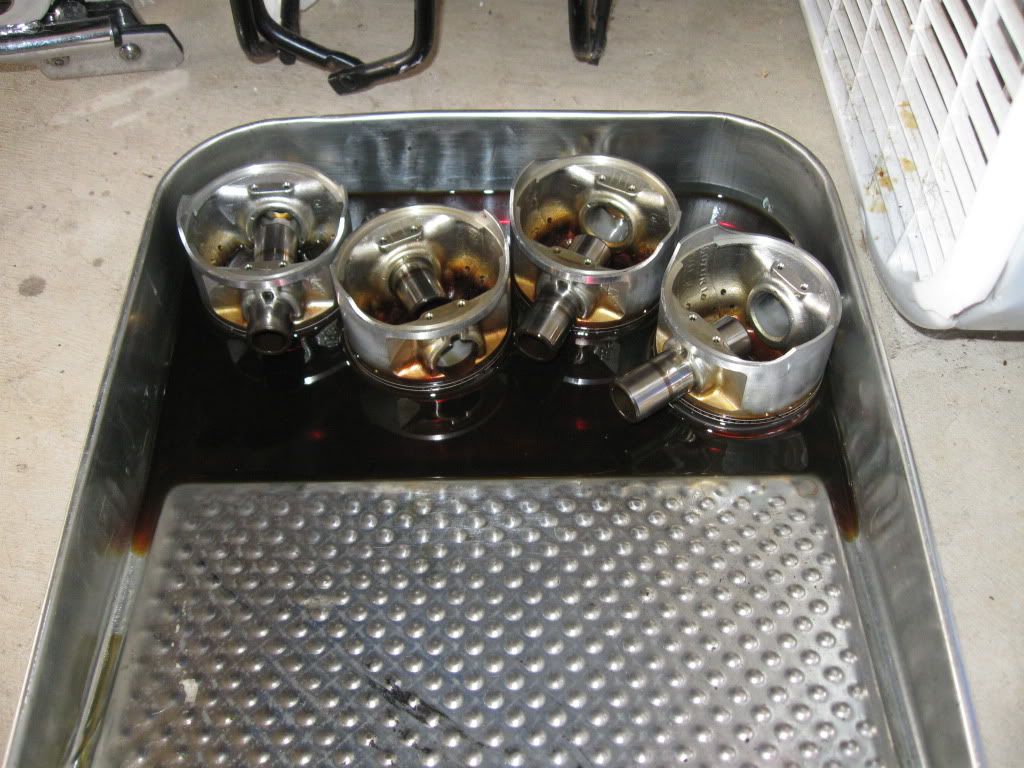
It works great for cleaning pistons, too !!!!!

IMG_0444.jpg
 
I've got to do that tonight, got my stock 1000's (pistons) in a drawer covered with carbon. Need to sell those things.
 
I need to pay more attention to detail those nylon parts never were thought about,back when i dipped mine the first time
 
Back
Top