• Required reading for all forum users!!!

    Welcome!
    Register to access the full functionality of the GSResources forum. Until you register and activate your account you will not have full forum access, nor will you be able to post or reply to messages.

    A note to new registrants...
    All new forum registrations must be activated via email before you have full access to the forum.

    A Special Note about Email accounts!
    DO NOT SIGN UP USING hotmail, outlook, gmx, sbcglobal, att, bellsouth or email.com. They delete our forum signup emails.

    A note to old forum members...
    I receive numerous requests from people who can no longer log in because their accounts were deleted. As mentioned in the forum FAQ, user accounts are deleted if you haven't logged in for the past 6 months. If you can't log in, then create a new forum account. If you don't get an error message, then check your email account for an activation message. If you get a message stating that the email address is already in use, then your account still exists so follow the instructions in the forum FAQ for resetting your password.

    Have you forgotten your password or have a new email address? Then read the forum FAQ for details on how to reset it.

    Any email requests for "can't log in anymore" problems or "lost my password" problems will be deleted. Read the forum FAQ and follow the instructions there - that's what we have one for...

  • Returning Visitors

    If you are a returning visitor who never received your confirmation email, then odds are your email provider is blockinig emails from our server. The only thing that can be done to get around this is you will have to try creating another forum account using an email address from another domain.

    If you are a returning visitor to the forum and can't log in using your old forum name and password but used to be able to then chances are your account is deleted. Purges of the databases are done regularly. You will have to create a new forum account and you should be all set.

Carburetor balance tools (knowledge so far and continued discussion)

  • Thread starter Thread starter skizm
  • Start date Start date
S

skizm

Guest
My intro post sort of ended up morphing into this topic so I decided to summarize what has been said over there here and continue the discussion here.

The initial question was can you build your own manometer and where do you get the fittings for the balancing holes?

Here is the parts that can be ordered for the purpose:

FITTINGS:
5 mm fittings: http://www.z1enterprises.com/detail.aspx?ID=3263
6 mm fittings: http://www.z1enterprises.com/detail.aspx?ID=3262
The other suggestion is to buy the proper tap set and tap 3/16" barbed fittings.
These fitting sizes vary bike by bike but the manometer should be the same for all 4 carburetor bikes.

MANOMETERS:
Manometer: http://www.carbtune.com/

Here is a rather nice photo of a home made manometer:
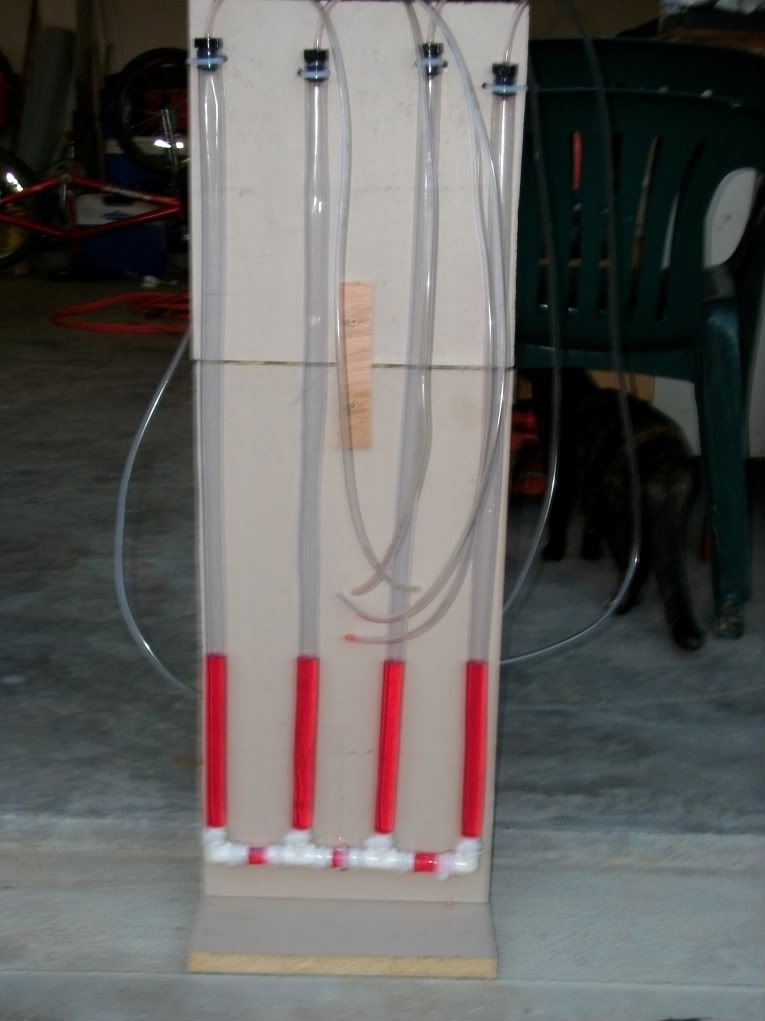
SANY0248.jpg


The basic principle behind these home made manometers is that you have a tube for each carburetor connected by 'T' and 'L' joints at the bottom filled halfway with fluid. It is important to notice that the bottom of this is fully sealed making it measure the pressure of one cylinder against the others so you don't need a 26 ft tall barometer style thing. When these are connected to the proper balancing holes the level of the fluid in the tubes will be higher for the carbs with more suction and lower for carbs with less, you can then adjust the carburetor using whatever procedure is best for the bike. It is important while using this type of manometer that you use a type of fluid that will not destroy your engine if one of the fittings comes loose and the rest of the fluid gets sucked in or if your carburettor is way out of balance (it is still important to minimize the amount of fluid that gets into the engine even if it is oil). The consensus so far is some kind of engine oil or other type of oil. It sounds like the carburetors need to be within 2 cm Hg of eachother meaning about 10.6 inches of H2O which is about 13 inches of oil since oil is less dense than water (it probably doesn't hurt to get them closer) but the tubes should be at the very least this tall and probably a lot taller since the carbs may be much more out of balance than that (taller tubes make for a smaller chance of sucking fluid into the engine due to imbalance).

I think i have all the information summarized here. If I missed anything let me know.

Thanks to the following users for answering questions about the setup.
BassCliff
glstine
Skateguy50
 
I sort of agree with the theory about having a sealed system, but you mention that you should have about 13" of height for oil. If, for example, one of your carbs is off a bit and there is not much vacuum, the gauge shown in the picture will allow what appears to be 3" of travel to the bottom, then the other cylinders will be trying to suck air instead of oil, and would quickly drain the gauge.

Just an opinion and a guess, as I have not tried this.

But, for what it's worth, my set of mercury "sticks" have a vented reservoir, but the mercury is heavy enough to allow that. :-k

.
 
DIY port adapters...

IMG_1030.jpg


IMG_1032.jpg


IMG_1033.jpg


IMG_1034.jpg
 
Last edited:
I am pretty Macgyver (see recent post) but bought a set of cheap gauges. They stow neatly in the included case and have a wide assortment of adapters included. This is after I built a 6 gauge set for tuning KZ1300's. Gauges with valves to fine tune needle damping work quite well for me.
PS nice work on the adapters nessism.
 
Oh a plastic ball floating on the oil in each tube should stop the engine from sucking out the oil in the event of a bad unbalence?
 
Whilst the first manometer is clever, there's a lot of room for inaccuracy / leaks with all the joins and pipes. Here's the one I made:

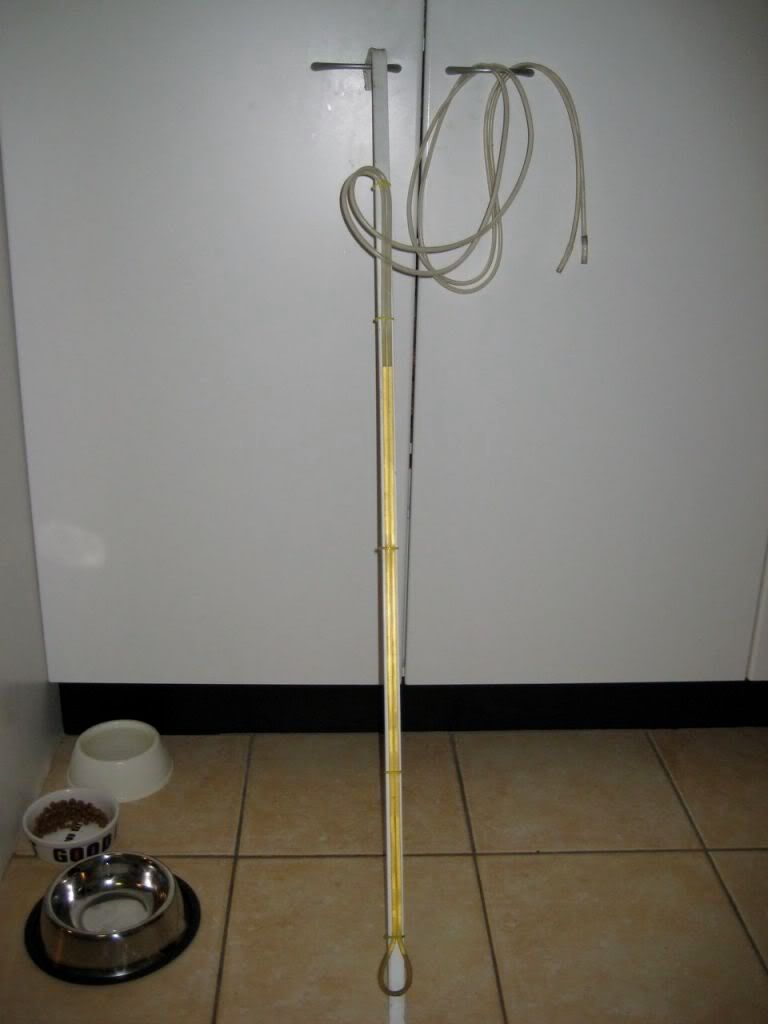
IMG_3689.jpg


Yes you can only do 2 carbs at a time, but it only has 1 piece of tubing (so no joins / leaks).

It is simple and accurate.
 
Steve, I may not have said this clearly enough but what I meant is that the carburetors need to be within 13" of oil of each other this would be preposterously short for the full manometer. Mercury is really the perfect fluid for these things at 13.5 g/cc as opposed to oil which is 0.78 g/cc or water at 1g/cc. Unfortunately the term mad as a hatter originates from the misuse of this substance and now you cant find it anywhere except well sealed labs and old equipment.

Nice adapters Nessism. Did you use a lathe to get the holes centered like that or just mad drill press skills?
 
Where did you find these nice T and L fittings shown at the bottom of your manometer? I have often looked for these ... without much success. :confused:
 
Plastic T's L's etc can be found at your local pet shop..
They are available in different sizes and are used for fish tanks.

John
 
So I am bouncing around the idea of buying the carbtune one, building one or just borrowing one. What I am wondering is how often does this need to be done to a bike? is it a once every 10 years sort of thing or is it something that should be done with each oil change? Also is this something that needs to be done to newer bikes as well or is it just for old bikes with multiple carburetors? And finally has anyone ordered off this carbtune web page, their checkout process seems a little sketchy?
 
I may have bought the same one. The hardware, etc. is excellent, but the gages are not too good. It has worked great though.

I am pretty Macgyver (see recent post) but bought a set of cheap gauges. They stow neatly in the included case and have a wide assortment of adapters included. This is after I built a 6 gauge set for tuning KZ1300's. Gauges with valves to fine tune needle damping work quite well for me.
PS nice work on the adapters nessism.
 
So I am bouncing around the idea of buying the carbtune one, building one or just borrowing one. What I am wondering is how often does this need to be done to a bike? is it a once every 10 years sort of thing or is it something that should be done with each oil change? Also is this something that needs to be done to newer bikes as well or is it just for old bikes with multiple carburetors? And finally has anyone ordered off this carbtune web page, their checkout process seems a little sketchy?

Stock bike, just once when you buy it and again after every valve adjustment. If you are messing with intakes, pipes and jetting you need to synch with every change to anything. It only takes a couple minutes after about the sixth time.
 
The point: I just don't see it. :confused:
 
Plastic T's L's etc can be found at your local pet shop..
They are available in different sizes and are used for fish tanks.

John
I've been there (more than once), but have certainly not seen any as nice as these.
 
I don't see what point you don't see, you see?

About $100 and five minutes of time spent ordering will buy a compact precision tool that can't destroy your engine by sucking fluid, that will last a lifetime, and can be stored in a drawer or easily transported. http://www.carbtune.com/

So, what's the point of spending days and at least half the money running around town to hardware stores and aquarium shops to cobble together an awkward homemade fluid manometer?

Yes, I know it can be quite accurate and it works fine. But it's potentially dangerous to your bike, inconvenient, difficult to store, impossible to transport, and in the end -- it's a mostly pointless waste of time and money that would be far better spent on a Morgan Carbtune.

It's not entirely pointless -- I understand that there's something to be learned here about physics, and there are enjoyable aspects to building things yourself.
 
I bought the Carbtune kit from Ireland but have not used it yet.

The question I have is; isn't there some air leakage around the throttle slide (early GS carbs) when you take the top of the carb off to make adjustments? That would throw the vacuum reading off for that carb wouldn't it? I thought about squirting some oil around the slide to temporariy seal the slide to the body.

Just a thought.:D

Brian
 
I bought the Carbtune kit from Ireland but have not used it yet.

The question I have is; isn't there some air leakage around the throttle slide (early GS carbs) when you take the top of the carb off to make adjustments? That would throw the vacuum reading off for that carb wouldn't it? I thought about squirting some oil around the slide to temporariy seal the slide to the body.

Just a thought.:D

Brian

No worry about syncing VM carbs with the tops off; apparently vacuum losses are not enough to worry about.

Regarding making your own sync gauges, I applaud you guys that give it a go. I made some mercury gauges years ago, back when mercury could be purchased over the counter, and they worked great. Mercury gauges were the standard for years and they can not be transported easily yet that never was a deal breaker for most of us.
 
Last edited:
The carb tune loks very nice especially compared to the dial style ones on fleabay for $110-$120 I think I got mine like the ones on ebay now for about $50 a few years ago and am happy with how it works. On any of the dial ones I have used getting the restrictor valves set just right is the trick to good results.
 
About $100 and five minutes of time spent ordering will buy a compact precision tool that can't destroy your engine by sucking fluid, that will last a lifetime, and can be stored in a drawer or easily transported. http://www.carbtune.com/

So, what's the point of spending days and at least half the money running around town to hardware stores and aquarium shops to cobble together an awkward homemade fluid manometer?

Yes, I know it can be quite accurate and it works fine. But it's potentially dangerous to your bike, inconvenient, difficult to store, impossible to transport, and in the end -- it's a mostly pointless waste of time and money that would be far better spent on a Morgan Carbtune.

It's not entirely pointless -- I understand that there's something to be learned here about physics, and there are enjoyable aspects to building things yourself.

I'll have to agree to all the above. For my time and money, there is nothing easier to use or more accurate than a carbtune. Period. Yes, it's not cheap, but it's a tool that will last you a lifetime.
 
Back
Top