• Required reading for all forum users!!!

    Welcome!
    Register to access the full functionality of the GSResources forum. Until you register and activate your account you will not have full forum access, nor will you be able to post or reply to messages.

    A note to new registrants...
    All new forum registrations must be activated via email before you have full access to the forum.

    A Special Note about Email accounts!
    DO NOT SIGN UP USING hotmail, outlook, gmx, sbcglobal, att, bellsouth or email.com. They delete our forum signup emails.

    A note to old forum members...
    I receive numerous requests from people who can no longer log in because their accounts were deleted. As mentioned in the forum FAQ, user accounts are deleted if you haven't logged in for the past 6 months. If you can't log in, then create a new forum account. If you don't get an error message, then check your email account for an activation message. If you get a message stating that the email address is already in use, then your account still exists so follow the instructions in the forum FAQ for resetting your password.

    Have you forgotten your password or have a new email address? Then read the forum FAQ for details on how to reset it.

    Any email requests for "can't log in anymore" problems or "lost my password" problems will be deleted. Read the forum FAQ and follow the instructions there - that's what we have one for...

  • Returning Visitors

    If you are a returning visitor who never received your confirmation email, then odds are your email provider is blockinig emails from our server. The only thing that can be done to get around this is you will have to try creating another forum account using an email address from another domain.

    If you are a returning visitor to the forum and can't log in using your old forum name and password but used to be able to then chances are your account is deleted. Purges of the databases are done regularly. You will have to create a new forum account and you should be all set.

Checking Valve Clearances: Near Disaster?

  • Thread starter Thread starter ekabil
  • Start date Start date
alright guys! Finally got those damn covers off the cams, vice grips what a blessing, and got the cams off.

Then I went through and removed the buckets one at a time, and now its spotless under the valve cover. I used a magnet too. The cams were also in pretty good shape but I filed them with a very small gauge file and made them even smoother.

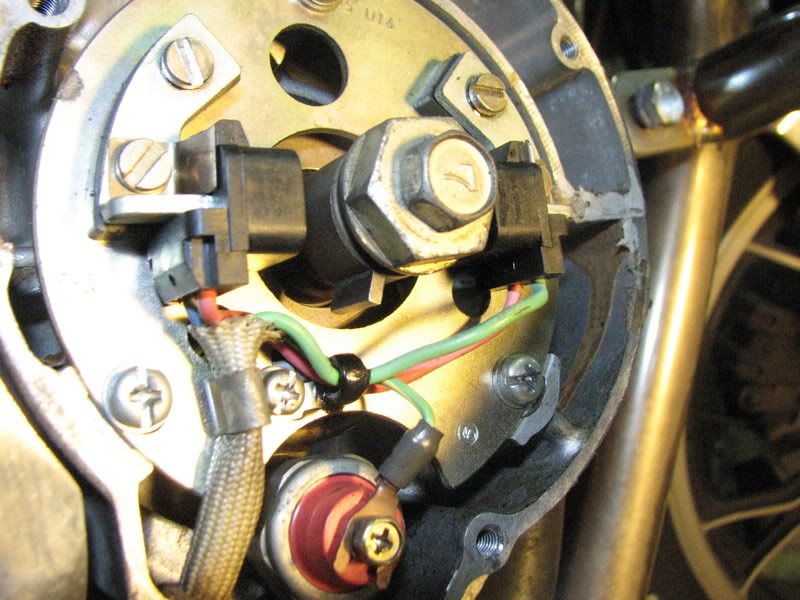
But I may have put the cams back on wrong. You see, in my clymer manual, the instructions are very vague for getting the timing back to TDC before reinstalling the cams. It just says to line up the "T" with "the marking" Luckily I had my good friend chuck to explain that it must be at TDC AND on the compression stroke. So I used my thumb to tell when air was blowing out of the spark plug hole (this means its on compression) and then used a rod down in the same hole to tell when the piston was at its highest. This point corresponded to the T mark under the ignition cover being lined up with a point to the LEFT of the T, not ABOVE the T as it says in the manual. But since the picture of the ignition timing panel in the manual is not like mine I figure its just a different model.

Now here is where I may have gone wrong...the spark plug I was using for all this was the one closest to me. Chuck said that its 1 and 4 that need to be TDC (and the manual) in order to line the cams up right. I thought that the cylinders were labeled 1 to 4 from the bike's left to bike's right. From port to starboard. But the valve's are labeled differenly, they go 1 2 3 4 in a clockwise direction, with 1 and 4 being on the left side of the bike. If I used the right-most spark plug hole to tell TDC and which stroke it is on, will my timing be right? Or will it be 180 degrees off

And the other thing is that the first valve bucket I took out, the back rightmost valve, did not go nback into the valve as easily as the other ones. As a result, I couldn't turn it or get it back out without needlenose pliers. I tried to reseat it and it turns more easily now but still nowhere near as easily as the rest. It is difficult to rotate the bucket by hand. What does this mean? And what should I do?

Otherwise, everything has gone smoothly. Big thanks to everyone, especially Steve and Chuck, for their help!!
 
Check the online version of the Suzuki manual on Basscliff's site. Mine is older version, but I think the correct position would be pointing up, not down. Once again check the manual to be sure.
 
But I may have put the cams back on wrong. You see, in my clymer manual, the instructions are very vague for getting the timing back to TDC before reinstalling the cams. It just says to line up the "T" with "the marking" Luckily I had my good friend chuck to explain that it must be at TDC AND on the compression stroke.
Because #1 and #4 go up and down together, they won't know which one is on the compression stroke until you intall the cam.
It is the valve timing that tells the piston it is on compression, and it's the cam that determines valve timing.


This point corresponded to the T mark under the ignition cover being lined up with a point to the LEFT of the T, not ABOVE the T as it says in the manual. But since the picture of the ignition timing panel in the manual is not like mine I figure its just a different model.
The model is probably similar enough, just an earlier year. Things changed a bit for '82 and '83, but the principle is the same: line up the "T" mark, which is shown in your picture.


Now here is where I may have gone wrong...the spark plug I was using for all this was the one closest to me. Chuck said that its 1 and 4 that need to be TDC (and the manual) in order to line the cams up right.
So far, everything is OK.


I thought that the cylinders were labeled 1 to 4 from the bike's left to bike's right. From port to starboard.
Everything is still just fine.


But the valve's are labeled differenly, they go 1 2 3 4 in a clockwise direction, with 1 and 4 being on the left side of the bike.
Where did you come up with a story like that?

How can you go "clockwise" when they are in a straight line?

Does that mean that 2 and 3 are on the right?

There are EIGHT valves, which ones are you numbering what?

The valves are numbered just like the cylinders: #1 is under your clutch hand (port), #4 is under your throttle hand (starboard).
Any other numbering system for the valves would introduce more confusion than is already there, and would be ludicrous.


If I used the right-most spark plug hole to tell TDC and which stroke it is on, will my timing be right? Or will it be 180 degrees off?
As I mentioned earlier, #1 and #4 go up and down together, they don't know which one is on compression until you install the cam. You will be fine.


And the other thing is that the first valve bucket I took out, the back rightmost valve, did not go nback into the valve as easily as the other ones. As a result, I couldn't turn it or get it back out without needlenose pliers. I tried to reseat it and it turns more easily now but still nowhere near as easily as the rest. It is difficult to rotate the bucket by hand. What does this mean? And what should I do?
This means that something is binding up in there. If you did not drop the bucket to possibly deform it, there must be a small piece of cam lobe stuck in there still. I would remove it and fish around with a magnet to try to find the little bugger, then use a rag to wipe down the wall around the valve spring to make sure it's clean.

.
 
"Things changed a bit for '82 and '83, but the principle is the same: line up the "T" mark, which is shown in your picture."
yes but line up the "T" with what mark exactly? My manual has the mark being through some kind of window directly above the crank bolt. My bike has no such window. But it looks like the mark on mine for cylinders 1,4 is on the left and 2,3 is to the right.

I did check on the service manual today and the picture is still blurry but it looks close to mine so I think I am ok. The thing is that under my ignition cover, there are three markings close together, a T, a |, and a F| (F with a line above it). So when it says to line up the "T", is it talking about the line directly adjacent to the T, or the T itself? From left to right it reads " T | F| "

Edit; about the clockwise number, I dont know what it was, but there are numbers in the outside oil wells on both sides labeled 1-4 like that. I was dumb and didn't realize the cylinders aren't arranged like that, please just ignore I said that. :)

last edit: I think I did install it right, and today I put the tensioner on and checked some valve clearances. I had a few in spec! What a great thing. The engine turned over much more easily than before, with the new smaller shims in. And it turned smoothly. The only strange thing here was the tensioner. It seemed like I couldnt push the rod very far in...only about halfway. As a result, it didn't quite fit flush up to the engine case. when I bolted it in (very gently of course) it was fine. then I let out the screw and....nothing. I think it might have moved out a millimeter if at all. But when I turned the crank backwards a little (as per the suzuki manual, to test it) , I could untwist the big spring/twister and it stayed. Then I turned the engine back forward and the tensioner wnet in by itself. According to the manual, this means it is good. How far is the plunger supposed to go into the tensioner body? Im worried there might be too much tension on the chain. Thanks guys.
 
Last edited:
yes but line up the "T" with what mark exactly? My manual has the mark being through some kind of window directly above the crank bolt. My bike has no such window. But it looks like the mark on mine for cylinders 1,4 is on the left and 2,3 is to the right.
I mentioned the change. Here is a picture of one of my bikes (can't remember which one) that shows the earlier setup:
IMG_2944.jpg


I did check on the service manual today and the picture is still blurry but it looks close to mine so I think I am ok. The thing is that under my ignition cover, there are three markings close together, a T, a |, and a F| (F with a line above it). So when it says to line up the "T", is it talking about the line directly adjacent to the T, or the T itself? From left to right it reads " T | F| "
The two "|" lines are the marks, the letters "T" and "F" merely identify the marks.

The "T" is for TDC, the "F" is the "Fire" mark for ignition timing. On the earlier bikes, there would also be a "||" mark on the other side of the "F" mark, that would be the mark to check the ignition advance.


Edit; about the clockwise number, I dont know what it was, but there are numbers in the outside oil wells on both sides labeled 1-4 like that. I was dumb and didn't realize the cylinders aren't arranged like that, please just ignore I said that. :)
Rather than ignore that, how about an education? Those numbers are for the tightening sequence for the head bolts. They have nothing to do with cylinder identification.


The only strange thing here was the tensioner. It seemed like I couldnt push the rod very far in...only about halfway. As a result, it didn't quite fit flush up to the engine case. when I bolted it in (very gently of course) it was fine. then I let out the screw and....nothing. I think it might have moved out a millimeter if at all. But when I turned the crank backwards a little (as per the suzuki manual, to test it) , I could untwist the big spring/twister and it stayed. Then I turned the engine back forward and the tensioner wnet in by itself. According to the manual, this means it is good. How far is the plunger supposed to go into the tensioner body? Im worried there might be too much tension on the chain. Thanks guys.
Sounds like you did not get the tensioner set properly before installation.

Since you have doubts about it, it would be wise to take the tensioner off and check it, to be SURE.

Remove the tensioner. Loosen the locknut and setscrew on the left side. While trying to depress the plunger, rotate the large knob on the right side, the plunger should go in, probably about 15mm or so. While holding the plunger in that position, tighten the setscrew (but not the locknut). Rotate the crank just a little bit to make sure there is tension on the FRONT of the chain and SLACK on the rear. Install the tensioner. When the bolts are snug, loosen the setscrew, you should see the large knob turn as the plunger takes up some slack. Now for the important part that is often missed. Tighten the setscrew, then back off 1/4 turn and lock it into place with the locknut. You do NOT want the setscrew tight against the plunger, or it won't be able to move to do its job.

.
 
Biblical

Biblical

Steve, you really do have the patience of Job!!:)
 
Holy cow, lousy deal ekabil! Do I have to worry about this with a 79' GS850G DOHC? I'm not really even sure if I have 8 or 16 valve configuration?:confused:
and didn't I read somewhere ya need a special tool for compressing the valve spring?
 
Thank you Steve.
Slyone,
I did use the special tool. After 3 or 4 valves I mastered it. But it's kinda tricky at first, as it has to be in the right place to work. Not too bad though. There is also a zip tie method that doesn't use the tool, and you can find that on BikeCliffs site. It's right under the link to the 8 valve adjustment guide.
 
Steve, you really do have the patience of Job!!:)
No, I just have lots of time and nothing else to do. :p


Do I have to worry about this with a 79' GS850G DOHC?
Depending on what "this" you are referring to, probably.


I'm not really even sure if I have 8 or 16 valve configuration?:confused:
You have an 8-valve engine.


and didn't I read somewhere ya need a special tool for compressing the valve spring?
Can't say whether you read it or not, but, yes, there is a "special" tool. Comes in two flavors: Factory-style and zip-tie.

.
 
wow Thanks, hadn't read cliffs valve adj.procedures..piece a cake! where can I get one of those handy tappet tools cheap?? Then I just read the zip tie deal..interesting too! Thanks
 
Last edited:
...
I want to talk about the cause of all this. What could cause every valve to be so far outside of clearance? The most alarming possibility is that the PO took the head off a much older and worn engine and replaced the head of my 14,000 mi engine with it.....

The other possibility is that the high temperature of ethanol-laced gasoline burnt the valves and knocked them out of their seats. Something like that anyway, my understanding is limited here but I don't think these engines were designed for ethanol gas.....

I could be wrong, but I think that the natural tendency is for shim-to-cam clearance to tighten with more miles.

Our engines run fine with 10% ethanol. They were designed to do so.

When I first checked clearance on my 850, I think that all were tight. The engine had < 12,000 miles, and it was probably the first time the valve shim clearance had been checked. For most of the valves, I could not get any feeler gauge in. So I bought a Kawaski shim that was about 0.015" thinner than my thinnest shim. (The number is a guess, as I really don't remember.) Kawaskai shims are roughly a mm smaller diameter than Suzuki shims, so there is no mistaking it for a Suzuki shim.

Two other resources: Steve (?) has a spreadsheet to assist calculating the proper thickness for replacement shims. I think that it can also help you record the history of shim clearances. Often it is possible to move shims from one valve to another, so that only a few shims must be purchased, even if all valves are tight.

Also, there is (used to be?) a shim exchange club/program.

A plastic canister, used to hold rolls of 35 mm film, is the right size to store your shims.

Finally, a big lesson ("meta" lesson) is that using a manual and searching GSR forums before starting can prevent many problems. It takes more time before starting, but usually the job will be done faster, and it will stay done.
 
I could be wrong, but I think that the natural tendency is for shim-to-cam clearance to tighten with more miles.
No, Tom, this time, you are RIGHT. :eek:


Our engines run fine with 10% ethanol. They were designed to do so.
Not sure they were designed with ethanol in mind, but they do tolerate 10% reasonably well.


When I first checked clearance on my 850, I think that all were tight. The engine had < 12,000 miles, and it was probably the first time the valve shim clearance had been checked. For most of the valves, I could not get any feeler gauge in. So I bought a Kawaski shim that was about 0.015" thinner than my thinnest shim. (The number is a guess, as I really don't remember.) Kawaskai shims are roughly a mm smaller diameter than Suzuki shims, so there is no mistaking it for a Suzuki shim.
It is quite typical for any "new" engine in your stable to be tight on clearances, regardless of miles on it.
Since the minimum clearance is right at the size of the thinnest feelers in most sets, it is also typical that you can not insert a feeler.

I would not recommend getting a Kawasaki shim. Yes, they do what Tom says, but they are only 0.5mm smaller in diameter and would be rather easy to mistake for a Suzuki shim. It would be far better to just get a thin Suzuki shim.


Two other resources: Steve (?) has a spreadsheet to assist calculating the proper thickness for replacement shims. I think that it can also help you record the history of shim clearances.
Yes, that's me, check my signature.
down2.gif


Tom should know what my spreadsheet does, I sent him a copy in May, 2009, then updated versions in February and April of 2010. :-k


Often it is possible to move shims from one valve to another, so that only a few shims must be purchased, even if all valves are tight.
Very true, but you need to inventory your shims to know what you have in there. That is one advantage of my spreadsheet.


Also, there is (used to be?) a shim exchange club/program.
As far as I know, it's still running. Look up user Ghostgs1 (do an advanced search for user name), look at his signature, it has information there.


A plastic canister, used to hold rolls of 35 mm film, is the right size to store your shims.
Of course, that assumes that you have access to some 35mm film cans. :o
You can stop by the photo processing center at most pharmacies or Wal-Mart, they are usually happy to give them to you.

If you plan on building your own stash of shims and might overflow a film can, a small compartmented tray works well. I think mine was designed to be a tackle box.


One last word of caution: DO NOT ROTATE THE CRANK UNLESS ALL OF YOUR SHIMS ARE IN PLACE.

Otherwise, you will be starting your own thread like this one. :oops:

.
 
Will I need to change out the gas if its been sitting for a month? The tank has been full this whole time.

And if I do, how do I dispose of gasoline properly?
 
Will I need to change out the gas if its been sitting for a month? The tank has been full this whole time.

And if I do, how do I dispose of gasoline properly?

No

Put in your car, it won't care about fuel quality
 
Back
Top