• Required reading for all forum users!!!

    Welcome!
    Register to access the full functionality of the GSResources forum. Until you register and activate your account you will not have full forum access, nor will you be able to post or reply to messages.

    A note to new registrants...
    All new forum registrations must be activated via email before you have full access to the forum.

    A Special Note about Email accounts!
    DO NOT SIGN UP USING hotmail, outlook, gmx, sbcglobal, att, bellsouth or email.com. They delete our forum signup emails.

    A note to old forum members...
    I receive numerous requests from people who can no longer log in because their accounts were deleted. As mentioned in the forum FAQ, user accounts are deleted if you haven't logged in for the past 6 months. If you can't log in, then create a new forum account. If you don't get an error message, then check your email account for an activation message. If you get a message stating that the email address is already in use, then your account still exists so follow the instructions in the forum FAQ for resetting your password.

    Have you forgotten your password or have a new email address? Then read the forum FAQ for details on how to reset it.

    Any email requests for "can't log in anymore" problems or "lost my password" problems will be deleted. Read the forum FAQ and follow the instructions there - that's what we have one for...

  • Returning Visitors

    If you are a returning visitor who never received your confirmation email, then odds are your email provider is blockinig emails from our server. The only thing that can be done to get around this is you will have to try creating another forum account using an email address from another domain.

    If you are a returning visitor to the forum and can't log in using your old forum name and password but used to be able to then chances are your account is deleted. Purges of the databases are done regularly. You will have to create a new forum account and you should be all set.

Corrosion. 12.5VDC dont mean sh!t

bonanzadave

Forum Sage
Super Site Supporter
Past Site Supporter
I hope Jim (Posplayr) will shed some "light" on this.

I was trouble shooting the inop dome light in my truck topper. Easy. Check the voltage at the bulb socket. 12.5 VDC. Bad Bulb. Nope. ???? There is 12.5V at the socket ! Two bad bulbs ? Nope. WTF. 12.5VDC on both sides of the fuse. A+ wire ohms out to the light socket. Bad ground ? Nope. Ground wire ohms out to the light socket. WTF !!! Crawled under the truck and found this badly corroded splice. Replaced it with a new splice and....:idea:.

How does the corrosion allow voltage but resists current ?
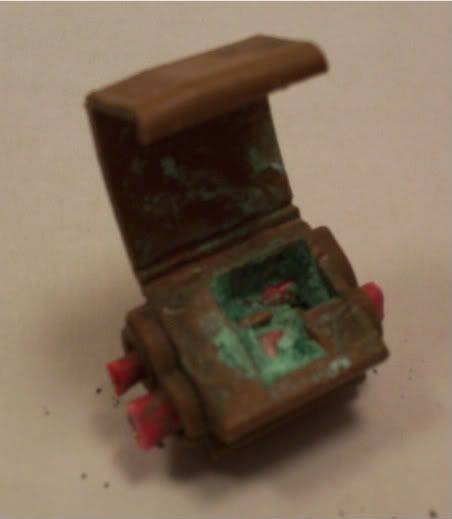
100_5263-1.jpg
 
be sure to use some dielectric grease on the new splices and clean up all the other connections and grease them also.. that will avoid many problems down the road.
 
I hope Jim (Posplayr) will shed some "light" on this.

I was trouble shooting the inop dome light in my truck topper. Easy. Check the voltage at the bulb socket. 12.5 VDC. Bad Bulb. Nope. ???? There is 12.5V at the socket ! Two bad bulbs ? Nope. WTF. 12.5VDC on both sides of the fuse. A+ wire ohms out to the light socket. Bad ground ? Nope. Ground wire ohms out to the light socket. WTF !!! Crawled under the truck and found this badly corroded splice. Replaced it with a new splice and....:idea:.

How does the corrosion allow voltage but resists current ?

100_5263-1.jpg

Though I'm no electrical wizzard by any standard, is not the voltage, the "allowed current" through a given passage and the Ohms resistance the electrical equivelant to the "pressure"?

Geeezzzz, Dave. that could have all been avoided if you would have bought a Ford! :p :D ^o
 
Very good illustration why there should never be spliced connections under a vehicle. :o

Even if it had been wrapped with a bunch of tape, water would still have found its way in. :oops:

.
 
Resistors are made from different materials that allow some flow but not much. Transistors and diodes are made from unique materials that allow current flow in strange ways.

In the light socket case you're looking for no monkey business, just low resistance. The green stuff looks like copper that has oxidized pretty bad. Try not to ford streams so much and you should be fine.
 
Very good illustration why there should never be spliced connections under a vehicle. :o

Even if it had been wrapped with a bunch of tape, water would still have found its way in. :oops:

.

What I was thinking to...only I'd say to never use scotchlock connects period, inside or otherwise.
 
Using a digital voltmeter?

Using a digital voltmeter?

Watch out when checking for voltages with a digital voltmeter. The input impedance is so high that a mere trickle voltage is enough for them to register.
You'll have better luck using one of the 12vdc trouble lights. I've added a really long clip lead to the negative side of mine. Clip it to the -side of the battery to check for 12 volts. Clip it to the + side and you can check for ground continuity. And I still use an analog VOM a lot. Much more dependable than a digital unit sometimes.


Double that agree here...we get those issues at work allllll the time..truck driver spends $200 on fancy lights and then installs them with those damn connectors..or worse yet..ive actually seen people use wire nuts..as in house wire nuts...a nitemare to trackdown and very costly to re-wire a set of 25+ lights correctly when it should have been done right the first time...they should outlaw those scotchlocks.

DDM
 
Scotchloks are evil. Eeeeeeeeeeevil. :mad:
 
By using a DIGITAL VOM and not the conventional/analog type, that's how.
You are not the first or last person to be fooled by a digital VOM.

Please explain the empirical or theoretical basis for your conclusion.
 
I'm an electronics tech by trade. My take on this is the faulty connector could pass 12vdc to the socket with no load (no bulb filiment) But once bulb was installed and circuit loaded (bulb filiment)the corrosion in the connector provided the path of least resistance and passed the small amount of current that should have been going to the bulb and went to ground. Not a short that would blow a fuse more like the corrosion created a poor mans resistor to ground. Agree with never use these snap connectors. Once removed over thirty of them on an old Goldwing. My choice is 40/60 solder and heat shrink.

Take care

Tim
 
Got it.....

Scotchlocks - Bad (I actually knew that)

Get a (maybe two) test lights.

Smart ass replys - Ask Mr. Dave8338 (I actually knew that too)

Empirical or theoretical conclusions - Ask Mr. teddux (could you fix my TV ?)


Thanks guys ! I see the light !! :) :idea: :)
 
For the very same reason that you CANNOT use a digital to check HV (microwave) diodes, NOT ENOUGH CURRENT.
In this case, you are checking for Voltage; hence, the D'Arsonval Movement Meter will require/supply a lot more current than a digital when checking voltage/resistance.:rolleyes:

And, if you don't like the looks of an analog multimeter, try getting a megger to blow things up.

Now, if you want to compare, try google-ing impedance/sensitivity on both.

The truth is, there is a voltage drop using a digital, but you "ain't" seeing it 'cause it will be in the -1.8 to -0.05V range and most that don't understand this are just happy to see 13.2V on a 14V system.
Which really boils down to knowing your toolz.

Aw, WTH.
For checking voltage using a digital VOM:
Input impedance=10M ohms
Circuit under test=12 Volts
Your E/IR; I=12/10,000,000=1.2uAmps (u as in MICRO, not Milli).

Analog voltmeters usually have a sensitivity of 20 to 30 kilohm per volt (kΩ/V), which varies with the voltmeter range setting.
12/25000=0.48mA

Comparing 0.48mA to 0.0012mA
400 times different.

Now you can see why using an incandescent bulb as mentioned b4 works great.
The truth is, you should be measuring "CONTINUITY" (I assume about 1.2mA on the digital) and not voltage.

Don't buy fancy/expensive tools you don't know how to use. The DIGITAL voltmeter was made to test ELECTRONICS with MINIMAL CURRENT so as to NOT DAMAGE components in circuit with too HIGH a CURRENT.

For automotive work, go buy your cheap "trouble-light", it's really all you need for those types of electrical diagnosis.

And if you were wondering, YES!
I have 4 digital multimeters, but know how to use them.
I also have 2 O'Scopes, 2 logic probes, 1 logic pulser, 1 variac, 1 analog multimeter, 1 megger, and $50,000.00 worth of other test sets/equipment. But that's getting into MY world, lol!

Well, look like you have a nice tool kit :rolleyes:; however your deduction that it is a test equipment issue doesn't appear to match the observations.

Given the confirmed fault was a corroded connection, implies that the connection must had sufficent resistance to drop most of the voltage across the connection. To keep things simple a 12W bulb at 12V is 1 amp which means it is 1 ohm of resistance in the bulb. To keep the light from coming on any resistance greater than 10 ohms in the connector would result in the observed fault measurements and the light not coming on.

If you do your circuit analysis, neither a 10M ohm input imedance of the DVM or the 20Kohm/V Analog meter will have any impact to those observations.

I provided the explaination in the other thread. It is really that simple and we dont need a $50K in test equipment to deduce that. :p
 
What you should have done is check the voltage drop across the bulb in a closed circuit (i.e., when the bulb should have been lit). Let's say this is a 10W bulb, and you know your electrical system is pushing 12.5V. Ohm's law + definition of wattage says:

watts = V^2/R

So if you do the math with the W and V given, you get an R of 15.6 ohms for the bulb. If you get a voltage drop of only 6.2V across the bulb, you know there's a resistance of about 16 ohms elsewhere (just making the math easy - the bulb is putting up about 1/2 of the resistance, and the other 1/2 is elsewhere).

ANY VOLTmeter - digital or analog - should have very high input impedance so as not to distort the readings by its own parasitic effects. In the above scenario, ~16 ohms of resistance in the wiring sucked away 1/2 of your voltage. In a loop closed by a voltmeter with a ridiculously low impedance of say 1000 ohms, the voltmeter would still make up more than 95% of the voltage drop and read very close to 12V. Up that to the megaohms any respectable voltmeter should be rated, and that 15 ohms of resistance in the wiring is negligible.

Voltmeters are meant to be used in parallel with active components - ammeters are meant to be used in series :)
 
To keep things simple a 12W bulb at 12V is 1 amp which means it is 1 ohm of resistance in the bulb.

It would actually be 12 ohms of resistance. V=IR, 12!=1*1.

If you do your circuit analysis, neither a 10M ohm input imedance of the DVM or the 20Kohm/V Analog meter will have any impact to those observations.

Quite right.
 
Time to get the umbrellas and galoshes out. :confused:

This appears to be turning into a pi$$ing match. :eek:

.
 
Back
Top