• Required reading for all forum users!!!

    Welcome!
    Register to access the full functionality of the GSResources forum. Until you register and activate your account you will not have full forum access, nor will you be able to post or reply to messages.

    A note to new registrants...
    All new forum registrations must be activated via email before you have full access to the forum.

    A Special Note about Email accounts!
    DO NOT SIGN UP USING hotmail, outlook, gmx, sbcglobal, att, bellsouth or email.com. They delete our forum signup emails.

    A note to old forum members...
    I receive numerous requests from people who can no longer log in because their accounts were deleted. As mentioned in the forum FAQ, user accounts are deleted if you haven't logged in for the past 6 months. If you can't log in, then create a new forum account. If you don't get an error message, then check your email account for an activation message. If you get a message stating that the email address is already in use, then your account still exists so follow the instructions in the forum FAQ for resetting your password.

    Have you forgotten your password or have a new email address? Then read the forum FAQ for details on how to reset it.

    Any email requests for "can't log in anymore" problems or "lost my password" problems will be deleted. Read the forum FAQ and follow the instructions there - that's what we have one for...

  • Returning Visitors

    If you are a returning visitor who never received your confirmation email, then odds are your email provider is blockinig emails from our server. The only thing that can be done to get around this is you will have to try creating another forum account using an email address from another domain.

    If you are a returning visitor to the forum and can't log in using your old forum name and password but used to be able to then chances are your account is deleted. Purges of the databases are done regularly. You will have to create a new forum account and you should be all set.

Effective Flywheel Removal

  • Thread starter Thread starter atvpyrofreak
  • Start date Start date
A

atvpyrofreak

Guest
I haven't posted here for a while but I was working on a friends GS750 tonight and needed to remove the flywheel. It was being a real pain so I decided to search the forums but didn't really find any answers. It seams as if a lot of people have the same problem I was experiencing, so I decided to share the solution I came up with for this stubborn flywheel.

The main problem with removing the flywheel is that the Bolt that threads into the crank and holds the flywheel on is 14mm and the threads in the flywheel for removing it are only 16. This means you only have 1mm on each side of the threaded hole going into the crank to push against. If you try to just screw a bolt or extraction tool into the hole, many time is the flywheel is at all stubborn, the inner threads of the crank (or outer threads of the bolt) will give way, resulting in ruined threads and possibly a stuck bolt.

Some people have suggested shoving a nut or ball bearing into the hole to prevent this, however I was unable to find anything of suitable size in my shop, and was also fearful of what some had reported... the object being jammed into the crank threads.

So, Here is my simple solution to a very frustrating problem. I cut the head off of an extra shorter 14mm bolt which threaded into the the crank (about an inch long). I then cut a strait slot in the end of the bolt with a dremel tool. Once I was satisfied with the slot, I cleaned the threads of the bolt good and put a little anti-seize on it. Then I screwed this into the crank, just so the head of it was sticking out of the crank. The picture (from my phone) shows this bolt.

After the bolt was installed I packed the rest of the cavity with grease. This is an old trick that I'm sure many of you have heard of, but it really does work. It helps to transfer some of the mechanical energy into hydraulic energy. After the grease, just insert your 16mm bolt into the flywheel and tighten with an impact or ratchet.

The flywheel which had previously resisted multiple types of pullers, heat, high power impacts, ect, ect... popped off with just a few slaps from the impact. I'm not garunteeing it will work this well for you, but It sure worked wonders for me!

Hopefully this write up wasn't too long to describe a fairly simple process, but I was just so overjoyed when this worked so easily, that I just had to share it with all of you.
 
That's just an outstanding idea. As soon as I saw your picture, I knew what the item's purpose was. Perfect solution!
 
Sounds interesting, what bike are you using this on? pre80 GS750? Does this apply to 1100E's? I'm trying to uderstand what that old drick is doing as I have never heard of it before.

The main problem with removing the flywheel is that the Bolt that threads into the crank and holds the flywheel on is 14mm and the threads in the flywheel for removing it are only 16. This means you only have 1mm on each side of the threaded hole going into the crank to push against. If you try to just screw a bolt or extraction tool into the hole, many time is the flywheel is at all stubborn, the inner threads of the crank (or outer threads of the bolt) will give way, resulting in ruined threads and possibly a stuck bolt.

I have had to apply a lot of force to my 1100ED for example using Mapp gass for heat and breaking the tool but never damaged the crank end. I was lucky on the 80-81 GS750's as their rotors almost fell off with a moderate amount of pressure on the center bolts.
 
Sounds interesting, what bike are you using this on? pre80 GS750? Does this apply to 1100E's? I'm trying to uderstand what that old drick is doing as I have never heard of it before.

Yes, this was done on a 78 GS750. I'm sure the same thing could be done on the 1100 but I am somewhat unfamiliar with the set up there. The sizes and everything might be different but the theory should be the same.

The bolt/plug in this case is being used for 2 reasons. The first is to plug the rather long, hollow space inside the crankshaft so the grease doesn't go down inside there. The other is so that incase the bolt tightens too much, it doesn't mangle the threads inside the crank. I don't know how much room the 1100 has, but like I said, there's only 1mm on each side of the bolt on the 750 to push against.

The grease trick I leaned for an old snowmobile mechanic for removing clutches. While I don't fully grasp how it works, I think it goes something like this.
When you tighten a puller bolt like this against a surface, you only have the ability to TURN the bolt (which does advance the bolt) however a lot of the force involved goes into rotating surfaces together. By filling the hole with grease and then tightening to bolt into the hole, you turn the cavity and bolt into sort of a hydrolic plunger which exerts most of its force on the end of the crank (or plug in this case). Since the grease doesn't compress, all of the energy from the turning, advancing bolt, goes into linear force, and pops the flywheel/clutch/ect off the shaft/crank.

I've used this trick a lot and it always seams to get the job done, even when the part is being stuborn.
 
The grease trick I leaned for an old snowmobile mechanic for removing clutches. While I don't fully grasp how it works, I think it goes something like this.
When you tighten a puller bolt like this against a surface, you only have the ability to TURN the bolt (which does advance the bolt) however a lot of the force involved goes into rotating surfaces together. By filling the hole with grease and then tightening to bolt into the hole, you turn the cavity and bolt into sort of a hydrolic plunger which exerts most of its force on the end of the crank (or plug in this case). Since the grease doesn't compress, all of the energy from the turning, advancing bolt, goes into linear force, and pops the flywheel/clutch/ect off the shaft/crank.

OK I think I understand.

Without the grease, the force applied to pull the rotor is all transmitted through the threads which could cause them to fail, as well as create alot of friction as that will be in proportion to the force on the threads.

With the grease, the force applied is that of the threads, as well as a potentially greater amount applied via the hydraulic force of the captured grease. The grease doesn't have any friction, and the load transfer through the grease reduces the pressure on the threads and therefore also reduces the friction on the threads.

Great trick. :rolleyes:
 
OK I think I understand.

Without the grease, the force applied to pull the rotor is all transmitted through the threads which could cause them to fail, as well as create alot of friction as that will be in proportion to the force on the threads.

With the grease, the force applied is that of the threads, as well as a potentially greater amount applied via the hydraulic force of the captured grease. The grease doesn't have any friction, and the load transfer through the grease reduces the pressure on the threads and therefore also reduces the friction on the threads.

Great trick. :rolleyes:
What's wrong with doobobs, thingys and chinga deras?
:p
 
Just as a word of caution for y'all. I had a doobob come loose on me last year and hit me right in the wangdoodle, not something I want to repeat!

/\/\ac


(Great idea, I'm going to try it out on a parts motor this week.)
 
Last edited:
I haven't posted here for a while but I was working on a friends GS750 tonight and needed to remove the flywheel. It was being a real pain so I decided to search the forums but didn't really find any answers. It seams as if a lot of people have the same problem I was experiencing, so I decided to share the solution I came up with for this stubborn flywheel.

The main problem with removing the flywheel is that the Bolt that threads into the crank and holds the flywheel on is 14mm and the threads in the flywheel for removing it are only 16. This means you only have 1mm on each side of the threaded hole going into the crank to push against. If you try to just screw a bolt or extraction tool into the hole, many time is the flywheel is at all stubborn, the inner threads of the crank (or outer threads of the bolt) will give way, resulting in ruined threads and possibly a stuck bolt.

Some people have suggested shoving a nut or ball bearing into the hole to prevent this, however I was unable to find anything of suitable size in my shop, and was also fearful of what some had reported... the object being jammed into the crank threads.

So, Here is my simple solution to a very frustrating problem. I cut the head off of an extra shorter 14mm bolt which threaded into the the crank (about an inch long). I then cut a strait slot in the end of the bolt with a dremel tool. Once I was satisfied with the slot, I cleaned the threads of the bolt good and put a little anti-seize on it. Then I screwed this into the crank, just so the head of it was sticking out of the crank. The picture (from my phone) shows this bolt.

After the bolt was installed I packed the rest of the cavity with grease. This is an old trick that I'm sure many of you have heard of, but it really does work. It helps to transfer some of the mechanical energy into hydraulic energy. After the grease, just insert your 16mm bolt into the flywheel and tighten with an impact or ratchet.

The flywheel which had previously resisted multiple types of pullers, heat, high power impacts, ect, ect... popped off with just a few slaps from the impact. I'm not garunteeing it will work this well for you, but It sure worked wonders for me!

Hopefully this write up wasn't too long to describe a fairly simple process, but I was just so overjoyed when this worked so easily, that I just had to share it with all of you.

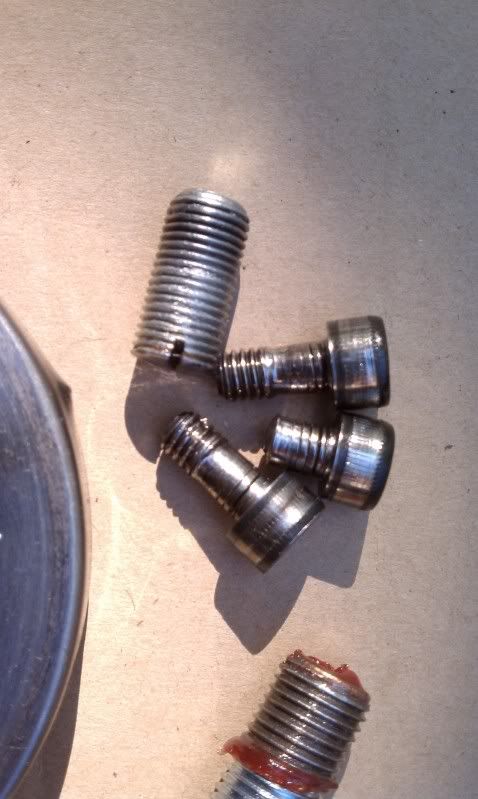
You my friend, are a genius! Worked great for my 850! The inner bolt/ modified set screw on my bike was a 12mm with 1.25 thread, while the outer bolt that put on the squeeze was a 14mm with 1.50 threads. For reference, the starter clutch bolts are M8 with 1.25 threads. Here's a pic after the removal. One bolt was completely broken...
IMAG0121.jpg


The new starter clutch bolts are slightly longer, so they can utilize all of the available threaded hole. Between that and red loc-tite, we should be good to go!
 
why not just use a flywheel removal tool? they make them and they are fairly cheap. at my shop i bought a complete set that will work on basically any bike for $99.00 but you can but the indavidual ones for $15.00 to $20.00 and it is way cleaner.
 
I know this is an old thread .............but found this and made one for myself , thank you.............also made my own puller out of a M16x1.5 doubled ended wheel lug nut stud from auto zone for $2.19 thanks again
 
Back
Top