• Required reading for all forum users!!!

    Welcome!
    Register to access the full functionality of the GSResources forum. Until you register and activate your account you will not have full forum access, nor will you be able to post or reply to messages.

    A note to new registrants...
    All new forum registrations must be activated via email before you have full access to the forum.

    A Special Note about Email accounts!
    DO NOT SIGN UP USING hotmail, outlook, gmx, sbcglobal, att, bellsouth or email.com. They delete our forum signup emails.

    A note to old forum members...
    I receive numerous requests from people who can no longer log in because their accounts were deleted. As mentioned in the forum FAQ, user accounts are deleted if you haven't logged in for the past 6 months. If you can't log in, then create a new forum account. If you don't get an error message, then check your email account for an activation message. If you get a message stating that the email address is already in use, then your account still exists so follow the instructions in the forum FAQ for resetting your password.

    Have you forgotten your password or have a new email address? Then read the forum FAQ for details on how to reset it.

    Any email requests for "can't log in anymore" problems or "lost my password" problems will be deleted. Read the forum FAQ and follow the instructions there - that's what we have one for...

  • Returning Visitors

    If you are a returning visitor who never received your confirmation email, then odds are your email provider is blockinig emails from our server. The only thing that can be done to get around this is you will have to try creating another forum account using an email address from another domain.

    If you are a returning visitor to the forum and can't log in using your old forum name and password but used to be able to then chances are your account is deleted. Purges of the databases are done regularly. You will have to create a new forum account and you should be all set.

GS 1100 G Rear air shock air pressures

  • Thread starter Thread starter J Mac
  • Start date Start date
J

J Mac

Guest
Does anyone have the recommended air pressure and damping # for rear air shocks for 2 up riding on 1983 GS 1100 G as per owners manual.

Tks
John
 
I've never heard of any GS with stock air shocks. Are you sure the shocks are original?
Yep. '82-'84 1100GK and '83 1100G. :encouragement:

J Mac, I can't help you with absolute numbers, but I can tell you how to find them. :-k

You are going to need your usual passenger and another helper. Your helper is going to have to measure the length of the rear shocks, while you and your passenger are seated on the bike, so choose carefully. This procedure will also determine the correct pressure for you, riding solo.

Start with the bike on the centerstand, if possible. It is also possible to start on the side stand, but pull the rear UP, to make sure the shocks are fully extended. Measure the shocks from two easily-repeatable points. Center-to-center of the mounting bolts would be perfect, but from the bottom of the shroud to the swingarm would work, too, as long as that location can be reached with two people on the bike. The stock shocks are about 13" long and have about 4" of travel. The recommendation for 'sag' on the rear is about 15-25%, so you are looking for about 5/8 to 1" of drop (sag).

Might be easiest to start with just you on the bike. Sit on the bike as close to your normal riding position as possible. Bounce on the suspension a bit to make sure it settles properly, then measure the shock length. Adjust your air pressure until you get no more than 1" of sag. Allow the shocks to fully extend, check the air pressure. Record that number. Repeat the process with your passenger on board. Record that number, too. You now have what pressures work for YOU, regardless of what the manual suggests. When you check/set your pressure for a ride, be sure the shocks are fully extended, for repeatable results.

EDIT: I just looked in the 1100GK manual and found that they recommend a minimum of 14 psi in the shocks and a maximum of 35 psi. Adjustments are to be made with a hand pump to avoid overpressurizing the system.

.
 
Last edited:
I've been using Showa air shocks on GS850s for decades now and found that anything between 25 to 35psi is good. I tend to favour a firmer ride, so usually leave them at 30+.
 
Actually, a bit of extra air makes the ride softer. :-k

That is, as long as the shock still moves. Extra air merely restores ride height, allowing more travel to soak up bumps, which results in a better ride, which can be interpreted as "softer".

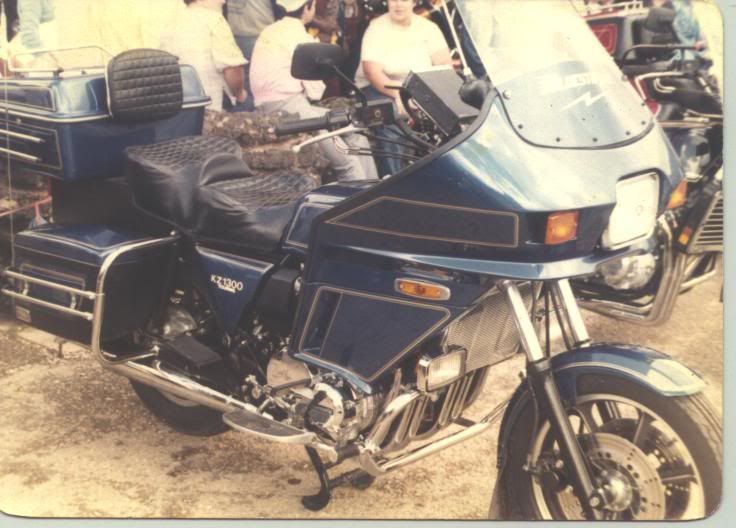
My experience with air suspension started with a Peterbilt and a furniture van that I herded across the country several times for about six years. My experience was refined a bit with S&W air shocks on my KZ1300. They were purely air, no metal spring at all. That made for a wonderful ride, with the best results when the most travel was available (without topping out).

Had gauges mounted on the handlebar for the shocks and the forks, for easy monitoring of pressures. Was very interesting to watch them move over road irregularities.

.
 
Actually, a bit of extra air makes the ride softer. :-k

That is, as long as the shock still moves. Extra air merely restores ride height, allowing more travel to soak up bumps, which results in a better ride, which can be interpreted as "softer".

My experience with air suspension started with a Peterbilt and a furniture van that I herded across the country several times for about six years. My experience was refined a bit with S&W air shocks on my KZ1300. They were purely air, no metal spring at all. That made for a wonderful ride, with the best results when the most travel was available (without topping out).

Had gauges mounted on the handlebar for the shocks and the forks, for easy monitoring of pressures. Was very interesting to watch them move over road irregularities.

.

Could well be I'm verging on them being too pumped up when they suit me, but that's what I find anyway. At 25psi they are noticeably a bit saggy and vague, whereas 30 (and even up at 40) they are nice and firm and all the vagueness is gone - exactly the same feeling as setting the preload on Marzocchis.
There is a sweet spot that suits me around about 35psi. If I set it there the system loses almost no air from one year's end to the next, so it's easy to forget where it's at.
I have a gauge on the front forks now and setting the static pressure at 17psi when the bike's on the centrestand results in the running pressure bumping up to over 40. This was enough for me to have ordered a 0-60 gauge, when I discovered the 0-30 gauge was inadequate. Something I hadn't expected to see much of was the effect of use - after about 5 miles or so the difference between cold and working pressures is about 10psi.
 
Any chance you have measured the sag on your shocks? :-k (Refer to post #4, if necessary.)

I had S&W gauges on the handlebar. The front was 0-100, the rear was 0-300, if I remember correctly. Pressures (while on the centerstand) were front: about 15, rear was about 75 solo, 110 dual. Never really noticed any increase to "warm" pressures while riding. Off the stand, the front rose to about 20, solo pressure at the rear went to 90, dual went to about 120. Pressures at the rear were higher than yours because there was no metal spring, only air.

.
 
Any chance you have measured the sag on your shocks? :-k (Refer to post #4, if necessary.)

I had S&W gauges on the handlebar. The front was 0-100, the rear was 0-300, if I remember correctly. Pressures (while on the centerstand) were front: about 15, rear was about 75 solo, 110 dual. Never really noticed any increase to "warm" pressures while riding. Off the stand, the front rose to about 20, solo pressure at the rear went to 90, dual went to about 120. Pressures at the rear were higher than yours because there was no metal spring, only air.

.

The GS1000G I recently bought from my brother also has S&W air shocks without metal springs. He told me he used to use 95 psi for dual riding with some clothes in the hard luggage cases.

I have not been able to ride much to test different pressures, as the shocks are losing air somewhere (zero pressure after about a week) and I cannot pinpoint where the leak is.

Steve, do you perhaps still have a copy of the S&W fitting instructions (user manual)? The document my brother had was damaged by water and is not legible anymore, and my search skills must be poor, as I cannot locate such a document online.
 
Don't have a manual, but will be happy to answer any questions you might have.

On shocks that use air, the only way to properly set pressure is at a known, repeatable volume, such as on the centerstand. To see what is proper for you, start with virtually any air pressure you want, from about 50-100 psi. When you take the bike off the stand, note the pressure (this is much easier with the handlebar-mounted gauges). Add some air, note the pressure. It will likely be the same, but the bike will be a little bit higher. Until the shocks top out, the pressure will remain the same, only the volume (bike height) will increase.

When you sit on the bike, the pressure will go up a bit. Note that pressure. It will likely be pretty much the same as you ride, except for bumps and dips in the road, of course. The 'ideal' pressure on the centerstand will be about 10 lbs less than your riding pressure.

If the shocks only required 95 psi for two-up touring, I have to assume a few things. 1. The bike might have been lighter than my 855 pound fully-dressed KZ1300. 2. The two people might have had a bit less gravitational attraction than our combined 25 stone. 3. The shocks might have been running low on travel. As mentioned earlier, I would set the shocks to about 110. When we loaded up the luggage and got on, the pressure would go to somewhere between 120 and 130. If I had set the pressure to over 130, it would take a large bump to move the shocks because they would be topped out. Setting them to something a bit less than running pressure was very nice.

.
 
Just to muddy the waters further, on the other bike I have a set of SW chrome-body air shocks, which I bought used some 30 years ago. The seller cautioned me against having them too low or too high in order to avoid shaft uni joint stress. He said on his bike that usually worked out around 40psi, and so it was on mine. At 40 they were quite comfortable and just about where I'd have set them anyway.
I'd have expected by this time the rubber bags to have perished, but they seem fine and still hold air perfectly well.
 
Were those shocks air only, or were they air over springs?

I believe that S&W offered more than one type.

.
 
Were those shocks air only, or were they air over springs?

I believe that S&W offered more than one type.

.

Air only, no springs anywhere that there's room for.
Hard to find any info anywhere about these early S&W chromebody ones - I think they were about ten years old when I bought them, so that likely puts them about 1979 (1) or earlier, which ties in with this article here - also has another take on setting the pressure. Probably end up at the same place.
https://amervoyassoc.org/forum/viewtopic.php?p=66372&sid=1329547c29b936d0299fe490d2a7d461#p66372

Just found a little bit more info, and something I didn't know at the bottom of it...
https://www.goldwingfacts.com/forum...forum/346577-s-w-air-shocks-2.html#post994145


(1) Probably 1979, because they are specifically GS 850 shocks, with the offset bottom eye. Might be some other bikes of that era had that, too. I know for a fact they had spent the previous decade or so on an 850, from new.
 
Last edited:
That link pretty much said what I suggested in post #10. They started with too much air and released until you felt movement. Basically, they just set the 'sag'. If you read the pressure then, that is your 'riding pressure'. With the shocks fully extended, set you pressure to just a bit less than that. When you get on the bike, it will sag until that pressure is reached.

The shocks on my KZ were black. Not sure if chrome was an option, but I chose black because they were basically hidden.

3rdplacefront.jpg


.
 
Found a price correction in Popular Science where the black bodies are listed as $48 and the chrome ones at $58, I presume that's a pair, in 1980.
I still can't find a pic of the chrome bodied ones in any online resource, to pin them down as the model I have - oddly, the black bodied ones are fatter, which makes me think they're of a different construction or a later mark.
 
I seem to remember paying a LOT more than that. :-k

Maybe because I also got the install kit, including the gauges for front and rear.

.
 
It may have been per shock, which even in 1980 would be feasible enough. I know I paid around 40 pounds for them used, at ten years old, and that seemed OK to me at the time.

Quite different to my acquistion of Showa air shocks, which have generally been around 25 to 30 USD (plus shipping). Many more of them around, of course.
 
Back
Top