• Required reading for all forum users!!!

    Welcome!
    Register to access the full functionality of the GSResources forum. Until you register and activate your account you will not have full forum access, nor will you be able to post or reply to messages.

    A note to new registrants...
    All new forum registrations must be activated via email before you have full access to the forum.

    A Special Note about Email accounts!
    DO NOT SIGN UP USING hotmail, outlook, gmx, sbcglobal, att, bellsouth or email.com. They delete our forum signup emails.

    A note to old forum members...
    I receive numerous requests from people who can no longer log in because their accounts were deleted. As mentioned in the forum FAQ, user accounts are deleted if you haven't logged in for the past 6 months. If you can't log in, then create a new forum account. If you don't get an error message, then check your email account for an activation message. If you get a message stating that the email address is already in use, then your account still exists so follow the instructions in the forum FAQ for resetting your password.

    Have you forgotten your password or have a new email address? Then read the forum FAQ for details on how to reset it.

    Any email requests for "can't log in anymore" problems or "lost my password" problems will be deleted. Read the forum FAQ and follow the instructions there - that's what we have one for...

  • Returning Visitors

    If you are a returning visitor who never received your confirmation email, then odds are your email provider is blockinig emails from our server. The only thing that can be done to get around this is you will have to try creating another forum account using an email address from another domain.

    If you are a returning visitor to the forum and can't log in using your old forum name and password but used to be able to then chances are your account is deleted. Purges of the databases are done regularly. You will have to create a new forum account and you should be all set.

GS850GLT Valve clearances.

  • Thread starter Thread starter peterd123
  • Start date Start date
P

peterd123

Guest
Just checked my clearances and found all but two reading 0.05mm wont know the other two till tomorrow when new gauge arrive. Mine only go down to 0.05mm.
The Suzuki manual states 0.03 to 0.08mm, this does seem a bit tight. What do you all set yours to?

Pete
 
Anywhere in that range should work fine. You find a few trains of though. One is to go smack in the middle others go to the "big" side. On my GS850G I have a few at .09mm after adjusting from the last adjustment. Not ideal but I'm ok with being .01mm too much clearance than .01mm too little.
 
Because the clearance decreases over time, most people aim for the high side or even a little above as Downs said.
 
Just checked my clearances and found all but two reading 0.05mm wont know the other two till tomorrow when new gauge arrive. Mine only go down to 0.05mm.
It's nice that most of them are right in the middle of the range. Evidently the other two are smaller, since you say your feelers only go down to 0.05mm.

I have to ask, ... are you measuring the clearance correctly? :-k
Use the procedure in the Suzuki manual, ignore the goofy picture that shows cam lobe positions. Just follow the text, and follow it CAREFULLY. You do NOT change the lobe positions for every valve you check, you do them in PAIRS, as explained in the factory manual. You do NOT simply point the lobe away from the valve you are checking, you need to follow the procedure in the factory manual. You may have always done that in the past, possibly on other vehicles, but on the GSes, it is critical to follow the procedure in the factory manual.


The Suzuki manual states 0.03 to 0.08mm, this does seem a bit tight. What do you all set yours to?
Yes, it does seem a bit tight, but that is what they are suppposed to be. Just for reference, 0.08mm is pretty close to 0.003", which is the generally-accepted thickness of a piece of paper. 0.03mm is approaching just one-third of that.

When I have to change any shims, I shoot for the upper end, and even a bit beyond. There are several of us that will go out to 0.10mm (0.004"). Because of the extra clearance, the valve will be opened ever-so-slightly less and the timing will change ever so slightly, as well. The valves will open later and close sooner, which is good, because they spend more time on their seats cooling off. The extra clearance is not enough to be noticeable during street riding. If you were tuning for a track, you might lose a fraction of a horsepower, but the lower duration and earlier closing of the intake valve might move the torque curve down just a bit into the range where we spend most of our time. It also will extend the time until the clearance gets low enough to need changing. Checking should still be done, but changes will be less frequent.

.
 
Thanks for replies, will double check all clearances tomorrow. Just out of curiosity, surely if the lobe is pointing upwards and away from valve, that is when the clearance is biggest, or is this not the case and if not why?
 
Thanks for replies, will double check all clearances tomorrow. Just out of curiosity, surely if the lobe is pointing upwards and away from valve, that is when the clearance is biggest, or is this not the case and if not why?
The following procedure is from the factory manual, I have added a few details for clarity.

Start with the exhaust cam, on the left side. (Note that any reference to direction is as if you are sitting on the bike, ready to ride, so “left” is under your clutch hand.)
- Turn the crank (using the 19mm nut on the right end of the crank) so the lobe for EX1 is pointing FORWARD, you will see that EX2 is pointing UP. With the lobes in that position, measure BOTH, EX1 and EX2.
- Rotate the crank 180?, you will find the lobe for IN1 is UP and the lobe for IN2 is pointing REARWARD. With the lobes in that position, measure BOTH, IN1 and IN2.
- Rotate the crank another 180?, you will find the lobes for EX3 and EX4 in the proper positions. Yep, check BOTH valves there.
- Rotate the crank a final 180?, you will find that IN3 and IN4 are in position. Check them, too.

Why these specific positions? It’s quite simple, when you know the reason. In those positions, both of the lobes you are checking are pointing away from their valves. More specifically, neither one is pushing down against a valve spring. There is a small amount of clearance in the bearings that hold the cam in place. I don’t know the actual clearance, but let’s pick a small number, like 0.001”. That is one thousandth of an inch. If you measure the valve clearance in inches, not millimeters, be aware that the range is 1,2 to 3.8 thousandths. If you simply point the cam lobe away from the valve, as we used to do many years ago on other engines, the lobe next door might be pushing on a valve, which can deflect the cam in the bearing. If it takes up that thousandth of an inch that is dedicated to oil film, it can add a thousandth or so to your clearance reading. If you then measure 2 thousandths, you will think all is good, but when you remove the deflection, you only have ONE thousandth for valve clearance. Having neither lobe pushing on a valve eliminates that chance of error.

In a nutshell: the valves angle toward the center of the cylinder at about 45?. Position the lobes so they are both pointing away, one will be up, the other will be away from the center of the engine.

.
 
Thanks for your answer. This is exactly what I was looking for.
The following procedure is from the factory manual, I have added a few details for clarity.

Start with the exhaust cam, on the left side. (Note that any reference to direction is as if you are sitting on the bike, ready to ride, so ?left? is under your clutch hand.)
- Turn the crank (using the 19mm nut on the right end of the crank) so the lobe for EX1 is pointing FORWARD, you will see that EX2 is pointing UP. With the lobes in that position, measure BOTH, EX1 and EX2.
- Rotate the crank 180?, you will find the lobe for IN1 is UP and the lobe for IN2 is pointing REARWARD. With the lobes in that position, measure BOTH, IN1 and IN2.
- Rotate the crank another 180?, you will find the lobes for EX3 and EX4 in the proper positions. Yep, check BOTH valves there.
- Rotate the crank a final 180?, you will find that IN3 and IN4 are in position. Check them, too.

Why these specific positions? It?s quite simple, when you know the reason. In those positions, both of the lobes you are checking are pointing away from their valves. More specifically, neither one is pushing down against a valve spring. There is a small amount of clearance in the bearings that hold the cam in place. I don?t know the actual clearance, but let?s pick a small number, like 0.001?. That is one thousandth of an inch. If you measure the valve clearance in inches, not millimeters, be aware that the range is 1,2 to 3.8 thousandths. If you simply point the cam lobe away from the valve, as we used to do many years ago on other engines, the lobe next door might be pushing on a valve, which can deflect the cam in the bearing. If it takes up that thousandth of an inch that is dedicated to oil film, it can add a thousandth or so to your clearance reading. If you then measure 2 thousandths, you will think all is good, but when you remove the deflection, you only have ONE thousandth for valve clearance. Having neither lobe pushing on a valve eliminates that chance of error.

In a nutshell: the valves angle toward the center of the cylinder at about 45?. Position the lobes so they are both pointing away, one will be up, the other will be away from the center of the engine.

.
 
It's all in the factory manual. As previously mentioned, though, ignore the goofy pictures that show the ends of the cams with wording that says something like "position the cams in one of these two orientations". All of the manuals (factory, Clymer, Haynes) have the same picture and the same wording accompanying them, only the factory manual has the text that says to check BOTH valves on that side of the cam without moving the crank.

.
 
I agree with you. Your explanation of the clearance in the cam bearings explained a lot. That's not in the manual. But makes sense and should be in the manual, I think.
It's all in the factory manual. As previously mentioned, though, ignore the goofy pictures that show the ends of the cams with wording that says something like "position the cams in one of these two orientations". All of the manuals (factory, Clymer, Haynes) have the same picture and the same wording accompanying them, only the factory manual has the text that says to check BOTH valves on that side of the cam without moving the crank.

.
 
I'm starting to think that pointing the cam lobe away from the valve might be the easiest way to judge clearance, you just need to extend the adjustment range up some, from .03-.08 to .06-.13. It won't hurt a thing to have more clearance. KZ Kawasaki's, which is the engine Suzuki copied in creating the GS family, use clearances up to .15 and I've never heard of anyone spitting a shim.
 
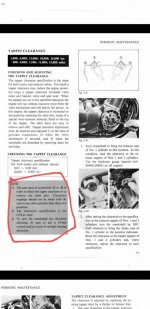
To be fair it specifies in a note in the FSM (for the GS1000 anyway) that the cam can be in either position to check. But then goes on to outline the procedure outlined earlier in this thread.

20180830_081223.jpg
 
To be fair it specifies in a note in the FSM (for the GS1000 anyway) that the cam can be in either position to check. But then goes on to outline the procedure outlined earlier in this thread.

View attachment 56113

In either case both adjacent valves will be on the base circle, which is the critical detail to assure the cams are properly positioned. If the adjacent valve is depressed the spring will push up on the cam and skew it in the journal clearance, thus affecting the clearance values.
 
In either case both adjacent valves will be on the base circle, which is the critical detail to assure the cams are properly positioned. If the adjacent valve is depressed the spring will push up on the cam and skew it in the journal clearance, thus affecting the clearance values.
Just wondering, has anyone actually put a dial gauge on the cams and measured any cam deflection in these so called "bad" positions?
 
Just wondering, has anyone actually put a dial gauge on the cams and measured any cam deflection in these so called "bad" positions?

I did do an experiment measuring valve lash with feeler gauges after positioning the cams using both methods, and the "point the cam away" method resulted in about .02-.04 mm extra clearance.
 
That's not in the manual. But makes sense and should be in the manual, I think.
Well, it's <sort of> in the manual. :-k
They DO tell you how to position the cam lobes, they just don't detail why to position them that way.


I did do an experiment measuring valve lash with feeler gauges after positioning the cams using both methods, and the "point the cam away" method resulted in about .02-.04 mm extra clearance.
The important thing to remember there is that you might see a clearance of 0.04mm and think "great, almost the middle of the range", when you are reading that 'extra' clearance and you really have NONE.

There is also no way to tell if you need to add the 0.02 or 0.04, so why not just position them correctly and trust the numbers you read?

There is another advantage of positioning them according to the manual. :-k
You only need to move the crank FOUR times. Once to set the position for the first two, then three more times for the next three pairs. Putting the lobe "up" for each valve will require you to move the crank EIGHT times.

Since I am basically lazy, I'll continue to do it the correct way. :encouragement:

.
 
Just my recent experience

Just my recent experience

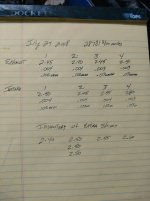
I just did mine about 3 weeks ago -
Below you can see the results of the adjustments I made -
With the tolerances all near the 'bigger' end I have noticed NO change in running or performance
I have heard it sounds just a little different -- a bit more noise -- like a loud sewing machine (once you can hear beyond the exhaust note)
I AM chasing an exhaust leak right now and expect that to help quite a bit in quelling the noises -
 

Attachments

  • IMG_20180726_222037447.jpg
    IMG_20180726_222037447.jpg
    86.8 KB · Views: 0
All valve clearances around 0.075mm. So well within spec. Sounds great. Next main job is the clutch slip.
 
Back
Top