• Required reading for all forum users!!!

    Welcome!
    Register to access the full functionality of the GSResources forum. Until you register and activate your account you will not have full forum access, nor will you be able to post or reply to messages.

    A note to new registrants...
    All new forum registrations must be activated via email before you have full access to the forum.

    A Special Note about Email accounts!
    DO NOT SIGN UP USING hotmail, outlook, gmx, sbcglobal, att, bellsouth or email.com. They delete our forum signup emails.

    A note to old forum members...
    I receive numerous requests from people who can no longer log in because their accounts were deleted. As mentioned in the forum FAQ, user accounts are deleted if you haven't logged in for the past 6 months. If you can't log in, then create a new forum account. If you don't get an error message, then check your email account for an activation message. If you get a message stating that the email address is already in use, then your account still exists so follow the instructions in the forum FAQ for resetting your password.

    Have you forgotten your password or have a new email address? Then read the forum FAQ for details on how to reset it.

    Any email requests for "can't log in anymore" problems or "lost my password" problems will be deleted. Read the forum FAQ and follow the instructions there - that's what we have one for...

  • Returning Visitors

    If you are a returning visitor who never received your confirmation email, then odds are your email provider is blockinig emails from our server. The only thing that can be done to get around this is you will have to try creating another forum account using an email address from another domain.

    If you are a returning visitor to the forum and can't log in using your old forum name and password but used to be able to then chances are your account is deleted. Purges of the databases are done regularly. You will have to create a new forum account and you should be all set.

GSX750ES 1985 : Front fork (new) stanchions planarization

  • Thread starter Thread starter dpascal
  • Start date Start date
D

dpascal

Guest
As part of my nuts and bolts restoration I had the front fork stanchions replaced by a pro.
When I was done with installing the front fork, using an elongated glass, I checked front fork stanchions planarization.
There was a serious amount of free play, meaning the stanchions are not exactly parallel.
I then loosened the 4 bolts of the lower yoke and the 4 bolts of the front wheel axis clamps.
When holding the front wheel firmly using my legs, I turned the handlebar and indeed, the amount of free play of the glass dropped dramatically. However ! I was not able to reduce the free play to zero.
Does this mean that something is bent ? Yokes ? The new stanchions ?
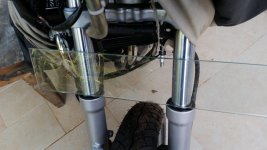
DSC_2668.jpg
 
OMG thats one serious amount of big words. Please tell us what you mean. and why you take your forks to a pro. one of the most simple things to rebuild. and u could have used that glass to roll the tubes over it to check how straight they where.
 
sharpy,
I use this wonderful forum for 5 years now and I love its professional attitude and professional members. I would appreciate it if you can use a less puffed-up attitude.
 
Last edited:
Just that ive re-read ure post a few times and still cant work out what u talking about. And looking what planarization is, im sure most wont know what it means or relates to forks. But im not a expert
 
I'm with Sharpy here - can you please tell us what you mean? I just looked up the word planarization as I had never heard of it and I cannot find it in the dictionary I have. Looking at Google, I see something on Wikipedia for drawing graphs from a planar to a non-planar nature and I see something else about chemical polishing.
 
English is not my native tongue so I assumed planarization is commonly used. I used it when working for the silicon industry. Basically it means that a surface is straight. It comes from the word plane.
I guess we have have an example where language barriers create miss communication. Sorry for the misunderstanding :-).
What I meant to say is that on each and every straight fork in which the stanchions are completely parallel, putting a piece of glass would stick to the stanchions without any free play.
This is not the case with my fork. I do manage to get things better by loosening lower yoke bolts + front wheel axis bolts and then twisting the handlebar while front wheel is held firmly between my legs.
However they are never completely parallel...
 
Thanks for explaining the term:

planarization: Chemical mechanical polishing/planarization is a process of smoothing surfaces with the combination of chemical and mechanical forces. It can be thought of as a hybrid of chemical etching and free abrasive polishing.

Looked that up and google led me to Wiki.

It's definitely not a term used here to test sanctions for complete parallel free play. Sometimes being a little too wordy creates an image of conceit...just an individual opinion but certainly nothing to get defensive about. Lesson learned.

So...back to your question...after reviewing your initial post, here is the question I believe you are looking for the answer:

"There was a serious amount of free play, meaning the stanchions are not exactly parallel."

What do you mean by "free play"? Is it wobbly? Or are the sanctions dipping too deep? It is interesting to read how you describe this scenario.


Ed
 
May I suggest also loosening the UPPER clamps? :-k

Be sure to support the front of the bike, though. If you loosen the upper and lower clamps at the same time, it's possible the bike will slide down the fork tubes.

By the way, another way to check without using a piece of glass is to hold two straight edges against the fork tubes. Place one as high as you can, near the upper clamp, place the other one as low as you can. Comparing the two edges will show if they are parallel or not.

By the way, your attached picture showed PERFECTLY what you were trying to do, even if you did use a word that is not in common use. And, based on your description, I made an educated guess, THEN looked at the picture for confirmation. :encouragement:

.
 
English is not my native tongue so I assumed planarization is commonly used. I used it when working for the silicon industry. Basically it means that a surface is straight. It comes from the word plane.
I guess we have have an example where language barriers create miss communication. Sorry for the misunderstanding :-).
What I meant to say is that on each and every straight fork in which the stanchions are completely parallel, putting a piece of glass would stick to the stanchions without any free play.
This is not the case with my fork. I do manage to get things better by loosening lower yoke bolts + front wheel axis bolts and then twisting the handlebar while front wheel is held firmly between my legs.
However they are never completely parallel...

Nothing wrong with your description. The one unfamiliar word taken in context does not affect the clarity of the rest of your post—and the picture confirmed the description. The glass is a good tool for this ��.

Come to think of it, I’m not sure what the best word would be to describe the geometric relationship between two things that are meant to be in the same plane. So an “A” for effort there.
 
Last edited:
Nothing wrong with your description. The one unfamiliar word taken in context does not affect the clarity of the rest of your post?and the picture confirmed the description. The glass is a good tool for this 👍.

Come to think of it, I?m not sure what the best word would be to describe the geometric relationship between two things that are meant to be in the same plane. So an ?A? for effort there.
Thanks!
In any case, here is a video ...
https://youtu.be/sACu3IjCw2o
 
That video may suggest ure tubes and/or the triple clamps are bent. With just the forks in the bike. sighting side one if there bent you should see the difference along the length.
 
Thanks!
In any case, here is a video ...
https://youtu.be/sACu3IjCw2o

That is challenging to describe...and much better viewed. You would think aligning the upper and lower triples and then bolting the lower tubes to the wheel would line up with no problems.

I'm gonna convert my single front disc "T" to dual disc and knowing this example to test "planarization" (as well as Steve's suggestion) are good to know.

What sort of "steering feel" do you get from the misalignment? I hope I don't run into any problems when I do my conversion.

Thanks for uploading the video...it really helps explain what some of us couldn't picture in our heads.


Ed
 
That is challenging to describe...and much better viewed. You would think aligning the upper and lower triples and then bolting the lower tubes to the wheel would line up with no problems.

I'm gonna convert my single front disc "T" to dual disc and knowing this example to test "planarization" (as well as Steve's suggestion) are good to know.

What sort of "steering feel" do you get from the misalignment? I hope I don't run into any problems when I do my conversion.

Thanks for uploading the video...it really helps explain what some of us couldn't picture in our heads.


Ed
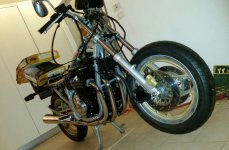
I just put the motor in the rolling chassis after a 4 year nuts and bolts restoration. The bike is not on the road yet due to a bad CDI.
 
Can i just say its a engine. A motor is what starts it and a motor is whats in ure washing machine. OMG and i wonder why i have no friends lol
 
Can i just say its a engine. A motor is what starts it and a motor is whats in ure washing machine. OMG and i wonder why i have no friends lol
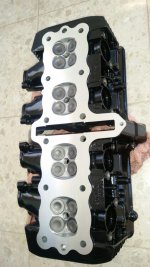
I made sure that engine head bottom surface will receive a thorough planarization :D
Seriously... I will try the various fork tips offered here and update ...

IMG-20161203-WA0010.jpg
 
To check if the forks are straight you will need to lift the front end off the ground:

Take off the front wheel leaving the forks in the triple clamps. Now loosen the clamp bolts on one fork and turn the stanchion in the clamps whilst holding the fork lower still. If the fork is bent you will see the fork lower move back and forth when you turn the stanchion.
 
To check if the forks are straight you will need to lift the front end off the ground:

Take off the front wheel leaving the forks in the triple clamps. Now loosen the clamp bolts on one fork and turn the stanchion in the clamps whilst holding the fork lower still. If the fork is bent you will see the fork lower move back and forth when you turn the stanchion.

MOAR helpful instruction! Thanks!!!


Ed
 
Following the tips here I loosened the bolts of the upper yoke as well. Since I powder-coated the yoaks, the stanchions do not fall down on the floor yet they have enough freedom to swivel.
So now the bolts on both yokes and the bolts of the wheel axis clamps are loose.
I put 2 packs of dog food on the rear of the bike so the front wheel can come up.
When holding the wheel between my legs and turning the handlebar I am now able to pass the glass test with 100% accuracy. The stanchions are perfectly parallel (below the lower yoke and even between the yokes).
At this point I conclude that there is nothing wrong with the stanchions.
So far the good news. The bad news are that if I strengthen the bolts of any of the yokes, the stanchions loose planarization ~severe coughing~
Are the yokes bent ? Am I doing something wrong ?

20171121_164743-1.jpg
 
You may have some uneven buildup from your powder coating. I would sand the inside of the holes in the yokes down to bare metal and try again.
 
You may have some uneven buildup from your powder coating. I would sand the inside of the holes in the yokes down to bare metal and try again.
That's a good point. At first the powder coating didn't allow the stanchions to fit in so I had to remove a millimeter down to bear metal using a flap wheel drill bit. It was a drill bit that fit in the hole but very tightly and this way I (hope I) achieved relative accuracy.
Nevertheless, there is a chance that the holes of the upper yoke are not exactly in the same center-line of the relevant holes below them. Just a theory ...
 
Last edited:
Back
Top