• Required reading for all forum users!!!

    Welcome!
    Register to access the full functionality of the GSResources forum. Until you register and activate your account you will not have full forum access, nor will you be able to post or reply to messages.

    A note to new registrants...
    All new forum registrations must be activated via email before you have full access to the forum.

    A Special Note about Email accounts!
    DO NOT SIGN UP USING hotmail, outlook, gmx, sbcglobal, att, bellsouth or email.com. They delete our forum signup emails.

    A note to old forum members...
    I receive numerous requests from people who can no longer log in because their accounts were deleted. As mentioned in the forum FAQ, user accounts are deleted if you haven't logged in for the past 6 months. If you can't log in, then create a new forum account. If you don't get an error message, then check your email account for an activation message. If you get a message stating that the email address is already in use, then your account still exists so follow the instructions in the forum FAQ for resetting your password.

    Have you forgotten your password or have a new email address? Then read the forum FAQ for details on how to reset it.

    Any email requests for "can't log in anymore" problems or "lost my password" problems will be deleted. Read the forum FAQ and follow the instructions there - that's what we have one for...

  • Returning Visitors

    If you are a returning visitor who never received your confirmation email, then odds are your email provider is blockinig emails from our server. The only thing that can be done to get around this is you will have to try creating another forum account using an email address from another domain.

    If you are a returning visitor to the forum and can't log in using your old forum name and password but used to be able to then chances are your account is deleted. Purges of the databases are done regularly. You will have to create a new forum account and you should be all set.

Headlight Modulator Question

  • Thread starter Thread starter bakalorz
  • Start date Start date
B

bakalorz

Guest
I've built a headlight modulator, and it works well.

I'm trying to figure out how to set the adjustment determining at which level of ambient light it stops modulating and sets the high beam to constant on.

The regulation says
(f) The system shall include a sensor mounted with the axis of its
sensing element perpendicular to a horizontal plane. Headlamp modulation
shall cease whenever the level of light emitted by a tungsten filament
light operating at 3000[deg] Kelvin is either less than 270 lux (25
foot-candles) of direct light for upward pointing sensors or less than
60 lux (5.6 foot-candles) of reflected light for downward pointing
sensors. The light is measured by a silicon cell type light meter that
is located at the sensor and pointing in the same direction as the
sensor. A Kodak Gray Card (Kodak R-27) is placed at ground level to
simulate the road surface in testing downward pointing sensors.

Since I have no real way to measure 270 lux, I'm wondering what that corresponds to in real-world brightness.
So for those of you who have modulators, at what darkness level do they stop modulating.

Does it stop an hour before sunset, just before sunset, a bit after sunset, half an hour after sunset, an hour later or something else.

Does it still modulate if its cloudy out.

If you sit under a short underpass does it stop, or only a long tunnel.

does it modulate sitting inside your garage on a sunny day, how about cloudy.

Thanks in advance for any responses.
 
I've built a headlight modulator, and it works well.

I'm trying to figure out how to set the adjustment determining at which level of ambient light it stops modulating and sets the high beam to constant on.

The regulation says


Since I have no real way to measure 270 lux, I'm wondering what that corresponds to in real-world brightness.
So for those of you who have modulators, at what darkness level do they stop modulating.

Does it stop an hour before sunset, just before sunset, a bit after sunset, half an hour after sunset, an hour later or something else.

Does it still modulate if its cloudy out.

If you sit under a short underpass does it stop, or only a long tunnel.

does it modulate sitting inside your garage on a sunny day, how about cloudy.

Thanks in advance for any responses.

OK, one at a time.

I live near the 40-degree parallel. This past week I left the house at 7, and the headlight did not modulate. By 7:30 it was modulating. So, just before sunrise it doesn't; at sunrise it does. Reverse it for evening.

It modulates when it's cloudy. Thursday evening it was cloudy when I left work at about 4:30, and it modulated. Still modulating at 5 or so, still cloudy.

Under a short underpass it continues to modulate. A tunnel such as the ones on the Blue Ridge Parkway in North Carolina makes it stop modulating, then re-starts right away, within a second of daylight.

Sitting in the garage it does not modulate. I have to shine a flashlight directly at the light switch to make it modulate. Sunny or cloudy day, it does not modulate inside the garage, even with the door open. As I back it out of the garage, it begins to modulate halfway out.

I hope I was able to answer your questions. Enjoy the modulator. The last time I rode to work, Thursday of this week, three slowpokes moved out of the way for me to pass. :-D
 
The one I am getting only modulates the high beam, and will stay steady state if you switch to low beam.
You may want to consider that for yours as well.


Sent from my iPhone
 
What'd your homebuilt unit cost you to make, Martin? I know you like to "roll your own," but assuming a cost savings was it enough for the average person to justify doing it yourself or does it make more sense to buy a commercial unit?

Regards,
 
OK, one at a time.

I live near the 40-degree parallel. This past week I left the house at 7, and the headlight did not modulate. By 7:30 it was modulating. So, just before sunrise it doesn't; at sunrise it does. Reverse it for evening.

It modulates when it's cloudy. Thursday evening it was cloudy when I left work at about 4:30, and it modulated. Still modulating at 5 or so, still cloudy.

Under a short underpass it continues to modulate. A tunnel such as the ones on the Blue Ridge Parkway in North Carolina makes it stop modulating, then re-starts right away, within a second of daylight.

Sitting in the garage it does not modulate. I have to shine a flashlight directly at the light switch to make it modulate. Sunny or cloudy day, it does not modulate inside the garage, even with the door open. As I back it out of the garage, it begins to modulate halfway out.

I hope I was able to answer your questions. Enjoy the modulator. The last time I rode to work, Thursday of this week, three slowpokes moved out of the way for me to pass. :-D


That was exactly what I was looking for.:-D

Could you maybe give me your zipcode, and I will plug it into weather.com and see what they say the sunrise and sunset times are where you are.
(trying to do it via lattitude on the web was frustrating)

Although I am primarily doing it for safety's sake, the "moving of slowpokes" is definately a benefit I am looking forward to also. \\:D/
 
What'd your homebuilt unit cost you to make, Martin? I know you like to "roll your own," but assuming a cost savings was it enough for the average person to justify doing it yourself or does it make more sense to buy a commercial unit?

Regards,


I got my microproccessors as free samples from microchip.com, but they are all of 2.25 each from digikey otherwise (pic12F683). The rest of it is:
regulator $0.50
CDs photodetector cell $0.78
P channel mosfets $0.59 each

At an ambient of 70 deg C the mosfets are good to 5.4 amps each, which is 65 watts at 12 volts ...
So one would theoretically just handle the stock light, two would let me handle a 100+ watt headlight, or three would give me a decent factor of safety even if I did a big headlight ... at < 60 cents each, I'll probably splurge and use 3 or 4 for the stock light.

So the grand total is around $6 for the electronics.
Add in connectors, housing, wire, etc.
Maybe $10 total
In the end, shipping is probably more than the parts cost.

I was actually shocked how much the commercial ones run when I was looking stuff up while designing it. There REALLY isn't much in there, and they charge an arm and a leg ...
Based on what I could find out, its not likely they are much, if anything, different from mine ...


Building it is almost trivial, the only hard parts are programming the micro and etching and soldering since the final will be surface mount components. (the current test version is on solderless breadboard)

If anyone wants source code, I'll post it.

If anyone wants preprogramed pics, I'd do that, but unless there are a bunch, the $/pic will be high because of digikeys shipping and minimum order policies.
 
I have two modulators here that are in use about every day. Both are make by Kisan, but the one on my Wing has adjustable sensitivity, the one on the 850 does not. In the less-sensitive mode, the Wing and the 850 have about the same response to light, and are pretty close to what Grandpa related. In the more-sensitive mode, I can extend operation about another half an hour earlier in the morning or later in the evening, but I find that with the lower light conditions, the modulator is just about too much. I think this is due to the modulation intensity. The standard requires the headlight to be at full brightness for 50-70% of the time. I have never meausred it on an oscilloscope, but mine looks like it's toward the 50% end of the scale. The modulator on the 850 looks closer to the 70% because it does not seem to pulse as deeply. In general, I prefer to rum mine in the more-sensitive mode during the day. This minimized the times it stops working when going under a bridge, although tunnels still make it stop. As it starts getting darker in the evening, I will either switch to the less-sensitive mode or just run low beams, which turns the modulator off. At that time, I will also turn on the switch to enable my Tulsa driving lights to come one with the high beam. THAT is a wall of light I would not want coming at me in the dark.

Martin, I commend you for building one for your self, and even asking about the sensitivity adjustment. \\:D/
Have you also met the other operating parameters?
*Modulation rate: 240 +/-40 per minute
*Minimum intensity 17%
*Time at max intensity 50-70%
*Not to be installed in ground wire
*In case of unit failure, headlight must revert to normal operation

And, as Planecrazy asked, what did it cost you, and do you think the effort was worth it? :-s


.
 
I got my microproccessors as free samples from microchip.com, but they are all of 2.25 each from digikey otherwise (pic12F683). The rest of it is:
regulator $0.50
CDs photodetector cell $0.78
P channel mosfets $0.59 each

At an ambient of 70 deg C the mosfets are good to 5.4 amps each, which is 65 watts at 12 volts ...
So one would theoretically just handle the stock light, two would let me handle a 100+ watt headlight, or three would give me a decent factor of safety even if I did a big headlight ... at < 60 cents each, I'll probably splurge and use 3 or 4 for the stock light.

So the grand total is around $6 for the electronics.
Add in connectors, housing, wire, etc.
Maybe $10 total
In the end, shipping is probably more than the parts cost.

I was actually shocked how much the commercial ones run when I was looking stuff up while designing it. There REALLY isn't much in there, and they charge an arm and a leg ...
Based on what I could find out, its not likely they are much, if anything, different from mine ...


Building it is almost trivial, the only hard parts are programming the micro and etching and soldering since the final will be surface mount components. (the current test version is on solderless breadboard)

If anyone wants source code, I'll post it.

If anyone wants preprogramed pics, I'd do that, but unless there are a bunch, the $/pic will be high because of digikeys shipping and minimum order policies.

Thanks for the heads-up, Buddy! So the next logical question is: If commercial units are so expensive by comparison, what would you charge to throw together a bunch of these for your GS brethren? I'd be interested in letting you do the work and charge a little premium for the effort, and I suspect others would too.

Regards,
 
That was exactly what I was looking for.:-D

Could you maybe give me your zip code, and I will plug it into weather.com and see what they say the sunrise and sunset times are where you are.
(trying to do it via latitude on the web was frustrating)

Although I am primarily doing it for safety's sake, the "moving of slowpokes" is definitely a benefit I am looking forward to also. \\:D/

21769.

I got my Kisan on eBay for what I thought at the time was a bargain. I was the only bidder, and won the auction by default.

Your projected price on the do-your-own is terrific. Hope everything works for you and that others can take advantage of your expertise.
 
I have two modulators here that are in use about every day. Both are make by Kisan, but the one on my Wing has adjustable sensitivity, the one on the 850 does not. In the less-sensitive mode, the Wing and the 850 have about the same response to light, and are pretty close to what Grandpa related. In the more-sensitive mode, I can extend operation about another half an hour earlier in the morning or later in the evening, but I find that with the lower light conditions, the modulator is just about too much. I think this is due to the modulation intensity. The standard requires the headlight to be at full brightness for 50-70% of the time. I have never meausred it on an oscilloscope, but mine looks like it's toward the 50% end of the scale. The modulator on the 850 looks closer to the 70% because it does not seem to pulse as deeply. In general, I prefer to rum mine in the more-sensitive mode during the day. This minimized the times it stops working when going under a bridge, although tunnels still make it stop. As it starts getting darker in the evening, I will either switch to the less-sensitive mode or just run low beams, which turns the modulator off. At that time, I will also turn on the switch to enable my Tulsa driving lights to come one with the high beam. THAT is a wall of light I would not want coming at me in the dark.

This is on the Wing I take it ... are there any driving lights worth putting on GSes, or the anemic stators rule that out ...

Martin, I commend you for building one for your self, and even asking about the sensitivity adjustment.
Have you also met the other operating parameters?
*Modulation rate: 240 +/-40 per minute
*Minimum intensity 17%
*Time at max intensity 50-70%
Those are all adjusted via software, and easy to meet.
I put the min at 18 or 19 % just to leave some leeway (like anyone would know ...)

Time at max is 66% (this makes adjusting the timing loops easy ... run through the same loop twice on high, then once on low, adjust the loop untill the total is .25 sec ...)

Modulation rate is right at 240 +/- less than 1%

If I get motivated I may play with the Modulation rate and time at max, and take them to the legal limits at each end just to see if it makes the lights more noticable ... or I'll get lazy and say good enough.

*Not to be installed in ground wire

$%^&* nanny state government ...

I can see why that would be good for commercial units (maybe)
It makes it a bit more obvious how to hook it in, it prevents a failure from taking out both lights (but a simple SPST switch in parallel would fix that)
and defaults the system to only modulating either high or low beam.

But it sucks for a couple of reasons.
N-channel fets are MUCH better than P-channel, (100+ amps versus 5 amps) and all the reasonable P-channel ones are surface mount ...

also, switching the low side would let me easily add two features.
1) automatically modulate either headlight, day or night, any time I press the horn button ... technically illegal, but worth it if it keeps some asleep at the wheel moron from violating my right of way
2) reduce the high voltage to both lights if the unit detects overvoltage
(i.e. keeps the lights from burning out in case of R/R failure)

Right now its legal, but I am considering changing it so I can add those features (oh the horrors ... I'm such a rebel)

*In case of unit failure, headlight must revert to normal operation
And WTH does this mean anyway ...

I set things up so that if the microprocesser locks up it should fail gracefully, and Kisan states somewhere that if their fets fail they fail shorted (which keeps light on) so if mine do that it will fail on, but I haven't blown any out intentionally to see what happens, and doubt I will bother.

Paralleling the whole unit with a plain old switch would allow recovery from ANY failure, but I doubt I will go that far, just because I consider it unlikely enough to happen, and even if it does there is still the low beam.
Not that I ride at night if I can help it (PA, land of the killer bambi)

And, as Planecrazy asked, what did it cost you, and do you think the effort was worth it?

$$$ wise, it was only 6 or 7 dollars for the extra components to make 2 of them (my PICs were free samples from microchip)

Timewise, it was quite a few lunch hours that I didn't surf the net ...
This was my first PIC project, so I had to build the programmer, learn assembly, learn how to work with PICs etc. So it took a while ...

Most people start to learn to program microproccessors by writing a program to make an LED blink ...
Just think of the headlight as a REALLY REALLY BIG LED. \\:D/
 
Thanks for the heads-up, Buddy! So the next logical question is: If commercial units are so expensive by comparison, what would you charge to throw together a bunch of these for your GS brethren? I'd be interested in letting you do the work and charge a little premium for the effort, and I suspect others would too.

Regards,

I'll help anyone that wants to build their own, and even program PICs for people.

I don't know about providing pre built units ...
If there is a LOT of demand I'd consider it, but I consider it unlikely there will be that much.

Mine will probably end up in a dental floss box or something, maybe even just wrapped in duct tape as insulation ... I suspect if people paid good money for theirs, they might want a more polished enclosure ...:oops:

Then there is the issue of liability ...
Electronics is a hobby for me; I'm good at it, but I'm not a professional.
I don't expect problems, but this is a basically untested unit. If mine fails, I'll go home and fix it.
If I sell them, and there are unexpected design problems, that would not be so good.
If I were making a thousand of them, I could afford to intentionally blow up a few, to see how and why they fail and what happens. If I make 10 or 20, its not really worth the money or time to test them that rigorously.

OTOH, if there are lots of you that want me to build you a modulator out there, speak up now, and lets see what the actual demand is ...
 
I'd like to build a few myself, but much to lazy to do all the thinking.
Can you send any drawings or schematics?
Thanks,'
Tom
 
Thanks for the reply on the design specs. It sounds like you have a good working unit there. It appears to be well-enough within the standard that you will likely never be questioned about it, but it would still be good to carry a copy of the standard for the officer's education if you should ever be stopped for your "blinking" or "flashing" headlight. I carry several copies in my bike, but have never been stopped or asked about the modulator in six years of use. 8-[

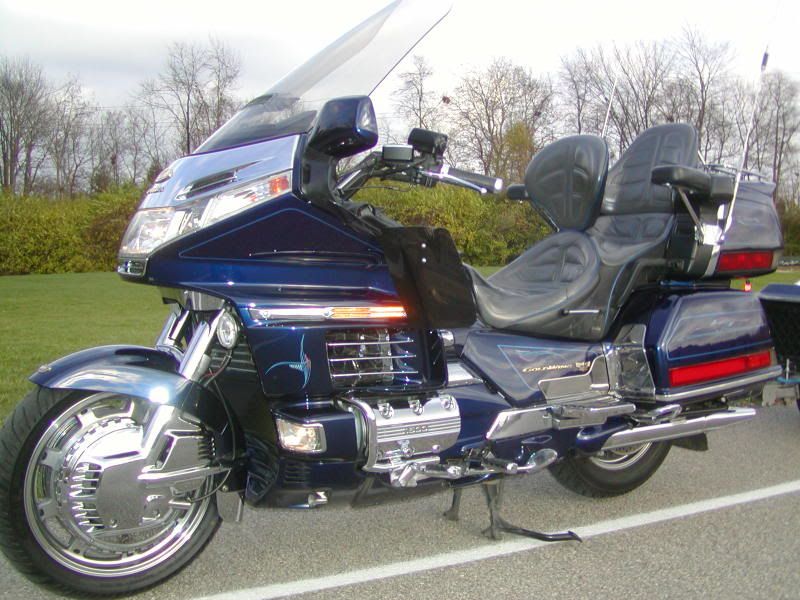
You commented on my comment about driving lights. Yes, they are on the Wing. Not sure if I would trust them on a GS, at least not unless there is a voltmeter on the GS. The stock Wing alternator (not a stator and rectifier arrangement) has a rather 'anemic' 42-amp output. Yes, that's over twice what a GS puts out, but let's face it, a Wing has a lot more lights to power. The previous owner had problems with his alternator and saw fit to replace it with a common unit for Wings. It costs a bit more than a stock unit, but has an output of 90 amps. \\:D/ Yes, it even charges at 800 rpm idle, with the brakes on, the high beams on, and the driving lights turned on.

PB134226.jpg


.
 
I'm definitely interested in the source code and schematics.

Are you using the watchdog timer? It would be a good idea, especially since you coded it in assembly, as it is REALLY easy to forget to set the code page bits before a jump and end up in no man's land. That way if you ever crash the PIC it will just reset itself and start right at the beginning :)

Oh and I love the idea of modulating when you honk!
 
Just think of the headlight as a REALLY REALLY BIG LED. \\:D/

Somewhat unrelated, but I wonder when we're going to start seeing headlights that really are REALLY REALLY BIG LEDs?

Less power consumption, less heat, and greater reliability would make me very happy, but I suspect LED headlights will be hellishly expensive if they ever arrive. Glowing filaments are pretty well understood technology and hard to beat...
 
Somewhat unrelated, but I wonder when we're going to start seeing headlights that really are REALLY REALLY BIG LEDs?

Less power consumption, less heat, and greater reliability would make me very happy, but I suspect LED headlights will be hellishly expensive if they ever arrive. Glowing filaments are pretty well understood technology and hard to beat...
untitled.jpg


http://www.treehugger.com/files/2006/10/led_headlights.php

LED-based headlights have appeared on the new car scene: the Audi R8 and Lexus LS will be the first vehicles to be using LED headlights. The benefits of LED headlights are lower power consumption, durability and significantly more flexible packaging. However, it does appear that heat build up within LEDs are a big issue, as are the fact that the LEDs need to deal with the heat from the engine compartment. See this post from Wheel Talk for a detailed examination of the new headlights.
 
Have you also met the other operating parameters?
*Modulation rate: 240 +/-40 per minute
*Minimum intensity 17%
*Time at max intensity 50-70%
*Not to be installed in ground wire
*In case of unit failure, headlight must revert to normal operation

Those are all adjusted via software, and easy to meet.
I put the min at 18 or 19 % just to leave some leeway (like anyone would know ...)

Time at max is 66% (this makes adjusting the timing loops easy ... run through the same loop twice on high, then once on low, adjust the loop untill the total is .25 sec ...)

Modulation rate is right at 240 +/- less than 1%

If I get motivated I may play with the Modulation rate and time at max, and take them to the legal limits at each end just to see if it makes the lights more noticable ... or I'll get lazy and say good enough.

I got motivated, and set it up so that modulation rate can be:
201/min, 240/min, or 279/min; selectable via jumpers or a switch. The default is 240

The "Time at max intensity" can be selected as either 50% or 67%, again selected via presence or absence of a jumper.

I am asking for those of you who want to build one to pick which one (50% or 67%) you would want as the default.

Reply to the thread, or private MSG me.

Vote early and vote often ... \\:D/
 
If you are going to offer a choice, with one of them as the default, use 50% as the default.
The "blinking" effect will be more pronounced, and that is what you are looking for. :shock:


.
 
Vote early and vote often ... \\:D/
If you are going to offer a choice, with one of them as the default, use 50% as the default.
The "blinking" effect will be more pronounced, and that is what you are looking for. :shock:


.
 
Back
Top