• Required reading for all forum users!!!

    Welcome!
    Register to access the full functionality of the GSResources forum. Until you register and activate your account you will not have full forum access, nor will you be able to post or reply to messages.

    A note to new registrants...
    All new forum registrations must be activated via email before you have full access to the forum.

    A Special Note about Email accounts!
    DO NOT SIGN UP USING hotmail, outlook, gmx, sbcglobal, att, bellsouth or email.com. They delete our forum signup emails.

    A note to old forum members...
    I receive numerous requests from people who can no longer log in because their accounts were deleted. As mentioned in the forum FAQ, user accounts are deleted if you haven't logged in for the past 6 months. If you can't log in, then create a new forum account. If you don't get an error message, then check your email account for an activation message. If you get a message stating that the email address is already in use, then your account still exists so follow the instructions in the forum FAQ for resetting your password.

    Have you forgotten your password or have a new email address? Then read the forum FAQ for details on how to reset it.

    Any email requests for "can't log in anymore" problems or "lost my password" problems will be deleted. Read the forum FAQ and follow the instructions there - that's what we have one for...

  • Returning Visitors

    If you are a returning visitor who never received your confirmation email, then odds are your email provider is blockinig emails from our server. The only thing that can be done to get around this is you will have to try creating another forum account using an email address from another domain.

    If you are a returning visitor to the forum and can't log in using your old forum name and password but used to be able to then chances are your account is deleted. Purges of the databases are done regularly. You will have to create a new forum account and you should be all set.

Is this the real thing (SH775)?

  • Thread starter Thread starter mnferwerda
  • Start date Start date
Can't say for sure without seeing the printing on the other end but the casting looks WAY too rough and the original doesn't have the mold marks near the bolt holes.. The real SH775AA is the Sea-Doo equivalent, AFAIK it is the same part as the SH775BA. Message the seller and ask if it is OEM....
Take a look at this for reference http://www.ebay.com/itm/Polaris-RZR...ash=item543f745d5b:g:ungAAOSwB09YPcUo&vxp=mtr
 
Last edited:
I agree, you really need to see the numbers on the other side.

Contact the seller for verification, that way you have something to fall back on in case you have to send it back.

.
 
I seriously doubt that is a real Shindengen SH775. The price has skyrocketed on the real deal parts so no way these guys come along and off them at that price.
 
Just get a used one. $37 shipped off ebay.

They are good robust units. No big concern with purchasing used Shindengen parts. There are lots of others too. search "polaris rzr regulator". Make sure there are photos showing the "sh775" lettering printed on the unit before purchase.
 
Just get a used one. $37 shipped off ebay.

They are good robust units. No big concern with purchasing used Shindengen parts. There are lots of others too. search "polaris rzr regulator". Make sure there are photos showing the "sh775" lettering printed on the unit before purchase.

Yep, I would buy that one as being real. People must crash a LOT of ATV's judging by the number available....
 
I've been looking at these too. Anyone know where to get the connectors for it? I've seen listing for the regulator and connectors but I have e feeling the regulators are knock offs
 
I've been looking at these too. Anyone know where to get the connectors for it? I've seen listing for the regulator and connectors but I have e feeling the regulators are knock offs

Triumph PN T2500676
 

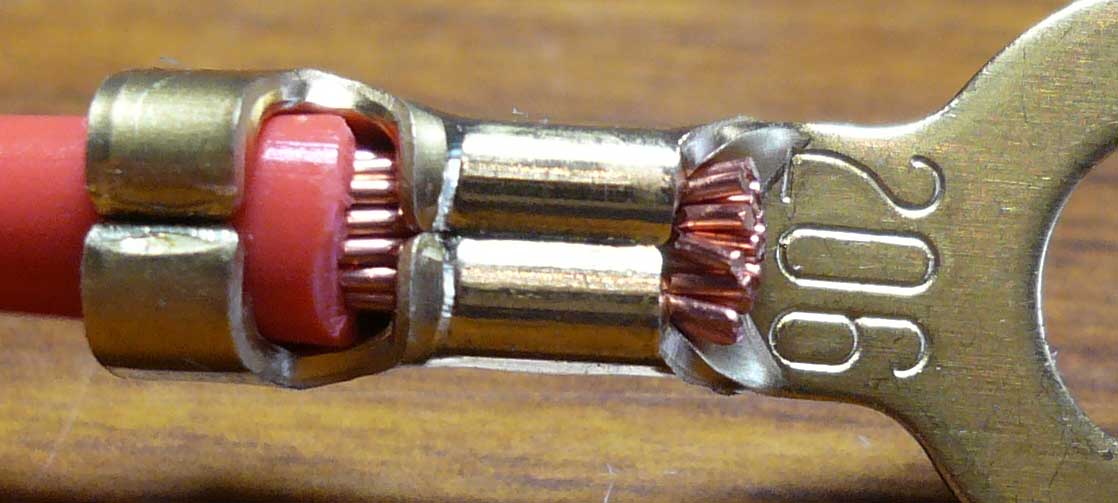
That will work, it's more money though. You need the type of crimping pliers that roll over the terminal tabs, not just crushes them flat.

This is what a good crimp looks like where the tabs are rolled over.

battery-ring-crimp.jpg
 
Yep, I would buy that one as being real. People must crash a LOT of ATV's judging by the number available....

Next year I am probably going to park my steady, reliable GS850G and part it on it's way. Never let me down one time in 4 years but it's worth a 1/3 to a 1/2 more in parts than it is sold as a titled running bike, it's very sad.

Anyways, from reliable sources, people/salvage yards are taking running ATV's & Quads and parting them down instead of reselling, same philosophy , true story.


That is a great picture; I'll supplement it with this link that is pretty descriptive of how a crimp can go wrong and what is good. There is also a section that I extracted below about soldering wire/contact crimps. The issue is, if you are not very good at crimping (e.g. incorrect tools/wire/crimp combination), then the "gas tight crimp" will leak, letting air/moisture in, and allowing corrosion to form(especially after several years in some environments) raising resistance in the electrcial circuits.

For most things this doesn't matter to much of you just spray your electrical contact every couple of years with something like DeOxit.
HOWEVER ON CHARGING SYSTEMS CONNECTIONS this is a whole other thing. Voltage drops can cause low charging voltages at the battery. Here even small 0.01 ohms resistance can cause a 0.1V drop when carrying 10 amps.

http://www.pinrepair.com/connect/

[SIZE=+2]Molex Connectors Explained,as used in Pinball.[/SIZE]
04/03/05 - by cfh@provide.net.
Information gathered from Molex.com, talking to Molex technical advisors, and [name removed by request] (an eight year automotive wiring industry Manufacturing Engineer, who worked for three years as supervisor of the wiring crimp die engineering department and four years as the Program Manager of a Vehicle Wiring Program for an automotive wiring company in Detroit). Most pictures by Molex.
Table of Contents.

  1. Connectors Explained (Introduction)
  2. When are Connectors Worn Out?
  3. Connector Tools & Parts Needed, and Where to Get Them
  4. How to Perform a Good Connector Crimp
  5. Should Connector Terminal Pins be Soldered?
  6. Converting Looped IDC Terminal Pins to Crimped Pins
  7. Removing Connector Terminal Pins

[SIZE=+1]5. Should Connector Terminal Pins be Soldered?[/SIZE]Some field repair people feel that after a 'good crimp' is performed on a new connector, the terminal pin should be soldered to the attaching wire. Maybe they are used to dealing with 'bad crimps' or feel they need the additional piece of mind. But is this the right thing to do?

The most common aspect of connector replacement in pinball is the GI (General Illumination) connectors. These fail the most, and require replacement most often. The generally accepted crimp-on .156" terminal pin to use for GI circuits is the trifurcon style terminal pin (i.e. Molex part# 08-52-0113, Digikey part# WM2313-ND). This terminal pin grabs the circuit board's header pin on three sides instead of just one. Though the current handling capability is not increased, the vibration resistance and durability of the pin goes up dramatically.

If a trifurcon pin is properly crimped, there is NO need to solder the connecting wire to the terminal pin. The only positive aspect of soldering a properly crimped terminal pin is the "wire pull out force" goes up. Current ratings do not go up with a soldered pin compared to a properly crimped-only pin (that information is directly from a Molex technical advisor who I talked with on the phone).

Now if there is a bad or improper crimp on a terminal pin, solder can increase the performance of a crimp. For example, a gas tight crimp is critical to long term performance. If there are voids between the wire strands or between the strands and the terminal because of a bad crimp, oxides can form (oxides are of higher resistance than the clean metals). Granted, in most applications the performance increase is negligible versus an unsoldered crimp, even a bad crimp. And the potential of doing "more harm than good" is very high when soldering a terminal pin (unless the user follows the terminal soldering method outlined below).

The risk of problems when soldering a terminal pin far out-weigh the benefit in most cases. For example, Adding solder to a terminal pin can get solder on the "locking tangs", making it unflexible. This in turn can ruin the connector housing, and make the pin nearly impossible to remove.

Soldering a terminal pin can also cause the terminal pin/wire insulation joint to fail. Or in the worse case, it can melt the insulation back beyond the pin, possibly causing a short. Also, in extreme situations, Iain documents the melted plastic insulator can wick down into the wiring, and cause the wire to become a sort-of capacitor. This can cause some difficult diagnostic problems!

Another problem with soldering terminal pins (as documented by Bobukcat) is having flux wick down and end up being left on the connector surface. This can interfere with connectivity to the header pin.

Lastly, though unlikely unless extreme heat is used, the plating on the terminal pins can be damaged by soldering.


Properly Soldering a Terminal Pin (if you must!)
With the potential problems of soldering a terminal pin known, some users may still want that additional "insurance".Or if a good crimp can not be performed (wrong tool or wire gauge?), soldering may be necessary to overcome the bad crimp. Molex reconizes that some user may not following their crimping directions, and may solder a terminal pin anyway. If this is the case, here is the ONLY terminal pin soldering technique Molex (relucantly) recommends. This information came from John Luthy, Molex's connector product division manager:
  • Before crimping the terminal pin, tin the end of the bare wire with some solder (best method is to dip the wire end into a hot solder pot).
  • Crimp the terminal properly (see the notes above!) using a good quality hand crimper (Molex WHT-1921 part# 11-01-0015, Molex part# 63811-1000, or Amp 725).
  • After the wire is properly crimped, using a temperature controlled soldering station (750 degree maximum), heat the terminal pin momentarily, right where the tinned wire is crimped in the terminal pin. The tinned wire's solder should heat and reflow, spreading to the terminal pin. Do NOT add any additional solder!
Talking to Molex representatives, they really discourage any terminal pin soldering (a good crimp does not require soldering!) But if it is done, the above steps are the technique to use.
 
Last edited:
Solder also wicks up the strands and makes the wire inflexible and can cause it to break under the insulation, the hotter the joint the further it will flow.
 
Solder also wicks up the strands and makes the wire inflexible and can cause it to break under the insulation, the hotter the joint the further it will flow.

That is the primary reason for NOT suggesting soldering.
 
Another tidbit that might help with a good, properly-crimped connection is a bit counter-intuitive.

Do NOT twist the bare wire ends before inserting into the connector.

That article talked about a "gas tight crimp", which would require that all the strands are straight and paralell. If you twist them, there WILL be spaces around the strands when they are gripped by the straight sides of the connectors.

.
 
Another tidbit that might help with a good, properly-crimped connection is a bit counter-intuitive.

Do NOT twist the bare wire ends before inserting into the connector.

That article talked about a "gas tight crimp", which would require that all the strands are straight and paralell. If you twist them, there WILL be spaces around the strands when they are gripped by the straight sides of the connectors.

.

If you consider out how many people here can do a gas tight crimp that will last more than 5 years in a moderately humid environment, you know why I suggest soldering.
 
Back
Top