• Required reading for all forum users!!!

    Welcome!
    Register to access the full functionality of the GSResources forum. Until you register and activate your account you will not have full forum access, nor will you be able to post or reply to messages.

    A note to new registrants...
    All new forum registrations must be activated via email before you have full access to the forum.

    A Special Note about Email accounts!
    DO NOT SIGN UP USING hotmail, outlook, gmx, sbcglobal, att, bellsouth or email.com. They delete our forum signup emails.

    A note to old forum members...
    I receive numerous requests from people who can no longer log in because their accounts were deleted. As mentioned in the forum FAQ, user accounts are deleted if you haven't logged in for the past 6 months. If you can't log in, then create a new forum account. If you don't get an error message, then check your email account for an activation message. If you get a message stating that the email address is already in use, then your account still exists so follow the instructions in the forum FAQ for resetting your password.

    Have you forgotten your password or have a new email address? Then read the forum FAQ for details on how to reset it.

    Any email requests for "can't log in anymore" problems or "lost my password" problems will be deleted. Read the forum FAQ and follow the instructions there - that's what we have one for...

  • Returning Visitors

    If you are a returning visitor who never received your confirmation email, then odds are your email provider is blockinig emails from our server. The only thing that can be done to get around this is you will have to try creating another forum account using an email address from another domain.

    If you are a returning visitor to the forum and can't log in using your old forum name and password but used to be able to then chances are your account is deleted. Purges of the databases are done regularly. You will have to create a new forum account and you should be all set.

Jet size differences

jdub6092

Forum Mentor
Super Site Supporter
My 81 gs650e BS32 carb lists the following standard jet sizes vs. those that I have installed:
Main jet - 97.5 -> 110
Pilot jet - 42.5 -> 42.5
Pilot air jet - 175 -> 160
I purchased a K& L kit, but if it will make a difference I will purchase some Mikuni jets. Where is the best store to purchase them?
What differences might I notice with my current arrangement? I see more fuel passing through the main and less air into the pilot jet.
 
No mods, had to replace a few when I first tore them down for cleaning. The 110s and 160s were what
was in the K&L kit.
I see that these were common on other 650 models.
 
I'd put the jetting back to stock. You can get proper Mikuni main jets at hundreds of sources, air jets, though, are going to be tough to find. The parts diagram suggest 175 is the proper size for the air jets. Did you save the originals?
 
The only way to really know how the jets/exhaust/air filters etc. are affecting the bike is to use the spark plug test. Buy 2 sets of plugs and a plug cleaner. Clean the plugs and run the bike on idle for 5 minutes. Remove the plugs and note the color. Golden brown on the center ceramic is ideal. No color means too lean. Black means rich. Adjust with the idle screws or change jets. Make sure the bike is warmed up and replace the plugs with clean ones. Start the bike and quickly get up to middle speed or about 80% of max. Shut off the bike, pull over and check the plugs using the same test used for in idle. Adjust by raising or lowering the needles. Put in another clean set in and quickly accelerate to the top 20% of speed. Again, shut off the bike and pull over. Inspect the color and adjust by changing the main jet size. You can also do this with a dyno tune machine if you have access to one.

Prior to doing these tests make sure that the timing is spot on and that valves are adjusted according to the service manual. Also make sure that the carbs are clean, synced and operating properly. These tests are the final tuning. This seems like allot of work but it is the only way to make sure that the bike is running at it peak.
 
Last edited:
I'd put the jetting back to stock. You can get proper Mikuni main jets at hundreds of sources, air jets, though, are going to be tough to find. The parts diagram suggest 175 is the proper size for the air jets. Did you save the originals?

I see exactly what you are saying. The Mikuni main jet is available, but I've only seen two places with old web site format that offer the air jets. I have a couple of the originals that survived removal after 30 years. Wondering if I could drill out the 160s to the proper size?
 
Last edited:
Found that my throttle/idle screw was stripped or the bracket thread is just too loose to hold it under spring tension. Maybe that's what has been causing hard starts?
 
Found that my throttle/idle screw was stripped or the bracket thread is just too loose to hold it under spring tension. Maybe that's what has been causing hard starts?

By throttle/idle screw I'm assuming you mean the central knob that sets the resting stop for the throttle shaft (i.e. sets idle speed)? If so, the knob just sets the idle speed and doesn't really affect ease of starting.

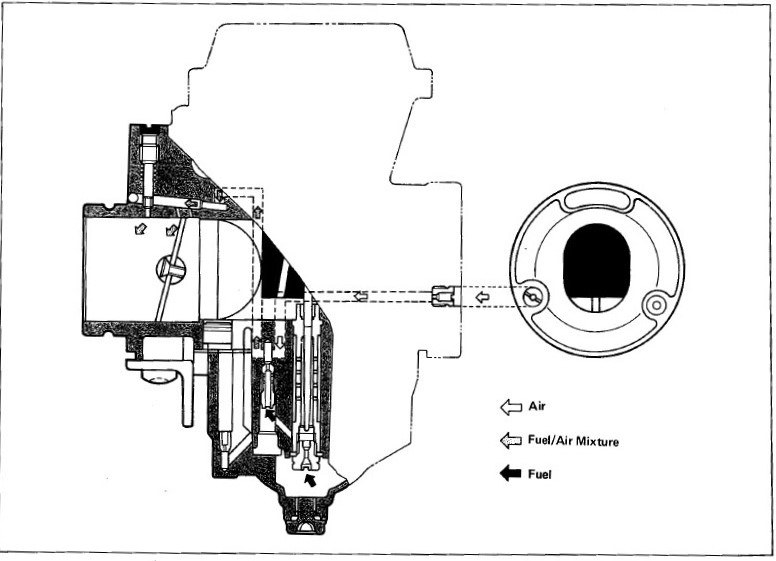
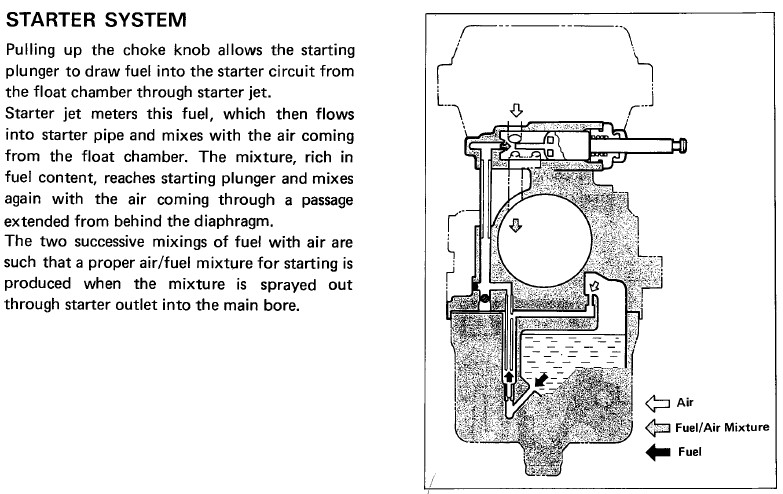
Properly jetted Mikunis don't start happily COLD without some use of the choke*. The 'choke' is actually a mini carburetor that shares a common casting with the main carb. It draws its fuel from the float bowl and its air either from the bell mouth inlet (sometimes the atmospheric space below the diaphragm in CV carbs). The choke plunger is the mini carb's slide and needle. It relies on the engine vacuum provided by a fully shut throttle to draw enough air though it to operate, so cracking open the throttle to cold start lowers the vacuum kills the chokes enrichment.

Cracking the throttle when HOT starting lets more air and fuel flow from the pilot AND by-pass orifices so the engine picks up revs immediately upon starting.

Is your problem hot, cold starting or both?


*rich pilot mixtures will allow cold starts without choke.
 
By throttle/idle screw I'm assuming you mean the central knob that sets the resting stop for the throttle shaft (i.e. sets idle speed)? If so, the knob just sets the idle speed and doesn't really affect ease of starting.

Properly jetted Mikunis don't start happily COLD without some use of the choke*. The 'choke' is actually a mini carburetor that shares a common casting with the main carb. It draws its fuel from the float bowl and its air either from the bell mouth inlet (sometimes the atmospheric space below the diaphragm in CV carbs). The choke plunger is the mini carb's slide and needle. It relies on the engine vacuum provided by a fully shut throttle to draw enough air though it to operate, so cracking open the throttle to cold start lowers the vacuum kills the chokes enrichment.

Cracking the throttle when HOT starting lets more air and fuel flow from the pilot AND by-pass orifices so the engine picks up revs immediately upon starting.

Is your problem hot, cold starting or both?


*rich pilot mixtures will allow cold starts without choke.

I am referring to the main idle knob. It slips under spring tension, so It wont open the butterflies and I am unable to bench sync the carbs, which do appear to be out of sync.

It had no problem starting warm. It was only cold start that was the problem and choke didn't help. Just one initial sputter then nothing. After several more minutes of cranking and minimal choke, it would eventually sputter and I had to use the throttle slowly to get it to hold revs. Adding a little more choke would kill it.

When I initially cleaned and rebuilt the carbs, I wasn't able to save all the seized jets, so I bought some K&L rebuild kits that were advertised as a fit for my bike. Turns out the jets in the kit are an exact match for the 650g and gl models and not the 650e that I have. Being pretty green at the time, I just replaced the jets.

Spec:/Previously installed/K&L current install
Main jet: 97.5/97.5/110
Pilot jet: 42.5/42.5/42.5. - At least this was correct
Pilot air jet: 175/170/160

I don't know how much the smaller air jet would affect starting.
 
I am referring to the main idle knob. It slips under spring tension, so It wont open the butterflies and I am unable to bench sync the carbs, which do appear to be out of sync.

It had no problem starting warm. It was only cold start that was the problem and choke didn't help. Just one initial sputter then nothing. After several more minutes of cranking and minimal choke, it would eventually sputter and I had to use the throttle slowly to get it to hold revs. Adding a little more choke would kill it.

When I initially cleaned and rebuilt the carbs, I wasn't able to save all the seized jets, so I bought some K&L rebuild kits that were advertised as a fit for my bike. Turns out the jets in the kit are an exact match for the 650g and gl models and not the 650e that I have. Being pretty green at the time, I just replaced the jets.

Spec:/Previously installed/K&L current install
Main jet: 97.5/97.5/110
Pilot jet: 42.5/42.5/42.5. - At least this was correct
Pilot air jet: 175/170/160

I don't know how much the smaller air jet would affect starting.

So the main jet is 5 sizes larger. Which is quite a bit richer, if the engine is stock with stock filter. This would be noticeable only at high rpm on a WFO throttle, say the last 2,000 - 2,500 rpm before redline. The twist grip controls the butterflies, but its volume of air passing underneath the slide at any given moment that lifts the slide up and that volume is dependent upon the butterfly position AND rpm, so the main jet isn't doing all the metering until a lot of air is being sucked through and the slide/needle is fully up. So that won't be affecting cold starting.

The pilot air jet /pilot circuit is separate from the cold start circuit, so doesn't directly affect the cold start circuit. The pilot air jet meters air to the pilot jet (fuel) which has air bleed holes on the sides of the pilot fuel jet and it is here that air is mixed with the fuel drawn up from the float bowl (via the main jet in the BS Mikuni as its isolated from bowl by the black plug). The AF ratio of the pilot mixture is set by the balance between the sizes of both jets. There are 3 or 4 outlets for this pre-set mixture -the pilot and by-pass orifices. Only the pilot orifice is affected by fuel screw (pilot screw) adjustment. The pilot orifice is the closest to the engine and is always on the engine side of the throttle butterfly. The fuel screw allows the pilot mixture to be trimmed to the air passing past the butterfly which is held just cracked at idle, by the main idle knob.


A smaller pilot air jet with the same pilot jet would be a richer mixture for the pilot circuit. Less air for the same fuel volume. Whether its significant or not, depends whether it makes any noticeable difference to how the bike runs at idle (and more importantly) just off idle when you are maneuvering at walking pace, slowly getting underway in 1st, or just starting to add throttle from closed exiting a corner. These are the times when incorrect pilot mixture causes glitches that intrudes into riding. It is mixture that you are hot starting on.

I have an 82 GS650GZ Katana and it has a 110 Main, 2.0 mm Main Air Jet, 42.5 Pilot, 160 Pilot Air Jet. And I do know the cam timing on the G was different to the E, with the Katanas at least having more top-end and less mid-range that the E. May be the different jetting is related to that?


The cold start circuit draws fuel through a brass tube that sits inside a passage in the casting of the float bowl. The fuel inlet to this tube is at the bottom of the float bowl. There is also a pressed-in non -removable fuel jet in the passage. These can get blocked with sediment and make the 'choke' inoperative. The bowl are often overlooked in cleaning. Aerosol carb cleaner should be able to easily pass through as a visual confirmation. Be careful not to shoot yourself in the eyes. Carb cleaner stings. The brass tube should also be able to pass carb cleaner up into where the choke plunger is located which should be removed or at least pulled open to prove the flow of cleaner.
 
Last edited:
The cold start circuit draws fuel through a brass tube that sits inside a passage in the casting of the float bowl. The fuel inlet to this tube is at the bottom of the float bowl. There is also a pressed-in non -removable fuel jet in the passage. These can get blocked with sediment and make the 'choke' inoperative. The bowl are often overlooked in cleaning. Aerosol carb cleaner should be able to easily pass through as a visual confirmation. Be careful not to shoot yourself in the eyes. Carb cleaner stings. The brass tube should also be able to pass carb cleaner up into where the choke plunger is located which should be removed or at least pulled open to prove the flow of cleaner.

Thanks for the detailed explanation of the various circuits. I tried to educate myself on these circuits and somehow came away with the idea that the pilot circuit played a role in keeping the engine running during start.

I did finally clean and blow out the tiny passages including using a fine wire strand on the small brass tubes a few days ago. The majority of the rebuild videos don't even mention this. At least I know for sure that they aren't blocked now.

I did go ahead and purchase the stock jets and a used idle knob screw and should have the carbs put back together and installed this coming weekend.
 
Back
Top