• Required reading for all forum users!!!

    Welcome!
    Register to access the full functionality of the GSResources forum. Until you register and activate your account you will not have full forum access, nor will you be able to post or reply to messages.

    A note to new registrants...
    All new forum registrations must be activated via email before you have full access to the forum.

    A Special Note about Email accounts!
    DO NOT SIGN UP USING hotmail, outlook, gmx, sbcglobal, att, bellsouth or email.com. They delete our forum signup emails.

    A note to old forum members...
    I receive numerous requests from people who can no longer log in because their accounts were deleted. As mentioned in the forum FAQ, user accounts are deleted if you haven't logged in for the past 6 months. If you can't log in, then create a new forum account. If you don't get an error message, then check your email account for an activation message. If you get a message stating that the email address is already in use, then your account still exists so follow the instructions in the forum FAQ for resetting your password.

    Have you forgotten your password or have a new email address? Then read the forum FAQ for details on how to reset it.

    Any email requests for "can't log in anymore" problems or "lost my password" problems will be deleted. Read the forum FAQ and follow the instructions there - that's what we have one for...

  • Returning Visitors

    If you are a returning visitor who never received your confirmation email, then odds are your email provider is blockinig emails from our server. The only thing that can be done to get around this is you will have to try creating another forum account using an email address from another domain.

    If you are a returning visitor to the forum and can't log in using your old forum name and password but used to be able to then chances are your account is deleted. Purges of the databases are done regularly. You will have to create a new forum account and you should be all set.

Lots of smoke from my rebuilt 1135 engine

John Kat

Forum Sage
I'm currently restoring a GS 1000 E with an 1135 16 valve engine.
The engine has been completely disassembled and rebuilt with new gaskets including OEM valve oil seals.
The PO had fitted .5 oversize pistons that look like new and the rings are well in spec.
The cylinder bores were honed during the rebuild.
The valves seats were also lapped during the rebuild.
Now the bad news: there is severe oil smoke coming out of the exhaust as soon as the engine is started!
After pulling out the exhaust manifold, the issue was related to cylinder N?3.
In 10 seconds flat, the front mudgard was covered with oil...
I'm at a loss to understand where the issue comes from?
As the CR is between 8.5 and 9.5 across the 4 cylinders, I'm wondering if the culprit could be one of the valve guides?
Any other idea out there?
 
Sounds like a damaged/miss installed oil control ring. Could the expander spring on that piston have overlapped?
 
I agree with Nessism.

New valve stem oils seals make it unlikely (but not impossible) that its a valve guide. I take it that "CR" you describe is cylinder compression pressure in bar? Rather than compression ratio (CR)? The compression rings handle the squeezing of the air, the oil control rings stop the engine oil getting into the air on the intake (vacuum) stroke. The presence of oil in the cylinder wont show up as a loss of compression unless something catastrophic has happened. In fact the oil may increase the pressure reading as it improves the seal of the compression ring against the cylinder wall. So yeah, oil control ring on No.3 would be my guess too.

As an aside, I've honed with the original used rings once before and they never seated properly; leading to steady and continuous oil burning, lots of topping up the engine oil and smoke clouds during hard acceleration. The bedding process of rings on a freshly honed surface is, initially at least, very aggressive. And used rings which have already been through the bedding process once, don't seem to take to it too kindly a second time -as basically your grinding the parts together to get the best fit. Chamfers and facings can get worn, essentially turning OK rings into worn-out rings. So now, its either don't bother honing and use the original rings, or hone with a set of new rings.
 
Last edited:
Sounds like a damaged/miss installed oil control ring. Could the expander spring on that piston have overlapped?

I pulled out the oil control ring and there was no visible issue?
Fitting the piston back into the cylinder with only the oil control ring showed normal kind of resistance.
 
I agree with Nessism.

New valve stem oils seals make it unlikely (but not impossible) that its a valve guide. I take it that "CR" you describe is cylinder compression pressure in bar? Rather than compression ratio (CR)? The compression rings handle the squeezing of the air, the oil control rings stop the engine oil getting into the air on the intake (vacuum) stroke. The presence of oil in the cylinder wont show up as a loss of compression unless something catastrophic has happened. In fact the oil may increase the pressure reading as it improves the seal of the compression ring against the cylinder wall. So yeah, oil control ring on No.3 would be my guess too.

As an aside, I've honed with the original used rings once before and they never seated properly; leading to steady and continuous oil burning, lots of topping up the engine oil and smoke clouds during hard acceleration. The bedding process of rings on a freshly honed surface is, initially at least, very aggressive. And used rings which have already been through the bedding process once, don't seem to take to it too kindly a second time -as basically your grinding the parts together to get the best fit. Chamfers and facings can get worn, essentially turning OK rings into worn-out rings. So now, its either don't bother honing and use the original rings, or hone with a set of new rings.

Yes, it's the pressure in bars that I quoted. Sorry for the confusion!
I understand your explanation about bedding in used rings on newly honed cylinders.
The issue is that Suzuki no longer sell .5 oversize rings so I'm stuck with fitting a Wiseco 1229 kit.
I've done this last year on my Katana that uses the same type engine and of course...no smoke!
My concern is that if the smoke doesn't disappear, I will have to start all over.
 
If it's just one cylinder (No.3), that's oiling then it might just be the oil control ring spacer in No.3

There is one more possibility.
What if the piston itself had a crack somewhere.
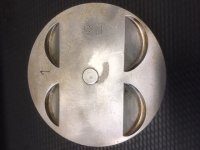
In fact when looking closely at the piston N?3, the only difference with the others is a little flame like trace coming out of it's center.
On the picture below, you can also see that I had scraped some deposit when I rebuilt the engine initially.
I will try to get some vacuum over the trace to test for leakage. IMG_3434.jpg
 
After 10 seconds mud guard covered in oil??? that's a lot. When you pulled the head back off, did the number 3 cyl. look different than the others. If not, maybe something in one of those valve seal.
 
Last edited:
After 10 seconds mud guard covered in oil??? that's a lot. When you pulled the head back off, did the number 3 cyl. look different than the others. If not, maybe something in one of those valve seal.

It's the second round of valve seals.
Following the issue the head was pulled to fit OEM valve seals.
No difference!
 
What I's thinking, that much oil coming by the rings and through the cyl., I'd have thought that cyl. would show obviously more oil than the others. Just as that ex. port has got to show more oil than the others. Not knowing, just thinking.
 
Bad oil control shows up as oil on the thread if the sparkplug. So first pulling and reading/comparing the plugs can assist in identifying if the problem is across multiple cylinders.
 
I still think it's an oil control ring issue. Did you verify that the expander spring was not overlapping?

I don't think it's the valve guide seals. Manufacturers didn't even use them back in the day, and the engines didn't pump oil out the exhaust.
 
I still think it's an oil control ring issue. Did you verify that the expander spring was not overlapping?

I don't think it's the valve guide seals. Manufacturers didn't even use them back in the day, and the engines didn't pump oil out the exhaust.

The expander ring was well in place.
The valve guide seals were changed for OEM ones as they were suspected for the oil fumes in the first place.
BTW, I just rebuilt the engine of my Honda CB 77 of 1966 as there was also smoke from one cylinder and yes, there is no oil seal on the valve guides.
The problem there was due to a worn piston.
Monday, I will have a complete "metrology" done on the cylinder block and pistons/rings and in parallel I'm having the valve guides checked for cracks.
I hope we won't discover that the cylinder head has an issue...
 
I had the machine shop on the phone and they declared that the cylinder head presented no leak whatsoever.
They did the test by pouring oil on top on the combustion chamber while creating a vacuum in each of the intake and exhaust ports.
The single culprit left will be the piston rings and their match to the cylinder bore...
To be followed!
 
Is the second ring on that piston fitted upside down ? This can be a source of high oil consumption.

No Greg, I checked that right away.
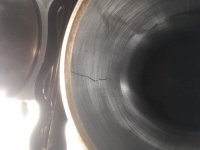
I did further research on the cylinder N?3 and found two cracks left and right of the bottom of the skirt.
As one can't see them on the outside of the skirt, I dismissed these as the source of the oil consumption?
I'm adding a picture that makes it look worse than in reality. IMG_3438.jpg
 
If the valves seal - as has been proved by the reconditioners vacuum test - then I'd look for a crack from the cam cavity to the exhaust port on that cylinder.
If you've got the head off, clean out that exhaust port, tilt the head so the exhaust side is lower - and leave some oil or better, petrol - in the head above that port.

Some years ago I was asked to look at a Norton which smoked from one side. Whoever had put new valve guides in it, had cracked the head above that exhaust port.
 
Back
Top