• Required reading for all forum users!!!

    Welcome!
    Register to access the full functionality of the GSResources forum. Until you register and activate your account you will not have full forum access, nor will you be able to post or reply to messages.

    A note to new registrants...
    All new forum registrations must be activated via email before you have full access to the forum.

    A Special Note about Email accounts!
    DO NOT SIGN UP USING hotmail, outlook, gmx, sbcglobal, att, bellsouth or email.com. They delete our forum signup emails.

    A note to old forum members...
    I receive numerous requests from people who can no longer log in because their accounts were deleted. As mentioned in the forum FAQ, user accounts are deleted if you haven't logged in for the past 6 months. If you can't log in, then create a new forum account. If you don't get an error message, then check your email account for an activation message. If you get a message stating that the email address is already in use, then your account still exists so follow the instructions in the forum FAQ for resetting your password.

    Have you forgotten your password or have a new email address? Then read the forum FAQ for details on how to reset it.

    Any email requests for "can't log in anymore" problems or "lost my password" problems will be deleted. Read the forum FAQ and follow the instructions there - that's what we have one for...

  • Returning Visitors

    If you are a returning visitor who never received your confirmation email, then odds are your email provider is blockinig emails from our server. The only thing that can be done to get around this is you will have to try creating another forum account using an email address from another domain.

    If you are a returning visitor to the forum and can't log in using your old forum name and password but used to be able to then chances are your account is deleted. Purges of the databases are done regularly. You will have to create a new forum account and you should be all set.

Low-idle problem on recently bought 83 GS650 G, many previous owners

  • Thread starter Thread starter KnowsNothing90
  • Start date Start date
K

KnowsNothing90

Guest
Hi, I am new to this forum and have basically 0 experience working on motorcycles. I recently bought a 83 GS 650 G (a shaft drive model with Mikuni BS32 SS carbs) that was running decently at the time of purchase and is now having a problem with the low-idle.

I had done some basic repairs (replaced the oil filter, did oil change, replaced battery) because of a problem with the bike dying suddenly after my first long ride (less than 2 hours) and before I got the safety inspection finished. Because the oil warning light came on I changed the oil and replaced the oil filter and since the battery was quite dry I replaced it with the exact model that was being used as recommended at the local parts store (a Canadian Tire).

It's a bit of a long story but the problem developed on a long ride (about 6+ hours of riding with some brief stops) from Ontario to Quebec (in central Canada) I experienced some major problems when we ran into very slow traffic and I was stuck in 1st gear starting and stopping following a long stretch of highway driving). The bike had run great on the highway at 60+ km/hr until this point but then it started revving very high cutting out sporadically. At this point luckily I was able to get it into a uhaul trailer and tow it the rest of the way back to Halifax, Nova Scotia.

I had a retired aircraft mechanic give me some advice and help to re-adjust the clutch lever and it is running fine in first (and all other gears) but when it is in neutral or the clutch is engaged the idle is very poorly regulated. I rarely have a problem the bike stalling anymore but once the engine is warmed up it is not uncommon for it to be idling all the way up to 3,000 rpm (I have the owners and service manuals which recommend an idle of 1,000-1.200 rpm).

Although this was not ideal I was still riding the bike on a short commute to work with minimal issues. Then I took it for a longer ride (~70 mins each way with ~45 mins break) and the next day on the way to work, after warming up the bike and running it for ~10 mins, it was suddenly idling all the way up at 5,000 rpm in neutral!

After doing some basic research I am going to make a go at adjusting the pilot screw and possible the air flow screws to try and retune the idle to the recommended setting. I'll let you know if I get anywhere.

Otherwise I have read that the high idle could be related to air leaks and getting new carb diaphrams might be a good idea, anyone have any opinions on this?
(for example from https://www.carburetordiaphragms.co...50-gs750-gs850-1980-1983-mikuni-carburettors/)
 
Since it was running "decently" at first blush, I wouldn't fiddle with pilot or mixture screws just yet, cuz it's unlikely that they changed - unless they fell out of carb bodies. Do you understand the "choke" (actually an enricher )mechanism ? Is it working right ...as in staying shut off? Maybe your long rides have compromised the carb intake boots, or their o-rings at head interface - this would give a crazy idle and is a common problem.
Be warned, carb rack removal on this critter is no fun if it comes to that.
 
I would say your problem lies elsewhere from the pilot and mixture settings.

Firrst inspect the operation of the choke (enricher) linkage and mechnism.

Also find the idle adjust knob under/behind, in middle of the two inner carbs. You didnt say anything about adjusting that.
If you set that for 1000-1200 when engine it good and hot/warm and is still okay after running awhile, but then is way too high idle when cold... that is a clue about maybe intake air leaks. ANd like wize if adjust that when engine is not hot/warm and idle is okay until engine is hot, that is an other clue, or actaully verification of intake air leak.

Usuall supects af air intake leak are:
- orings in the intake boots, up against the head. If they are original they probably arent even rubber anymore.
- intake boots them selves. See if they have crqacks. See if the rubbur is comming apart from the flange at the head. See if the clamps have been tightned so much that the rubber is smooshed. See if boots are not actually on the carbs. Pull carbs to better inspect the boots.
(many folks will tell you the same. Common knowledge here.)

Need to remove the boots from the head to inspect the orings. If the boots and the screws are original, getting those screws out maybe quite a task. Get a replacemnt set of bolts (and orings) from Cycle ORings. If the booots are original, and even if they might appear to be good with not terrible cracks, they are probably so hard that they dont seal well and are alsodifficult to remove and reinstall the carbs. A new set of boots will be needed sometime anyway, so get some now (aint cheap, but not terrible - yet) and then carb work will be much easier. If clamps have been overtightned, will want new clamps too.
I know this sounds expensive. And maybe you got a near 40 year old bike because of the low cost. But, hey, if this stuff is original, you are behind in maintenance by decades.

And a not so usual suspect, but one that had me running in circles for some time:
- the carb orings in the choke (enricher) in each carb. THis requires not only removing the carbs, but breaking down each carb from the rack - which is why I had replaced every other oring in carbs, with not much improvement. Then after doing a more complete carb breakdown (and cleaning) so I could replace the enricher oring and than finally took care of the high-hanging idle. Thaat was my expereince (I dont hear other guys stating such experience.)
 
Hey, Welcome to TheGSR.

we need to see picture before helping you much
 
Last edited:
I have read that the high idle could be related to air leaks and getting new carb diaphrams might be a good idea, anyone have any opinions on this?
Just one opinion on that. :-k

Hopefully you mis-read something or at least are mis-remembering it. New carb diaphragms will likely NOT fix what we are suspecting the problem is. Diaphragms are the last thing you want to change "just because". The ones you linked are $100 for the set, but that is for the diaphragm ONLY. There will still be a considerable amount of work to change them out. Sit down for this, new ones from Suzuki are $141 EACH, but that includes the slide and all the hardware that attaches the two together. You will still have to transfer your needles.

Your most-likely culprit(s) will be the o-rings between the intake boots and the cylinder head. Those are available from cycleorings.com for a very decent price. While ordering, you might also want to consider changing the bolts that hold the boots to the head. They seem to be made of Aged Cheddar cheese, and you might damage them in the removal process. If you have a little more money just itching to be spent, the boots could be replaced, too. They are likely hardened enough to make you think they are plastic, but they are actually rubber and supposed to be rather pliable. If they are not, new ones will make getting the carbs back into place SO much easier. New boots are just under $30 each.

.
 
Hey, Welcome to TheGSR.

we need to see picture before helping you much

Here are some pictures I took while messing around on monday:

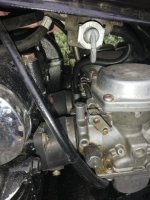
This picture shows the top of the carbs, as far as I know (which is very little!) the screw top shown at the middle front is a pilot screw that adjusts the air flow (so more turns add more air into fuel mixture, making it leaner). I read that the pilot screws can be either to control the amount of air entering the carb or the amount of fuel but that it will not have both fuel and air screws.
1-airscrew2.jpg
 
Hey, Welcome to TheGSR.

we need to see picture before helping you much

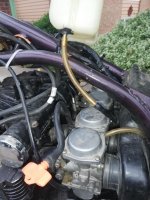
This picture shows how I had things set up so that I could get gas flowing into the carbs without having the tank attached, so that I could adjust the pilot screws. The black fuel hose in the front is plugged off so extra air isn't going in (maybe a good idea?) and the other fuel hose (both were attached to the fuelcock) is fitted into the hose coming out of the small plastic gas tank to allow fuel into the system.
3-tank removed.jpg
 
Hey, Welcome to TheGSR.

we need to see picture before helping you much

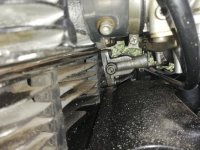
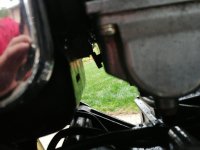
This picture (sorry i had to zoom so its low quality) shows the idle adjustment knob that you mentioned. I didn't know about it beforehand but I nudged it a bit on monday and it significantly affected the idle speed and is located between the 2nd and 3rd carbs like you said. How does this knob regulate the idle speed, does it control the amount of fuel going in or is it a different type of mechanical adjustment??
4- idle adjust knob.jpg
 
So to follow up as to what I ended up doing on Monday and what the resulted from it I will summarise here. I warmed the bike up for about 10 minutes, removed the fuel tank and attached the small plastic fuel tank (pictured in3[SUP]rd[/SUP] reply to first reply post asking for pictures). Ran the bike again with small tank until did not require choke and was idling higher (was not quite up to 3,000 rpm as was when riding before but probably around 2,200-2,500 rpm).

Then, I closed all the pilot screws (I think they were air screws, see picture replywith picture) and recorded how many turns it took to close them without applying very much force. The carbs 1 & 2 (numbered right to left facing forward as in the manual) took about 1.5 turns and 3 &4 took about 1 turn (note that the tailpipe for carbs 1&2 backfires much more often when reducing throttle than the tailpipefor 3&4). After that I found the idle adjustment knob (before knowing what it was) and edged the idle rpms down a little bit using this knob.

After this the idle rpm was consistent around 2,000rpm and I took the bike for a test drive to put some more gas in the tank. It ran extremely well in the low throttle range (under ~1/4 throttle) when the pilot system should be significant but didstall/die at 2 out of about 6 dead stops. I figured it was an improvement and rode to bike the work and back the next day but the pilot circuit did not run well at all the next morning. I had to try and engage the throttle to full and try to bypass the pilot fuelsystem because I was getting almost no response under 1/4 throttle and was afraid the bike would stall and we stuck somewhere. It didstall at one point but I was able to start it again.


I don't know why it was so much worse the next day but I had warmed it up for about 10 minutes before riding to work that morning, maybe some of the screws settled and further reduced the air in the fuel mixture? Anyhow, it ran fine once it was above the low throttle but was horrible in the low throttle zone. I am going to try to adjust the pilot screws and open them to 2 +/- .5 turns and reduce the idle to around 1100 using the idle adjustment knob for now and then I will check the intake boots as you suggested.

Thank you so much for the prompt replies and sage advice!
 
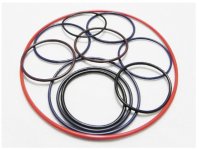
Yes I misunderstood, I thought that the link I posted for the diaphragms was what you meant by o-rings (total newbie!). The o-rings are actually these little rubber parts that these small screws are holding in place for each carb (see picture)?

View attachment 59301
 
Yes, the choke mechanism seems to be working fine and is always shutting off when I'm riding the bike. If I engage the choke the rpms rev much higher and return to "normal" once it is disengaged. I seemed to have messed up the pilot fuel system by moving the pilot screws so I will try to readjust them and reduce the idle using the idle adjustment knob instead. I know the engine did get really hot at one point so maybe the carb intake boots or o-rings were damaged. I will check it out. I guess the carb intake boots are the rubber parts I thought were the o-rings. By o-rings you mean these small rubber rings (see pic attached
product-1.php
)?

o-ring.JPG
 
Point of clarification. Carbs, cylinders are numbered 1-4, left to right as you sit on the bike.
 
OK, let's drop back 5 yards before we punt. :-k

The screws on the top of the outlet of the carbs (pictured in post #6) are, indeed, the pilot screws. Also known as "mixture" screws because they don't control only air (or fuel), they control a MIXTURE. Contrary to what you are guessing, turning those screws out makes the mixture RICHER. Other than the idle speed adjustment, this is the ONLY adjustment you can make without disassembling the carbs. Settings of 1 and 1.5 turns is a bit leaner than stock, which was already a bit too lean. When the carbs are FULLY cleaned (hint, hint), those screws will probably end up in the 2 to 2.5 turn range, but in their current condition, turn them to whatever works.

The ONLY screw you should be messing with under the carbs is the idle speed adjuster. The item shown in post #7 is the cam chain tensioner. Do NOT play with that, especially when the engine is running.

Post #8 shows an acceptable way to add gas. It would be better if you had a valve to stop gas flow when necessary. Also, don't set the fuel supply very much higher than the stock fuel tank.

Post #9 shows the idle speed adjuster. It operates by mechanically opening the butterfly valves to allow more airflow through the carbs.

Post #10 raises a few eyebrows. There should be no need to warm up the engine for 10 minutes. At ANY time. When the carbs are CLEAN (hint, hint) and properly adjusted, 30 seconds to a minute will have the engine warm enough to respond to throttle inputs, then you can go ride. By the time you are in third gear, you can turn the "choke" off. 10 minutes of running without going anywhere is simply too long. When the carbs are CLEAN (hint, hint), the idle speed is specified at 1100 ?100 RPM.

Your attachment in post #11 is not working. The o-rings that were mentioned are not visible until the carbs are removed from the bike AND the intake boots (the tubes between the carbs and the engine) are also removed. Look at THIS PAGE on cycleorings.com to see what I'm talking about. If you look at the picture in post #6, the intake boot is right behind the clutch cable.

I have been dropping some hints (hint, hint) about CLEAN carbs. Since the bike is new to you, you really have no idea about the maintenance history. Don't believe what the previous owner might have told you, just assume nothing was ever done and you will need to do it. Carb cleaning, valve adjustment and electrical checks/cleaning are at the top of the list, followed closely by tires and brakes.

.
 
Ok, thanks for the feedback Steve. I checked out the link and now I understand why you guys are pushing for getting the o-rings replaced and what they are/do, as they put it in the link:

"Either way, you wind up with a temperamental engine; it'll run fine under some conditions, but it'll be crabby & lethargic other times. A classic symptom is an unstable idle speed. If your bike's idle runs way up after it's warm, this is the likely cause. It can be hard-starting and will run hot. It leans out the mixture, can cause your valves to burn, and generally causes annoyance. It is an absolute waste of time trying to tune a motorcycle with an intake leak, as you're aiming at a moving target."
 
.......
.......................I nudged it a bit on monday and it significantly affected the idle speed and is located between the 2nd and 3rd carbs like you said. How does this knob regulate the idle speed, does it control the amount of fuel going in or is it a different type of mechanical adjustment??
View attachment 59298

It is pretty much just an adjustment to hold the carb throttle open a little bit, much the same as holding the throttle grip open a little bit.
Now that you understand that, please go back to the 3rd line of post #3.


.
 
Last edited:
Thanks a million to all of you for your feedback, as pretty much a total newbie I appreciate it very much! I cancelled my insurance since it was registered in Ontario (which is way more expensive than where I am now in Halifax, Canada). I've been working alot and took a break on the motorcycle, but I've got some time off over the break and as things slow down over the winter at work (i'm helping out a small arborist company at the moment) so I will be getting back at it very soon.

The plan is to take the carburetor apart and clean it over the winter based on the info I can find on how to do this from the forums. Then, once I replace the o-rings and perhaps the bowl gaskets, as mentioned in the "Carb-rebuild-vs-cleaning" thread:

"What most carbs that are not running well need is a cleaning of the small passages and new o-rings. So you need o-rings (search for "Cycle ORings" ~$15 total) and probably new bowl gaskets and a bucket of carb dip."

Then I should be able to do a vacuum test on each of the 4 carbs and be able to figure out if there are any other issues that need to be resolved before I can get the carbs tuned properly for spring of next year. This bike was so fun to ride when it was in working order, so hopefully the o-rings and bushings are the main source of the idling problems. I think pretty much everything else on the bike needs to be gone over with a fine tooth comb before it's a solid reliable ride based on what I've been reading on here about previous owners and used motorcycles, and the transmission is also probably suspect but I'm willing to put the time in myself to minimise the costs of getting it professionally worked in (which I will make sure to do after I'm done tinkering around)!
 
Then I should be able to do a vacuum test on each of the 4 carbs and be able to figure out if there are any other issues that need to be resolved before I can get the carbs tuned properly for spring of next year.
Please brace yourself. :-k
You can not simply do "a vacuum test on each of the 4 carbs". When you do a vacuum synchronization (sync), you will need to connect to all four carbs at the same time. The forum favorite is the Morgan Carbtune. The price changes from time to time, based on the exchange rate, as it comes from England. At today's rate, the 80GBP translates to $136CAD.

What makes you think the transmission is "suspect"? They are rather bullet-proof, so I doubt there are problems there.

.
 
The reason I'm thinking the transmission could be suspect is because when I was riding east from the Toronto area I made it to a small town North of Montreal driving pretty much without any long stops (probably ~4-6 hours, i was already a few hours east of Toronto when I left). Up to this point it had been mostly open road and highway driving but in this small town we ended up in stop and go bumper to bumper traffic (which is when I first ran into real problems with the bike, see post 1). At this point the bike was acting very erratically in first gear (cutting out, idling high etc).

Once I got it back home a friend of ours readjusted the clutch (also mentioned in post 1) but there was also another issue, which is the point I am getting at, when I shifted out of first gear the bike would lurch forward (even after the clutch adjustment). So, based on this our friend (the retired aircraft mechanic) figured that during this long ride the first gear must have fused with something else in the transmission (probably the clutch plate?). He was able to address the issues with a quick fix at the time, that is we shifted the bike out of first gear while it had the front tire set against the wall of our house. After we did this a few times the first gear did become "unstuck" and was no longer jumping forward when I shifted it out of first. Maybe this "quick fix" did unfuse the first gear from the clutch plate (or whatever it was sticking on) and might not cause me any more issues, but that was the reason I thought maybe I should try and take a good look at the transmission.

Probably not a conventional way to address transmission problems, but it was shifting fine afterwards and could very well be back to normal functioning. I was just thinking that maybe all this could have damaged the first gear or clutch plate and it could be a liability going forward - what's you take on this?
 
Back
Top