• Required reading for all forum users!!!

    Welcome!
    Register to access the full functionality of the GSResources forum. Until you register and activate your account you will not have full forum access, nor will you be able to post or reply to messages.

    A note to new registrants...
    All new forum registrations must be activated via email before you have full access to the forum.

    A Special Note about Email accounts!
    DO NOT SIGN UP USING hotmail, outlook, gmx, sbcglobal, att, bellsouth or email.com. They delete our forum signup emails.

    A note to old forum members...
    I receive numerous requests from people who can no longer log in because their accounts were deleted. As mentioned in the forum FAQ, user accounts are deleted if you haven't logged in for the past 6 months. If you can't log in, then create a new forum account. If you don't get an error message, then check your email account for an activation message. If you get a message stating that the email address is already in use, then your account still exists so follow the instructions in the forum FAQ for resetting your password.

    Have you forgotten your password or have a new email address? Then read the forum FAQ for details on how to reset it.

    Any email requests for "can't log in anymore" problems or "lost my password" problems will be deleted. Read the forum FAQ and follow the instructions there - that's what we have one for...

  • Returning Visitors

    If you are a returning visitor who never received your confirmation email, then odds are your email provider is blockinig emails from our server. The only thing that can be done to get around this is you will have to try creating another forum account using an email address from another domain.

    If you are a returning visitor to the forum and can't log in using your old forum name and password but used to be able to then chances are your account is deleted. Purges of the databases are done regularly. You will have to create a new forum account and you should be all set.

Paper-ing my Stator: Or... Electricity confuses me

  • Thread starter Thread starter Roostabunny
  • Start date Start date
I'll flip it over and shoot it when I get home this evening. :D

.

Thanks, Steve, for the shot and the future other shot. :D


As a general update, two things...

1.) I ordered the Polaris 4012941 R/R and will install when it arrives. Since I'll end up with a super-deluxe charging system at the end of this oddyssey (and I've got a stylin' new crimper), I'll be sure to replace the rest of those heated connectors while I'm at it.

2.) Got confirmation that the Rick's folks got my email and that techs were looking at the info I sent. Waiting to hear back.
 
I am jumping into this late, with a question:


That last set of numbers, are those volts? Are you trying to measure voltage between the stator legs and ground? The three stator windings have absolutely no relation to chassis/engine ground and any voltage readings taken like this are nonsense. You want to instead measure resistance. With the engine off and the stator disconnected from the R/R. You should get an open circuit (infinite resistance) between any of the three stator legs and ground. Anything else means there's a path for current to flow from the stator to ground which implies a damaged stator or wire.

But even if there's no short to ground, it's possible you could still have a bad stator. I just don't know how you can be getting 80v across all legs and not be charging the battery unless the R/R or some wiring somewhere is bad. I agree with posplayr that it would be a good idea to verify the accuracy of your multimeter.

It is not nonsense it means there is a short to ground? If you had a perfectly good stator, what do you think happens if you short one of the legs to case ground? Do you think you will see voltage between chassis and any other leg? You sure will.
 
It is not nonsense it means there is a short to ground? If you had a perfectly good stator, what do you think happens if you short one of the legs to case ground? Do you think you will see voltage between chassis and any other leg? You sure will.
This is what happenned to my previous stator- it "leaked" to ground, ohms checked out OK, but it could barely deliver 13 volts running. I ran it about 12 hours like this- it didn't get worse, but I knew it was sick.
 
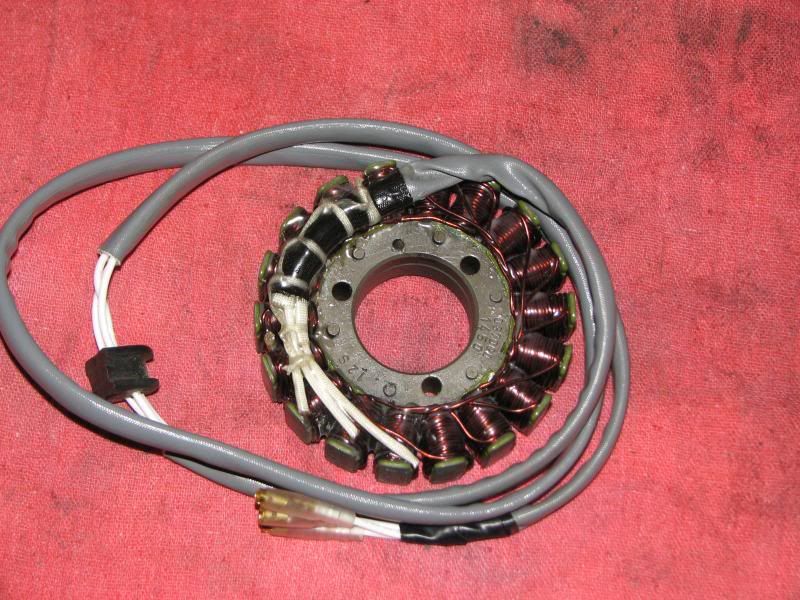
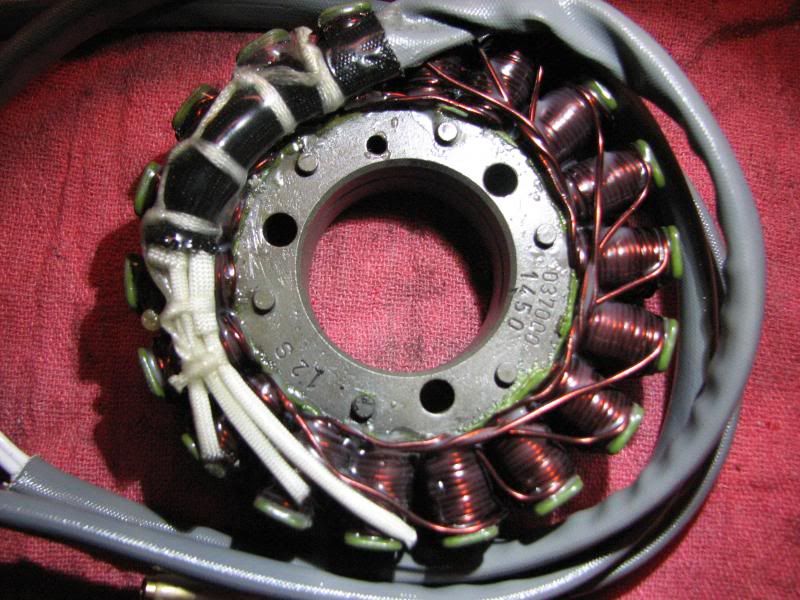
OK, I am home, pictures are shot.

IMG_7083_zps7a9ac992.jpg


IMG_7086_zpse103d9b2.jpg


.
 
It is not nonsense it means there is a short to ground? If you had a perfectly good stator, what do you think happens if you short one of the legs to case ground? Do you think you will see voltage between chassis and any other leg? You sure will.

In the case of a perfectly healthy system, any voltage readings between a leg on the stator and ground are nonsense because the stator is electrically isolated from every single other part of the bike, including ground, except for the three wires going into the R/R and the circuit inside the R/R itself. A much more scientific and fool-proof test is to check for continuity between the stator and engine. (Bearing in mind of course, that a faulty stator may only "short" to ground when warm or at higher RPMs.)

If the stator is connected to the R/R while testing, then what you're really seeing is part of the R/R circuitry, which isn't helpful unless you understand how the R/R circuits work and given that the input and outputs are so easy to test on their own.

Now if the stator is disconnected... and a leg on the stator has continuity to ground, you would see 0V on one leg (or close to it), and the other two would read 80V. The only way I can see getting a reading of 40V across all three is if the center tap of the stator (which is not connected to the R/R) is connected to ground. And I've never seen a charging system schematic that showed the center tap connected to anything. If this happened, would it interfere with the workings of the R/R? I honestly don't know.
 
Last edited:
In the case of a perfectly healthy system, any voltage readings between a leg on the stator and ground are nonsense because the stator is electrically isolated from every single other part of the bike, including ground, except for the three wires going into the R/R and the circuit inside the R/R itself. A much more scientific and fool-proof test is to check for continuity between the stator and engine. (Bearing in mind of course, that a faulty stator may only "short" to ground when warm or at higher RPMs.)

If the stator is connected to the R/R while testing, then what you're really seeing is part of the R/R circuitry, which isn't helpful unless you understand how the R/R circuits work and given that the input and outputs are so easy to test on their own.

Now if the stator is disconnected... and a leg on the stator has continuity to ground, you would see 0V on one leg (or close to it), and the other two would read 80V. The only way I can see getting a reading of 40V across all three is if the center tap of the stator (which is not connected to the R/R) is connected to ground. And I've never seen a charging system schematic that showed the center tap connected to anything. If this happened, would it interfere with the workings of the R/R? I honestly don't know.

You failed to read my post, which means you failed to grasp the diagnostic capability of the test method. The leg to ground tests at 5K RPM has been established as probably one of the best diagnostic measurement for determining failed stators.

Your statement above is also incorrect and can be confirmed with a simple circuit analysis. You can put one short any where an any of the three legs and it will not have any bearing on the VAC outputs. Again draw yourself a circuit.

By the way, I have never seen a voltmeter register "Nonsense", is that a special kind of meter? Could you elaborate on what that means?
 
Last edited:
Wow, those are gorgeous for home - rolled. Includes a grommet, and connectors, even. Have you dialed in a price yet?
Wish I could take credit for the work, but I send them out to a guy who does this for a living.

Price? See below.

I've got the carcass of the OE stator I pulled off of mine. How much for a rewind?
I have the second batch out for rewinding right now. Once they get back, I will be "hanging my shingle" for rewound stators.

For now, I am thinking that the price will be $85, shipped to your door. :eek:

If that's not quite enough, I will be happy to "adjust". :D

Of course, this will be on an "exchange" basis, but I hope to have a few stators on-hand to minimize turn-around time.
Exchanges will be tracked, but I hope to keep them on an honor system, so I don't have to go through the hassle of a core charge.

If you would like to send a stator to be rewound, send me a PM or an e-mail for arrangements.


I would also like to ask if anyone else has any dead stators they would like to donate to the project.
I would be happy to pay shipping costs for items donated to the project, but exchange units are on your "dime".

.
 
That's a nice looking rewind job! I'll donate some BBQ ones , I'm a good recycler and need to clean out my stash.
 
I'll end up with a spare core when all this is through, and based on the lofty claims about the series R/R that's on its way, keeping a spare stator is clearly superfluous. ;)

Seriously though, Steve, I'll end up with at least one core you can have toward buffer inventory.
 
I'll end up with a spare core when all this is through, and based on the lofty claims about the series R/R that's on its way, keeping a spare stator is clearly superfluous. ;)

Seriously though, Steve, I'll end up with at least one core you can have toward buffer inventory.
Thanks. :D

I just put a post in the Parts Wanted forum. :cool:

.
 
You failed to read my post, which means you failed to grasp the diagnostic capability of the test method. The leg to ground tests at 5K RPM has been established as probably one of the best diagnostic measurement for determining failed stators.

Established by whom? I already conceded that it's not worthless. I just think it has a lot of potential (har) to be misleading to those who can't read and apply circuit diagrams.

Your statement above is also incorrect and can be confirmed with a simple circuit analysis. You can put one short any where an any of the three legs and it will not have any bearing on the VAC outputs. Again draw yourself a circuit.
Don't need to, I have one right here:

charging_diag.jpg


If one leg is shorted to ground, and you put one voltmeter lead on that leg, and the other on ground, you will get 0 volts. That's what a short is. If neither of the other two legs are shorted to ground, you will get 80 volts on both, assuming that the stator normally puts out 80 volts for the given conditions.

By the way, I have never seen a voltmeter register "Nonsense", is that a special kind of meter? Could you elaborate on what that means?
I didn't say the voltmeter registered nonsense, I said the reading (i.e., the result) is nonsense. In a working system. Because they're two separate circuits. If you want to check for continuity between two things which should not have continuity, you do that. Not check for voltage. It's a much more direct way to test for the kind of failure you're looking for.

Anywho, I'm excusing myself from the rest of this thread. Nothing we're debating here is helping the OP and besides, life's too short to argue on the Internet. :)
 
eil said....
"If you want to check for continuity between two things which should not have continuity, you do that. Not check for voltage. It's a much more direct way to test for the kind of failure you're looking for."

Yes, but when you ohms test, the stator is not producing- no stress on windings, etc. Plus the multimeter is probably using 9 volts maximum to test, whereas the running AC to ground test is more severe- more likely to find a path to ground if one is available.
 
Established by whom? I already conceded that it's not worthless. I just think it has a lot of potential (har) to be misleading to those who can't read and apply circuit diagrams.

Don't need to, I have one right here:

charging_diag.jpg


If one leg is shorted to ground, and you put one voltmeter lead on that leg, and the other on ground, you will get 0 volts. That's what a short is. If neither of the other two legs are shorted to ground, you will get 80 volts on both, assuming that the stator normally puts out 80 volts for the given conditions.

I didn't say the voltmeter registered nonsense, I said the reading (i.e., the result) is nonsense. In a working system. Because they're two separate circuits. If you want to check for continuity between two things which should not have continuity, you do that. Not check for voltage. It's a much more direct way to test for the kind of failure you're looking for.

Anywho, I'm excusing myself from the rest of this thread. Nothing we're debating here is helping the OP and besides, life's too short to argue on the Internet. :)

OK here we go.

Griffin has reported that he has used this method for years. It also makes perfect sense. There are also other members here that have been using it Tom has reported the same.

As you stated the stator should be isolated from the engine case. However if there is any contact between the stator and the case (any place except for the ideal neutral and ground) there will be a perceptible portion of the VAC voltage from the stator measurable from the case. It is exactly the error condition that is being detected.

I didn't say the voltmeter registered nonsense, I said the reading (i.e., the result) is nonsense.

You are also correct in saying that a meter does not read nonsense. The meter reads the potential difference between the leads. If the stator is isolated from the stator the leg to case voltage will be zero (not nonsense) and if there is a short to the case in the stator there will be an AC voltage reading. Also not nonsense. It is not nonsense because the meter doesn't know what nonsense is. It measures voltage. If you indicated two points to locate the volt meter leads on that schematic and showed anyplace where there is a short (except the degenerate case) what I'm saying would I hope become clear to you.


And under the stated fault condition there will be voltage present. History (ask Griffin) has reported that this is a very good diagnostic tool; in fact he claims he has never mis diagnosed (That is however probably a stretch) a stator using this technique


If one leg is shorted to ground, and you put one voltmeter lead on that leg, and the other on ground, you will get 0 volts.

I'm not sure how you deduced making this statement?? Of course if tow voltmeter leads are shorted together no matter what you grounded them to 10,000V or ground the voltage is always zero. That should be obvious and completely unrelated to the discussion.

I believe my statement was that you could short the stator anywhere in one place and still measure 80V across any two legs. However at the same time, if the stator has that short you will pick up that voltage between a leg to ground test. That is exactly the point of the test procedure.


The reason that an ohm meter doesn't work is because there is not enough voltage to break down the insulation. An ohm meter is a very poor choice. It only works if there is a hard failure.
 
any place except for the ideal neutral and ground

I know it's holiday and many people are somewhere from tipsy to flat out wasted but WTF?

Are you trying to tell us that a three phase with neutral power system will produce 0 volts AC between any line and neutral. Better consult with an electrical engineer that works power distribution before you hurt yourself playing with electricity.
 
I know it's holiday and many people are somewhere from tipsy to flat out wasted but WTF?

Are you trying to tell us that a three phase with neutral power system will produce 0 volts AC between any line and neutral. Better consult with an electrical engineer that works power distribution before you hurt yourself playing with electricity.

Sorry for being unclear , I do have a degree so if there is anything specific that you want to ask go ahe
 
Last edited:
You know that scene in the Hobbit where the rock giants are duking it out while the wee hobbits and elves hang on for dear life?

Feeling like a hobbit.
 
You know that scene in the Hobbit where the rock giants are duking it out while the wee hobbits and elves hang on for dear life?

Feeling like a hobbit.

So where do you stand now? Are you waiting for the sh775? Is the stator still in the bike? Did you recheck the measurements on the stator but first confirm the meter is working.
 
Back
Top