• Required reading for all forum users!!!

    Welcome!
    Register to access the full functionality of the GSResources forum. Until you register and activate your account you will not have full forum access, nor will you be able to post or reply to messages.

    A note to new registrants...
    All new forum registrations must be activated via email before you have full access to the forum.

    A Special Note about Email accounts!
    DO NOT SIGN UP USING hotmail, outlook, gmx, sbcglobal, att, bellsouth or email.com. They delete our forum signup emails.

    A note to old forum members...
    I receive numerous requests from people who can no longer log in because their accounts were deleted. As mentioned in the forum FAQ, user accounts are deleted if you haven't logged in for the past 6 months. If you can't log in, then create a new forum account. If you don't get an error message, then check your email account for an activation message. If you get a message stating that the email address is already in use, then your account still exists so follow the instructions in the forum FAQ for resetting your password.

    Have you forgotten your password or have a new email address? Then read the forum FAQ for details on how to reset it.

    Any email requests for "can't log in anymore" problems or "lost my password" problems will be deleted. Read the forum FAQ and follow the instructions there - that's what we have one for...

  • Returning Visitors

    If you are a returning visitor who never received your confirmation email, then odds are your email provider is blockinig emails from our server. The only thing that can be done to get around this is you will have to try creating another forum account using an email address from another domain.

    If you are a returning visitor to the forum and can't log in using your old forum name and password but used to be able to then chances are your account is deleted. Purges of the databases are done regularly. You will have to create a new forum account and you should be all set.

RR neg to battery neg mod question

  • Thread starter Thread starter bryan
  • Start date Start date
Tests

Tests

OK back to your first question of the nite:

Any way to test used Stators/RRs at salvage yard?

This is probably a dumb question, but is there anyway to test used stators or RRs when their off a bike?

The only test in Section B or C that involves the bike running or could ONLY be done with the parts installed is the last test in part B. The ohm meter tests in B and the entire Part C could be done in the junk yard.

Question is the only thing you should buy at the junk yard is the stator "if it is bad". If you get a R/R get duaneage's Honda unit for only $40 delivered and it solves several problems as well.

As I have reread your descriptions, assuming that your 5000 RPM voltage difference(battery to R/R) reading is low you might be looking at a stator. If you can charge the battery and it takes a charge, but ridding around drains it then basically you are not getting enough out. The R/R would probably fail to regulate and over boil the battery not cause under charging. It doesn't really stop charging unless it were to short and smoke all of your wiring.

Get the voltages and confirm wiring but be prepared for a stator. I have a spare 1981 GS750 stator (old).

Posplayr
 
Last edited:
Update on charging issue

Update on charging issue

Bearing in mind I really don't know what these numbers mean, according to the flow chart it looks like I have a bad stator. Here are the steps followed by my readings in red:

"Switch the multimeter to DC Volts. Switch the range to 20 or 50 V. Connect the multimeter leads to the battery terminals. Start and rev the engine up to 2500 rpm. Check the battery-voltage" 12.5'ish at 2,500 RPM; 13'ish at 4,000

"Let the engine idle, and connect the black multimeter lead to the battery(+). Connect the red multimeter lead to the RED output wire of the RR. Leave the RR connected to the bike. Check the reading on the meter. Leave the engine idling!"
Idle -.25; 5,000 RPM .13

"Connect the red multimeter lead up to the battery's negative pole (-) Connect the black multimeter lead up to the negative output of the RR (BLACK/WHITE), but leave the RR connected up to its leads on the bike. If you can't find a negative output wire, then the casing of the RR is normally the negative lead to the frame. Check the reading on the meter. Leave the engine idling" 0.00 - Assuming this is because of the negative RR to negative battery terminal mod I did?

"Stop the engine. Disconnect the wires emerging from the stator. Switch the multimeter to Ohms, the lowest range on the meter. Connect the multimeter leads BETWEEN two of the three yellow wires. Check the reading on the meter. Switch one of the multimeter leads to another of the three wires and check the reading again..."
Green/White and Blue/White - No Reading (1 .)
Green/White and Yellow - 1.5
Blue/White and Yello - No reading (1 .)
Green/White and Blue/White - No reading (1 .)

Is no reading odd? :-k Clueless. But it seems all signs point to bad stator.
 
Is no reading odd? :-k Clueless. But it seems all signs point to bad stator.


A bad RR leads to a damaged stator

Here are a couple of points on the subject of charging systems,


The purpose of the RR is to power the bike, not just charge the battery. Yes, the battery is kept charged but the RR is tasked with powering the bike, at cruising speed the battery does not power the bike. You can run with no battery and it would still work, since the electrical system provides the juice. In fact that is a good test for the bike, disconnect the battery - lead while the engine is running and see what happens. A bad electrical system will stop the engine immediately/

THe RR case is not grounded. Attaching a ground wire to it won't do much except maybe shield it or something.

The best ground connection on your bike is the frame. In fact, the other devices like lights and horns, starters, coils, etc are connected to the frame at some point. Make a new ground wire from the battery to the frame, then run a SHORT ground wire from the RR to the frame. Keep ground wires from devices like an RR as short as you can and use the frame,

Establishing a great connection from RR to battery and back sounds like a plan but ignores the rest of the bike. If the connection from the battery to the frame is questionable then what good is a battery charger that can't properly power the bike?

Everyone hates bullet connectors, and I agree the connections on these bikes are less than ideal. But new bullet connectors offer as much contact area as a spade terminal and test out just as good as a spade does. The problem is not so much what type of connector it is how old. New connectors are not made of brass, they are much better designed than what they had 30 years ago.
Just my .02 on the subject.

I offer Honda RR kits for Suzuki bikes, several dozen have been shipped already, and for 40 dollars delivered it's the best insurance against RR failure there is. The Honda beats OEM suzuki hands down, and the aftermarket RR's are about half the size of the Honda. The Honda also has a voltage sense that measures the bike voltage and adjusts accordingly. By looking at the bike voltage, not just what leaves the RR, it can compensate for load, battery level, resistance, whatever.

PM me if your interested in one, I ship the very next day
 
Last edited:
Well the connections appear OK

Well the connections appear OK

But there are still some inconsistencies in your results.

a.) Did you really mean to make the second voltage positive?? That would mean that the battery is draining at 5000 RPM. The negative number at idle means the charging system is supplying current to the motor cycle. A plus sign means current is moving to the R/R output. The bike has no way of producing power so it must be coming from the battery. Check that sign again.
Idle -.25; 5,000 RPM .13

b.) 0.1 ohms is not very much to generate 1 volt as said before. Measure the voltage dont assume. Even after putting in direct ground to both negative side of the battery and the chassis I still have 0.30 v difference.

0.00 - Assuming this is because of the negative RR to negative battery terminal mod I did?


c.) What is the lowest range reading on your Multi meter when it read ohms? (short the leads and see how it reads)
I just checked a GS750 stator and there should be about 0.7 ohms between stator legs. No reading seems to indicate low resistance but the G/W to Y leg seems to be high if we are to believe you are measuring right. You should get the same 0.7-0.8 ohms between any two legs. The high one suggests that that one leg of the stator may be bad. However I dont know how it effects only one measurement pair(two should be bad)? Recheck what you are going?
Green/White and Blue/White - No Reading (1 .)
Green/White and Yellow - 1.5

Blue/White and Yellow - No reading (1 .)
Green/White and Blue/White - No reading (1 .)

Recheck and see if we are to believe these numbers mentioned above. If we are to I guess i would order the Honda unit, install it and see if it corrects the problem,. The worst thing is then you have to replace the stator but the Honda unit is still at $40 is a cheap upgrade.

Posplayr
 
Thanks, guy. I'm learning a little something here. Trying to soak in as much as I can. I'll triple check all of the readings again. And let you know what I find.
 
You will feel like an old

You will feel like an old

pro once you get it fixed. \\:D/

Posplayr
 
duaneage

duaneage

THe RR case is not grounded. Attaching a ground wire to it won't do much except maybe shield it or something.

As I mentioned before I think there was an improvement in regulation when I tied the R/R neg to the case v.s. not doing it. I probably did this with an alagator clip. It was back in Dec so I will have to repeat when I swap out the Honda R/R and will report back.

I'm pretty sure I did this all before adding the big copper pipe grounds.

Agree that there also needs to be good chassis ground to the battery negative.

Posplayr
 
His stator is toast. Looks like one leg.

To get an accurate reading of the stator windings the ohm meter must be set to zero. Digital meters, at least expensive ones, have a zero button you press while holding the leads tips together. This eliminates the little bit of resistance in the leads and gives an accurate reading. Needle meters had a control that let you zero the meter the same way.

Looks like one leg of the stator is a bit higher than the other, classic example of a RR that took a stator with it. The strange voltage readings are a combination of bad stator and bad RR.

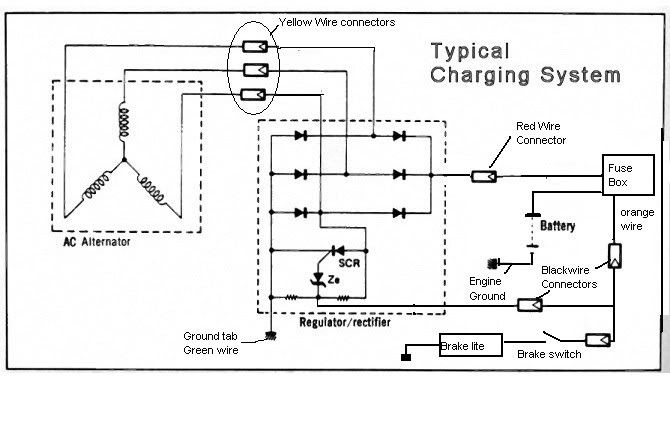
Here is a wiring diagram, this may help a bit

HondaRRconnections-1.jpg


Notice how all three come together and then the result gets adjusted ( this is for the Honda RR but with the exception of the sense wire the Suzuki is similar). You need all three legs of the stator to work or it limps along at around 2/3 efficiency. That is barely enough to run the bike and not nearly enough to charge the battery as well.

One interesting thing is the ground is regulated, not the + output. Japanese voltage regulation is sometimes done on the grounds not the +

Sony televisions were this way for years, they used regulation on the ground side not the hot. I always thought it strange, but then again voltage actually flows from - to +, not the other way around.

This is why you have to pay attention to the ground connections on a motorbike, it's essential.
 
If the connection from the battery to the frame is questionable then what good is a battery charger that can't properly power the bike?

I checked the main ground and it was clean, so I'm pretty sure that isn't it. I also polished it up with a little steel wool for good measure.

What is the lowest range reading on your Multi meter when it read ohms? (short the leads and see how it reads)

it goes from 2000k down to 200. When I short the leads at 200 it reads .7

Measure the voltage dont assume.

This was what it read on the meter. I just meant I assumed that 0.00 reading had to due with me putting the ground mod on.

Can't wait to take a long, LONG ride when I get this all sorted out!
 
Remote debugging

Remote debugging

Looks like one leg of the stator is a bit higher than the other, classic example of a RR that took a stator with it. The strange voltage readings are a combination of bad stator and bad RR.

See my comment. If you are always measuring the resistance between (thru) two legs how does just one get high? Two should be high. But maybe he did not zero out the meter and somehow we actually have two high and one low ??? Or there are actually one short dragging the two measurements down so the high one is the good one??? Dunno

Bottom Line : all three comparisons need to be close to the same.

That positive voltage flow to the R/R was a pretty clear indication of bad R/R (again if we believe the measurements).

Unless he can get a good read on the stator I think I would just try the Honda R/R and see if it fixed the problem. If the R/R is wacky, it suggests that the charging is not "that" bad and maybe he could put off the stator replacement for a while.

He would need to be careful and make sure that with the new R/R everything was OK and not run it on a bad stator (and then take out the good new R/R).

Posplayr
 
The clues are stating to make sense

The clues are stating to make sense

it goes from 2000k down to 200. When I short the leads at 200 it reads .7

So sound like you need to do a zero adjust on the meter when you have your test leads together.

Then with a zero adjust redo the stator comparisons. If you are reading 0.7 ohms just in the leads then the one high reading might actually be 0.8 ohms (1.5=0.7+0.8 ohms)

That would mean the other two legs are shorted out and congratulation you win a trip to the stator store.

Posplayr
 
The stator can't damage the RR, although a RR can sure do damage to the stator, especially when a diode goes bad. Considering the work, mess and expense of getting the coils out of the side of the engine I would spin it up with the Honda RR, sacrifice a live chicken, hold the rabbits foot and throw salt over my shoulder and hope for the best.

If a lead shorts internally to another lead in a stator it can give bizarre resistance readings. I had a bad stator from a parts bike that read 1.4 ohms on one lead only, and .6 on the other two. I knew it was bad because the owner measured it with the engine running and only had about 20 volts coming from one pair. Really strange. The stator was burnt pretty bad, RR was a paperweight.

Since he had no money to fix it I ended up with it for a salvage price.
 
Makes Sense

Makes Sense

The stator can't damage the RR,

Yea that makes sense. Max current is max charging and that only happens when the stator is good and pumping on all three legs.

Stator shorts just reduce the stator current output.

An open Regulator will keep sucking current out of the stator on the other hand and over heat it break down the insulation and wala a winding short and no more stator output.

Posplayr
 
So sound like you need to do a zero adjust on the meter when you have your test leads together.
My multimeter is a cheapy. Not sure it has one? Maybe inside the casing? I'll have to check after work.

I noticed last night that the wires from the stator are copper and the wires from the RR LOOK like aluminum. The connectors I took off weren't original bullets, so the charging system has been messed with by a po.

I don't know much, but I know copper and aluminum cause oxidation. I wonder, could this have been the culprit in frying my stator and/or RR?
 
Last edited:
Well according to the schematic

Well according to the schematic

This is the subject of some discussion if not controversy.8-[

In theory ,if the parts are working correctly, then the charging system "should not" over charge, even with bad connections. In theory (i.e. according to the published schematics) bad connections will cause undercharging in most situations. Basically that is because the R/R is the source of power (and current flows from the R/R; this is why I was interested in the sign of the voltage drops between R/R and battery) and any drops are drops which reduce voltage across the battery.

There are some latent theories, that the Suzuki R/R (combo unit) has an internal defect (possibly layout of the bundled components), not shown in the schematic, that causes some type of sensitivity that will cause over charging. Good grounds seem to quell this charging issue. There is universal endorsement of good grounding to both the battery and the frame (I think).

Also in theory if the R/R Zener voltage reference can "loose" reference (i.e. break) and cause an elevated charging output then the R/R will basically stop working and the stator winding will produce full output as a function of RPM.

First Hand Experience, on my GS750, I had smoked stator wires connections (melted, stiff in the connction area) and smoked ground wire (all insulation gone) from R/R mounting plate to the battery and I caught the problem early enough to fix grounds/connections and have all of the original parts regulate quite well. So the parts are somewhat robust even if the design is not the best.

So in my mind it is clear that good parts and bad connections can cause an overcharge condition. How I dont know other than to blame the R/R for a design defect:confused:.

Posplayr
 
Last edited:
The connectors were most likely a plated type that is compatible with copper. I think your RR died because Suzuki used inferior diodes and a small heatsink that was overworked. they should of had ShinDenGen build them instead of Nippon Denso. And they charge over 300 dollars for one at a dealer, what a rip.
 
So in my mind it is clear that good parts and bad connections can cause an overcharge condition. How I dont know other than to blame the R/R for a design defect:confused:.

Posplayr

The Honda is rated at 450 watts and the Suzuki Stator puts out around 280, so it has way more capacity than the stator can dish out, this guarantees reliable operation. I got the specs from my cm400a manual, which uses the infamous honda rr that we all love.
 
duaneage

duaneage

I understand the Honda is a better unit and I even did a copper heat sink to provide better power handling capacity for my Suzuki R/R because I heard of people using computer fans to aid in the heat dissipation.

The point I was making is that I had a.) overheated connections between stator and R/R and b.) smoked ground wire between mounting plate ground to the frame ground wire and c.) cooked out battery (and if I'm not wrong definite over +16V charging voltage at RPM) all of which are clear indications of overcharging and there is nothing wrong functionally with the original R/R. I'm still running it on the bike and it acted just the same as a parts bike R/R with good looking wires.

The only component I changed was the electrosport stator and I made sure it worked the same way as the OEM after I installed it. Basically a disaster in process was averted to completely normal function ; restored with connections ONLY. :)

So moral of the story is that Over charging doesn't just happen when an R/R goes bad (gets hot and fails) because mine over charged and the R/R is fine. Cleaning connections and grounds solved the problem.

Posplayr
 
If you push 15 amps at 14.5 volts through a connector with dirt, grease and corrosion the joint will develop a lot of heat. That is close to 200 watts continuously on the joint with no where for that heat to go.

If a diode fails inside the RR, then almost 250 watts or even 280 flows through the connector to the RR and then to the ground wire. The dead short caused by a bad diode burns the wires, the connectors and ultimately the Stator leg feeding it. Pure torture for the electical system.
 
duaneage

duaneage

If you push 15 amps at 14.5 volts through a connector with dirt, grease and corrosion the joint will develop a lot of heat. That is close to 200 watts continuously on the joint with no where for that heat to go.

I agree corrosion will make the connections hot and possibly melt the insulation without actually overcharging. The Power would be closer to 15 amps x 1 volt drop = 15 watts v.s. dropping the entire 14.5 volts; most of that still goes to the battery/electrical system


If a diode fails inside the RR, then almost 250 watts or even 280 flows through the connector to the RR and then to the ground wire. The dead short caused by a bad diode burns the wires, the connectors and ultimately the Stator leg feeding it. Pure torture for the electrical system.
Yes agree, a shorted diode on the output side is probably how Bryan is getting that positive drop (i.e. reverse current direction).

None of this explains overcharging :confused: with good parts and bad connections. Item #1 is likely in this scenario, but item #2 had not happened yet to my R/R; That is why I was attributing it to the mystery "design defect". :oops:

For Bryan #2 likely happened and over loaded his stator and the insulation broke down and shorted the windings. :shock:


Posplayr
 
Back
Top