• Required reading for all forum users!!!

    Welcome!
    Register to access the full functionality of the GSResources forum. Until you register and activate your account you will not have full forum access, nor will you be able to post or reply to messages.

    A note to new registrants...
    All new forum registrations must be activated via email before you have full access to the forum.

    A Special Note about Email accounts!
    DO NOT SIGN UP USING hotmail, outlook, gmx, sbcglobal, att, bellsouth or email.com. They delete our forum signup emails.

    A note to old forum members...
    I receive numerous requests from people who can no longer log in because their accounts were deleted. As mentioned in the forum FAQ, user accounts are deleted if you haven't logged in for the past 6 months. If you can't log in, then create a new forum account. If you don't get an error message, then check your email account for an activation message. If you get a message stating that the email address is already in use, then your account still exists so follow the instructions in the forum FAQ for resetting your password.

    Have you forgotten your password or have a new email address? Then read the forum FAQ for details on how to reset it.

    Any email requests for "can't log in anymore" problems or "lost my password" problems will be deleted. Read the forum FAQ and follow the instructions there - that's what we have one for...

  • Returning Visitors

    If you are a returning visitor who never received your confirmation email, then odds are your email provider is blockinig emails from our server. The only thing that can be done to get around this is you will have to try creating another forum account using an email address from another domain.

    If you are a returning visitor to the forum and can't log in using your old forum name and password but used to be able to then chances are your account is deleted. Purges of the databases are done regularly. You will have to create a new forum account and you should be all set.

Split the cases or no??

Keith Lane

Forum Newbie
AF1QipPEhcVPTQz7tFKyqxm08qncCAkv8bKNL7B1LY4y
Hi All, I have a 1980 GS1100E and It's time to stop the leak behind the sprocket cover. I don't really know if it's the countershaft seal or the shifter seal, but I plan to replace both. My question is, do you have to split the cases to do this (I'm hoping not of course.).

Should it be needed to determine the answer, the engine number is: S110X-105997
 
I've never done such a repair but the seals themselves don't have any lips on them which interlock with the cases so you may have a fighting chance. Worst case you destroy a couple of seals trying to drive them in.
 
I've never done such a repair but the seals themselves don't have any lips on them which interlock with the cases so you may have a fighting chance. Worst case you destroy a couple of seals trying to drive them in.
The countershaft seal has a sheet metal c ring on the outside of the seal that fits into a groove in the upper case half to keep the seal from pushing out. It would be very difficult to remove or replace the seal.
 
The countershaft seal has a sheet metal c ring on the outside of the seal that fits into a groove in the upper case half to keep the seal from pushing out. It would be very difficult to remove or replace the seal.

Hum. Forgot about those. C RING PN 09390-62008. Bummer.

I was wondering what kept the seal from popping out???
 
I just replaced the countershaft seal with the cases together.
There is a C-ring in the way holding the seal back.
I drilled a small hole on the back end of the C-Ring and using a snap ring pliers I was able to snap it out of the groove fairly easy. It also goes in fairly easy.

The most difficult part is the case edges are very sharp and were cutting my seal while I was driving it in initially. I took a deburr tool and file to soften the leading edge and give it a small taper to help with the cutting.

The seal still took a few nicks going in so I used a small bead of threebond around the perimeter just to be sure. Seems to be working fine. If I had spent more time cleaning up the edge, it would have went much better.

I also replaced the spacer to give the seal a fresh surface to ride on, and don't forget, there is a very tiny o-ring behind the spacer.

Good Luck
 
So, is the split ring in FRONT of the seal to hold it in or behind it ? Seems to me that if it's in front of the seal it would be pretty simple to get out. ( I don't have that bike, I'm just curious)

Mad
 
So, is the split ring in FRONT of the seal to hold it in or behind it ? Seems to me that if it's in front of the seal it would be pretty simple to get out. ( I don't have that bike, I'm just curious)

Mad

The C-Ring is in front of the seal, but no where to grab it. That's why I drilled a small hole for a snap ring pliers.
 
All very good information (I think / hope).
I got the seals, but with work stuff and just a general lack of enthusiasm due to cold and rainy weather I have not done the clean-it-all and run it to see which seal is leaking routine.

When I get a good handle on the source of the leak and get it fixed I will report back, maybe with pictures!

Many thanks.
 
Hi Everyone,

I see this is a pretty old thread, but I'm hoping someone will still be looking at it and might be able to expand a bit on the repair procedure described here. I have a '81 GS750E that has a sprocket seal leak. I verified by cleaning all the grime behind the sprocket cover and letting the bike sit overnight. Oil is definitely weeping from the outer perimeter of the sprocket seal.

My bike also has a C-ring that is visible on the top of the seal. If my bike is the same as the GS1100E then I think I can use this same procedure to replace the seal. My question is, 1) do you have to loosen any of the engine case bolts; and 2) After pulling the C-ring out did you have to drill the seal and put screws in it so you could pull it out, or were you able to just fish it out of there with a pick?

Thanks!
 
Well, I was hoping not to split the cases because the motor runs fine and it would be a shame to completely disassemble a good engine to replace a single leaky oil seal. It sounds like at least one person has done this without splitting the cases but I am having a hard time seeing how it’s possible. The C-ring isn’t very thick so you couldn’t drill a very large hole, maybe only 1/16”, and I’m not sure that’s large enough for the tips of most snap ring pliers. Not to mention you’d need a massive pair of snap ring pliers to span both ends of the C-ring and clear the transmission shaft. It might just be that I let this seal leak until the motor blows up which, since it’s a Suzuki, will probably take another 40 years. :-)
 
You don't need to completely disassemble the motor to change the seal.
remove motor from chassis, remove starter, remove side covers, remove top case bolts, flip it over, remove bottom case bolts. Split cases, clean and do repair.
The crank, pistons and head remain intact
 
Thank you! I need to study the engine diagrams again. I didn’t realize this was possible with this engine.
 
You don't need to split the cases. You can drill a small hole in the C-Clip and using a strong Ice Pick, pry it out, using a small flat screw driver behind it to keep the progress, and slide the clip up. Drill two holes, and use a C-Clip remover. Pulling the cases is really a big job, unless you intend to pull them off completely and change all the seals, I wouldn't do it. IMHO. ;)
 
Hey ya'll, I got that C-ring out and I made a YouTube video about it. It turns out that splitting the cases would not help in any way to get that C-ring out. I fumbled with the camera a lot in this video but hopefully you'll get the point. To make a long story short, all you need to do is drill a 1/6" hole in one end of the clip, insert an awl or a punch into the hole, and tap lightly in a downward motion on the end of the awl (or punch) with a hammer. There is no need to pull inward with an ice pick. In fact, that makes it very difficult.

https://youtu.be/ex7VfvZkgBM
 
Excellent video documentation of this. Subscribed in case I ever have to do this myself. Please document installation of the new seal, c ring and the tiny c clip. Thanks for taking the time. Much appreciated.
 
Nice video. I don't have a GS with a chain, so couldn't say whether the cases needed split or not, but I have a quite definite recollection of somebody on here making the same discovery years back, but probably not the same model.
I'd be leary of using Scotchbrite anywhere near a bearing - it gives off abrasive particles. Stick to solvents and ear buds.
The use of a sealer on the perimiter of the seal is a sound idea, no problems with that. Just enough and no more.
 
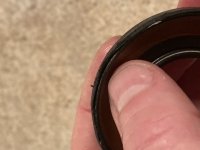
Installing the seal is proving difficult. This is clearly the part that splitting the cases would help with but I’m not ready to go there yet. The seal is hard and covered in a thin layer of rubber. The cavity the seal goes into is so small that when I start to gently tap the seal into place with my PVC pipe and a mallet, the outer rubber covering catches on the engine case and starts to peel off as the seal starts to enter the cavity.

There aren’t any jagged edges on the case. I filed all those down. I think this is simply an issue of size/clearance. The seal is quite rigid so it won’t give enough to squeeze it in place. I’ve tried putting the seal in the freezer for a few hours hoping it would shrink but no luck.

I’m currently considering what else I might do. Any suggestions would be appreciated. Thanks.
 

Attachments

  • photo60219.jpg
    photo60219.jpg
    48.9 KB · Views: 0
You can put a taper on the inner edge of the seal to help it enter. I've done it freehand on a bench grinder in the past. Then lube, plenty of lube. What you use is personal preference but I've found rubbergrease good. It's the grease used when reassembling brake calipers. Something of a large diameter to drive the seal home is useful too. Piece of pipe with a squared off end or similar. Lube the ID of the seal too.
 
I think PVC absorbs much of the force that needs to pass through to the seal. A smooth metal tube would be better, a thick diameter wall will ensure no seal damage. :)
 
Back
Top