• Required reading for all forum users!!!

    Welcome!
    Register to access the full functionality of the GSResources forum. Until you register and activate your account you will not have full forum access, nor will you be able to post or reply to messages.

    A note to new registrants...
    All new forum registrations must be activated via email before you have full access to the forum.

    A Special Note about Email accounts!
    DO NOT SIGN UP USING hotmail, outlook, gmx, sbcglobal, att, bellsouth or email.com. They delete our forum signup emails.

    A note to old forum members...
    I receive numerous requests from people who can no longer log in because their accounts were deleted. As mentioned in the forum FAQ, user accounts are deleted if you haven't logged in for the past 6 months. If you can't log in, then create a new forum account. If you don't get an error message, then check your email account for an activation message. If you get a message stating that the email address is already in use, then your account still exists so follow the instructions in the forum FAQ for resetting your password.

    Have you forgotten your password or have a new email address? Then read the forum FAQ for details on how to reset it.

    Any email requests for "can't log in anymore" problems or "lost my password" problems will be deleted. Read the forum FAQ and follow the instructions there - that's what we have one for...

  • Returning Visitors

    If you are a returning visitor who never received your confirmation email, then odds are your email provider is blockinig emails from our server. The only thing that can be done to get around this is you will have to try creating another forum account using an email address from another domain.

    If you are a returning visitor to the forum and can't log in using your old forum name and password but used to be able to then chances are your account is deleted. Purges of the databases are done regularly. You will have to create a new forum account and you should be all set.

Starter Question

  • Thread starter Thread starter n1elkyfan
  • Start date Start date
N

n1elkyfan

Guest
Does anybody on here know the actual amperage draw of the starter on a 79 750.
 
Does anybody on here know the actual amperage draw of the starter on a 79 750.

There's a lot of variables to your question but with room temp 10W40 oil, in an engine that WILL turn over easily, with a good battery and wiring, I'd plan on a ballpark figure of 80 amperes +/- 15. Cold, friction, thick oil, battery with 1 shorted cell (typical external problems) or worn starter bearings (more current) or dirty commutator/bad brushes/springs/connections (less than normal or NO current) are a couple of other typical internal possibilities.

What sort of problem are you troubleshooting there?
 
how can a 14 amp battery supply 80 amps?

Howdy Walt. Good question and the answer lies in what that "14 amp" value actually refers to, which is actually Ampere-Hours, abbreviated AH (and more specifically is related to a time period...20 hours is one).. Basically, the battery is rated for a continuous discharge current of 14 amperes for 20 hours without the per/cell voltage dropping below 1.75 volts (or 10.5 volts for a 6 cell or 12 volt battery.....a "battery" being a collection of "cells").

That said, if an application needs a minimum amount of power for 40 hours then the 20 hour discharge rate would have to be lowered accordingly to accomplish that. If you require 90 amperes, then the rate would have to be be less than 1/7th the time. This sounds ideal but in fact the construction (and safety!) of the battery limits the maximum power available. Power (in case you weren't aware) expressed electrically as Watts is what determines the work that can be done and is the product of voltage and current.... (expressed in the formula P = E x I. It is therefore Power for a very few seconds which you use to crank the starter......and starters are typically rated with torque performance at a particular RPM with a certain amount of current input, at a minumum voltage......typical to lead acid battery systems this is 9.6 volts.

Those small "booster packs" that you see sold many places now for automotive and even some truck applications are merely small AH batterys which may get you out of a jam by supplying a few hundred amperes (yep!) for just a few seconds.........doesn't do 'em any great good....but it works!

If your interested further.......read up on battery internal resistance and look at some battery voltage vs current curves (which will vary with temperature)......quite interesting. Further to this, take a look at ohms law with respect to the power lost with just slightly dirty connections (small amounts of resistance). There are many types of motor winding configurations depending on their use and a typical engine cranking motor (starter) is a series wound DC motor.....look up it's torque output vs current and voltage and you'll see how complex designing a relatively simple job can become (keeping in mind what ELSE needs to be operating at the same time.....ignition....with it's own requirements!).
 
I don't have any problems at the moment but was thinking of shrinking the electronics on the bike as much as possible and one area I thought of was repalcing the starter relay with a transistor. Just wanted to know the amperage so I could get one big enough.
 
AN FET or 2 would be a much better choice. Very low ON resistance means very low power dissipation and more juice to the starter motor than a transistor can provide.
 
I don't have any problems at the moment but was thinking of shrinking the electronics on the bike as much as possible and one area I thought of was repalcing the starter relay with a transistor. Just wanted to know the amperage so I could get one big enough.
You must get really bored in the winter... :-s

But let everyone know how it turns out!

Ryan (first_timer) was successfully using a very small SLA battery on his GS1000, tucked under the swingarm. You have to make sure the bike is tuned and maintained perfectly so that it always starts instantly, but last time the topic came up, he wasn't having any problems.

There are also some very tasty replacement electronic "dashboards" out there that could clean things up considerably. They're spendy, though. You could also just cheap out and use a bicycle speedometer.

Eliminating the gear position indicator (if your bike has one) will get rid of quite a few wires.
 
I don't have any problems at the moment but was thinking of shrinking the electronics on the bike as much as possible and one area I thought of was repalcing the starter relay with a transistor. Just wanted to know the amperage so I could get one big enough.

Good luck with your project! I'd recommend keeping the electro-mechanical switch (solenoid switch) as they are VERY reliable, and I'd bet that by the time you geared up a heatsink for your solid state switch, it'll be much larger than the device it replaces. You also want to consider what the "failsafe" mode is for any modification - that is, what it's likely to do when it fails and whether that condition will be dangerous, or merely inconvenient. The failsafe mode for a solenoid switch is MOST OFTEN open circuit....just won't work (it IS possible for them to weld closed but on a small engine this is a seldom occurance). A transistor or many other types of solid state switches, however often fail with a shorted path through their heavy current path.....this would be VERY UNDESIRABLE as it would cause the starter to engage and stay there until the wiring/battery was disconnected. Just food for thought.

Simplest of all would be a heavy current pushbutton cranking switch (these used to be on vehicles and machines and were pushed usually by your foot....This would mount on the side of the bike and take the place of the solenoid switch without the need for any control circuit. Not much to fail there......not as commonly found nowadays though.
 
Reading the data sheet it says the package limits the max current to 75 amps. You'll want 2 in parallel then. With only 0.008 ohms Rds(ON) you'll only be dissipating a few watts through each one.

One thing to watch is what will happen with a weak battery. That 0.008 ohm ON resistance is with a 10 volt gate drive. As the battery gets weaker it won't be putting out full voltage and if it fall below 10 volts your ON resistance will begin to rise. Higher ON resistance means more power dissipation and heat to get rid of while providing less voltage to the motor.

Like SPARKSS sez, watch the failure mode too. Dying shorted is bad.

Its amazing what you can buy for a dollar these days.
 
I don't have any problems at the moment but was thinking of shrinking the electronics on the bike as much as possible and one area I thought of was repalcing the starter relay with a transistor. Just wanted to know the amperage so I could get one big enough.


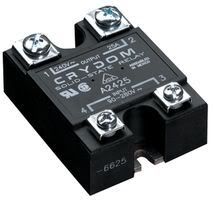
Wouldnt you need something like this....

relay1.jpg
 
Amp Hours

Amp Hours

Howdy Walt. Good question and the answer lies in what that "14 amp" value actually refers to, which is actually Ampere-Hours, abbreviated AH (and more specifically is related to a time period...20 hours is one).. Basically, the battery is rated for a continuous discharge current of 14 amperes for 20 hours without the per/cell voltage dropping below 1.75 volts (or 10.5 volts for a 6 cell or 12 volt battery.....a "battery" being a collection of "cells").

That said, if an application needs a minimum amount of power for 40 hours then the 20 hour discharge rate would have to be lowered accordingly to accomplish that. If you require 90 amperes, then the rate would have to be be less than 1/7th the time. This sounds ideal but in fact the construction (and safety!) of the battery limits the maximum power available. Power (in case you weren't aware) expressed electrically as Watts is what determines the work that can be done and is the product of voltage and current.... (expressed in the formula P = E x I. It is therefore Power for a very few seconds which you use to crank the starter......and starters are typically rated with torque performance at a particular RPM with a certain amount of current input, at a minumum voltage......typical to lead acid battery systems this is 9.6 volts.

Those small "booster packs" that you see sold many places now for automotive and even some truck applications are merely small AH batterys which may get you out of a jam by supplying a few hundred amperes (yep!) for just a few seconds.........doesn't do 'em any great good....but it works!

If your interested further.......read up on battery internal resistance and look at some battery voltage vs current curves (which will vary with temperature)......quite interesting. Further to this, take a look at ohms law with respect to the power lost with just slightly dirty connections (small amounts of resistance). There are many types of motor winding configurations depending on their use and a typical engine cranking motor (starter) is a series wound DC motor.....look up it's torque output vs current and voltage and you'll see how complex designing a relatively simple job can become (keeping in mind what ELSE needs to be operating at the same time.....ignition....with it's own requirements!).

The way I understood it 10AH means 1 amp for 10 houres or 10 amps for 1 hour or any equivalent in between the two.
 
The way I understood it 10AH means 1 amp for 10 houres or 10 amps for 1 hour or any equivalent in between the two.


correct, a 14amp hour battery is good for 14 amp load for one hour before voltage drops below a set limit.

in theory that would translate to a load of 140 amps for 6 minutes but I wouldn't bet on the battery lasting that long before the plates over heated.

the amp hour rating is good for deep cycle batteries that have to power a load like a light or a blower for a extended time.

cranking amps is more important for cranking batteries in motorcycle and car applications.
 
Back
Top