• Required reading for all forum users!!!

    Welcome!
    Register to access the full functionality of the GSResources forum. Until you register and activate your account you will not have full forum access, nor will you be able to post or reply to messages.

    A note to new registrants...
    All new forum registrations must be activated via email before you have full access to the forum.

    A Special Note about Email accounts!
    DO NOT SIGN UP USING hotmail, outlook, gmx, sbcglobal, att, bellsouth or email.com. They delete our forum signup emails.

    A note to old forum members...
    I receive numerous requests from people who can no longer log in because their accounts were deleted. As mentioned in the forum FAQ, user accounts are deleted if you haven't logged in for the past 6 months. If you can't log in, then create a new forum account. If you don't get an error message, then check your email account for an activation message. If you get a message stating that the email address is already in use, then your account still exists so follow the instructions in the forum FAQ for resetting your password.

    Have you forgotten your password or have a new email address? Then read the forum FAQ for details on how to reset it.

    Any email requests for "can't log in anymore" problems or "lost my password" problems will be deleted. Read the forum FAQ and follow the instructions there - that's what we have one for...

  • Returning Visitors

    If you are a returning visitor who never received your confirmation email, then odds are your email provider is blockinig emails from our server. The only thing that can be done to get around this is you will have to try creating another forum account using an email address from another domain.

    If you are a returning visitor to the forum and can't log in using your old forum name and password but used to be able to then chances are your account is deleted. Purges of the databases are done regularly. You will have to create a new forum account and you should be all set.

Steering stem head torque question

  • Thread starter Thread starter Guest
  • Start date Start date
G

Guest

Guest
What's the correct amount of torque and/or resistance one should achieve when tightening the steering stem nut down.

The service manual says to tighten to 34 ft/lbs (as I remember) and then back off 1/4 - 1/2 turn.

The guys at the Honda shop say they use a small spring loaded scale and tighten 'til the force need to turn the forks is 3 lbs.

I read here somewhere that 1 lb force is the correct value...

What's the proper value?? I followed the manual & then backed off 1/4 turn, thinking the new bearings & races will wear in a bit over time and loosen - it feels a little stiff but I've not done this before so I don't know what it should feel like. I don' have a fish scale.

TIA

Mike
 
What's the correct amount of torque and/or resistance one should achieve when tightening the steering stem nut down.

The service manual says to tighten to 34 ft/lbs (as I remember) and then back off 1/4 - 1/2 turn.

The guys at the Honda shop say they use a small spring loaded scale and tighten 'til the force need to turn the forks is 3 lbs.

I read here somewhere that 1 lb force is the correct value...

What's the proper value?? I followed the manual & then backed off 1/4 turn, thinking the new bearings & races will wear in a bit over time and loosen - it feels a little stiff but I've not done this before so I don't know what it should feel like. I don' have a fish scale.

TIA

Mike

GS manual uses the toque method but the GSXR's moved to the fishscale method.

Old time GS members just raise the frount wheel and tighten till it gets a little friction but not notchy. They settle so you will need to come back if you just finished swapping them out.
 
What's the proper value?? I followed the manual & then backed off 1/4 turn, thinking the new bearings & races will wear in a bit over time and loosen - it feels a little stiff but I've not done this before so I don't know what it should feel like. I don' have a fish scale.

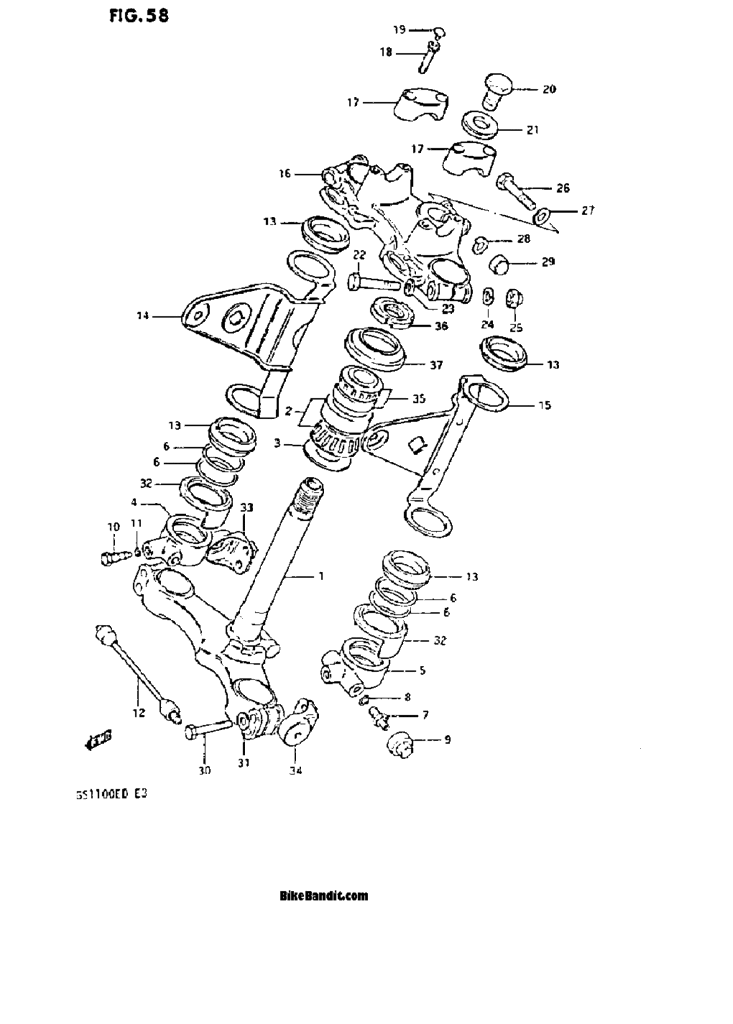
And what is the proper procedure ? As you tighten that big nut are you pulling the top and bottom fork trees closer together ? If so, wouldn't you have to have at least one set of fork bolts loose ? And then what about the big bolt right on top of the stem ? Then there is the smaller pinch bolt too.

Whats first ? .......Whats last ?

SU0062_059.gif
 
Last edited:
1st: loosen the upper fork clamps (2x#22)and the pinch bolt on the stem(1x#26).
With a long punch and a small hammer gently hit the notches and tighten #36.
Check for side to side friction using the handlebar with the tire off the ground. You should be able to move the fork to a position and it should stay but not so tight that it feels notchy.

When done:

Tighten #20 (notice you never had to loosen it at first as long as you are tightening #36) to get the top clamp as low as it will go.

Tighten 2x#22
Tighten 1x#26

Done
 
Better to be a little loose than too tight to avoid damaging the bearings - I use the lift the front wheel and shake technique. You can always make up the adjustment later if there is too much play - you will notice a clunk when braking.
 
Thanks for the replies - seems everyone does something a little different.

I think I'll stick with the manual procedure, but if I happen to find a fish scale how much forch should it take to move the forks (front tire off the ground I assume)?

As I stated before, it's little stiff (it will stay in any position I turn it), but not at all notchy.

Before I replaced the bearings & races it was VERY notchy, as in CHUNKA-CHUNKA-CHUNKA as the forks were turned lock-to-lock.

Thanks again

Mike
 
Everytime i've had a triple tree apart for maintenence, i've always set the bearing preload simply by feel. My philisophy is if the bars can roll side to side on their own, it's too loose. If you feel excessive friction your too tight. A wise old owl told me years ago most people set steering prelaod too loose. (which will cause handlebar shake). If anything a tad tight is better than too loose...

An old skool' trick on motocross bikes to rid the bike of "death swap" is to run a tight preload, sometimes it worked, sometimes the only sloution beyond this was a steering stabilizer..
 
Last edited:
1st: loosen the upper fork clamps (2x#22)and the pinch bolt on the stem(1x#26).
With a long punch and a small hammer gently hit the notches and tighten #36.
Check for side to side friction using the handlebar with the tire off the ground. You should be able to move the fork to a position and it should stay but not so tight that it feels notchy.

When done:

Tighten #20 (notice you never had to loosen it at first as long as you are tightening #36) to get the top clamp as low as it will go.

Tighten 2x#22
Tighten 1x#26

Done
I just wanted to thank Posplayr for this detailed but simple set of instructions for tightening the steering. The front wheel on my 1100E was very loose. I did a search on "steering nut" and lo and behold the help one GSer gave another two years ago is exactly the help I needed now. Is this a great website or what?

I left just a little bit of "flop" out near the stops and I noticed that the wheel going to the right flops sooner in the turn than to the left. Is that something to be expected or should they be exactly symmetrical? I also was not able to tighten #20. It no budge either direction beating on a big 1/2 inch ratchet handle with a hammer. I decide to quit before I stripped off the edges and revisit the issue later. Even so the bike handles much better now. That looseness in the steering head is clearly what was giving the front end the wigglies in turns and on rain grooves.

Thanks again.
 
Last edited:
1st: loosen the upper fork clamps (2x#22)and the pinch bolt on the stem(1x#26).
With a long punch and a small hammer gently hit the notches and tighten #36.
Check for side to side friction using the handlebar with the tire off the ground. You should be able to move the fork to a position and it should stay but not so tight that it feels notchy.

When done:

Tighten #20 (notice you never had to loosen it at first as long as you are tightening #36) to get the top clamp as low as it will go.

Tighten 2x#22
Tighten 1x#26

Done

I use this procedure but as the tightness measure, I want the handlebars to move on their own to the stop but not bounce.
 
I use this procedure but as the tightness measure, I want the handlebars to move on their own to the stop but not bounce.
Nope, that would be too loose for me. Once I start into the turn I want to bars to stay where I put them unless I move them. The only reason I left the few degrees of flop I did is that it was so loose to begin with I was a little unsure about how much change I wanted to do at one time.
...
 
Nope, that would be too loose for me. Once I start into the turn I want to bars to stay where I put them unless I move them. The only reason I left the few degrees of flop I did is that it was so loose to begin with I was a little unsure about how much change I wanted to do at one time.
...


Since I work in machine tool maintenance, I decided I would ask the mechanics I work with about bearing preloads. We do our own high speed machine spindle rebuilds in-house and often can beat the manufacturer's mean-time-between-failure numbers so I know these folks know what they are doing.
My concern was that over-tightening might brinel the bearing which leads to premature failure.
I was told that a tapered roller bearing in that application would be hard to tighten enough to damage the bearing. The bearing is not spinning and the speed is, of course, very slow.
The procedure I was given was to tighten it HARD to make SURE that the races seat then loosen it up and retighten to the level of preload you like.
Keeping everything clean and properly greased during the installation was what was most important to them.

They did say that ball bearings ( in this application) can be a little more sensitive but not enough to worry about. (less surface area)
So, for what its worth, that's what I found out....

Best, Don
 
Last edited:
Since I work in machine tool maintenance, I decided I would ask the mechanics I work with about bearing preloads. We do our own high speed machine spindle rebuilds in-house and often can beat the manufacturer's mean-time-between-failure numbers so I know these folks know what they are doing.
My concern was that over-tightening might brinel the bearing which leads to premature failure.
I was told that a tapered roller bearing in that application would be hard to tighten enough to damage the bearing. The bearing is not spinning and the speed is, of course, very slow.
The procedure I was given was to tighten it HARD to make SURE that the races seat then loosen it up and retighten to the level of preload you like.
Keeping everything clean and properly greased during the installation was what was most important to them.

They did say that ball bearings ( in this application) can be a little more sensitive but not enough to worry about. (less surface area)
So, for what its worth, that's what I found out....

Best, Don
Good info.
 
Back
Top