• Required reading for all forum users!!!

    Welcome!
    Register to access the full functionality of the GSResources forum. Until you register and activate your account you will not have full forum access, nor will you be able to post or reply to messages.

    A note to new registrants...
    All new forum registrations must be activated via email before you have full access to the forum.

    A Special Note about Email accounts!
    DO NOT SIGN UP USING hotmail, outlook, gmx, sbcglobal, att, bellsouth or email.com. They delete our forum signup emails.

    A note to old forum members...
    I receive numerous requests from people who can no longer log in because their accounts were deleted. As mentioned in the forum FAQ, user accounts are deleted if you haven't logged in for the past 6 months. If you can't log in, then create a new forum account. If you don't get an error message, then check your email account for an activation message. If you get a message stating that the email address is already in use, then your account still exists so follow the instructions in the forum FAQ for resetting your password.

    Have you forgotten your password or have a new email address? Then read the forum FAQ for details on how to reset it.

    Any email requests for "can't log in anymore" problems or "lost my password" problems will be deleted. Read the forum FAQ and follow the instructions there - that's what we have one for...

  • Returning Visitors

    If you are a returning visitor who never received your confirmation email, then odds are your email provider is blockinig emails from our server. The only thing that can be done to get around this is you will have to try creating another forum account using an email address from another domain.

    If you are a returning visitor to the forum and can't log in using your old forum name and password but used to be able to then chances are your account is deleted. Purges of the databases are done regularly. You will have to create a new forum account and you should be all set.

Switched to LED signals now my relay wont blink

  • Thread starter Thread starter Dre
  • Start date Start date
D

Dre

Guest
As stated I switched to LED signals and now my signals wont blink. I purchased a generic LED relay but when I plug it in I lose all signals instead of the all of em on with the old relay.

Any suggestions to fix this?

Thanks.
 
Have you got the relay wired correctly?

Its a 3 pin relay and I just put it in the 3 pin harness but could the wiring be not in that particular order, should I remove the pins inserted in the harness and try different variations?
 
Doesn't sound like "plug and play" :)

Nope. More like plug and cry. Lol. I know the wiring is fine cause it was all working ok when I had the non led lights on. Hell i had put the led in front and still had the old bulb signals in the back and it was working ok. As soon as I added the leds in the back aswell, lost my blinking. I know its a relay resistance issue I just dont known how to adress it.
 
Its a 3 pin relay and I just put it in the 3 pin harness but could the wiring be not in that particular order, should I remove the pins inserted in the harness and try different variations?

Bikes like yours with the automatic canceling signals have a nonstandard flasher. The plug is a standard three terminal jobbie, but the function of one of the wires is different, so you can't just plug in a 3 terminal flasher.

You can make a 2-pin flasher work, but you'll lose the automatic cancelling function. You have to stick a small tool inside the connector to release the tabs on the terminals inside. Then experiment a bit -- I forget which two it is, but if you hook up two of these terminals to a 2-terminal flasher, it'll work normally. Then just tape up the third terminal you're not using.
 
Bikes like yours with the automatic canceling signals have a nonstandard flasher. The plug is a standard three terminal jobbie, but the function of one of the wires is different, so you can't just plug in a 3 terminal flasher.

You can make a 2-pin flasher work, but you'll lose the automatic cancelling function. You have to stick a small tool inside the connector to release the tabs on the terminals inside. Then experiment a bit -- I forget which two it is, but if you hook up two of these terminals to a 2-terminal flasher, it'll work normally. Then just tape up the third terminal you're not using.

Thats what I was using before and the self canceling never worked. I have a 2 pin relay but all the signals stay on and wont flash but they did when I had my old signals in the back.
 
I purchased a generic LED relay but when I plug it in I lose all signals instead of the all of em on with the old relay.

Its a 3 pin relay and I just put it in the 3 pin harness but could the wiring be not in that particular order, should I remove the pins inserted in the harness and try different variations?

Bikes like yours with the automatic canceling signals have a nonstandard flasher. The plug is a standard three terminal jobbie, but the function of one of the wires is different, so you can't just plug in a 3 terminal flasher.

I had the same problem when I switched to LED signals and bwringer is correct. I purchased a generic 3 pin relay and had to reorient two of the wires on the socket. Look on the side of your relay, it should have graphics showing what each pin is. I think mine has 12V in, a signal input and ground. You need to then look at your wiring diagram and make sure the Suzuki wires are connected to the correct pin on the relay. IIRC I had to swap two of the wires and make one of them a frame ground in order to get it working. The auto-cancel system was long dead when I got the bike so I didn't miss it when I went to the standard flasher.


Mark
 
As bwringer mentioned, the stock flasher is very non-standard. There is not another flasher available at ANY auto parts store that will work without some modification.

First of all, it is a thermal-based flasher. It requires a certain amount of current flowing through it to heat the bi-metallic strip enough to break the circuit. When it cools (because there is no current flowing), the lights come on again and the cycle repeats. LED signals simply don't require that much current, so the flasher never flashes.

For the flashers that ARE available for low-current (LED) applications, they are basically a timer. There will be a terminal for current coming in, which powers the timer and the signals. There is a second terminal, which is the intermittent output to the signals, the third pin is a ground for the timer circuit. THAT pin is where Suzuki is different.

One way to use LED signals is to also use a load resistor, but if your goal was to reduce the electrical load on the charging system, you will not acheive it. Another way is to use some electronics to trick the system (that is what I have on my bike). You can also remove that third wire from the socket, connect it to ground for the timer and simply give up on your self-cancelling signals.

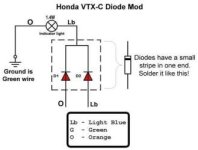
One reason that ALL signals flash is that there is a single bulb in the instrument cluster. I don't know if your bike has one or two (mine has two), but if it's only one, it will need to be re-wired with a couple of diodes to keep from lighting the signals on the other side.

.
 
Huh...with regard to the Suzuki difference; I was able to use a bog-standard off-the-shelf universal electronic flasher on mine, no rewiring required. All it needed was a ground connection (that doesn't count as rewiring). Granted, IIRC the 550 only has a two-pin connector (and two instrument blinking indicators).

Regarding the single bulb instrument blinking indicator; as said by steve, all it takes are two diodes (Could be seen as kinda rewiring). Penny parts, even if you decide to do a nice "Y cable" jobby with proper bullet connectors and heatshrink it won't set you back more than two $ or so. Done that on my brother's bike.

In any case, with LED replacements you'll have to do very lightweight modifications to the electrics; either diodes or universal flasher.

In my opinion load resistors are stupid. The only valid reason I can think of is when they can be connected without cutting any wires; so the bike can be brought back to a very unmolested stock configuration and still have the possibilty to use LEDs until then. I dunno, there are people which do care about such minute details (personally, I just want the frame to be ok).
 
As bwringer mentioned, the stock flasher is very non-standard. There is not another flasher available at ANY auto parts store that will work without some modification.

First of all, it is a thermal-based flasher. It requires a certain amount of current flowing through it to heat the bi-metallic strip enough to break the circuit. When it cools (because there is no current flowing), the lights come on again and the cycle repeats. LED signals simply don't require that much current, so the flasher never flashes.

For the flashers that ARE available for low-current (LED) applications, they are basically a timer. There will be a terminal for current coming in, which powers the timer and the signals. There is a second terminal, which is the intermittent output to the signals, the third pin is a ground for the timer circuit. THAT pin is where Suzuki is different.

One way to use LED signals is to also use a load resistor, but if your goal was to reduce the electrical load on the charging system, you will not acheive it. Another way is to use some electronics to trick the system (that is what I have on my bike). You can also remove that third wire from the socket, connect it to ground for the timer and simply give up on your self-cancelling signals.

One reason that ALL signals flash is that there is a single bulb in the instrument cluster. I don't know if your bike has one or two (mine has two), but if it's only one, it will need to be re-wired with a couple of diodes to keep from lighting the signals on the other side.

.


Makes sense. The signal indicator bulb is still attached,
 
Makes sense. The signal indicator bulb is still attached,

Yep. My KLR has LED signals and I had to add diodes to the indicator bulb on the dash so that they wouldn't all flash at once. Very simple in the end, but it took some staring and thinking before I understood.
 
Huh...with regard to the Suzuki difference; I was able to use a bog-standard off-the-shelf universal electronic flasher on mine, no rewiring required. All it needed was a ground connection (that doesn't count as rewiring). Granted, IIRC the 550 only has a two-pin connector (and two instrument blinking indicators).

Right. Bikes with automatically cancelling turn signals have the weird nonstandard flasher; other bikes can use a regular ol' flasher.
 
you likely need the mod to the indicator lamp or lamps in your gauges. Diodes are involved..OR ,as I did, replace the lamp or lamps with TWO tiny 12 volt leds (you can cram both into the same place if you just have a single indicator on your dash) for indicators ...believe it or not, there's enough power flowing to ground through the original incandescent bulbs there to light all your signals.

This diagram gives some clue for a "single indicator"
turnindicatordiode_schematicforLed.jpg
 
you likely need the mod to the indicator lamp or lamps in your gauges.
You shouldn't have to add diodes if you have separate bulbs in the instrument panel.

The only time there is a problem is if you have a single bulb to show the turn signals are ON.

.
 
Back
Top