• Required reading for all forum users!!!

    Welcome!
    Register to access the full functionality of the GSResources forum. Until you register and activate your account you will not have full forum access, nor will you be able to post or reply to messages.

    A note to new registrants...
    All new forum registrations must be activated via email before you have full access to the forum.

    A Special Note about Email accounts!
    DO NOT SIGN UP USING hotmail, outlook, gmx, sbcglobal, att, bellsouth or email.com. They delete our forum signup emails.

    A note to old forum members...
    I receive numerous requests from people who can no longer log in because their accounts were deleted. As mentioned in the forum FAQ, user accounts are deleted if you haven't logged in for the past 6 months. If you can't log in, then create a new forum account. If you don't get an error message, then check your email account for an activation message. If you get a message stating that the email address is already in use, then your account still exists so follow the instructions in the forum FAQ for resetting your password.

    Have you forgotten your password or have a new email address? Then read the forum FAQ for details on how to reset it.

    Any email requests for "can't log in anymore" problems or "lost my password" problems will be deleted. Read the forum FAQ and follow the instructions there - that's what we have one for...

  • Returning Visitors

    If you are a returning visitor who never received your confirmation email, then odds are your email provider is blockinig emails from our server. The only thing that can be done to get around this is you will have to try creating another forum account using an email address from another domain.

    If you are a returning visitor to the forum and can't log in using your old forum name and password but used to be able to then chances are your account is deleted. Purges of the databases are done regularly. You will have to create a new forum account and you should be all set.

Synching Carbs - Low Compression

  • Thread starter Thread starter hjacobmiller
  • Start date Start date
H

hjacobmiller

Guest
I was synching my GS300 carbs today with vacuum gauges and I couldn't get them anywhere close to the same on each side.

What was a little bit more frustrating is that the right cylinder had some really low/sporadic readings. Needle was all over the place but way below normal readings.

Nothing I did to the synch screw seemed to help.

I recently checked the clearances, but maybe I should again?

I thought maybe the possibility of a burnt valve because when I bought the bike the PO had put a big cinch in the right header and I don't how much it restricted things, but honestly I don't know exactly what a burnt valve is or the symptoms of one are.

Any thoughts or suggestions?
 
Did you plug the vacuum line that goes to the petcock? :-k

Also, when you say "gauges", do you mean analog style, with needles?
If so, did you connect both gauges to the same source at the same time to verify that they read the same?

.
 
Did you plug the vacuum line that goes to the petcock? :-k

.

Yes indeed I did with a golf tee. Seen a couple guys do that. Should that work?

I didn't know if I should do the same to the other vent that goes back towards the airbox or not (not the breather tube, just another line coming from the carb)
 
What kind of manometer are you using? Are there any restrictors in the lines to minimize the bounce in the level indicators?

A vacuum leak could cause all sorts of headaches, as well as a drastically inaccurate bench synch. Even a leak where you have them attached to the carbs could present a problem.

Which is the "master carb" on your 300?

EDIT- Steve beat me to it
 
What kind of manometer are you using? Are there any restrictors in the lines to minimize the bounce in the level indicators?

A vacuum leak could cause all sorts of headaches, as well as a drastically inaccurate bench synch. Even a leak where you have them attached to the carbs could present a problem.

Which is the "master carb" on your 300?

EDIT- Steve beat me to it

I think the left. The right throttle valve is the one that moves with the synch screw so I'm assuming that it isn't the master.

This is the set of gauges I have:
http://www.amazon.com/Carburetor-Sy...-1&keywords=2+cylinder+carburetor+syncronizer

Are the little plastic inserts for the lines the resistors your talking about? The instructions didn't mention those so I didn't know how to install those.

Does anyone feel like enlightening a noob on what a burnt valve is and its symptoms? :D
 
The restrictors go in the vacuum lines.
 
The restrictors should go in the vacuum lines, probably close to the gauges, but it doesn't really matter. They will help keep needle bounce to a minimum.

However, you need to come up with a "Y" adapter so you can connect both gauges to the same cylinder first, so you can verify that they actually read the same vacuum level. It's a real pain to find out that one gauge reads 20 and the other reads 16 when connected to the same source, then try to set your carbs so both of them read 20. One of them will be off by 4.

Having to match the gauges EVERY TIME YOU USE THE GAUGES and the needle bounce are two factors that really dampen the thrill of the slightly lower cost of the gauges.

As far as a "master carb" goes it really doesn't matter, as you only have one adjustment to make, but the "master carb" is going to be the one that has the throttle cable attached to it.
If I am reading the parts fiche correctly, that would be your left carb. Left, as in "clutch hand", not right, as in "throttle hand".

.
 
Thanks!

I'll have to try that out and double check that they are matched. The Alpha moto didn't come with great instructions. I thought those valves were to use it to do a four carb sync. Sorry, noob mistake.

So should I still be worried about a burnt valve or is it too early to tell?

Yeah, I believe it is the left.
 
I thought those valves were to use it to do a four carb sync. Sorry, noob mistake.
What 'valves'? I see two gauges, some adapters and some hose in the picture.
icon_shrug.gif


And, to do four carbs, you need four gauges. Some noobs will argue that, but ... :-\\\

No, your "noob mistake" was getting the dial gauges. Sorry. :oops:

.
 
What 'valves'? I see two gauges, some adapters and some hose in the picture.
icon_shrug.gif


And, to do four carbs, you need four gauges. Some noobs will argue that, but ... :-\\\

No, your "noob mistake" was getting the dial gauges. Sorry. :oops:

.

Resistors. Sorry theyre called valves on the amazon ad. Yeah, had to keep the budget low. I've drained my wallet enough with this bike and I haven't even started the rebuild!
 
https://www.google.ca/search?num=10....,cf.osb&fp=7af16df19978da20&biw=1120&bih=624

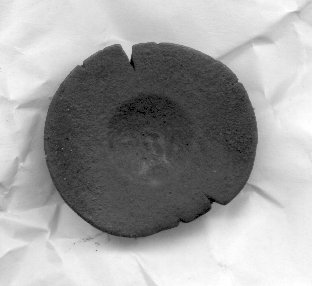
This is a burnt valve.
valve.jpg


Also keep in mind that if you connect the gauges directly without the restrictors, the bounce can damage the gauge and make any reading inaccurate. Or just destroy the gauge like i did with my first set years ago.
Test the left cylinder with both and see if they are close. You can get a T connection at any auto parts store. or pet store for aquarium air pumps.
 
Last edited:
https://www.google.ca/search?num=10....,cf.osb&fp=7af16df19978da20&biw=1120&bih=624

This is a burnt valve.
valve.jpg


Also keep in mind that if you connect the gauges directly without the restrictors, the bounce can damage the gauge and make any reading inaccurate. Or just destroy the gauge like i did with my first set years ago.
Test the left cylinder with both and see if they are close. You can get a T connection at any auto parts store. or pet store for aquarium air pumps.

Good to see you Mechanix!

Thanks! I went back this morning and redid the hoses on my gauges and put the restrictors in.

Also working on making a better remote fuel supply.

Didn't have time to try them out, but I'm going to do a static timing check tomorrow morning and then go from there.

Razor suggested putting something at the end of the exhaust like a rag or something to see if it is actually pulling air in instead of pushing it out.

I'll see how tomorrow morning goes and check in then.
 
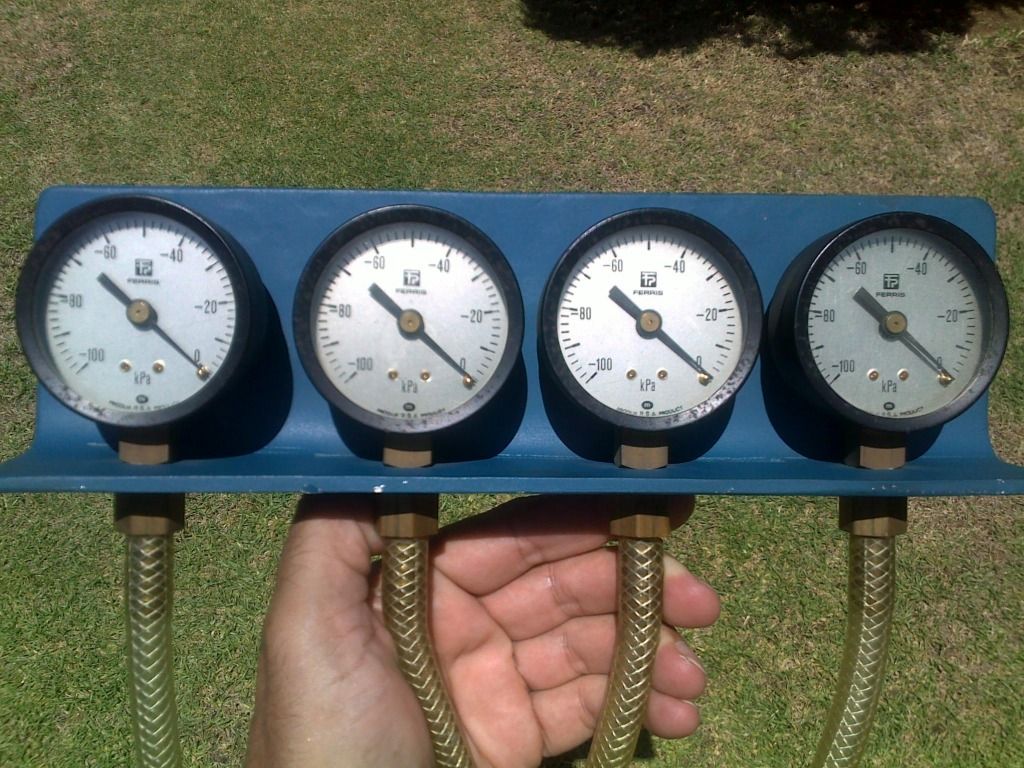
I have been using a set of the dial type vacuum gauges since 1981. They were good quality and have a restrictor with a very small hole, which was pressed into the metal mounting inlet of the gauges. I mounted them on a piece of aluminium plate. I have found these to read within one small scale division of each other when connected to the same cylinder, so the calibration is good enough for me.

I recently obtained a set of the OEM Suzuki gauges, and found that I get the same results as with the dial type gauges. However, the dial type gauges are easier to use, as I can lay them flat on the saddle, whereas the OEM Suzuki gauges cannot lie flat, or the balls will just run along the tubes. The OEM gauges also have to be calibrated individually to ensure accurate results, and this process takes extra time.

21022010025.jpg
 
Can you do us all a favor? :pray:

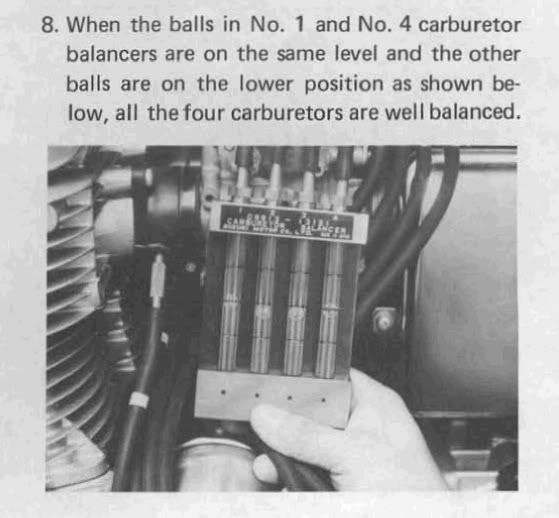
Please compare the readings of the Suzuki gauge to your dials. The manuals all show the vacuum levels to be "half a ball" different for the inner two cylinders, but none of us has the original Suzuki gauge.

What we would like to know is: what is the vacuum difference in "half a ball"? Your gauge is calibrated in kPa, but we can convert that to units that we know and use better than we can convert "half a ball".

Here is what we see in the manual, what is the difference between the inner and outer vacuum levels?

CVcarbsync.jpg


.
 
I was synching my GS300 carbs today with vacuum gauges and I couldn't get them anywhere close to the same on each side.

What was a little bit more frustrating is that the right cylinder had some really low/sporadic readings. Needle was all over the place but way below normal readings.

Nothing I did to the synch screw seemed to help.

I recently checked the clearances, but maybe I should again?

I thought maybe the possibility of a burnt valve because when I bought the bike the PO had put a big cinch in the right header and I don't how much it restricted things, but honestly I don't know exactly what a burnt valve is or the symptoms of one are.

Any thoughts or suggestions?

Reading the replies to your original question again, nobody has really answered this. You seem to have a couple of basic concepts mixed up. The carb synch process is to ensure that the butterfly valves both (or more if 4 cyl) open exactly the same amount, allowing the same amount of air to enter into the cylinders.

Compression is a totally different concept, and you do not see this on the carb synch gauges. The gauges are actually showing a reading of "vacuum" or suction, which is the opposite of compression!

Compression is measured with a compression tester gauge screwed into a spark plug hole. It measures the pressure built up inside the cylinder by the piston. If a valve is burnt (like the one shown in the picture) it cannot seal properly against the valve seat, and some of the pressure will escape. This will result in a low compression reading.

The fact that your one carb gave a lower reading on your gauges (vacuum) simply means that carb's butterfly was more closed compared to the other carb. So as explained above, it has nothing to do with "compression" and the condition of the valves.

Make sure you are turning the correct synch screw on the linkage between the two carbs, because there will be a change in readings as the position of the carb butterflies is changed (maybe you were turning the idle speed adjustment screw - the big one - by mistake?)
 
Can you do us all a favor? :pray:

Please compare the readings of the Suzuki gauge to your dials. The manuals all show the vacuum levels to be "half a ball" different for the inner two cylinders, but none of us has the original Suzuki gauge.

What we would like to know is: what is the vacuum difference in "half a ball"? Your gauge is calibrated in kPa, but we can convert that to units that we know and use better than we can convert "half a ball".

Here is what we see in the manual, what is the difference between the inner and outer vacuum levels?

CVcarbsync.jpg


.

Hi Steve

Yes, I was actually going to do just that out of curiosity! During the earlier years I never had the correct manual for the CV carbs, so I always used to set all 4 carbs to the same readings on my gauges.

However, when I found GSR and BassCliff's wealth of information (including the correct manual!) I saw that 2 and 3 should be "half a ball" lower than 1 and 4 (the ball is about 6 mm diameter).

As I only obtained the Suzuki gauges a few months ago, I also never knew how much the offset had to be on my gauges. I will now be able to do the comparison, and will let you know.
 
Reading the replies to your original question again, nobody has really answered this. You seem to have a couple of basic concepts mixed up. The carb synch process is to ensure that the butterfly valves both (or more if 4 cyl) open exactly the same amount, allowing the same amount of air to enter into the cylinders.

Compression is a totally different concept, and you do not see this on the carb synch gauges. The gauges are actually showing a reading of "vacuum" or suction, which is the opposite of compression!

Compression is measured with a compression tester gauge screwed into a spark plug hole. It measures the pressure built up inside the cylinder by the piston. If a valve is burnt (like the one shown in the picture) it cannot seal properly against the valve seat, and some of the pressure will escape. This will result in a low compression reading.

The fact that your one carb gave a lower reading on your gauges (vacuum) simply means that carb's butterfly was more closed compared to the other carb. So as explained above, it has nothing to do with "compression" and the condition of the valves.

Make sure you are turning the correct synch screw on the linkage between the two carbs, because there will be a change in readings as the position of the carb butterflies is changed (maybe you were turning the idle speed adjustment screw - the big one - by mistake?)

Arg I didn't think even of that! Of course the gauges are for vacuum and not for compression.

Wow, I feel REALLY dumb. I wish there was an emoticon for me hitting myself in the forehead. As Homer would say, DOH!

No I definitely was turning the sync screw. Just a little two cylinder so only one sync screw to adjust.

OH man that makes me feel a lot better.

I almost guarantee it was a problem due to no restrictors in the hoses then or a leak in them.

Will double check once I get the exhaust back on. I'm waiting for new exhaust gaskets which will come in next week.

I feel REALLY REALLY dumb. :o
 
Last edited:
Back
Top