• Required reading for all forum users!!!

    Welcome!
    Register to access the full functionality of the GSResources forum. Until you register and activate your account you will not have full forum access, nor will you be able to post or reply to messages.

    A note to new registrants...
    All new forum registrations must be activated via email before you have full access to the forum.

    A Special Note about Email accounts!
    DO NOT SIGN UP USING hotmail, outlook, gmx, sbcglobal, att, bellsouth or email.com. They delete our forum signup emails.

    A note to old forum members...
    I receive numerous requests from people who can no longer log in because their accounts were deleted. As mentioned in the forum FAQ, user accounts are deleted if you haven't logged in for the past 6 months. If you can't log in, then create a new forum account. If you don't get an error message, then check your email account for an activation message. If you get a message stating that the email address is already in use, then your account still exists so follow the instructions in the forum FAQ for resetting your password.

    Have you forgotten your password or have a new email address? Then read the forum FAQ for details on how to reset it.

    Any email requests for "can't log in anymore" problems or "lost my password" problems will be deleted. Read the forum FAQ and follow the instructions there - that's what we have one for...

  • Returning Visitors

    If you are a returning visitor who never received your confirmation email, then odds are your email provider is blockinig emails from our server. The only thing that can be done to get around this is you will have to try creating another forum account using an email address from another domain.

    If you are a returning visitor to the forum and can't log in using your old forum name and password but used to be able to then chances are your account is deleted. Purges of the databases are done regularly. You will have to create a new forum account and you should be all set.

The final skinny on over filling float bowls

  • Thread starter Thread starter brandman
  • Start date Start date
B

brandman

Guest
I just did a thorough cleaning of my carbs off of my 77 gs 750 - total dissassembly, soaking, spraying and compressed air, then back together.
The bike runs great except the float bowl on carb#1 is overflowing and splashing out the rubber drain hose. The float needle valves and needle valve seats have been replaced. Now my petcock which I did rebuild with an assortment of new seals still leaks intermittantly in on the on position.
I have read some conflicting info from various threads on this forum, some that say a leaky petcock has nothing to do with float bowl levels and some saying a leaky petcock will indeed overflow the bowls.
Would some one care to chime in with a final answer on this to end all dispute?
I think I have had these carbs in and out at least a half a dozen times now (and getting quite fast at it).
Thanks everyone for all of your generosity and helpful info.
 
I think it's somewhat common for a person to rework old carbs and do everything right, and still have leakage / overflow problems like yours.

First, let me point out the obvious: If a carb (or carbs) are overflowing when the bike is not running, you have TWO problems. First, your petcock should prevent ANY flow; second, the needle valve should allow flow only up to a fixed height in the bowl (ie, not overflow). Excess fuel has to make its way past both of these parts.

(A third possibility on old carbs is for fuel to flow past the inlet seat O-ring. [n/a for VM]. That doesn't apply to newly rebuilt carbs, since the owner has just installed brand new. Right??)

I'm not 100% sure why some needle valves leak and others don't, but I'm starting to lean with Keith Kraus' suggestion, which is to use only OEM valves and seats. Simply because it works. The question why is a separate matter. (I have a theory, but no guinea pig to test it on at present).

For the petcock, you'll hear a number of suggestions. I think that the vacuum operated petcock should be kept operational, for a few safety reasons.

Several of the folks here are convinced that petcock rebuild kits are useless, and your only real option is to buy a new OEM petcock.

For now, for people who are 100% sick of carb overflow & the ensuing problems, the consensus then is to go with OEM petcock, seats & needles. it's expensive, but it seems to be the only certain way to correct this BS once and for all.

(I would add: no doubt there are people whose overflow problems began when they bought carb rebuild kit(s). The machining on the parts is often abhorent and inexcusably amateurish, and the f&^%#ing O-rings don't fit correctly. The consensus for a while now has been to buy gaskets IF you need them, valve seats & needles IF you need them, and an O-ring kit.)

I'm going to make a text file out of this one, too, so a cut & paste is all I need to do. Anyone else care to chime in?
 
the petcock holds the fuel back when the engine is off. so if you are getting more then a 1/4 cup of fuel spilling on the ground when the bike is off then your petcock is bad. if you are getting less then that amount spilling (the amount the fuel line can hold when petcock is off) then the petcock is doing it's job and fuel is leaking past the needle valve.

do your self a favor, take the tank off hook up some hose put the tank on table, let the hose drain into a fuel safe container and let it sit over night. if fuel in container, bad petcock.

needle valves can't hold back large amounts of fuel for long times, they only control the speed at which the bowls fill, the faster the gas is used the faster it fills, and vise versa.

if your bike is puking fuel while it is running, then you either have your float heights set wrong or your needle valves are bad or dirt holding them open. Check your floats as well. if they are bass they may have pin holes. to check submerge them for a few hours take them out and see if you hear /feel liquid splashing around inside them. if foam inspect to see if they soak up fuel, weight/hold them in your hand when dry, remember how they feel then submerge for a few hours and see if they feel/weight alot more.

i have tried the KL petcock rebuild kit, and it was crap. for a extra 20 bucks you can buy a brand new petcock
 
Ditto

Ditto

I don't have anything to add, other than endorsing what Robert said above. Not that I personally have a lot of experience, but having gone through this just recently, I have sought the advice of several quite experienced master MC mechanics and seasoned retorers of these vintage bikes.

The very few bucks I could have saved going with aftermarket components or rebuild kits can not compare with all the potential problems. Not only is the general consensus on the forum to stay away from rebuild kits, anyone I've talked with locally says the same. I will always stay OEM. With the o-ring kit from cycleorings, and bowl gaskets from your preferred omline source, you actually save quite a bit of money by not buying inferior kit components you don't need to begin with.

I would also not put on a non-vacuum petcock for the same reasons Robert mentioned. In fact, I have a Kawasaki KZ1000 the PO put a pingel petcock on, and I am going to buy the OEM vacuum-operated petcock to restore the system back to original. There are some things I personally wouldn't compromise and that's the fuel system. I don't cherish the idea of a fuel leak between my legs or my bike catching on fire (I watched many years ago a buddy have his bike go up in flames with him on it because of a petcock leaking - by the time he had put his burning pants out, his bike was toast). I can't imagine trying to scrimp on a few bucks buy trying to rebuild (against the advice of senior members on this forum) rather than spending the money to replace with a new OEM. It ain't worth it!!!

Norseman
 
Last edited:
, some that say a leaky petcock has nothing to do with float bowl levels

That's my take. Based on this: when the bike is running, a good petcock will be wide open. If this somehow caused the bowls to overflow, then brand new bikes would all have this problem.

The petcock does not, in any way, REGULATE the rate of flow. It should be either on or off. If you have overflow on a running bike, there's a problem with the inlet valve.

Either:

1) the float is no longer buoyant enough or is badly adjusted, or

2)the valve is bad, or is being held open by some foreign matter.
 
Their is nothing wrong with a pingle but you must remember to turn it off. I my old days Tri, Norton. I made it a habit to turn the fuel off before shutting the engine off
 
Problems solved(I think), now moving right along

Problems solved(I think), now moving right along

Thanks gentlemen for all of your thorough and informative replys.
I think I have solved the problems with both the petcock and the carbs.
I pulled the carbs out again took the bowls off and re-cleaned them and replaced some o-rings I had left over in the rebuild kits.
I took the petcock apart again and recleaned the parts scrapping off some old gasket I left on from the prior rebuild. No more leaks(fingers still crossed). Now to tackle those brake issues. Don't go away, I 'll have more questions, Thanks again!!

By the way might anyone no where I can pick up a turn signal flasher for this Bike??
 
YOu're right Lynn. When a bike is running, the petcock is open whether it is a Pingel or OEM vacuum. The only difference is the off function on the OEM is vacuum controlled and on the Pingel, it is "your hand" controlled. Therefore, the off function is only faulty with the Pingel if the idiot with the hand cannot operate their fingers. LOL

E.


Their is nothing wrong with a pingle but you must remember to turn it off. I my old days Tri, Norton. I made it a habit to turn the fuel off before shutting the engine off
 
YOu're right Lynn. When a bike is running, the petcock is open whether it is a Pingel or OEM vacuum. The only difference is the off function on the OEM is vacuum controlled and on the Pingel, it is "your hand" controlled. Therefore, the off function is only faulty with the Pingel if the idiot with the hand cannot operate their fingers. LOL

E.

the petcock holds the fuel back when the engine is off. so if you are getting more then a 1/4 cup of fuel spilling on the ground when the bike is off then your petcock is bad. if you are getting less then that amount spilling (the amount the fuel line can hold when petcock is off) then the petcock is doing it's job and fuel is leaking past the needle valve.

do your self a favor, take the tank off hook up some hose put the tank on table, let the hose drain into a fuel safe container and let it sit over night. if fuel in container, bad petcock.

needle valves can't hold back large amounts of fuel for long times, they only control the speed at which the bowls fill, the faster the gas is used the faster it fills, and vise versa.

if your bike is puking fuel while it is running, then you either have your float heights set wrong or your needle valves are bad or dirt holding them open. Check your floats as well. if they are bass they may have pin holes. to check submerge them for a few hours take them out and see if you hear /feel liquid splashing around inside them. if foam inspect to see if they soak up fuel, weight/hold them in your hand when dry, remember how they feel then submerge for a few hours and see if they feel/weight alot more.

i have tried the KL petcock rebuild kit, and it was crap. for a extra 20 bucks you can buy a brand new petcock
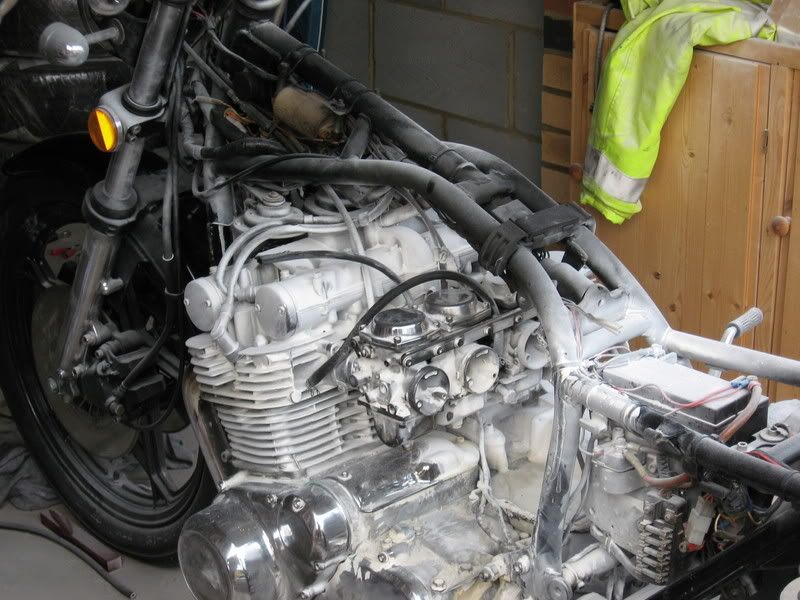
TrikeBuild330-1.jpg

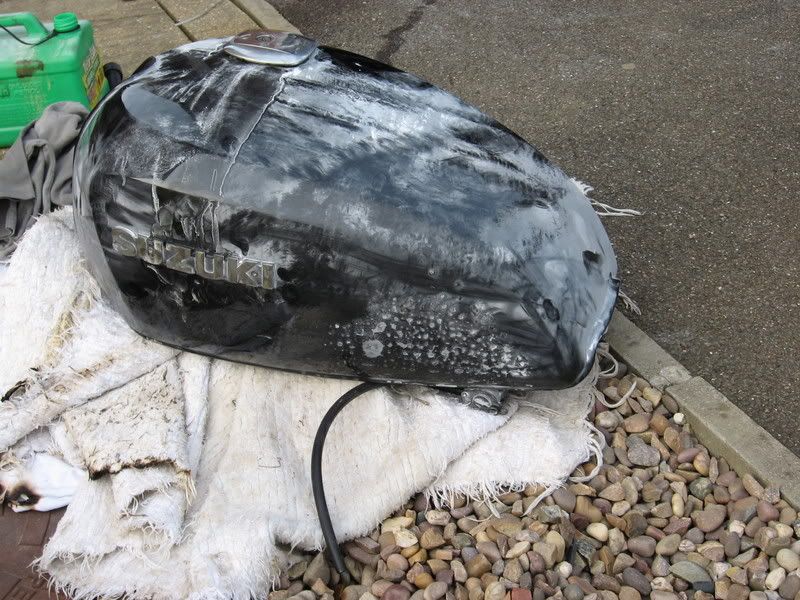
TrikeBuild332.jpg


The aftermath of a leaking fuel tap and sticking floats????

Burns to hands healing, tank gone for repainting, wiring replaced.

Carb rebuilding this week.
New petrol tap on its way from Suzuki.

What else can go wrong?

Any suggestions? - can anyone cheer me up?
 
Back
Top