• Required reading for all forum users!!!

    Welcome!
    Register to access the full functionality of the GSResources forum. Until you register and activate your account you will not have full forum access, nor will you be able to post or reply to messages.

    A note to new registrants...
    All new forum registrations must be activated via email before you have full access to the forum.

    A Special Note about Email accounts!
    DO NOT SIGN UP USING hotmail, outlook, gmx, sbcglobal, att, bellsouth or email.com. They delete our forum signup emails.

    A note to old forum members...
    I receive numerous requests from people who can no longer log in because their accounts were deleted. As mentioned in the forum FAQ, user accounts are deleted if you haven't logged in for the past 6 months. If you can't log in, then create a new forum account. If you don't get an error message, then check your email account for an activation message. If you get a message stating that the email address is already in use, then your account still exists so follow the instructions in the forum FAQ for resetting your password.

    Have you forgotten your password or have a new email address? Then read the forum FAQ for details on how to reset it.

    Any email requests for "can't log in anymore" problems or "lost my password" problems will be deleted. Read the forum FAQ and follow the instructions there - that's what we have one for...

  • Returning Visitors

    If you are a returning visitor who never received your confirmation email, then odds are your email provider is blockinig emails from our server. The only thing that can be done to get around this is you will have to try creating another forum account using an email address from another domain.

    If you are a returning visitor to the forum and can't log in using your old forum name and password but used to be able to then chances are your account is deleted. Purges of the databases are done regularly. You will have to create a new forum account and you should be all set.

Tuning and Jetting My 1982 450

  • Thread starter Thread starter Guest
  • Start date Start date
Well I still get an occasional little... well... almost crackle on deceleration, but only after holding small throttle openings for a bit and then closing the throttle. If I've had the throttle half or more open and close it, no crackle or pop that I've observed.

I did bump the idle up just a smidge when I got to work this morning as it seemed to be idling a touch too low.

So after all that, I have almost eliminated my jerky throttle closed to open from a standing start and if I need to shut it during a low speed corner. Much smoother transition now.

So, to summarise...

Initial symptoms:
- Hesitation when opening the throttle and accelerating until over 1/2 throttle.
- Stumbling when holding constant throttle around 1/4 throttle.
- Pops and crackling on deceleration with a closed throttle.
- Jerky transition from a closed throttle.

End result:
Pilot Jets: Stock (17.5)
Mixture Screws: 3 3/4 turns out
Needles: Stock needles (4C3-3), raised to the richest position (E clip in lowest position)
Main Jets: Mikuni N102.221 Small Round jets, size 150

Modifications:
Shortened slide springs ~20mm
Drilled slide vacuum holes to 3mm

A couple of other things...

For you US folk, I have no comparison of the stock Aus needle (4C3-3) to the stock US need (4C2) except that the US one is non-adjustable. You will need lots of shims to get it to the same richness as the maximum adjustment on the 4C3. I'm not sure if there is a different taper or not.

If you need to use bigger pilot jets in these particular model of carbs, you will need to get Mikuni VM22/210 type jets, but take note that these have bleed holes down the side that the stock ones don't have. Therefore, I'm not sure if the stock 17.5 is exactly the same fuel flow as a VM22/210 17.5.

Once I get the dyno day done with the Kat guys I will come back to this and update it.

In the meantime I'm going to enjoy the new throttle response and fun :D
 
Most everything here does seem to be fairly screwed up for emissions. Happen to know if the whole slide and diaphragm assembly is different or just the needle? It would be worth while for us here to find stock non US parts to install if they are even available. Or we need to figure out what standard Mikuni adjustable needles are correct for out carbs.
I should also like to find the purpose of those bleed holes.
 
Last edited:
I don't know if the bleed holes make much difference, I've had to raise my pilot jet one size, (I'm at 5200ft+ with pods and a non-stock exhaust), and it doesn't seem to have affected the way in which the idle circuit operates, but then again, maybe I just can't tell the difference.
 
Most everything here does seem to be fairly screwed up for emissions. Happen to know if the whole slide and diaphragm assembly is different or just the needle? It would be worth while for us here to find stock non US parts to install if they are even available. Or we need to figure out what standard Mikuni adjustable needles are correct for out carbs.
I should also like to find the purpose of those bleed holes.

The slides and diaphragms are all the same, same part numbers etc. The online parts fiche shows the differences when I compare the listed jets and needles to what's in my factory manual.

Needles are difficult to work out which is why I'm still running the stock one.

The way to work your needle out is to take measurements along the way then compare it to other needle's measurements as outlined here:

http://mikunioz.com/needles_numerical_list.htm

I don't know if the bleed holes make much difference, I've had to raise my pilot jet one size, (I'm at 5200ft+ with pods and a non-stock exhaust), and it doesn't seem to have affected the way in which the idle circuit operates, but then again, maybe I just can't tell the difference.

The only way I've known anything with the pilot circuit is the pops/crackles on decel with a closed throttle after not having the throttle open that much.

You truly won't know without plug chops or an AFR meter...
 
I have trouble understanding exactly which carburetors we have and what series needles fit them, #4 series? Even more so because nothing used stock seems to appear in any charts, so like you say I would have to measure a needle with calipers at various lengths or something to find out what one step richer than a 4C3-3 (which sounds like what we want) with the adjustment notches would be.
Thankfully with the main and pilot jets the numbering system is sane and you just play match that picture to get the right type. Not sure about the needle jet or whatever you call the big tube, probably just as bad as the needle.

Data copied from a chart on that link:
#4 All 18mm Carburetors 22mrn and 24mrnFlange
#5 26mm-32mm Spigot 28mrn-34mm Flange
#6 30mm-38mm Spigot
#7 40mm and 44mm Spigot
#8 HSR 42/45 Carbs
#9 RS and HS Carbs
 
Hi Pete, I meant so e illustrations of the drilling of the vacuum slides.

I am sure I am gonna bug you once I have to dial in mine - when the sparky is eventually done with it.
 
I have trouble understanding exactly which carburetors we have and what series needles fit them, #4 series? Even more so because nothing used stock seems to appear in any charts, so like you say I would have to measure a needle with calipers at various lengths or something to find out what one step richer than a 4C3-3 (which sounds like what we want) with the adjustment notches would be.
Thankfully with the main and pilot jets the numbering system is sane and you just play match that picture to get the right type. Not sure about the needle jet or whatever you call the big tube, probably just as bad as the needle.

Data copied from a chart on that link:
#4 All 18mm Carburetors 22mrn and 24mrnFlange
#5 26mm-32mm Spigot 28mrn-34mm Flange
#6 30mm-38mm Spigot
#7 40mm and 44mm Spigot
#8 HSR 42/45 Carbs
#9 RS and HS Carbs

Yup, the needles are the painful bit! If you look on the parts fiche on Alpha Sports (they have the best fiche but prices are expensive) you will see the jet size and needle type in brackets beside the part number.

Our carbs have the #4 series needles.

If you want to try a different needle, you will have to measure your 4C2 at the intervals outlined and start comparing. It won't be easy which is why I've just richened my stock one as much as possible for the moment.

I'll possibly revise this after the dyno run...

Hi Pete, I meant so e illustrations of the drilling of the vacuum slides.

I am sure I am gonna bug you once I have to dial in mine - when the sparky is eventually done with it.

Aaaah I get ya' Wally! In that case return to post #8 in this thread :)

Basically, you'll need some very long circlip pliers to get the circlip out of the middle of the slide which will allow you to remove the needle etc.

Once that's done you can safely drill the vacuum hole out. That's the off-centre hole in the bottom of the slide, not the hole the needle seats in.
 
Last edited:
If I open my eyes a bit more I suppose things will go a lot better in life! :D
 
Hey Pete, couple questions for you:
- Any info on the snap ring pliers you used for the slide? I'm having a heck of a time finding anything that is remotely close to fitting in there! I've found some Motion Pro ones that look like they'll work but no one carries them in town so I'll have to order them.
- For the modifications to the slide. You shortened the spring by 20mm, correct? The hole in the slide has been upped to 3mm?

Thanks again!
 
Hey Jeff, I don't have good ones either... I use a pair of long nose pliers you can see here:


But they tend to slip out of the circles on the circlip when trying to lift it, so what I've done is gotten a piece of wire and bent a hook in one end so that as I squeeze the circlip, I can hook the wire under it and lift it up.

As for the springs and vacuum hole, yep that's right :)

My suggestion would definitely be to get your jetting right first though so you know how it should run, then do one modification at a time.
 
I finally resorted to a pair of long needle nose pliers from a hardware store bargain bin. Just ground the tips down a tad with the Dremel, work pretty good!

I've got my jetting pretty dang close, definitely not spot on, but close. Luckily I've got a complete extra rack of carbs, so plenty of parts to do experiments on.

I went to drill the slides and shorten the springs yesterday and found out that the new set of carbs I purchased a while back had already been shimmed (or 'un-shimmed') to run richer. I've got a mixed set of diaphragm/slide assemblies, (one old-one new), in my on-bike carbs now, so one's stock, ones rich...goes to show you shouldn't believe PO's! I've now got the shims set equally, one shim richer than stock, and plan to drop them in tomorrow!
 
Last edited:
Pete,

Ive been inspired by this thread to start fiddling with my bike and i made some discoveries. You mentioned before that cutting the springs has made a difference, and i'm getting close to doing the same.

Background:
Pods
Stock exhaust
Rejetted the mains to 130
shimmed the needles up ALL the way.
Pilots turned out 2.5 turns.
Floats set to 24 mm

The bike was running pretty well from idle through 1/4, and pulling strong from 3/4 - 100%. the mid range was iffy when the bike was cold, but got better as things warmed up. I assumed this was a lean condition given that air gets less dense as it warms up. This is why my initial reaction was to raise the needles. After thinking about it for a few days, I have reevaluated a bit.

Clues to consider:

1 - the bike was starting right up without choke when it was stone cold
2 - my fuel mileage was around 50 mpg, much lower than i expected.
3 - the exhaust smelled rich on startup, and if i choked it it would die, warm or cold.

Action steps today:
1 - lower the floats from 24 - 26 mm in keeping with the recommendations
2 - shim the needles down 1 shim's worth on both sides
3 - replace the spark plugs so i can get a good read on the plug chops

Results:
1 - bike is much more happy at idle, and choke no longer kills it, but instead helps with cold starts.
2 - bike feels strong from idle through about 1/2 throttle, but then gets boggy
3 - bike pulls like a mule past 3/4 throttle
4 - occasional spitting/popping from the intake during stop and go traffic.

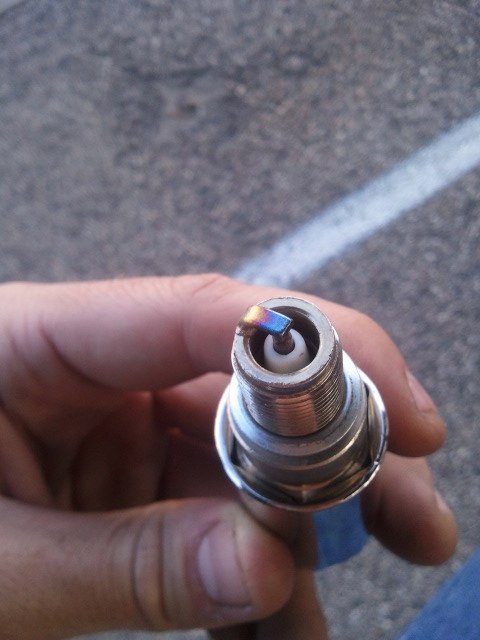
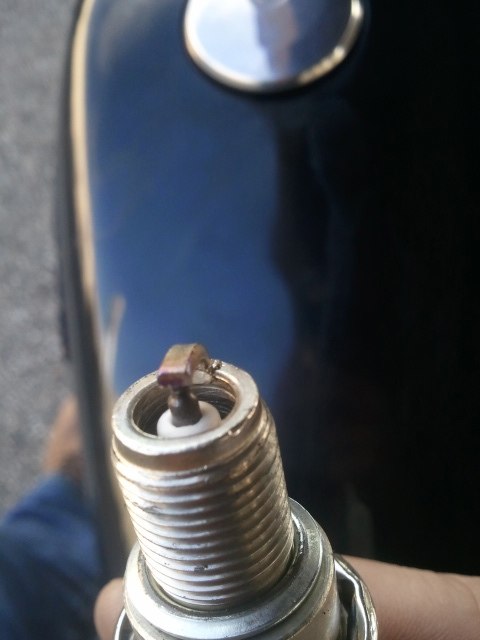
Im assuming that lowering the needle a tad was helpful in the mid range, but the plug chops didn't seem to indicate much. I did these chops after a 1/4 mile run at 1/2 throttle and 6k rpms in 4th where the bogging has persisted. These are brand new plugs gapped to spec:

Left side:
8707794473_18c8b9c18c_z.jpg


Right Side:
8708917290_b02b9fd726_z.jpg


Neither were wet with fuel, or black with carbon, or white with ash. The left side electrode seemed a bit blue, but i chocked that up to being brand new.

With all this said, it seems as if the bike is dialed in fine until you get to about 6k rpm, at any throttle position between 1/3 and 2/3. It will accelerate fine, in any gear, all the way up to about 6k, and then kind of bog. The only way to get through it is to blip the throttle up to 3/4 or 100% to get it fully onto the main jet, and then it pulls great.

Thoughts?
 
I'm crap at reading plugs :)

If it pulls hard in WOT, that typically would say your main is good.

From what you say though, I'd be shimming your needles a bit richer again.

Most likely you're going to have to end up with some sort of compromise while still using the stock needles as from what I can see of available alternatives, the stock ones are designed to be quite lean.
 
Yeah, I took it for a long ride today and it seems soft in the mid range again. I may give the folks at jetsrus a call and ask for input. That, or turn some grooves into my stock needles on a lathe.
 
Well... according to the shims I bought on eBay, the needle grooves are 0.04" apart, and the shims I bought have 0.01", 0.02", and 0.03" sizes in there.

I believe Mikuni shims are 0.02", so two of those would be one notch, and four two notches which in theory would be the equivalent of my 4C3 needle's richest setting.

How many shims do you have on the needle?
 
well until saturday there were none (richest setting). i added 1, and the problem got fractionally worse. i would assume this means i need to raise the needle beyond the limit of the clip and groove currently available to me.
 
OK its looking like we really need to identify a currently available needle for the US folks to swap in that is in the correct range and has the notches.

Could someone explain what the second diagram down is trying to tell me about where to measure the needle:
http://mikunioz.com/needles_numerical_list.htm
Are those arrows with numbers 10-70 10mm increments to measure?
What the heck is the a and b measurement? Overall length and length to start of the taper?

If all of that is correct the 4C2 needle (mine is labeled with mikuni stamp and 4C2) is an odd job, it would be about:
A: 48.2mm
B: 20.5mm (or so)
D1 and D2 (before the taper) are 3mm which is above any series 4 needle on the smaller chart of measurements.
D3 2.88mm
D4 2.74
End of needle is about 2.65

EDIT: confirmed that in Mikuni needle measuring A is overall length, B is the length from the top of the needle to the start of the taper (on a single taper needle) and the D measurements are in 10mm increments (D-1 = 10mm from top of needle)
Also finished measuring my needle though its far from exact.
Comparing my numbers to petes (next page) and taking into account measuring errors (these things are impossible to measure accurately) I think the 2 needles may actually be the same but the US ones are non adjustable (only one clip position).
 
Last edited:
Quick question.

If I give the bike the beans and then let off I can hear some slight popping on decel. I had thought this was due to running lean but am not certain.

Is this a symptom of rich or lean?
 
Back
Top