• Required reading for all forum users!!!

    Welcome!
    Register to access the full functionality of the GSResources forum. Until you register and activate your account you will not have full forum access, nor will you be able to post or reply to messages.

    A note to new registrants...
    All new forum registrations must be activated via email before you have full access to the forum.

    A Special Note about Email accounts!
    DO NOT SIGN UP USING hotmail, outlook, gmx, sbcglobal, att, bellsouth or email.com. They delete our forum signup emails.

    A note to old forum members...
    I receive numerous requests from people who can no longer log in because their accounts were deleted. As mentioned in the forum FAQ, user accounts are deleted if you haven't logged in for the past 6 months. If you can't log in, then create a new forum account. If you don't get an error message, then check your email account for an activation message. If you get a message stating that the email address is already in use, then your account still exists so follow the instructions in the forum FAQ for resetting your password.

    Have you forgotten your password or have a new email address? Then read the forum FAQ for details on how to reset it.

    Any email requests for "can't log in anymore" problems or "lost my password" problems will be deleted. Read the forum FAQ and follow the instructions there - that's what we have one for...

  • Returning Visitors

    If you are a returning visitor who never received your confirmation email, then odds are your email provider is blockinig emails from our server. The only thing that can be done to get around this is you will have to try creating another forum account using an email address from another domain.

    If you are a returning visitor to the forum and can't log in using your old forum name and password but used to be able to then chances are your account is deleted. Purges of the databases are done regularly. You will have to create a new forum account and you should be all set.

VM Pilot Air Screw Insensitivity

LeonAlistar

Forum Apprentice
Super Site Supporter
Hi all,

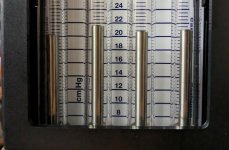
I've got a '79 GS750(N) with stock everything and stock VM26SS carbs (15 pilot, 102.5 mains, middle notch on needle). I've done valve clearances, all intake sealing (air box, boots, o-rings), ignition timing, full carb clean & reassembly with new o-rings, fuel level, etc. I balanced the carbs with a Morgan Carbtune (image below, within 2 cm Hg @ 1,500rpm per manual, feel free to weigh in if you feel this is close enough or not). What I am having difficulty with is setting the pilot air screws. The pilot fuel screws are all at a baseline 1 turn out (tried 7/8 first, wouldn't idle well). I have the carbtune attached to try to help indicate when RPM changes, but it seems like nothing changes unless I pretty much screw the air screws all the way in, at which point RPM does drop quite a bit. Could my correct setting really be not far off completely closed? Are the pilot fuel screws not turned out far enough? Thanks in advance!
 

Attachments

  • photo62036.jpg
    photo62036.jpg
    66.4 KB · Views: 0
I'd use 1.5 turns out on the pilot air, and 7/8 on the pilot fuel. That's a good starting point anyway. You can try to make small adjustments from there, goal being to increase the rpm, but if turning them doesn't effect rpm, leave them there.
 
Suzuki numbered VM 26 carbs with no modifications except jetting and needle height:
Engine is bored out 4mm, Dyna ignition, 3ohm coils, 4 into 1 w/open slip-on and a factory air box thats modified in the filter section. The whole top end has been redone but no other internal mods.

My air screw is out 2 full turns and I'm adjusting from there. However my pilot jet is probably a 16 instead of a 15. It's been drilled out the very next drill bit over a 15. My fuel mixture screw ( the front screw ) is out somewhere between 1/2 and 3/4 turn. So far - at this setting my exhaust has leaned out and I am getting a better off idle throttle response.

I did try a 17.5 pilot jet but I couldn't get the idle to clear up/stumbling/poor performance off idle...

The needle will not have any affect on the idle unless it's missing. It closes the main jet during idle. Moving the e-clip up or down only opens the main quicker (clip moved down) and slower ( clip moved up )

When you turn the screws in, you're cutting off the idle fuel and air and it should drop the idle speed and/or die.

Because of the extreme heat we've been dealing with, I haven't tried to sync the carbs since pulling them and resetting the needle and swaping the pilots. After this and some seat time, my mixture screws will need some tweaking. I use the Motion Pro liquid sync tool.
 
Hi LeonAlistar,

I am having the same experience as you with my 79 gs850 (same carbs, essentially same engine). The bike will idle okay but not smoothly. They’re vacuum synced within spec. The adjustments I make to the idle air screws have little effect on the idle of the bike. The bike vibrates slightly when revving and at idle. At this point, it doesn’t really bog when revving on the stand.

Is your vibrating/smooth? Any input is appreciated.
 
I did a lot of head scratching with VM with air screws (side of the carb) and fuel (pilot) screws (under the carb) working out what does what. I found 'juggling the screws to get a smooth idle' with four carbs pretty much impossible. But I finally got it figured out. Understanding the operation of the pilot circuit is really important as things only make sense when you get this. Sorry if you already know this stuff. But was a lightbulb moment for me.

AIL4fc8M3Yiqky4n0uccK6lcREnmndCbrz3qpmFg48uiW1nM6K3UN2DhtdrbBMW4Dgba8P_ClWPzMbFoNwV_qAnCJ93hvuP57bTwYUX10eyb-iCFu_o_UFAD=s0


The basic operation is air enters the pilot intake situated on the edge of the bellmouth. This air flow is metered by the air screw (rather than the air jet depicted above) which then goes to the pilot jet. The pilot jet is a combination fuel metering jet and emulsion tube. The hole in the bottom of the jet meters the fuel the pinholes on the side of the jet allow air from the air screw to mix with the pilot fuel to form an air/fuel mix (emulsion) that is fixed for the entire idle/pilot system. Being like a fuel/air 'froth' this mix is more easily atomized into a mist as it it drawn into the inlet tract.

This pilot circuit emulsion A/F ratio (mix) is set by the pilot jet size and air screw position. Screw in less air = richer, screw out more air = leaner. This is the mix for the entire idle/pilot circuit.


This pilot mix enters the main airflow through small orifices drilled on the floor of the carburettor venturi one on the engine side of the throttle slide, the others are located upstream and are under the throttle slide, downstream from the needle and needle jet.

The one closest the engine is the pilot orifice and this is metered by the fuel screw. The other orifices are called by-pass orifices and have no adjustments.

With the throttle closed at the lowest idle there is a tiny amount of air flowing under the slide and not enough vacuum to draw fuel out of the needle jet or pilot circuit by-passes. Engine vacuum is focused on the pilot orifice controlled by the fuel screw. Turn the screw out allows more volume of the pilot mix into the airflow passing under the 'closed' throttle slide. Turning the fuel screw in decreases the pilot mix joining this air. The idle fuel/air mix is the sum of both the main air flow and pilot mix passing the fuel screw. So turning the fuel out adds more pilot mix = richer combined A/F ratio, and turning the fuel screw in makes the combined ratio leaner.

What is important to realise is that the pilot orifice and fuel screw only have a strong influence on fuel mixture when the throttle is shut at warm idle and the pilot orifice is the only game in town. As soon as you lift the slide the by-passes start to flow pilot mixture into the increased air flow passing under the slide and this greater quantity of pilot mix is not metered by the fuel screw. I proved this to myself turning the fuel screw at a high idle and getting no colour change on a colortune plug - so this adjustment was making a negligible difference to the mixture.

When the throttle is cracked open above idle the engine is running on the by-passes. When you are cruising on a just open throttle you are on the by-passes. This fuel mixture is set by the pilot jet and air screw.

Because the air screw is upstream of the fuel screw, any adjustment of the air screw affects both the by-passes and pilot. The fuel screw only fine tunes idle mixture
​​​​
My method was to set the air screws at a high idle of around 3,000 rpm using a colortune plug. So I was reading the mixture while the engine was running on the by-passes. Once that was set the idle was dropped to as slow as it would steadily tick over and the fuel screw adjusted to give a Bunsen blue flame. That set the base line. At that point I left the fuel screws alone and tweaked the air screws for the best throttle response.

Doing this way you are setting for correct mixture. Not a fan of arbitrary screw settings across all carbs. The adjustment is there to compensate for the differences between the carbs.
 
Last edited:
I've been working through my bike over (our) colder months, and have circled back to the carbs. I managed to forget about this thread, but wanted to thank you for this detailed explanation - reading through it again, it really helps to make sense of it all. I'd like to pick up a colortune, I'm thinking that'd help a lot to get the carbs dialed in.
​​​​


I did a lot of head scratching with VM with air screws (side of the carb) and fuel (pilot) screws (under the carb) working out what does what. I found 'juggling the screws to get a smooth idle' with four carbs pretty much impossible. But I finally got it figured out. Understanding the operation of the pilot circuit is really important as things only make sense when you get this. Sorry if you already know this stuff. But was a lightbulb moment for me.

AIL4fc8M3Yiqky4n0uccK6lcREnmndCbrz3qpmFg48uiW1nM6K3UN2DhtdrbBMW4Dgba8P_ClWPzMbFoNwV_qAnCJ93hvuP57bTwYUX10eyb-iCFu_o_UFAD=s0


The basic operation is air enters the pilot intake situated on the edge of the bellmouth. This air flow is metered by the air screw (rather than the air jet depicted above) which then goes to the pilot jet. The pilot jet is a combination fuel metering jet and emulsion tube. The hole in the bottom of the jet meters the fuel the pinholes on the side of the jet allow air from the air screw to mix with the pilot fuel to form an air/fuel mix (emulsion) that is fixed for the entire idle/pilot system. Being like a fuel/air 'froth' this mix is more easily atomized into a mist as it it drawn into the inlet tract.

This pilot circuit emulsion A/F ratio (mix) is set by the pilot jet size and air screw position. Screw in less air = richer, screw out more air = leaner. This is the mix for the entire idle/pilot circuit.


This pilot mix enters the main airflow through small orifices drilled on the floor of the carburettor venturi one on the engine side of the throttle slide, the others are located upstream and are under the throttle slide, downstream from the needle and needle jet.

The one closest the engine is the pilot orifice and this is metered by the fuel screw. The other orifices are called by-pass orifices and have no adjustments.

With the throttle closed at the lowest idle there is a tiny amount of air flowing under the slide and not enough vacuum to draw fuel out of the needle jet or pilot circuit by-passes. Engine vacuum is focused on the pilot orifice controlled by the fuel screw. Turn the screw out allows more volume of the pilot mix into the airflow passing under the 'closed' throttle slide. Turning the fuel screw in decreases the pilot mix joining this air. The idle fuel/air mix is the sum of both the main air flow and pilot mix passing the fuel screw. So turning the fuel out adds more pilot mix = richer combined A/F ratio, and turning the fuel screw in makes the combined ratio leaner.

What is important to realise is that the pilot orifice and fuel screw only have a strong influence on fuel mixture when the throttle is shut at warm idle and the pilot orifice is the only game in town. As soon as you lift the slide the by-passes start to flow pilot mixture into the increased air flow passing under the slide and this greater quantity of pilot mix is not metered by the fuel screw. I proved this to myself turning the fuel screw at a high idle and getting no colour change on a colortune plug - so this adjustment was making a negligible difference to the mixture.

When the throttle is cracked open above idle the engine is running on the by-passes. When you are cruising on a just open throttle you are on the by-passes. This fuel mixture is set by the pilot jet and air screw.

Because the air screw is upstream of the fuel screw, any adjustment of the air screw affects both the by-passes and pilot. The fuel screw only fine tunes idle mixture
​​​​
My method was to set the air screws at a high idle of around 3,000 rpm using a colortune plug. So I was reading the mixture while the engine was running on the by-passes. Once that was set the idle was dropped to as slow as it would steadily tick over and the fuel screw adjusted to give a Bunsen blue flame. That set the base line. At that point I left the fuel screws alone and tweaked the air screws for the best throttle response.

Doing this way you are setting for correct mixture. Not a fan of arbitrary screw settings across all carbs. The adjustment is there to compensate for the differences between the carbs.
 
The fact that you have to limit the air to achieve idle indicates that the fuel flow is clogged some where.

Start by removing the fuel needles and see if their tips are broken off in the carb body.

If not, work back to the pilot jet, checking the fuel flow in the carb body

You did clean the carb bodies per the tutorial?
 
Back
Top