• Required reading for all forum users!!!

    Welcome!
    Register to access the full functionality of the GSResources forum. Until you register and activate your account you will not have full forum access, nor will you be able to post or reply to messages.

    A note to new registrants...
    All new forum registrations must be activated via email before you have full access to the forum.

    A Special Note about Email accounts!
    DO NOT SIGN UP USING hotmail, outlook, gmx, sbcglobal, att, bellsouth or email.com. They delete our forum signup emails.

    A note to old forum members...
    I receive numerous requests from people who can no longer log in because their accounts were deleted. As mentioned in the forum FAQ, user accounts are deleted if you haven't logged in for the past 6 months. If you can't log in, then create a new forum account. If you don't get an error message, then check your email account for an activation message. If you get a message stating that the email address is already in use, then your account still exists so follow the instructions in the forum FAQ for resetting your password.

    Have you forgotten your password or have a new email address? Then read the forum FAQ for details on how to reset it.

    Any email requests for "can't log in anymore" problems or "lost my password" problems will be deleted. Read the forum FAQ and follow the instructions there - that's what we have one for...

  • Returning Visitors

    If you are a returning visitor who never received your confirmation email, then odds are your email provider is blockinig emails from our server. The only thing that can be done to get around this is you will have to try creating another forum account using an email address from another domain.

    If you are a returning visitor to the forum and can't log in using your old forum name and password but used to be able to then chances are your account is deleted. Purges of the databases are done regularly. You will have to create a new forum account and you should be all set.

Volt meter recommendations

picked up one of the earthquake proof ones. Does this wire right to the battery? maybe i could wire it into my sspb?
 
picked up one of the earthquake proof ones. Does this wire right to the battery? maybe i could wire it into my sspb?
Hook it to O/G (Pin7) SIGNAL or the RED2( Pin 8) switched ACCESSORY if you want the voltmeter only ON when the ignition switch is on. You would need t o jumper ACCESSORY to come on with the IGNITION SW however. If you use O/G, then keep it as close to the SSPB output as possible. If you converted to Led then probably any where on o/g.

If you add a charger port then it is nice to see volts when trickle charging but you need an extra switch.
I have an accessory port for 12v devices including trickle chargers. So I wanted to see voltage when the bike is off but not drain the batt. I measure the unswitched output at the plug but with a small inline switch I can turn off.

it is not necessary to trickle charge , only to activate/deactivate the meter.

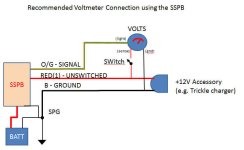
Here is a schematic
SSPB_Voltmeter_Connections_zps7z6yrlm3.jpg

attachment.php
 

Attachments

  • SSPB_Voltmeter_Connections.jpg
    SSPB_Voltmeter_Connections.jpg
    29.7 KB · Views: 0
Last edited:
Wow. I think I got that right! Except for tapping into the Gr wire (tach, speedo, etc. lights) in the headlight bucket for gauge power. Why keep it as close as possible to SSPB on the O/G? I figured that wouldn't matter, as long as the sense wire was as close as possible to the battery, and Neg at SPG.

Thanks for the amazingly helpful info (yet again).
 
Wow. I think I got that right! Except for tapping into the Gr wire (tach, speedo, etc. lights) in the headlight bucket for gauge power. Why keep it as close as possible to SSPB on the O/G? I figured that wouldn't matter, as long as the sense wire was as close as possible to the battery, and Neg at SPG.

Thanks for the amazingly helpful info (yet again).

Grey is the O/G just down stream.

The sense wire (you still not running a SERIES R/R?) keeps the R/R charging the battery at the proper 14.5V even if there is resistance between the Battery(+) and the R/R(+). It doesn't help for dirty grounds). However if you are drawing 5-10 amps for blinker, brakes and tail light through the O/G and there are dirty contacts you could get quite a big drop when you consider you are trying to monitor the battery voltage.

If you take O/G output right at the SSPB then the only voltage drop is due to the SSPB MOSFETS which is about 0.1 ohms.

On the other hand if you did not load the SWITCHED accessory and used that as your sense point, it would basically be extremely close to battery voltage as you are not pulling any current from it.

Basically for measuring voltage you need to be as close to the battery as you mentioned, but you need it switched and the SSPB is in fact a bunch of electronics switches. So the closest thing to the battery that is switched is the output O/G of the SSPB.

Note the 0.1 ohm resistance is slightly more than a perfectly clean contacts or mechanical relay. However, those things do not stay pristine and will corrode increasing the resistance. On the other hand the MOSFET does not degrade and doesn't get any worse.


Given all that teh O/G may not even be teh best choice.
 
Just got one of these, which sidesteps the mounting issue for the moment, and is transferrable if I put proper 2" gauges into the fairing later on.
http://www.ebay.co.uk/itm/361246303092

Be nice to find an oil temp gauge in the same style and size.

attachment.php
 

Attachments

  • voltmeter bar mounted.JPG
    voltmeter bar mounted.JPG
    27.4 KB · Views: 0
That looks like a good solution for my 78 1000,thanks Grimly:encouragement:
 
Grey is the O/G just down stream.

The sense wire (you still not running a SERIES R/R?) keeps the R/R charging the battery at the proper 14.5V even if there is resistance between the Battery(+) and the R/R(+). It doesn't help for dirty grounds). However if you are drawing 5-10 amps for blinker, brakes and tail light through the O/G and there are dirty contacts you could get quite a big drop when you consider you are trying to monitor the battery voltage.

If you take O/G output right at the SSPB then the only voltage drop is due to the SSPB MOSFETS which is about 0.1 ohms.

On the other hand if you did not load the SWITCHED accessory and used that as your sense point, it would basically be extremely close to battery voltage as you are not pulling any current from it.

Basically for measuring voltage you need to be as close to the battery as you mentioned, but you need it switched and the SSPB is in fact a bunch of electronics switches. So the closest thing to the battery that is switched is the output O/G of the SSPB.

Note the 0.1 ohm resistance is slightly more than a perfectly clean contacts or mechanical relay. However, those things do not stay pristine and will corrode increasing the resistance. On the other hand the MOSFET does not degrade and doesn't get any worse.


Given all that teh O/G may not even be teh best choice.

Pos, what you're describing doesn't sound like the schematic you drew. Or at least, my reading of it. My distal connection to O/G powers the gauges ("lights" on your schematic). The voltmeter's positive wire ("sense") is almost directly on the battery terminal, so I don't have a collection of voltage drops on it. The gauge reads almost exactly the same voltage my multimeter reads at the battery terminals.

My regulator has been a Cycle Electric 601 for four years now. I was referring to the new voltmeter's sense wire, not a 5- or 6-wire R/R.
 
Pos, what you're describing doesn't sound like the schematic you drew. Or at least, my reading of it. My distal connection to O/G powers the gauges ("lights" on your schematic). The voltmeter's positive wire ("sense") is almost directly on the battery terminal, so I don't have a collection of voltage drops on it. The gauge reads almost exactly the same voltage my multimeter reads at the battery terminals.

My regulator has been a Cycle Electric 601 for four years now. I was referring to the new voltmeter's sense wire, not a 5- or 6-wire R/R.


Hook it to O/G (Pin7) SIGNAL or the RED2( Pin 8) switched ACCESSORY if you want the voltmeter only ON when the ignition switch is on.
I described several things that I figured did not need a diagram.So you are correct the diagram does not reflect connecting the voltmeter to O/G or RED2 the two things I initially mentioned. As you see above, O/G and RED2 are only recommended if you DO NOT want to measure the voltage when the bike was off.

However, the diagram is how I would suggest using the SSPB for use for a power plug and to monitor the voltage as I can do it with the bike off. I figured this did need diagram to show those details.
 
I described several things that I figured did not need a diagram.So you are correct the diagram does not reflect connecting the voltmeter to O/G or RED2 the two things I initially mentioned. As you see above, O/G and RED2 are only recommended if you DO NOT want to measure the voltage when the bike was off.

However, the diagram is how I would suggest using the SSPB for use for a power plug and to monitor the voltage as I can do it with the bike off. I figured this did need diagram to show those details.

OK, that all makes sense to me. But the way I read your post, it sounded like you expect the voltmeter to measure voltage from O/G, instead of from the wire labeled "sense" on the schematic.
 
OK, that all makes sense to me. But the way I read your post, it sounded like you expect the voltmeter to measure voltage from O/G, instead of from the wire labeled "sense" on the schematic.

It did and it does. As my GF says , "it is an if-then-statement"; If you want a switched source to read voltage when the ignition is turned on, use O/G as close to the SSPB as practical (or Red2 with provisos). Interpret "read voltage" as "sense voltage".

I did not draw a schematic as it should be pretty obvious.
 
37mm diameter digital oil temp gauge to match the voltmeter... not too sure about how weatherproof it might be, or how easily it could be made so, but it's cheap enough to find out. I'm sure I can find a bar mount clamp from one of the many sellers of flashlight mounts for bicycles.
http://www.aliexpress.com/store/pro...ure-Gauge-Meter-Silver/412191_1532796275.html
The seller has a range of other instruments.

With the size of those small LED displays, you can almost stick them anywhere. I just ordered a red LED Boost gauge that I'm going to dissect to see if I can mount the gauge in my stock gauge cluster rather than in the gauge pod housing. Beyond my stock gauges, I'm running VOM 52mm Volts (90 degree) and 15 psi mechanical (270 degree)Pressure gauges. I also have a 270 degree Volt meter on order, but if the boost gauges comes apart , I will not be using it.

Mechanical dial gauges are really much better except in the case of volts, where the swing is really not large enough and with pressure gauges because unless you get a electronic gauge which is pretty expensive in 15 psi range, the mechanical gauges wear out. I was able to repair mine well beyond the factory robustness, but it will eventually wear out as well.


The GS1100ED has so many obsolete idiot lights there is actually quite a bit of room for these small LED displays if bare. I already prototyped the volt meter and it fits in place of the electrolyte idiot light. I have plans for conversion of several of the idiot lights , and then get rid of my gauge pods. More on that later.
 
Last edited:
These are not waterproofed like the expensive $5 units. But for $2.68 how can you go wrong?

http://www.ebay.com/itm/DC-3-50-30-...7&pid=100005&rk=3&rkt=6&sd=301611670229&rt=nc

The high end model............

http://www.ebay.com/itm/Waterproof-...7&pid=100005&rk=2&rkt=6&sd=301611670229&rt=nc


The water proof one is very accurate. I tested from 3.5V up to 30V and it tracked very well. My power supply is three digits, but under 10V only shows to 0.1V and this little bugger shift to 0.01 V resolution below 10V. The numeral height is smaller than the other LED I have and it is smaller than the LED in this boost gauge which I disassembled.


http://www.ebay.com/itm/261876163942?_trksid=p2057872.m2749.l2649&ssPageName=STRK:MEBIDX:IT

I'm planning on mounting both Volt and Pressure meter into my dash.
 
This is my little voltmeter.

IMG_6325.JPG


IMG_6267.JPG


It has a clock function as well. It has 3 wires. I wired it into the headlamp circuit (in the UK we have a headlamp on and off switch). With the ignition off you can push the button to read the battery status. With the engine running and the headlamp on, it reads voltage continuosly. It registers about .5 v down from what a multimeter reads at the battery.

It just saved my trip to Spain. Initially when I started the trip at 5K it was showing 13.9 (real time 14.4) but by the middle of day 2 of the trip it was reading 11.9. My battery was not being charged and this little device warned me.

I immediately checked output from the stator and the condition of the reg/rect and both tested good. Something else was amiss. After a while I discovered the bottom screw to the starter solenoid (which has the output from the reg/rect attached to it) was lose. It was only on by a few threads and this obviously caused a bad connection and no charging of the battery.

IMG_6320.JPG


My trip was saved by this device and I will never go anywhere without one.

Greetings
 
Last edited:
That light green white carries all of the current from your charging system and as you have noted the connection is vital to charging. You should invest $30 to but a decent crimper (like the oem one next to it ) and put a proper ring lug on to it.

The crimps are designed to grab the insulation to support the wire. You wire is unsupported and even worse at a 90 degree angle. With a little bit of persistent vibration that copper will flex, work harden and then break-off. You will probably notice that on your volt meter, but why leave that to happen at an inopportune time?


In the same vein, you seem to have wires going all over in that picture. You should use some tie straps to support the wires so that flexing is minimized.

You can search around for a better price, but this crimper is the most versatile I have found. There are perhaps better looking ones, but they are not as versatile. Most crimpers crimp the conductor and insulation together. That requires a good match between 4 elements, 1)the wire, 2.)insulator, 3.) ring lug and the 4.) crimper tool. Most of the times they do not match unless you buy specific wire and lugs for your tool.

This simple tool does allows you to find the best crimp for the insulator and then the conductor or in whatever order you wish. It also has a set of small jaws in the front that can be used if the crimp just doesn't get squeezed enough.

Probably the best feature of the design goes mostly un-noticed. I only realized it when comparing different crimpers that I had purchased. Most designs have the jaws fixed using a central pin. As a result the jaws come together in an arch. That tends to rotate the crimp and twist it.

These simple little crimpers has a two pin arrangement that maintains the jaws parallel. So there is no rotation and they tend to just squeezed together like a vice instead of a twisting motion of the others.

http://www.ebay.com/itm/14-24-AWG-M...580?pt=LH_DefaultDomain_0&hash=item235047bb0c
 
Last edited:
Londonboards, my current voltmeter does time (and ambient temp) too but is 4 times the size of yours. Looks decent, weatherproof?

Thanks posplayr, I've been looking for a decent crimp tool at a good price. Was going to comment on that little green wire/crimp too, but you thoroughly covered it. :D

My "expensive ($5)"waterproof voltmeter should be here in about a week, glad to hear that it tested out good, nice to have that granular voltage below 10V.
 
I received these; they are ideal for mounting in a gauge face or other protected locations. The LED is larger than the waterproof units.

http://www.ebay.com/itm/380687977328?_trksid=p2057872.m2749.l2649&ssPageName=STRK:MEBIDX:IT

There is just a small PCB mounted to the back of a standard 3 digit LED dispalay to turn it into a volt meter. My bike is not running at the moment so I don't know how noise immune it is, but I'm going to add some filtering regardless. The wires are very thin so be forewarned.

http://www.ebay.com/itm/150961267048?_trksid=p2055119.m1438.l2649&ssPageName=STRK:MEBIDX:IT

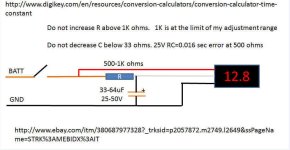
I added a low pass filter using a capacitor and resistor to the meter. If you keep the input resistor at 1K and below you can use the trim pot at the back to adjust the voltage. I used 1K ohms and 64 uF at 50V which is what I had in the cabinet. The input resistance of the meter was 65K ohms so 650 ohms is about a 1/100 of full scale (30 V) which would be about 0.3 Volts.

After the adjustment, the device tracks my Fluke 75 pretty well below 10 volts where I get 0.01V of resolution on both. Probably within 0.05V below 10V but it will depend on your adjustment and the resistor you choose if you can get it exact. At 500 Ohms it is within the adjustment range of the pot.

Be very careful when making the adjustment. I shorted out my first meter doing the adjust in a confined space. :( Another $1.50 down the drain.

attachment.php
 

Attachments

  • voltage_conditioner3.jpg
    voltage_conditioner3.jpg
    50.5 KB · Views: 0
Last edited:
Back
Top