• Required reading for all forum users!!!

    Welcome!
    Register to access the full functionality of the GSResources forum. Until you register and activate your account you will not have full forum access, nor will you be able to post or reply to messages.

    A note to new registrants...
    All new forum registrations must be activated via email before you have full access to the forum.

    A Special Note about Email accounts!
    DO NOT SIGN UP USING hotmail, outlook, gmx, sbcglobal, att, bellsouth or email.com. They delete our forum signup emails.

    A note to old forum members...
    I receive numerous requests from people who can no longer log in because their accounts were deleted. As mentioned in the forum FAQ, user accounts are deleted if you haven't logged in for the past 6 months. If you can't log in, then create a new forum account. If you don't get an error message, then check your email account for an activation message. If you get a message stating that the email address is already in use, then your account still exists so follow the instructions in the forum FAQ for resetting your password.

    Have you forgotten your password or have a new email address? Then read the forum FAQ for details on how to reset it.

    Any email requests for "can't log in anymore" problems or "lost my password" problems will be deleted. Read the forum FAQ and follow the instructions there - that's what we have one for...

  • Returning Visitors

    If you are a returning visitor who never received your confirmation email, then odds are your email provider is blockinig emails from our server. The only thing that can be done to get around this is you will have to try creating another forum account using an email address from another domain.

    If you are a returning visitor to the forum and can't log in using your old forum name and password but used to be able to then chances are your account is deleted. Purges of the databases are done regularly. You will have to create a new forum account and you should be all set.

wera V5 road race chasis set up

  • Thread starter Thread starter cbrophy22
  • Start date Start date
C

cbrophy22

Guest
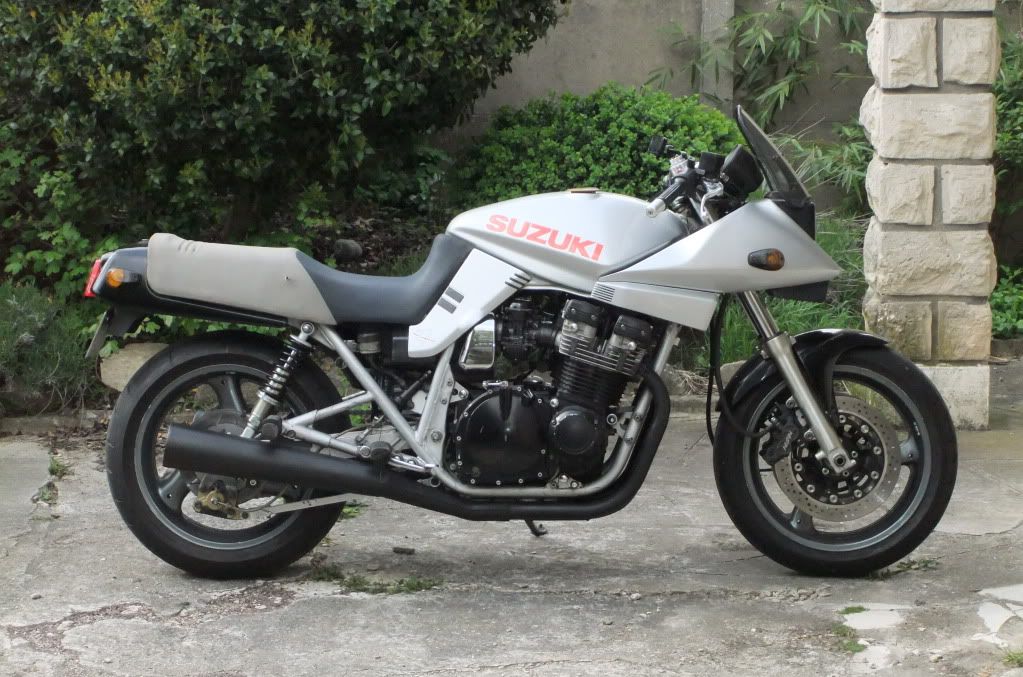
I was thinking about turning my 83 11e into a track bike. I am still very much on the fence with this.

the basics. 92 gsxr forks and rim. the swing arm is stock with a 92 5.5 rim.

plan to mono, in the works soon.

What I am really looking for is ride height, shock angles, head tube angles, or run stock? I really just don't know.

I went to cedar point WV, my buddy Shane #331 races V7. that was one of the coolest weekends I had had in a long time 10y+. its some thing that looks like a lot of fun.

any thoughts thanks
 
I would be surprised if USD forks and monoshock would be allowed. But what do i know.
My thought would be to get a hold of a rulebook and find out what you can change.
 
Given the size and weight of the 1100E, I don't think it would make a great roadrace bike. If you're going to change the forks, shocks, swingarm, wheels, etc, you have a new problem which is that you still have a big, heavy bike, but now it's with an unproven suspension/tire package.

Keep in mind that when Wes Cooley and Feddie Spencer were road racing these bikes, they had factory backing with factory parts, and factory testing, on top of their skills as riders. Everyone else riding these bikes back in the day were using stock parts, or proven upgrades.

So if you build a hybrid 1100E with modern parts, and ride it on the streets, that's one thing. You'll never get close to the limit of any of the parts riding on the street, and so you can be pretty sure that it will be safe. Once you put it on the track, you're looking at the torque-monster of a motor in a chassis never designed for the suspension and tire loads that modern forks/shocks and radial tires can generate.

You would have to be a skilled and experienced track rider to take an unproven collection of parts and be able to assemble and tune them for track use. You would need to start from scratch with regards to spring rates, fork/shock valving, fork/shock oil weight, preload and compression settings, ride height, tire selection, brake bias, etc. For my money, it seems like a big project that not too many folks are qualified for.

You could pick up a 90's CBR, GSXR, or FZR 600 for very little money, overhaul the stock components and fit new tires for about $500 more. Race-tech will have info on file for those bikes, and if you give them your weight and riding style, they can guide to proven set-ups for springs, oil and valving, and you'll end up with a quick, lightweight, bike that will have proven, reliable handling.
 
Building a vintage racer sounds like fun. As Steve points out though, you need to know what you can, and what you can not modify. Most likely a modern fork will be off limits. Another option is to build a vintage track day bike. For that, anything goes.:D
 
Building a vintage racer sounds like fun. As Steve points out though, you need to know what you can, and what you can not modify. Most likely a modern fork will be off limits. Another option is to build a vintage track day bike. For that, anything goes.:D

True - and the rules of the various Vintage racing organisations are a good place to start. Vintage racing has been around long enough now that the clubs have pretty much sorted what is safe and what's not.

Kawfeedave is a little over the top...the 1100's do make a very competitive Vintage racebike - if you're man enough to handle it....17 inch wheels in the limited widths allowed make just enough difference to be interesting. The GS1000 I look after for a very good local rider is starting to get too much for it's tyres now too - not just weight but HP too...
 
Kawfeedave is a little over the top...the 1100's do make a very competitive Vintage racebike - if you're man enough to handle it....17 inch wheels in the limited widths allowed make just enough difference to be interesting. The GS1000 I look after for a very good local rider is starting to get too much for it's tyres now too - not just weight but HP too...

Note that you state 'if you're man enough' and that your friend is a 'very good local rider'. I do state that it's possible to set-up and run a bike as described in the first post, but that it would take a degree of skill and experience, just as you described.

I think the point that many people miss is that the design and component choice of a new bike is far more than just seeing what's around, or what they can wedge into an existing bike. The suspension geometry, pick-up point, front/rear weight balance, wheelbase, head angle etc, are all carefully chosen to provide a specific result, and even then it's tested extensively for many miles by some very skilled riders.

All of the resto-mod projects I have seen were assembled on the basis of what was easiest to fit, or what they could find the cheapest when sourcing components, and that's not the way to build a race bike. The proper way would be to run it stock, identify the flaws one at a time, and then address those flaws individually. If the fork is too soft, or flexy, up grade the forks, then work on the springs, oil, valving, and settings, and get it working with the new forks. Then move on to address the next problem, and so on.

To simply replace everything front and rear, and then hit the track with a heavy, long wheel-base, tourque monster running modern suspension on a 30 year old frame is not the way to go. Show me the factory race team or racing shop that builds a hodge-podge bike and then send it out with a novice rider on day one, and I'll retract my posts, but you won't find it.

There's a reason that Kenny Roberts and Kenny Jr practice with XR100s on their ranch, and that's because it's the rider that makes it go fast, not the bike. They could handle any size XR they wanted, but all they need are the 100s to really work their skills and keep themselves sharp. A lighter, well sorted bike will be far eaiser to ride (and ride fast) then a mixed up, heavy brute of an 1100e, plain and simple.

All of that is ignoring the fact that modern suspenion and tires will load up the chassis that much faster, and spit the rider off that much quicker unless the bike and rider are both 'expertly set-up'. Watch the movie 'Faster' about Moto-GP, and they describe the life style as 'Practice on Sat, race on Sunday, and travel all week during the season, and then test, test, test, test, test, the rest of the year'. Set-up and rider skill are come first, big horsepower is a distant second.
 
By kawfeedave's logic, there would be no vintage racing. Whatever dude.
 
By kawfeedave's logic, there would be no vintage racing. Whatever dude.

You guys are both right. :)
If you want to run at the front in the more competitive classes then you really do need to have your ducks in a row. Know what parameters really matter (and why!), how all the various bits work together, when too much power is going to cause more problems than it's worth...all the stuff it takes to build a proper race bike.
On the other hand, the vast majority of the vintage paddock isn't like that, it's guys throwing stuff together, going out and having a great time.

And that's how you learn the right way, by going out and doing it wrong for a while. :D
 
I've been doing the wrong way for a long time... But I heal fairly quick...!
Curt
 
I don't want to contradict what is being said here too much, but from my limited experience building my ED up with stock parts albeit with upgraded springs/shocks/valving and then in comparision going to 88 GSXR 1100 wheels/forks/radial tires/brakes, rest assured just putting on newer rubber,forks and brakes will make your bike a whole lot safer at higher speeds than it ever was as originally designed and aged by some 30 years. :twistedevil:

That is not to say you will have an optimum configuration as that is where the art of racing and riding will come into play. But bolting on some vintage (1st gen / 2nd gen suspension) modifications will go along way on the street and maybe close to what you need on the track.
 
I don't want to contradict what is being said here too much, but from my limited experience building my ED up with stock parts albeit with upgraded springs/shocks/valving and then in comparision going to 88 GSXR 1100 wheels/forks/radial tires/brakes, rest assured just putting on newer rubber,forks and brakes will make your bike a whole lot safer at higher speeds than it ever was as originally designed and aged by some 30 years. :twistedevil:

That is not to say you will have an optimum configuration as that is where the art of racing and riding will come into play. But bolting on some vintage (1st gen / 2nd gen suspension) modifications will go along way on the street and maybe close to what you need on the track.

That's correct - the old frames are actually not as bad as reputed..If you stick to 18 inch wheels the rubber available becomes the limiting factor. Unless you have the budget for Avons..in which case you can afford to go 17 inch anyway.Most associations limit wheel width in the popular pre 82 class to 3.5in front and 5 in rear..which usually means a 4,5 rear as there are very few 5 inch 17's around. this size rubber is adequate - not brilliant, and not really enough to handle a full house 1100 but good enough to go racing on. Most association's rules severely limit what can be done in updating - fork diameter limits, age of main components etc.
You are definitely not producing an ideal race bike from scratch...
To put it crudely - you're producing a pastiche of a period racebike. As accurate as circumstances and available parts allow...to give as accurate an impression as possible of riding the original back in the day. Wheelspin and wobbles included....

From my point of view as a constructor i've got to assess the customer's ability and give him something he can ride to his limits without scaring the pants off him and those around him...
 
I don't want to contradict what is being said here too much, but from my limited experience building my ED up with stock parts albeit with upgraded springs/shocks/valving and then in comparision going to 88 GSXR 1100 wheels/forks/radial tires/brakes, rest assured just putting on newer rubber,forks and brakes will make your bike a whole lot safer at higher speeds than it ever was as originally designed and aged by some 30 years. :twistedevil:

That is not to say you will have an optimum configuration as that is where the art of racing and riding will come into play. But bolting on some vintage (1st gen / 2nd gen suspension) modifications will go along way on the street and maybe close to what you need on the track.
I can only confirm this with two examples: an 1100 Kat with 2nd gen GSXR components (17" wheels) and a GS 1000 S with 1st gen GSXR components (18" wheels) except for the rear monoshock.
In both cases the high speed stability of the bikes has increased dramatically over the originals.
I know as I have kept one of each:)
401a7447.jpg

0cdddacd.jpg
 
Yes I was thinking more of a track day bike or a weekend track bike. I am not really trying to take on the whole season. More like something fun to do on the weekends. but if there is a race that weekend in my class, I am there to win.

I checked the WERA rule book and the only thing illegal with my proposed set is the new calipers. so if I get flagged I am not to worried about it.

So what is a good starting point to shoot for. for head tube angle, ride height, wheel base etc. and yes there will be many miles of testing,

Right Now I am not worried about damping rates, I need to know were to mount my shock, or If I have to cut down my swing arm.

Thanks CB
 
The one easy thing to remember is that lowering the front end by 1 inch will decrease the caster angle by 1 degree.
The GS family came with 28? of caster out of the box.
The same applies of course if you lift the rear by 1 inch.
I recommend the " Motorcycle Dynamics" book by Vittore Cossalter for further info:).
A good compromise in terms of fork length ( to maintain adequate ground clearance) and compatibility with the steering head is the GSXR 1100 1st gen fork.
Be aware however that they differ between years and are not identical to the GSXR 750 model:rolleyes:
 
Reading some of these posts I think there are some basics that you can start with, these everyone will agree on.

Geometry, homework will need to be done AND if possible alternate mounts should be made to the rear end to tailer geometry to the track.
Components, modern brakes and suspension will make a difference, this will include additional weight springs and oils to tune suspension.
Frame, stiffening up the frame will provide stability and we should look to the period race bikes for clues as to what was done (huge difference between my bikes).
Engine, power is part 2, reliability is more important for the consistent high RPM work.
Weight, it needs to go but not leave the bike a wet noodle.

When I look at building my bike into a track bike this is where it starts, each one of those items is a project in itself but if done right the first day at the track will be safe.
 
Keep in mind too that steering head angle isn't what really matters, it's trail that's important. That angle is just one of the parameters that affect trail. Tire radius, fork length, shock length, triple clamp offset are other things that will change it.

On ride height, rough rule is that 3mm of change in ride height gives you a 1mm change in trail.
 
Back
Top