• Required reading for all forum users!!!

    Welcome!
    Register to access the full functionality of the GSResources forum. Until you register and activate your account you will not have full forum access, nor will you be able to post or reply to messages.

    A note to new registrants...
    All new forum registrations must be activated via email before you have full access to the forum.

    A Special Note about Email accounts!
    DO NOT SIGN UP USING hotmail, outlook, gmx, sbcglobal, att, bellsouth or email.com. They delete our forum signup emails.

    A note to old forum members...
    I receive numerous requests from people who can no longer log in because their accounts were deleted. As mentioned in the forum FAQ, user accounts are deleted if you haven't logged in for the past 6 months. If you can't log in, then create a new forum account. If you don't get an error message, then check your email account for an activation message. If you get a message stating that the email address is already in use, then your account still exists so follow the instructions in the forum FAQ for resetting your password.

    Have you forgotten your password or have a new email address? Then read the forum FAQ for details on how to reset it.

    Any email requests for "can't log in anymore" problems or "lost my password" problems will be deleted. Read the forum FAQ and follow the instructions there - that's what we have one for...

  • Returning Visitors

    If you are a returning visitor who never received your confirmation email, then odds are your email provider is blockinig emails from our server. The only thing that can be done to get around this is you will have to try creating another forum account using an email address from another domain.

    If you are a returning visitor to the forum and can't log in using your old forum name and password but used to be able to then chances are your account is deleted. Purges of the databases are done regularly. You will have to create a new forum account and you should be all set.

What To Do With 3 Air Bleed Holes

  • Thread starter Thread starter Suzuki_Don
  • Start date Start date
S

Suzuki_Don

Guest
I have dipped two of my CV carbs so far. I have made the tool with matchstick and wire bristle from a wire brush. I have cleaned all the small holes that the tutorial shows to do.

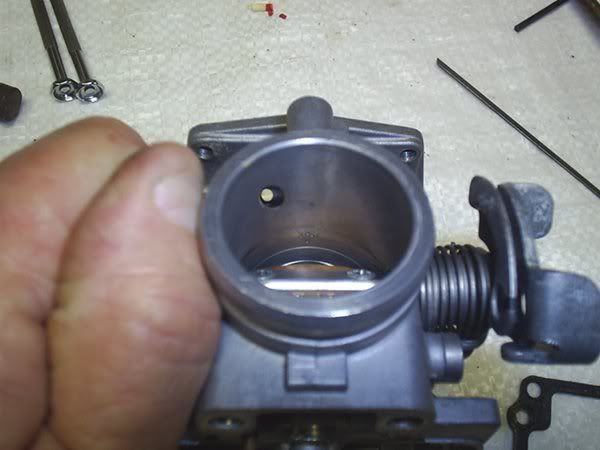
But I have found three other very small holes between the throttle plate and the piston which I believe to be Air Bleed holes. I cannot get the wire tool to penetrate these holes as I cannot line things up as with the other small holes. How do I clean these small holes? Where are the other ends of these bleed holes? Can I access these holes from the other end of the hole?

I don't want to put the carbs back on and find it doesn't run right because of this. All or any help appreciated.
m_S3010018-1.jpg


QUESTION 2: Each of the CV carbs has a reasonably strong spring on it and I assume when this spring pressure is multiplied by four there is going to be quite a bit of pressure at the twist grip for the rider. Is there a need to weaken these springs in any way to make things easier on the rider's right hand. Do all four need to be connected and if so is this the reason why there is only one throttle cable on CV equipped bikes. i.e. the springs close the throttle and no need for PULL close throttle cable?

Just trying to understand the principle of how this system works, not wanting to re-invent the whole thing.

Thanks in advance for any help given.
 
Last edited:
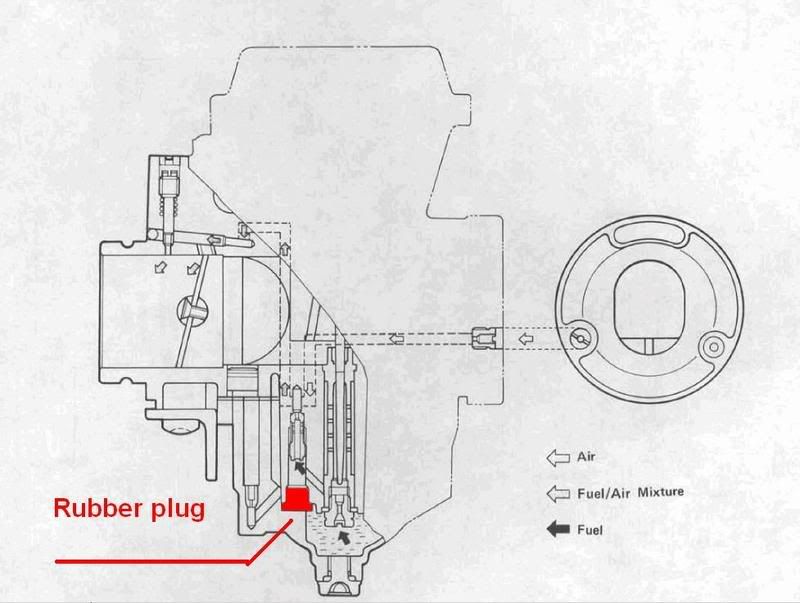
They are not "air bleed" holes. That is where the mixture comes in from the pilot system. The two closest to the camera are never covered by the throttle plate, and the closest one is the one that the "idle mixture adjustment screw" lives in. The other one will be uncovered as the throttle opens.

This cut-away drawing is from the factory manual. It was colored to show the importance of the rubber plug, but it shows the three openings and how they work:
CarbRubberplug.jpg


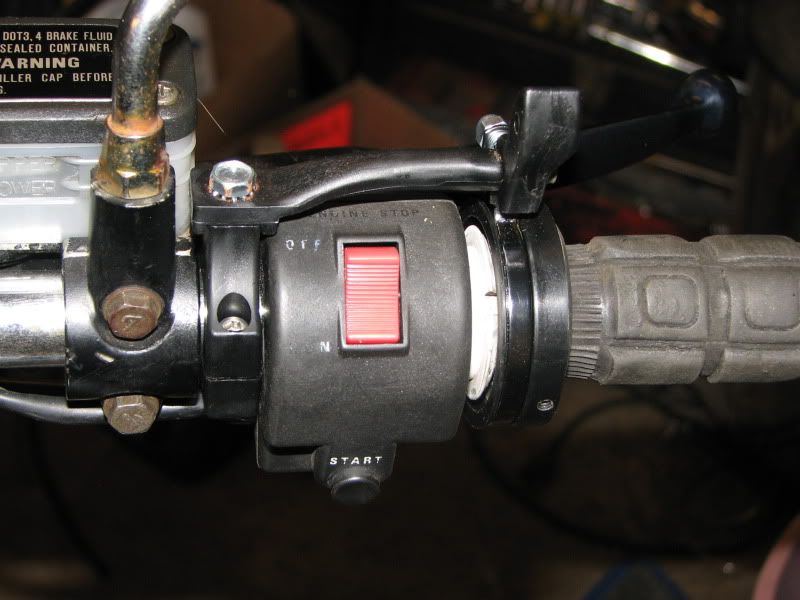
Don't worry about the spring tension. It seems to be a lot when playing with the individual carbs, but the leverage in the throttle grip makes it tolerable for all but the weakest riders. If you are worried about having to hold it somewhat steady for longer trips, install a throttle lock to hold it for you.

IMG_3501.jpg


.
 
Last edited:
As far as cleaning the holes, after the dip use spray carb cleaner to shoot through the holes, watch the spray come back out to make sure the pattern is the same on all four carburetors.
If there is one with a problem it won't spray through the same as the others, you can see this. Those holes don't tend to clog as they are above the level of fuel in the bowl, as long as some particle didn't block the passage it will be fine.
 
Thanks STEVE, how do I clear those other holes. I have cleared the one directly below the mixture screw, but cannot get a clear go at the other three.
Thanks.
 
As far as cleaning the holes, after the dip use spray carb cleaner to shoot through the holes, watch the spray come back out to make sure the pattern is the same on all four carburetors.
If there is one with a problem it won't spray through the same as the others, you can see this. Those holes don't tend to clog as they are above the level of fuel in the bowl, as long as some particle didn't block the passage it will be fine.

Thanks TKENT,

Just another quick one. Do I spray the carb cleaner from the pilot jet end or in through the holes in the venturi.

Thanks again.
 
Thanks TKENT,

Just another quick one. Do I spray the carb cleaner from the pilot jet end or in through the holes in the venturi.

Thanks again.

Spray down though the pilot screw Don, path is shorter.
 
I would also caution against using a bristle from a wire brush. The steel bristle is harder than the metal in the carb and can gouge away some of the material around the hole. I prefer to use a single strand of copper from some 16- or 18-gauge wire. If the hole is too small, find some finer copper strands. The copper is stronger than most dirt, but softer than the carb body (and the brass jets), so it won't enlarge the holes.

.
 
You can lesson the tension by unwrapping the spring one revolution. I wouldn't though since you really want the carbs to snap shut. The effort is minimal at the throttle.
 
You can lesson the tension by unwrapping the spring one revolution. I wouldn't though since you really want the carbs to snap shut. The effort is minimal at the throttle.
I had wondered about doing something like that on mine. My throttle hand gets numb very quickly, and I have tried several grip methoods
 
I had wondered about doing something like that on mine. My throttle hand gets numb very quickly, and I have tried several grip methoods
Even though it's your hand that goes numb, take a good look at the rest of your upper body.
If you have to hunch your shoulders forward to reach the bars, it can put strain on nerves that will then be felt in your hand.

My wife had that problem before I added set-backs to the buckhorn bars.
Now she does not have to reach for the bars, they have come back to her. :D

.
 
I tried one but it kept sliding around the bar

I wasn't mounted right, or was the wrong size.
They work great.

Don, I like to spray those holes every which way, making sure all the holes react the same on every carb. Plug the jet side with your thumb, then see a different spray pattern.
 
I wasn't mounted right, or was the wrong size.
They work great.

Don, I like to spray those holes every which way, making sure all the holes react the same on every carb. Plug the jet side with your thumb, then see a different spray pattern.
One of the velcro attachment deals, the one I tried, unless they sell something better. It was strapped on very tight, but would slowly wander..
 
One of the velcro attachment deals, the one I tried, unless they sell something better. It was strapped on very tight, but would slowly wander..

Was it on upside down?
It is made to tighten when you rock it down?
Mine stays put forever.
Maybe you have a cheap imitation?
 
I wasn't mounted right, or was the wrong size.
They work great.

Don, I like to spray those holes every which way, making sure all the holes react the same on every carb. Plug the jet side with your thumb, then see a different spray pattern.

Thanks Tom. I am getting a great spray pattern now I have worked out how to do it with your help and others.
 
Another question - diaphragm pistons

Another question - diaphragm pistons

When I removed the two pistons from #1 & #2 carbs before I dipped them I found that there was an oily substance on the pistons which would explain why these two pistons were sluggish returning to the bottom of their travel.

Are these pistons supposed to be in a dry environment or is there some lubricant on them to prevent air leaks when the motor is running. Do I put them back dry or should they have a spray of WD40 or something else.

What is the best method of cleaning the diaphragms and with what. I would think carb cleaner is a bit severe.

Thanx.
 
I spray a corner of a towel and wipe down the slides. I don't let harsh chemicals touch the diaphrams. It warps them and it makes it a bear to reassemble plus it probably isn't good for the material.
The slides and bore should be dry and clean.
 
I spray a corner of a towel and wipe down the slides. I don't let harsh chemicals touch the diaphrams. It warps them and it makes it a bear to reassemble plus it probably isn't good for the material.
The slides and bore should be dry and clean.

Thanks Bill. I knew I could trust you for some reliable carb information. You being the CARB GURU on the site.

The diapragms and slides are in really good nick, like new. So didn't want to risk causing any damage. I think these carbs had very low milage on them as the mixture screw plugs were still in place. No holes or passages were blocked, float bowls were really clean, etc.

Just one other question: Seeing as these carbs are off a 650G motor and I am tuning them for a 650E, what difference do the springs that fit in the top of the carbs make. I notice on the parts fiche that these springs have different part numbers for the "G" and "E" models. How will this affect the operation of the carbs with "G" springs. The springs are small in diameter compared with another set that I have from a GSX750 which are larger in diameter.

Thanks again
 
Back
Top