• Required reading for all forum users!!!

    Welcome!
    Register to access the full functionality of the GSResources forum. Until you register and activate your account you will not have full forum access, nor will you be able to post or reply to messages.

    A note to new registrants...
    All new forum registrations must be activated via email before you have full access to the forum.

    A Special Note about Email accounts!
    DO NOT SIGN UP USING hotmail, outlook, gmx, sbcglobal, att, bellsouth or email.com. They delete our forum signup emails.

    A note to old forum members...
    I receive numerous requests from people who can no longer log in because their accounts were deleted. As mentioned in the forum FAQ, user accounts are deleted if you haven't logged in for the past 6 months. If you can't log in, then create a new forum account. If you don't get an error message, then check your email account for an activation message. If you get a message stating that the email address is already in use, then your account still exists so follow the instructions in the forum FAQ for resetting your password.

    Have you forgotten your password or have a new email address? Then read the forum FAQ for details on how to reset it.

    Any email requests for "can't log in anymore" problems or "lost my password" problems will be deleted. Read the forum FAQ and follow the instructions there - that's what we have one for...

  • Returning Visitors

    If you are a returning visitor who never received your confirmation email, then odds are your email provider is blockinig emails from our server. The only thing that can be done to get around this is you will have to try creating another forum account using an email address from another domain.

    If you are a returning visitor to the forum and can't log in using your old forum name and password but used to be able to then chances are your account is deleted. Purges of the databases are done regularly. You will have to create a new forum account and you should be all set.

Electrical mods - confirmed working

darrell3001

Forum Apprentice
Hello all,

I thought i would share some mods ive made on 83 11E. I will also share some pix as well. I will be sharing links in Amazon. Most of these modes were low cost, but there was some trial and error involved. Some may find this of value to know what has been tested and known good.

1) updated my R/R with an OEM mosfet R/R. This was just one that i found on Amazon. First of, dont be deceived by the pix; the heat sync is HUGE. It wont fit on the side panel where the factory R/R goes. If you are running pods, you will have plenty of room to mount it where the air box would have gone, just over the top of the battery. I tie wrapped mine to the frame, just under the seat. I will attach a pix on a FUP reply to this thread.

https://www.amazon.com/gp/product/B0...?ie=UTF8&psc=1

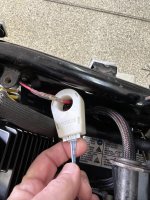
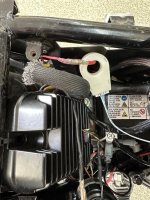
2) Added a volt/ammeter to the console. This is a nice addition as i can monitor battery voltage and charging amps coming directly off the R/R. It has a ring that you put around the wire such that you can monitor load (ie amps). I ended up routing this back under the seat and put the ring on the red wire coming directly off the R/R from above. I will post pix in a FUP reply to this thread.

https://www.amazon.com/gp/product/B0...?ie=UTF8&psc=1

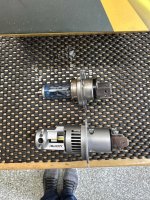
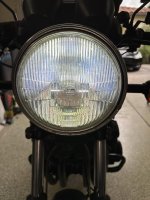
3) upgraded headlight to HID led. Its a plug replacement for the incandescent bulb. Connector is short and does not extend too
far into housing. It also has a cooling fan which is a plus. Note, you will also need to add some dummy load resistor to both legs (high and low beam) of the circuit. Technically, you would want to add enough dummy load to match what the incandescent bulbs were drawing. This should be about 50w for each circuit. Note, that my calculation this was specifically about 40w, however, Amazon did not sell 40w dummy load resistors; they only had 10w and 50w. I tried both and what i found was that 1) the 50w resistors generated TONS of heat. I mean TONs. It was so hot it would burn your hand if you touched it. 2) the 50w resisters put excess load on the circuit, so much so that the R/R was having to work extra hard to charge the battery. Bottom line, i didnt like the 50w option. In the end, i found that i could use simple 10w load resistors instead. This was enough load to turn off the dash indicator for the headlight. I routed the heat sinks on the resistors on the outside of the headlight housing such that it would not generate a lot of heat in the housing thus baking the wiring harness and making them more brittle than they already are.

https://www.amazon.com/gp/product/B0...0?ie=UTF8&th=1
https://www.amazon.com/gp/product/B0...1?ie=UTF8&th=1

4) replaced brake/tail light with LED that has a blink feature when you press/pull the brake. Basically it flashes about 3 times, then stays on full. Ive seen this on several bikes and its a great safety feature. Note, you will need to add another (i actually used 2 wired in series) 10w load resistor.

https://www.amazon.com/gp/product/B0...0?ie=UTF8&th=1
https://www.amazon.com/gp/product/B0...?ie=UTF8&psc=1

5) Replaced license plate light with clear white LED. Note, you will need to add another 10w load resistor.

https://www.amazon.com/gp/product/B0...0?ie=UTF8&th=1
https://www.amazon.com/gp/product/B0...?ie=UTF8&psc=1

The blinkers swap out for LED's is another story. Bottom line, i left these as incandescent bulbs because 1) they are working just fine, 2) they are bright enough and 3) my turn signal auto cancel is working just fine and i want to keep it that way. The turn signal LED topic is well documented on the forums.

Please feel free to reply/PM me if you have any questions about these mods.

Best Regards,
 
Last edited:
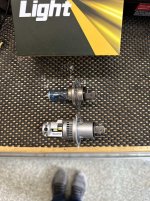
I didn't go for the LED headlight because the elements are not placed properly, and the pattern you see is inferior to the pattern that the stock bulb gives. There are many videos on this. If you could match the headlight itself with a matching LED, that would be different. I was considering grabbing a unit off of a newer car, and incorporating that into the headlight opening, but I see well enough at night with the stock set up, and I don't have to rewire anything. It might be interesting to mount one of the really small LED units under the main headlight to really brighten up the road.:) :)
 
I was considering grabbing a unit off of a newer car, and incorporating that into the headlight opening, but I see well enough at night with the stock set up, and I don't have to rewire anything.

Interesting idea. Yes, for sure the coverage is not ideal with the LED, but intensity is vastly improved. I ended up doing the swap for better visibility for other drivers. I have nothing scientific to back it up, but the LED bulbs white hue seem to be much more visible during the day than the yellow of the incandescent bulbs. That could be an optical illusion. Regardless, it makes me feel a bit safer when approaching a guy at an intersection about to pull into my lane of travel.

Suzukian did you upgrade your brake lights to LED's? I really like the strobe feature on the ones that i used.

Regards,

Darrell
 
No, I have left everything incandescent. I purchased the motorcycle in 1983, new, in the crate, and it still has the original tail light bulb, and signal light bulbs. Crazy, eh? ;)
 
No, I have left everything incandescent. I purchased the motorcycle in 1983, new, in the crate, and it still has the original tail light bulb, and signal light bulbs. Crazy, eh? ;)

Yes. Amazing and very impressive. Good on you for holding on to it all these years. Is it an 11e? Blue or Red?
 
I have a few questions/comments, They will be inserted in a shortened quote of your post.

1) updated my R/R with an OEM mosfet R/R. Whose "OEM" did you use? Suzuki never had a MOSFET R/R, and any MOSFET unit is merely an update, not an actual upGRADE.

I will attach a pix on a FUP reply to this thread. What is a "FUP" reply?

2) Added a volt/ammeter to the console. ... and put the ring on the red wire coming directly off the R/R from above. Nice meter, have not see a combo unit like that. Note that your choice of sensor location will show LOT of amps, virtually all the time the bike is running. It will include whatever the bike is using, along with what is actually going to the battery. If you move it to the wire that attaches to the MAIN fuse, it will show only what is charging the battery. Years ago, I played with an ammeter and a voltmeter in my vehicles, decided to ditch the ammeter and keep the voltmeter. MUCH more informative.

3) upgraded headlight to HID led. Which did you do, HID or LED? They are mutually exclusive terms for different types of bulbs. Looking at your link, it was an LED. Although it is a decent brand, it might not be the best replacement available. Please be sure to check the beam pattern on a wall AND on the road in front of you at night. Too many of the "lesser-quality" lights put light where it should not be.

Note, you will also need to add some dummy load resistor to both legs (high and low beam) of the circuit. Technically, you would want to add enough dummy load to match what the incandescent bulbs were drawing. This should be about 50w for each circuit. Note, that my calculation this was specifically about 40w, however, Amazon did not sell 40w dummy load resistors; they only had 10w and 50w. Why would you possibly want to add resistors to your headlight circuit? (OK, saw you had an 1100E with the monitor panel. Only your 1100E and the similar 750E have that panel, so would be the only ones to "need" a resistor.) Next, were the resistors 10 and 50 WATTS or 10 and 50 OHMS? If they were rated in watts, what were their ohms? Again, mutually exclusive terms. Personally, I would have tried to modify the sensor for the dash monitor and leave full power to the light.

4) replaced brake/tail light with LED that has a blink feature when you press/pull the brake. Basically it flashes about 3 times, then stays on full. Ive seen this on several bikes and its a great safety feature. Note, you will need to add another (i actually used 2 wired in series) 10w load resistor. Why do you need a load resistor here? The light is made to work with a 12-volt system, let it do its thing.

5) Replaced license plate light with clear white LED. Note, you will need to add another 10w load resistor. Why do you need a load resistor here? The light is made to work with a 12-volt system, let it do its thing.

The blinkers swap out for LED's is another story. Bottom line, i left these as incandescent bulbs because 1) they are working just fine, 2) they are bright enough and 3) my turn signal auto cancel is working just fine and i want to keep it that way. The turn signal LED topic is well documented on the forums. Probably the best thing, considering what you have done to the other circuits. Yes, it's possible to change to LEDs, but it does take some precise modifying.

Please feel free to reply/PM me if you have any questions about these mods.
 
I have a few questions/comments, They will be inserted in a shortened quote of your post.

Hi Who.. First off.. WOW!!! Thank you for you very detailed writeup. Im very impressed with your attention to detail. These types of exchanges are where data is truly turned into information. You have enlightened me on my understandings.

See replies below, inline

1) updated my R/R with an OEM mosfet R/R. Whose "OEM" did you use? Suzuki never had a MOSFET R/R, and any MOSFET unit is merely an update, not an actual upGRADE.​ [darrell said] Yes. Nessim schooled me on this. My (incorrect) assumption was that a MOSFET R/R meant Series R/R. Its not. I was using an Amazon special R/R. It seems to work ok, but i bought a SH775 from Nessim and i will be swapping that out this weekend.

1a) I will attach a pix on a FUP reply to this thread. What is a "FUP" reply?​ [darrell said] Sorry, this is IT lingo.. FUP = Follow UP.

2) Added a volt/ammeter to the console. ... and put the ring on the red wire coming directly off the R/R from above. Nice meter, have not see a combo unit like that. Note that your choice of sensor location will show LOT of amps, virtually all the time the bike is running. It will include whatever the bike is using, along with what is actually going to the battery. If you move it to the wire that attaches to the MAIN fuse, it will show only what is charging the battery. Years ago, I played with an ammeter and a voltmeter in my vehicles, decided to ditch the ammeter and keep the voltmeter. MUCH more informative.​ [darrell said] Humm. Let me better understand what you are saying.. So the current location of the ring is on the lead directly off the R/R. My thought in doing so was to measure the amps that the R/R is pumping into the battery. This entire mod (volt/ammeter) was caused by a failure i encountered on a ride where my bike died mid-ride due to a discharged battery. At the time, i was only doing short rides to test carb tuning. This was caused by a faulty connection between R/R and battery. This was user error as i originally connected the lead coming from battery to lead coming from R/R with one of those solder/heat shrink joints. The idea is that you just butt the wired together in the joint and then heat them up and solder and heat shrink makes a water tight connection. My conclusion on this type of connector is that you need to use a lighter to "close the deal" rather than a heat gun. The heat gun does not seem to heat up the solder enough. Obviously, i can hold the heat gun near the solder for a longer time, but that ends up melting the heat shrink. Bottom line, i screwed up this connection and it came loose and i didnt realize it until my battery was completely discharged. Thankfully i was close to home. Question: so you are saying to move the pickup ring to the load side of the main fuse? Could i just use the switched mains wire (that goes to the key) in the headlight? That would be a much shorter wire run and allow me to bury the pickup ring in the headlight instead of under the seat. Please confirm if my understanding is correct.

3) upgraded headlight to HID led. Which did you do, HID or LED? They are mutually exclusive terms for different types of bulbs. Looking at your link, it was an LED. Although it is a decent brand, it might not be the best replacement available. Please be sure to check the beam pattern on a wall AND on the road in front of you at night. Too many of the "lesser-quality" lights put light where it should not be.​ [darrell said] So I will plead ignorance on this one. This was an amazon purchase that had good reviews. The beam intensity is greatly increased and it is much more "directed" vs being scattered with bulb i had it in original. I will do some research on HID vs LED. Can you offer any suggestions of one vs the other? Is there a good reason to use one vs the other or is it mainly a personal preference?


3a) Note, you will also need to add some dummy load resistor to both legs (high and low beam) of the circuit. Technically, you would want to add enough dummy load to match what the incandescent bulbs were drawing. This should be about 50w for each circuit. Note, that my calculation this was specifically about 40w, however, Amazon did not sell 40w dummy load resistors; they only had 10w and 50w. Why would you possibly want to add resistors to your headlight circuit? (OK, saw you had an 1100E with the monitor panel. Only your 1100E and the similar 750E have that panel, so would be the only ones to "need" a resistor.) Next, were the resistors 10 and 50 WATTS or 10 and 50 OHMS? If they were rated in watts, what were their ohms? Again, mutually exclusive terms. Personally, I would have tried to modify the sensor for the dash monitor and leave full power to the light.​ [darrell said] They are 10 and 50 WATT respectively. See link below. So what i did was measure load (with multimeter with pickup ring) of both high and low beam leads using original headlight. Then did same test with new LED light. The delta was ~4A for each. ie the LED was drawing 4A less than original. using Watts = Amps * Volts, that comes out to 48Watts. So my assumption (very likely incorrect) is that i need to add ~48Watts of load to each leg to simulate same load. This does, indeed get rid of the idiot light on the dash. However, as i mentioned, these 50W resistors get HOT, HOT, HOT. I found that just adding a simple 10W resistor seems to solve the problem and these generate far less heat. I simply routed them outside of the headlight housing thus they get airflow when bike is moving. Please correct me if im wrong is any of my conclusions from above. The resistors did not cause any noticeable decrease in brightness in the light

50watt: https://www.amazon.com/gp/product/B00L4V9ECY/ref=ppx_yo_dt_b_asin_title_o03_s00?ie=UTF8&psc=1
10watt: https://www.amazon.com/gp/product/B07DJ6889C/ref=ppx_yo_dt_b_asin_title_o08_s01?ie=UTF8&th=1

4&5) replaced brake/tail light with LED that has a blink feature when you press/pull the brake. Basically it flashes about 3 times, then stays on full. Ive seen this on several bikes and its a great safety feature. Note, you will need to add another (i actually used 2 wired in series) 10w load resistor. Why do you need a load resistor here? The light is made to work with a 12-volt system, let it do its thing. ​[darrell said] the 10w load resistor is to solve same problem from above.. ie the idiot lights on the dash. Without them, my dash looks like a Christmas tree. Yes, i could have solved this other ways, but i dont like the idea of disconnecting a sensor just because it annoys me. I would rather give the sensor data that is within its tolerance thus it will still function normally, ie tell you when the bulb is burnt out.

6) The blinkers swap out for LED's is another story. Bottom line, i left these as incandescent bulbs because 1) they are working just fine, 2) they are bright enough and 3) my turn signal auto cancel is working just fine and i want to keep it that way. The turn signal LED topic is well documented on the forums. Probably the best thing, considering what you have done to the other circuits. Yes, it's possible to change to LEDs, but it does take some precise modifying.​ [darrell said] Yes. I do have some LED blinker bulbs that i tried. My understanding is that yes, it is possible, but from what ive read, it appears that (at a minimum) would require replacement of blinker relay with solid state device and some heavy mods to make the self cancelling unit continue to work. IMO the juice is not worth the squeeze on this one. Blinkers are bright enough and, call me old fashion, but i do get a certain amount of satisfaction out of watching the 40 yr old technology of the self cancelling device work in present day. The self cancelling circuit and the gear indicator on the dash are, IMO, the most technologically advanced features on the bike.


Again, Thank you very much for your input.

Best Regards,

Darrell


Tried quoting your post, then adding to it, as before, but the way you added your quotes to my quoted comments prevents that. So, ...

Thanks for the clarification on the R/R and "FUP".
I'm not in IT, so am not acquainted with the term.

Regarding ammeter sensor location:
The output of the R/R goes into the main harness and splits. One leg goes forward to the ignition switch, then back to the fusebox, where it provides power to run the bike. The other leg goes back through the MAIN fuse to charge the battery. If you place your sensor on the bottom leg (right near the R/R), you will simply be measuring ALL the current that the R/R is producing, but won't know if it's running the bike or charging the battery. If you move your sensor to the 'forward' leg, you will only be measuring the current that the bike requires for normal running. If you move it to the 'battery' leg, you will only measure the current that is going to (or coming from) the battery.

I mentioned earlier that I have found a volt meter to be more useful than an ammeter. Think of electricity as a fluid (gas or water), it's easier to visualize. The ammeter measures current flow, much like gallons per minute. The volt meter measures pressure, much like psi in a tank. More fluid in a tank, more psi. Now, consider this: while riding, and thinking of your fuel supply, would you rather know that you are using fuel at 2 gallons an hour or that you have 1/4 tank left? In the case of your electrical failure, you would have shown a large discharge on the ammeter, but would not have a clue if that happened on a fully-charged battery or if your battery was just about fully gone. Discharge rate would remain about the same. If you had a volt meter, seeing 12.5 volts or 11.0 volts would tell you how critical your situation is. Having both is great, but the volt meter tells you more at a single glance.

HID vs LED lights.
HID lights use a High-Intensity Discharge, which is basically an electric arc in a (usually) Xenon-filled envelope. They tend to be sensitive to input voltage and don't like to be turned on and off very many times. Having the light turn on when you turn on the key, then having the voltage dip considerably when you start the engine is just about as bad. Overall, some may have gotten away with one, but probably not a good idea on a motorcycle.

Once again, only your 1100 and its little brother 750 have those tattle-tail instrument panels. Converting the lights to a lower-draw LED sounds like a good idea, but then you are adding resistors to put the load back up to the point where the computer does not sense a problem. If your goal is to reduce load on the charging system, you have failed. If your goal was to have longer-lasting light bulbs, you might have succeeded, but some LEDs will fail if they don't have the correct power. When you added resistors, did you put them in-line with the light leads or across them, much like trying to add another light? Putting them in-line will reduce voltage to the lights, reducing their effectiveness. Putting them across the leads is the correct way, but they will get HOT, so mount them carefully.

I see now that the resistors for the brake/tail light are just to fool the computer, so I have to ask ... is it worth it?

LED turn signals are possible, but you need resistors for them, too, as well as a different flasher. If you install a different flasher, you will lose the self-cancel feature, as the Suzuki flasher is unique. There is nothing else in all of motorcycling or automobile use that will plug in (and work) without considerable modification. I have done that on my bike, but what I did would not work with all your sensors.
 
Back
Top