• Required reading for all forum users!!!

    Welcome!
    Register to access the full functionality of the GSResources forum. Until you register and activate your account you will not have full forum access, nor will you be able to post or reply to messages.

    A note to new registrants...
    All new forum registrations must be activated via email before you have full access to the forum.

    A Special Note about Email accounts!
    DO NOT SIGN UP USING hotmail, outlook, gmx, sbcglobal, att, bellsouth or email.com. They delete our forum signup emails.

    A note to old forum members...
    I receive numerous requests from people who can no longer log in because their accounts were deleted. As mentioned in the forum FAQ, user accounts are deleted if you haven't logged in for the past 6 months. If you can't log in, then create a new forum account. If you don't get an error message, then check your email account for an activation message. If you get a message stating that the email address is already in use, then your account still exists so follow the instructions in the forum FAQ for resetting your password.

    Have you forgotten your password or have a new email address? Then read the forum FAQ for details on how to reset it.

    Any email requests for "can't log in anymore" problems or "lost my password" problems will be deleted. Read the forum FAQ and follow the instructions there - that's what we have one for...

  • Returning Visitors

    If you are a returning visitor who never received your confirmation email, then odds are your email provider is blockinig emails from our server. The only thing that can be done to get around this is you will have to try creating another forum account using an email address from another domain.

    If you are a returning visitor to the forum and can't log in using your old forum name and password but used to be able to then chances are your account is deleted. Purges of the databases are done regularly. You will have to create a new forum account and you should be all set.

1983 GS750ES Bikes goes dead when Flasher is removed

Suzukian

Forum Sage
I purchased an aftermarket flasher for LED lights that was supposed to be plug and play. I followed the instructions, and when I turned the bike on, the whole bike flashes on and off when either signal light is engaged . I put the original one back on, and the LED lights come on, but do not flash (not enough of a voltage drop, I know).

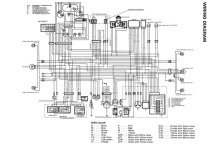
I then put a 6 ohm 30 watt resistor across each of the leads of the LED front signal lights, leaving the regular incandescent lights on the rear of the bike, and the signal lights now work normal. I looked at the schematic, which shows a 3rd wire coming from the Flasher, but there are only two tabs on the actual bike. If you remove the flasher unit, the bike is completely dead. I have owned this bike for 40 years and never knew this happened.

Any ideas on this? I was going to pick up 2 more Resistors, but am tempted to just go back to the original set up, or leave the rear ones in place, and go with the LED lights in the front (they don't seem very bright though). Anybody have any comments on this. Would a fuse across the flasher make the needed connection if for some reason the 40 year old flasher cr@apped out on me, and I had to remove it to get going? Thanks. ;)
 
I read those links. Thanks. The problem I have is the bike is completely dead without the flasher unit in it. If I put in the LED Flasher Unit, the whole ignition system flashes with the signal lights. When I jumped the two front signal lights adding a 30watt, 6 Ohm resistor to each, and keeping the rear incandescent, everything flashed normally, with the original flashing unit (the stock flasher), and the bike lit up normally, the starter motor engaged, all worked just as it did previously

What I don't understand is that when you remove the flasher unit from the fuse panel, the bike has no electricity going anywhere, it's completely dead. The only thing I have ever removed were the stock horns. I cut those wires and added a relay and mounted FIAMM Horns. Other than that, the harness is stock. I did the Stator Mod, the 3 Stator wires going directly to the R/R and the +/- of the R/R going right to the battery.

I never noticed this before, as I never had reason to remove the flasher. It seems odd to me that the bike would go completely dead when the flasher is removed from the fuse panel. It doesn't make sense, as when the bike is running, the flasher unit, when engaged does not shut off the bike. Maybe this happens only when the bike is shut off? That would mean if the flasher unit ever went bad, you couldn't start the bike. I suppose a 20 amp fuse in it's place would jump the circuit. This has me very confused. I have added a schematic of the bike. Thanks.

I see that at some point the relay is wired into the horn, maybe removing a floating ground when I removed the stock horns caused this. The stock Horns were isolated by rubber, meaning neither of the leads could touch ground, or the bike shorted. Maybe a fuse has to be put in it's place, or I need to power the horns off of the original horn leads, could this have caused this? I'm at a loss.

;)

Click image for larger version  Name:	GS750ES Schematic.jpg Views:	0 Size:	75.3 KB ID:	1726368
 
Last edited:
Sounds like you're backfeeding through the flasher due to a poor/lost power connection somewhere upstream.

That what I though too, but when the two pin flasher is taken used, (it's just a strip of metal with a point connected at the end), the bike runs normal, it does not flash when the signal lights are used, which is what happens when the LED flasher is in place. I've never removed it, so I never noticed the present issue, which must have been there all along.

I do think you are right about an upstream connection. The only thing I ever changed was the horns, and those ran using a voltage drop to run the horns, which were in circuit, not run to ground. If any of those wires touched the frame, the main fuse would blow. Maybe, I thought, I need to wire those stock horn wires (the pairs) negatives to negative, positives to positives (relatively speaking) together so they maintain a connection, or run the new horns off of them. Looking at the schematic, and having the bike since new, this is the only change that was made. It's too darn hot to go out there and mess around. Hopefully it will cool off after dinner.

Looking at the schematic, disconnecting the Horns does not initially seem to cut any circuit, though, and the Horn wires not being connected to anything creates a "Horn Off" situation. I can't see how these cut horn wires would affect anything?
 
Sounds like something is shorted in the turn signal circuit. I'd start by removing the resistors and LED signals, returning the bike back to stock. Get a stock flasher relay too. In other words, go back to basics and verify the bike works as it should.
 
I did that, and it works normal. When I took the flasher unit out, the bike had no lights going on. No ignition lights in the dash, nothing. As I stated, the only thing I removed was the horns. I am wondering if the horns circuits are needed, even when not engaged for Suzuki's whacky wiring system. The bike is operating normal, and I can get it to operate normal with the shunted LED front headlights. In both cases, LED, or incandescent lights, removing the signal light flasher from the fuse box causes all the lights to shut off. Very strange. I have never had reason to remove this before. When I ride the bike, and use the signal lights, everything operates normally, even thought the flasher unit is working.

Right now, it is operating normal with the 2 LED lights in the front (which I am going to remove, fix the old stock signal lamps, and go back to incandescent). I just don't understand why the flasher unit being removed would kill the system. When I look at the schematic, it seems like the horns are wired into many things. This one has got me stumbled.
 
What I don't understand is that when you remove the flasher unit from the fuse panel, the bike has no electricity going anywhere, it's completely dead.

;)


I am just trying to follow along here, but I know this is waaay over my pay grade, but just where on the schematic you posted is this “flasher unit from the fuse panel” you speak of? I can’t find a “flasher unit” in the fuse panel or any place on your schematic.
 
It's called "Turn Signal Relay". Sorry, I called it by it's colloquial name. Up on top, between the "Ignitor" and the "Rear Brake Light Switch". ;)
 
It's called "Turn Signal Relay". Sorry, I called it by it's colloquial name. Up on top, between the "Ignitor" and the "Rear Brake Light Switch". ;)

Got it. Thank you for taking the time to get me straightened out.

Just thinking out load here, but if that ground at the rear of the bike (wiring diagram) has gone bad or weak (not bear metal, or corroded threads as you have described), perhaps the Turn Signal Relay’s third wire has been providing the ground. Ergo, when you unplug the Turn Signal Relay, the ground goes away for many of the control circuits and the machine appears dead?
 
I thought about that too. What I don't get is why doesn't thee bike's lighting blink when I use the turn signal?
I've decided I am going to work my way backwards and buy a set of stock Horns off of EBAY, and this will put the bike to completely stock condition. The FIAMM horns are wired separately, so the original horns being in circuit (non of those wires go to ground, and blow a fuse if they touch the frame), would be easy to bypass, and I could reconnect the wires to the stock horns.

Looking at the Schematic, I thought maybe I could tie one black wire to the other, and the other black wire to the other horn, which would complete the circuit as shown in the schematic, but without the load of the Horn. I don't have the old ones, so I don't know how many ohms it made. If I knew that value, I'd try a resistor in there instead of the horns. I may try a 10 amp fuse and see if that completes the circuit on each side, and won't have to buy stock horns. It's so freakin' hot, I go out their and get drained really fast. I repaired the stock signal lights from the inside with some JB-Weld, and can put them back on, and forget about the LED's, since you have to use a big 30 Watt resistor, you aren't saving any energy using them.

The actual Turn Signal Relay does not have a 3rd wire. This is something that has me stumped, as the schematic shows a wire that isn't there, and I've owned this bike since new. Nothing there has been modified. That part that it just a two tab turn signal relay blows me away. There is no wire that color in the Harness, and I know this is the book for my bike.

Thanks for the input. ;)
 
Troubleshooting is easier with everything stock.
Especially for us that can't see your setup.
All nonstandard components and wiring are adding extra complexity to the troubleshooting,
for us and for you.

So removing or unhooking all non-standard wiring and components, like LED blinkers and non-standard relay, wiring and load resistors, FIAMM horns wired seperately, possibly with an extra relay, etc etc - would be a good thing.
You can always put them back on when the issue is solved.

The bike does not require any load from horns, no need to buy new original ones to troubleshoot.
Just leave the wires unhooked.

The wiring schema shows a Turn signal relay connection to ground, but that connection is not a wire.
The metal relay housing is grounded by bolting it to the electrics plate, metal to metal.
Sometimes called a "hidden ground wire" here on GSR.

I had a problem on my GS1000S that was confusing, the horn would squirm softly when i pressed the starter button
and there was an issue with my turn signals. Can't remember exactly what that was, it's been years.
Turns out the ground connection from frame to electrics plate was bad, not gone, but weak.
Attaching a ground wire from battery - to electrics plate solved all issues, proving where the problem was.
After that, solving the ground issue and removing the extra wire was easy peasy, been ok for 10 years now.
 
Last edited:
Thanks Rijko

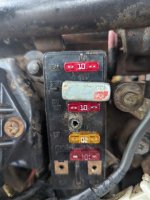
Here's what I have found out. Since this forum only allows one pic per post, this will take two. The first post shows the two blade Flasher in place, and the fuse Box has "Flasher" written on it. All lights go out if this is removed.

Click image for larger version  Name:	PXL_20230721_140307296.jpg Views:	0 Size:	67.0 KB ID:	1726664
 
Last edited:
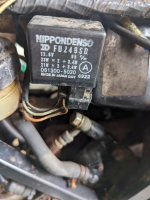
When I remove the Flasher, and stick a 10 amp fuse in it, lo and behold, the flasher start blinking and all works normal, but now I hear a clicking from the other side of the motorcycle, right above the rear brake reservoir. This is the actual Flasher Relay Unit.

PXLActual Flasher Unit.jpg
 
Since I am the only person who has worked on this bike, I do not recall playing the two blade flasher in the fuse panel, I don't even know where to get those. It has to have been me that did it though. I don't know where and when, but putting a 10 amp fuse in there now, the signal lights now work, and the bike is flashing off of the signal light flasher I posted in the previous post.

I don't know how I screwed this up. That little box has been plugged into that fuse panels for as long as I can remember. It clicks when the signal lights are switched on. I've owned the bike 40 years, and 40 years ago, I did not know what I know now. There's no one to blame. The bike is all set now. I did not reconnect the old Horns, just made sure they were sealed as two of them do have 12 volts coming out of them when the power is on. The horn button would connect the ground. That was all by passed when I put in the FIAMM Horns.

In place of the big metal relay is a 10 amp fuse now. It has been a morning of discovery. ;)
 
Yes, I think all issues are solved. The LED Flashers in the front are even brighter now. I have left the stock in the rear, as they are big, and those Resistors are $16 bucks a piece, ouch! Thanks for your input, I really appreciate it. I was quite young
and did not have the electronics background I have now. I have to take responsibility though, because I am the only person who has touched the bike.

:)
 
Perhaps that metal can is some kind of a slow blow fuse, or a fuse that auto resets when cooled?

P.S. Pictures do add a whole lot to the discussion!
 
Perhaps that metal can is some kind of a slow blow fuse, or a fuse that auto resets when cooled?


I took it apart, it is a flat piece of metal with a coil around it, and a set of points at the end. It's a flasher unit. It still works. it flashed (made the ticking sound, loud enough that I didn't hear the other one on the other side! Maybe it does operate as a re-settable fuse? Now you have me wondering? I will keep it for posterity.

;)
 
Back
Top