• Required reading for all forum users!!!

    Welcome!
    Register to access the full functionality of the GSResources forum. Until you register and activate your account you will not have full forum access, nor will you be able to post or reply to messages.

    A note to new registrants...
    All new forum registrations must be activated via email before you have full access to the forum.

    A Special Note about Email accounts!
    DO NOT SIGN UP USING hotmail, outlook, gmx, sbcglobal, att, bellsouth or email.com. They delete our forum signup emails.

    A note to old forum members...
    I receive numerous requests from people who can no longer log in because their accounts were deleted. As mentioned in the forum FAQ, user accounts are deleted if you haven't logged in for the past 6 months. If you can't log in, then create a new forum account. If you don't get an error message, then check your email account for an activation message. If you get a message stating that the email address is already in use, then your account still exists so follow the instructions in the forum FAQ for resetting your password.

    Have you forgotten your password or have a new email address? Then read the forum FAQ for details on how to reset it.

    Any email requests for "can't log in anymore" problems or "lost my password" problems will be deleted. Read the forum FAQ and follow the instructions there - that's what we have one for...

  • Returning Visitors

    If you are a returning visitor who never received your confirmation email, then odds are your email provider is blockinig emails from our server. The only thing that can be done to get around this is you will have to try creating another forum account using an email address from another domain.

    If you are a returning visitor to the forum and can't log in using your old forum name and password but used to be able to then chances are your account is deleted. Purges of the databases are done regularly. You will have to create a new forum account and you should be all set.

Revision of homemade electric diagram

Diirk

Forum Apprentice
​Hi guys,

I haven't had all the time I wanted because if that were true I'd be riding my ass off instead of opening this thread.
However life happens to us all thus here we are and since I haven't the time yet to actually start working on the bike, I might as well ask for opinions of knowledgeable internet strangers

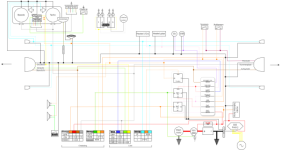
I've taught myself some basic "automotive electrics" and applied that new skill to drawing a diagram for my "79 GS850.I think it's all good, but because I'm new to this and I don't have anyone in my direct vicinity to confirm, I'm asking you guys.
Could you take a look at this diagram and confirm for me that I didn't make any mistakes? I'm aware USB-charging is only available with lights on because I want to be able to charge in PARK as well. And yes, I have an ON/OFF switch for the lights so the relais is "not neccesary" but I'm future-and-dummy-proofing it.

I've thrown this up in another forum as well, but didn't get any comments on it. Maybe 'cause it's really good... or maybe because nobody saw what's wrong with it (if anything).
Like I mentioned earlier: I'm insecure because I've never made a diagram like this and I need a pat on the back or a slap on the wrist to know if I'm heading the right direction.​​

CLICK HERE FOR A BIGGER PICTURE.
GS850Suzy.drawio (1).png - Click image for larger version  Name:	GS850Suzy.drawio (1).png Views:	0 Size:	48.7 KB ID:	1743790

I haven't calculated the wiring yet, as I'm kinda putting it off since I don't know for sure if the diagram is correct. I'm being really overly cautious here, I know :o
 
Last edited:
The picture, as displayed on the forum page, is too fuzzy to read the labels. I was going to try to see if I could improve it. I’ve clicked on your link for a bigger picture but all I get is this:
beN1Trem.png

and not just when I’m in the company computer with protections from foreign sites and such. I get the same on my phone.
 
I'm a tool :hopelessness:
I hosted the picture somewhere else, should be good now. As for the inline image: that's the best I could make of it using the forum's software.
Mind you: practically all the labels are in Dutch, but you should understand most of it nonetheless.
 
Nice drawing!
What software did that?

I have a question about the diagram.
(Note that I will always be trying to learn more about electrical stuffs.
So if my question is too silly, just ignore it.)

It looks to me like if the stator/RR is putting out more voltage than battery is supplying, I don’t see how the headlamp switch circuit is being protected by a fuse.
So if you had a short, say, like a wire in the head lamp circuit chaffed and got to ground while you were riding along, wouldn’t that circuit get fried?
 
I used an online tool called draw.io but I can't recommend it. It's quite the hassle to line everything up nicely but it's free however and as you can see, it gets the job done (one way or another).


For your electrical question I'll do my best to answer, as I am also no expert by any means.

The light circuit has it's own fuse (follow the dark blue wire to the fuse "LICHT") but I assume you're talking about the wires that go from the switchgear to the low and high beam.
If a short should happen in any of those two wires (green or yellow) then the fuse "LICHT" will blow because they are connected to the dark blue wire through the switchgear.

That the r/r is pumping out more than 12V doesn't matter because it's being regulated to a safe maximum voltage. In we assume that this part of the r/r works correctly then in fact increasing the voltage lowers the current (this is Ohms Law).
In example: take a 60watt headlight and divide that by 12V = 5A. Now take the same headlight of 60W divided by 16V = 3.75A. This is merely an example, but you can see how the increase in voltage does not harm the circuits. Again, assuming the r/r is doing it's job. If you were to get 24V somehow, I guess you'd run into other issues.
 
Wow! You’re way ahead of me.

I only got as far as the output of the R/R.
I see how the head light circuit is protected by the fuse (can’t make out the fuse name or number of that fuse) when the battery is supplying the current.
And I see how that same fuse is protecting the battery circuit while the battery is being charged by the R/R.

My concern is that if the R/R is supplying more current than the battery needs (I.e., the battery is charged up) won’t the R/R current bypass that fuse and feed the light circuit as per your diagram?

If no one else sees the diagram that way, I’ll just return to lurk mode.
 
My concern is that if the R/R is supplying more current than the battery needs (I.e., the battery is charged up) won’t the R/R current bypass that fuse and feed the light circuit as per your diagram?
That's the job of the regulator - once the battery is fully charged, the regulator won't carry on passing current, because it has limited the charging voltage.
Of course, with a shunt type, it just diverts the excess back into the stator - much trouble ensues down the road, as we know.
 
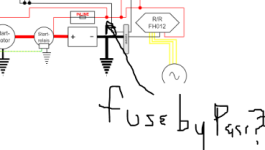
Okay, one more time:

Let's say the R/R is charging the battery..
What keeps the R/R supplied current from by passing that fuse
and going straight to the headlight circuit?

image.png - Click image for larger version  Name:	image.png Views:	0 Size:	17.2 KB ID:	1743950
Sorry for my crude pointer
I'm still a clutz at this computer stuffs..​
 
My mistake
that red wire goes to the ignition switch, not the headlight circuit.
From there it feeds a number of circuits..

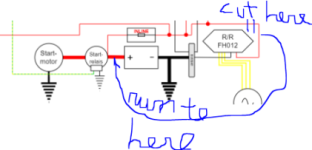
Here is what I would do/recommend:


image.png

That way those other circuits will be protected by a fuse.​
 
In your drawing the r/r is unfused so if anything should happen, it'll damage the battery (or worse). I more or less copied the original diagram on how to hook up the r/r and even though that diagram has it's own set of flaws, I believe the setup is equal to most UJM.
Of course I could just place another fuse in between the circuit that you drew, you might've already had that in mind as well. So you definitely have a point. After all: redundancy is better than a headache later on.

That's the job of the regulator - once the battery is fully charged, the regulator won't carry on passing current, because it has limited the charging voltage.
Of course, with a shunt type, it just diverts the excess back into the stator - much trouble ensues down the road, as we know.
The FH012 should be a series type (although there's some debate about it) so the stator shouldn't turn crispy... again :rolleyes:


Rich82GS750TZ and Who Dat? maybe you can weigh in now the diagram is clear?​
 
I have learned by reading and asking questions on this forum about the many things I didn't know about my own bike's electrics. My bike is pretty much stock except for the few modifications I've made: Changed out the stator, replaced the R/R w/ a Shindengen SH775, Consolidated the grounds around the panel to a Single Point, cleaned or made new every single electrical connection. These modifications were made under the tutelage of folks on the forum who are much more educated in these matters than I. So I will leave the advice to the experts. :)
 
I think I am learning something here.
But here is where my head is at.

When you have the new wiring harness installed and running,
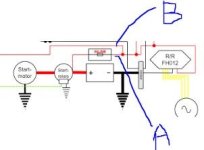
place your amp clamp at A and see what direction the current is flowing.

If the current is flowing towards the fuse on its way to the battery,
then the battery is being charged.

The line at B feeds the ignition switch, relay, and ?
When the battery is being charged by the R/R,
where will line B get its current to feed the ignition switch?


amp clamp.jpg
 
I'll do my best to explain, but to make it easier to understand I'll make it brief and as such less technically true. So if any engineer comes across this bit of information, don't shoot me for not mentioning the real flow of electrons, importance of magnetism or including circuits exclusively being powered by the battery or what have you.
Also please keep in mind that I am really merely a novice that couldn't have written this answer down a couple of months ago because that's how new I am to all of this.


You are correct that a battery can not simultaneously charge and​​ supply. However, it doesn't need to. The battery is only used for starting the bike and supplying power at idle. This is because for the rest of the time, the stator (through the r/r ofcourse) will supply power to the bike.
  1. When starting the bike, obviously an external source of power is needed because the stator isn't able to provide anything "standing still".
    So we draw current from the battery to power up the starter motor.
    .
  2. Once the bike is running, it idles and the stator supplies less than the 12V the battery has.
    As such, the bike's loads (lights, heated grips etc) are running off the battery.
    .
  3. Now we ride the bike: the increased rpm of the engine spins the flywheel around the stator faster, thus making enough power to supply the needs of the bike's loads.
    • Because the output of the stator is now greater than that of the battery, the potential difference (difference in voltage) between them makes the battery a load. It is now being charged.
    • When fully charged, the draw of current will be lower as the battery doesn't "ask" for more and the r/r will lower the voltage to whatever is needed.
      .
  4. At the next traffic light, the potential difference will be in favor of the battery (it supplies more volts than the stator at idle/low rpm) so it will take over the function of supplying power to the bike's loads again.
    .
  5. Rinse and repeat steps 3 and 4 ;)

    Remark by Who Dat?:
    The r/r does not lower voltage. It accepts whatever is coming in from the stator, rectifies it to a pulsed DC current, then limits (regulates) it to whatever its setpoint is, usually around 14 volts. As the engine slows down from riding speed, the input voltage is not going to be enough to need regulating, so the voltage does drop, but not because the r/r lowers it.​
 
Last edited:
Diirk, I really do appreciate the time and effort you have taken to help me understand your planned wiring diagram in non-technical terms.
It is obvious that you as a novice have a much better understanding of this electrical stuff than I do.
(And much better verbal and computer skills than me.
BUT I will select some of your explanation as a final attempt to explain where my head is at.

You are correct that a battery can not simultaneously charge and​​
[*]Now we ride the bike:
[*]Because the output of the stator is now greater than that of the battery, the potential difference (difference in voltage) between them makes the battery a load. It is now being charged.]

That is exactly my point. When the stator voltage is greater than the battery's voltage, the wire going up to the ignition switch is not fused.

Enough.
 
It's fused on the individual circuit fuses shown in orange on the other side of that switch. I don't think any current would flow until the switch is powered on so there would be no smoke in that red wire to leak out in that instance..... It would do nothing until you switched it on & at that point the fuse would blow.

I may be wrong though..... :)
 
That is exactly my point. When the stator voltage is greater than the battery's voltage, the wire going up to the ignition switch is not fused.

Enough.

https://ibb.co/4MgKX5D

In the link above you can see I highlighted the circuit starting from the r/r. The red wire going to the ignition switch does seem to be unfused.
However, when that wire leaves the switch again as an orange wire, we can see #1 goes to the NO relay and #2 goes to the RNC fuse.
You always want to look at the circuit as a whole and not a single wire going from one place to another (given the wire gauge is correct, of course).
  1. The wire marked #1 going to the relay is "signal" and therefore will carry a very low current.
    This part of the circuit is indeed unfused but because of the very low current I'm not too worried about it.
    .
  2. The wire marked #2 going to the fuse is, well, fused.
    If anything should happen that fuse breaks and the red wire will also be protected because if one part of the circuit is interrupted, the whole circuit is -> as salty_monk correctly stated.​
    .
  3. Now if you look at the right you'll notice the KOSO instrument highlighted in green that is completely unfused. This is a potential hazard.
This happens to be the last (minute) thing I added to the diagram and even though this is again a low current (0.15A I think?), the instrument itself is exposed to the elements which increases the risk of a short happening. Hadn't really seen the risk it could pose until I started looking at it so you have my thanks for that. I could pop a little 0.5A inline fuse in there just to be on the safe side.


PS: thank you for complementing my "verbal skills". It's a nice compliment for a non-native speaker :)
 
Last edited:
Back
Top