• Required reading for all forum users!!!

    Welcome!
    Register to access the full functionality of the GSResources forum. Until you register and activate your account you will not have full forum access, nor will you be able to post or reply to messages.

    A note to new registrants...
    All new forum registrations must be activated via email before you have full access to the forum.

    A Special Note about Email accounts!
    DO NOT SIGN UP USING hotmail, outlook, gmx, sbcglobal, att, bellsouth or email.com. They delete our forum signup emails.

    A note to old forum members...
    I receive numerous requests from people who can no longer log in because their accounts were deleted. As mentioned in the forum FAQ, user accounts are deleted if you haven't logged in for the past 6 months. If you can't log in, then create a new forum account. If you don't get an error message, then check your email account for an activation message. If you get a message stating that the email address is already in use, then your account still exists so follow the instructions in the forum FAQ for resetting your password.

    Have you forgotten your password or have a new email address? Then read the forum FAQ for details on how to reset it.

    Any email requests for "can't log in anymore" problems or "lost my password" problems will be deleted. Read the forum FAQ and follow the instructions there - that's what we have one for...

  • Returning Visitors

    If you are a returning visitor who never received your confirmation email, then odds are your email provider is blockinig emails from our server. The only thing that can be done to get around this is you will have to try creating another forum account using an email address from another domain.

    If you are a returning visitor to the forum and can't log in using your old forum name and password but used to be able to then chances are your account is deleted. Purges of the databases are done regularly. You will have to create a new forum account and you should be all set.

1978 GS1000 + blown main fuse + cylinder three misfiring =

  • Thread starter Thread starter Guest
  • Start date Start date
G

Guest

Guest
Much as I love the music of a Japanese four with a megaphone exhaust, I haven't been riding the GS much the past few years. The weekend boulevard cruise, the occasional freeway bullrush, then home and to the yard, which is more like an orchard/farm, and very high maintenance. This Sunday I gave the GS a going over, which took a couple of days and included, sad to say, clearing some cobwebs with a toothbrush and cleaning rag. Changed the oil and filter, washed and re-oiled the pod filters, tightened bolts and fasteners, lubed the cables and chain, aired the tires and set off on what would become about a 40-mile out-and-back ride along the Sacramento River near where I live and into the California Delta. Great two-lane roads, long lazy curves with good pavement, much of it atop narrow levees with steep drops into sloughs on either side. Good riding. About five miles from home the bike starts coughing through the air filters, then sputtering, then dying at 65 mph, which was a good thing, since it gave me momentum to find a wide place to pull over on Interstate 5, which I'd taken for a high-speed leg home. After marveling at the amount and variety of debris on the shoulder, I set my helmet a few feet back from the rear tire, popped the seat, took a screwdriver from the rear cowl, took off the side cover and looked at the fuses. The 15-amp main fuse was dark gray in its glass tube. After replacing the main with a spare, the bike started instantly and accelerated hard to highway speed. When I exited a mile from home the air filters coughed again on overrun, and the bike sputtered into our driveway. The teenage girls across the street were not impressed.

In the morning I rolled the bike out of the garage. The main fuse was intact. The engine started promptly, as it has always done, but soon began coughing and sputtering. I shut it off and touched the headers. All hot, except number three. I rolled the bike back into the garage and felt the electrical connectors in my brain heating up. The known knowns are a good battery and generally sound electrical health: the headlight works, low and high, as do the turn signals, the horn, the brake light, oil pressure light, neutral light, speedo and tach lights. I think it's got an Electrosport R/R that's at least eight years old, and an Electrosport stator, installed at the same time. Dyna coils and ignition. Valves were inspected and within spec 300 miles ago.

As a prelude to the methodical tracing of wires and connectors, riddle me this: is there an obvious connection between the blown main and misfiring third cylinder, or are there many possibilities, with patience and study required. Been looking for a non-agricultural project, and suspect I have found one . . .
 
Hello mate, good to see you back here! Sometimes those glass fuses just get old and thin! If the charging voltage is decent when it’s running I would just check connectors and the back of the fuse box to make sure the connectors are all good back there. Sometimes they benefit from re-soldering (just re-melt the solder that’s there).

I would expect it not to be related. the cold cylinder would most likely be some gunk that moved and blocked the pilot jet.. does the cylinder run at higher revs and/or with the choke on? First thing I would try would be a high dose of sea foam and ride it again... Cheers, Dan
 
Nice to see you back, John.
I agree with Salty and would look at the carbs first.
Don't think the age of the Electrosport hardware would come into play as i don't think it has seen much use?
 
Good to be back, thanks. Appreciate the advice as always. Will post follow-up after looking at the pilot.
 
As I was looking at the carburetors in preparation for removal, my eye went to the three float bowl vent tubes, all of which were uncapped/unhosed. Something stirred in my memory. I found a rubber cap and put it over the vent to the left of #3 carburetor. Bike fired right up on all four cylinders.

At some point years back I removed the three tube hoses as part of the conversion to pod filters and a V&H exhaust, and later getting a tip from someone here to cap the #3 vent. Would someone remind me why it needs to be capped, but not the other two?

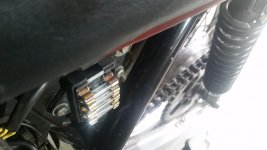
As to the blown main fuse, closer inspection showed that the clips holding the main fuse had sagged somehow and were able to touch one side of the fuse holder immediately below. If this caused the main to blow, why didn't it take out the fuse directly below?
 
John that's exactly what mine did! I suppose the main fuse blew first because the one below either wasn't drawing anything or didn't have a path to short through. Take the fuse block off, you may find the plastic is work or melted. I re-soldered (melted) the joints & then potted (filled the back cavity up) with clear epoxy and it's been fine ever since (probably a dozen years and 20,000 miles since then..).

I posted some pictures here somewhere.

That vent you're talking about is not the vacuum tube for the petcock is it? If you have a manual petcock then yes that one has to be plugged. On mine (with pods) I don't have vent tubes, just the fuel pipe & the vacuum pipe going to the petcock, nothing else.
 
Now that you remind me, it is the vacuum tube for the original petcock, since replaced by a Pingel. All this points to the importance of keeping a maintenance journal, as opposed to relying on my memory, which seems to have more problems than a Japanese bike from the 70s!
 
:lol: :lol: That cylinder would have been running lean.

If it were mine I'd probably still run some seafoam through it :)
 
Glug glug glug. One can of Seafoam down the hatch. Then back on the iron horse for another ride around the delta. Shifting is buttery smooth with a crankcase full of Rotella T6. Not sure why I have Forum Mentor next to my name. If anything I am a wayward pupil. Thanks to everyone here for the continuing education.

Enjoyed a visit yesterday to a local motorcycle Smithsonian. https://www.thevintagemonkey.com/ Check it out. A few feet from the shop manager sat a GS1000 in the middle of a Yoshimura racing replication circa 1980 . . . the manager told me that the GS1000 has become a much-sought commodity among younger riders with vintage leanings. Hang on to your hogs everybody, it could fund your retirement!
 
I remember the same sort of thing happening with the vent hoses.
Trying to tune the carbs while being feed from an auxiliary tank. Ran crummy, put a golf tee in the vent hose and no more crummy.
 
CSI Sacramento has determined that it happened like this: main fuse clip touches fuse clip immediately below, killing all power, causing the engine to chuff, causing the carburetors to cough the old cap from vent tube #3 . . . golf tee seems the elegant solution, or maybe a miniature laboratory-grade stopper . . .
 
Did the fuse box melt at all?
Remove it and check the back as Dan suggested. Clean all of the connections
Then, pull your head light and remove your ignition switch
Take it apart and clean it. If it looks pitted, sand the contact s with very fine sandpaper to provide a clean smooth surface.
 
Mine started randomly blowing the main fuse. I cleaned up my fuse box and had a connection resoldered; the fuse kept blowing
I finally broke out the VOM and found my main fuse had 12.6V, But the other circuits had 9.8V. So, I pulled the ignition switch and found this
IMG_20200505_160822757 by on, on Flickr

I sanded these with 1500 and 3000 til they looked like this
IMG_20200505_163020629 by T, on Flickr

I cleaned and buffed the other copper contacts, reassembled and found 12+V all around
 
My 1000e blew a fuse once. I was in Kentucky somewhere and stopped for gas. Inside the convenient store they had icecream. It was a hot day and the icecream looked so good so I got myself a icecream cone. I go out to sit with my motorcycle to enjoy my icecream treat. After getting gas and cleaning up my hands and face, I jumped on the bike to continue my journey. Well, as I'm pulling out of the parking lot the bike died! No lights, no nothing, I figured it was a blown fuse. I popped another fuse in there and didn't have anymore problems... So, I figured the motorcycle was upset because it didn't get any icecream! For now on, I don't enjoy icecream in front of my motorcycles, well unless I get my motorcycle some icecream too. 🌞
 
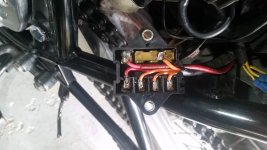
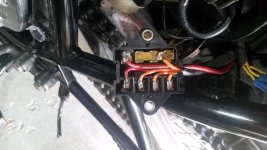
. . . and bare wire at the connectors on the back.

Fuse 2.jpg

The plastic surrounding the main fuse clips no longer provides a solid base for the clips, so I'm gonna replace the fusebox with a generic box using blade fuses, unless someone talks me out of it.

Also overdue (and good advice, thanks) is an inspection of the ignition switch contacts.
 
I tried to insert the back-of-the-fusebox photo inline, but upon review I see it won't open when clicked, unlike the attached thumbnail in the previous post. Is there some trick to getting the photo inline with the text?
 

Attachments

  • Fuse 2.jpg
    Fuse 2.jpg
    93.4 KB · Views: 0
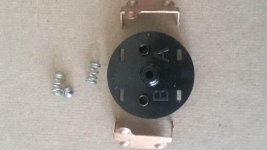
Big T, I think this is for you: I disassembled and cleaned up the ignition switch contact plate and contacts, but in the process sent a couple of springs and a ball bearing flying into my un-laboratory like garage. Fortunately, I was able to find all three bits. I can deduce where the ball bearing sits, but I am unsure about the two springs that go beneath the A and B contact clips. There are two smaller springs that sit in wells just above the letter B and the letter A, and these stayed in place. Do the larger two springs go around the smaller springs?
 

Attachments

  • ignition contacts two.jpg
    ignition contacts two.jpg
    98.7 KB · Views: 0
That fuse box looks like a healthier version of mine... I would at least melt the connections & maybe add a bit more solder, clean the front contacts up, new fuses & then fill the back with epoxy before putting the cover back on. Mines been trouble free since I did that.. :)
 
Nope

The two springs go in the holes on the side and the ballbearing s go in on top of the springs.

Squeezing both bearings while you reinsert the plate can be a bit tricky

The ball bearings provide the detent
 
Back
Top