• Required reading for all forum users!!!

    Welcome!
    Register to access the full functionality of the GSResources forum. Until you register and activate your account you will not have full forum access, nor will you be able to post or reply to messages.

    A note to new registrants...
    All new forum registrations must be activated via email before you have full access to the forum.

    A Special Note about Email accounts!
    DO NOT SIGN UP USING hotmail, outlook, gmx, sbcglobal, att, bellsouth or email.com. They delete our forum signup emails.

    A note to old forum members...
    I receive numerous requests from people who can no longer log in because their accounts were deleted. As mentioned in the forum FAQ, user accounts are deleted if you haven't logged in for the past 6 months. If you can't log in, then create a new forum account. If you don't get an error message, then check your email account for an activation message. If you get a message stating that the email address is already in use, then your account still exists so follow the instructions in the forum FAQ for resetting your password.

    Have you forgotten your password or have a new email address? Then read the forum FAQ for details on how to reset it.

    Any email requests for "can't log in anymore" problems or "lost my password" problems will be deleted. Read the forum FAQ and follow the instructions there - that's what we have one for...

  • Returning Visitors

    If you are a returning visitor who never received your confirmation email, then odds are your email provider is blockinig emails from our server. The only thing that can be done to get around this is you will have to try creating another forum account using an email address from another domain.

    If you are a returning visitor to the forum and can't log in using your old forum name and password but used to be able to then chances are your account is deleted. Purges of the databases are done regularly. You will have to create a new forum account and you should be all set.

1980 GS850 Rebuild

  • Thread starter Thread starter Guest
  • Start date Start date
G

Guest

Guest
Hello GS Forum. I got my hands on a non-running GS a couple of months ago CHEAP, so I'm slowly working my way through it in an effort to get it back on the road. It has a fair oil leak somewhere (I think toward the top end, TBD), and the wiring is pretty hacked up. I'm taking it slow and trying not to spend too much money in case it turns out to be a lost cause. Here's my progress so far:

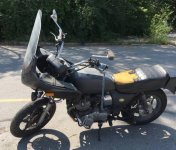
I removed the Vetter fairing. It won't be going back on. Also removed the tank (remarkably clean and rust free inside), seat, airbox and carbs so I could give the bike a thorough degreasing.

Now that it's clean enough to touch, I started working through the wiring. The PO had installed a new generator, but he told me it still wasn't charging. I disconnected and cleaned all the wiring harness connectors, labeled everything and temporarily reconnected the hacked wires so I could do some testing on the electrical system and the engine.

I temporarily connected one of my jet ski batteries and was able to confirm that the engine turns over. One small victory! So, I shot a little oil in each cylinder and checked compression. Compression in all four holes was good, so I think it's safe to start spending a little money on this thing.

I disassembled the carbs, cleaned them up, adjusted floats and replaced o-rings. Carbs, like the gas tank were cleaner than I expected and in overall pretty good condition. I reinstalled the carbs and hooked up an auxiliary fuel tank, cleaned the plugs, topped off the oil and tried to start it. It took a little spinning, but eventually fired up!! It was loaded up initially because of the oil I'd put in the cylinders, but it eventually cleaned out and ran pretty good. I hadn't installed the air box, so it liked to stumble through mid range, but it would rev out and it idles well. It also shifts through all the gears like it should. I had identified some mistakes the PO had made wiring up the new generator, so it's now charging as well. Victory #2. Time to spend more money.

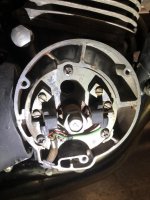
My next step is to get it reassembled far enough to do some road testing and hopefully find out where the oil leak is. So, I purchased a new battery and have the rubber pipes between the air box and carburetors on order (~$85! Ouch, but the old ones were rock hard). I also bought a used headlight (couldn't mount the one from the Vetter) and cleaned up the brake systems. I ended up needing a rebuild kit for the front master cylinder, so that's on order. Finally, I reworked my temporary wire connections to a more permanent state. I tried to restart, but now I'm getting no spark at any of the plugs. I'm working my way back through my wiring, but haven't found the culprit yet. I did find that someone had installed an aftermarket signal generator at some point (bonus!?). I was hoping to post a picture so I could get help identifying the manufacturer, but the site will only let me attached on file. Maybe I'll follow up later.

So, here's my first real question to the GS experts. In trouble shooting my no spark situation, I'm finding good voltage (bright light on my test light) at the orange/white wires to the coils with the ignition switch turned on. I'm getting a very dim light at the black and white coil wires with the ignition on. When I run the starter, the dim light kind of flickers. I guess I was expecting something a little more dramatic. Is this typical of a non-points ignition system? Is my signal generator not getting adequate voltage? The service manual only addressed points, so I'm not sure what to investigate next.

Thanks in advance for your help. I'll continue to update, and I'll post more pictures when I have something worth showing off.
2020-09-11 18.50.21.jpg
 
Here's a picture of the signal generator. If anyone knows the manufacturer or can provide any other information, I'd appreciate it. Thanks.

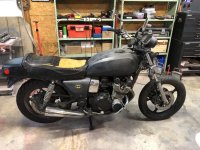
2020-10-20 17.44.41.jpg
 
One more shot of the bike before the initial disassembly. Sorry for posting out of order.

00X0X_9MnfJwsvwfi_0t20lM_1200x900.jpg
 
Welcome to the forum! It’s usually the CDI that goes out (spark box) not the signal generator. The Dyna ignition fits that bike and is worthwhile for peace of mind in my book....

How are the brakes? The Twinpot brakes fit that bike... at the very least you should flush all the calipers out and change the lines for new braided ones. Safety first....

Cheers,

Dan
 
Although it is often mis-labeled as "CDI", you don't have an actual CDI on your bike. :-k

There is no large capacitor that gets discharged to provide the spark, hence no "Capacitor Discharge Ignition".

What you DO have is a box of transistors that act like the mechanical points, Suzuki calls it the "Ignitor". You should always see a strong voltage (should be VERY close to battery voltage) on the orange/white wire. The wires at the other end of the coils are effectively switched ground wires, so they WILL flicker.

Won't help your "no spark" situation, but have you checked your valve clearances? That is a MUST DO item for any bike where you don't know the history.

.
 
Thanks for the input fellas. I'll continue to sort the wiring this weekend. I'm suspecting a bad ground, but who knows. My master cylinder rebuild kit showed up, so that's what I worked on yesterday. Good brakes all the way around now.

Valve adjustment is definitely on the to-do list. I expect to have to replace some gaskets (maybe even the base gasket) before this is all over with, so the engine is probably coming out at some point. That seems like the most convenient time to deal with valves.
 
Hi there!

Welcome in!

I strongly believe all you'll ever need is in there: http://gsarchive.bwringer.com/
Incredibly complete info on your bike.

For your electrical problem, I'd check the coils first... --> http://gsarchive.bwringer.com/storagecliff/images/electrical_odd-n-ends.html
Then check if the black wires are getting to ground with the right timing. See the section Testing The Ignition System in the above document.
Also worth mentionning is connections, of course. Most of my problems dispeared after a through out cleaning of the connectors.

Good luck...

Frank
 
Thanks Frank. A well thought out, step by step procedure is invaluable. I knew about BikeCliff's site, but hadn't drilled down that deep.
 
I expect to have to replace some gaskets (maybe even the base gasket) before this is all over with, so the engine is probably coming out at some point.
There is no need to remove the engine to replace the base gasket. In fact, unless you have a way to stabilize the engine on a bench or a dedicated engine stand, I think it would be easier to replace the gasket while the engine is still in the frame. Everything necessary comes off easily enough in the frame. I have just replaced an engine in my 850 and can confirm this from experience, not just guessing.

.
 
There is no need to remove the engine to replace the base gasket. In fact, unless you have a way to stabilize the engine on a bench or a dedicated engine stand, I think it would be easier to replace the gasket while the engine is still in the frame. Everything necessary comes off easily enough in the frame. I have just replaced an engine in my 850 and can confirm this from experience, not just guessing.

.
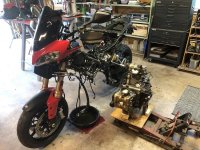
Good to know. But, I've got more than one reason to remove the engine. PO had "murdered" it out, so I want to disassemble as far as I can to get this thing cleaned up. I'm not afraid to drop an engine. Here's a shot of my Multi a couple of months ago when it had a crank bearing go bad.

2020-08-11 19.10.12.jpg
 
The technique that my son and I used to change my engine works rather well. It does require two people without major physical handicaps.

After removing everything that holds the engine to the bike (carbs, exhaust, wiring, mounts, etc.) the engine is just sitting on the frame. We used two ratchet straps as lifting slings. On the left side, the only practical attachment (on an 850) is the left rear, above the shifter. There is a hole where the airbox drain hose goes through. Place one hook there and hook the second hook of the same strap into the first hook. Loop the strap around the stator cover, then up, over your neck. The second strap can be hooked into holes in the crankcase that appear to be designed for this. One is in the front, one is at the rear. Place this strap over the second person's neck. Adjust the length of the straps so you are standing almost upright, but can still see the engine. Use your legs to lift and swing the engine to the right side a bit. You will have to move the left-side strap/sling to inside the frame rails while balancing the engine on the right frame rail, then move it again with the strap to the right of the frame and set the engine down on a dolly.

It probably sounds a bit harder than it actually is, but the two of us were able to easily remove the engine from my bike, then remove the engine from the parts bike and move it to my bike. One of the smaller Harbor Freight dollies will hold the engine well enough and it's easy to push around on the floor.

.
 
The technique that my son and I used to change my engine works rather well. It does require two people without major physical handicaps.

After removing everything that holds the engine to the bike (carbs, exhaust, wiring, mounts, etc.) the engine is just sitting on the frame. We used two ratchet straps as lifting slings. On the left side, the only practical attachment (on an 850) is the left rear, above the shifter. There is a hole where the airbox drain hose goes through. Place one hook there and hook the second hook of the same strap into the first hook. Loop the strap around the stator cover, then up, over your neck. The second strap can be hooked into holes in the crankcase that appear to be designed for this. One is in the front, one is at the rear. Place this strap over the second person's neck. Adjust the length of the straps so you are standing almost upright, but can still see the engine. Use your legs to lift and swing the engine to the right side a bit. You will have to move the left-side strap/sling to inside the frame rails while balancing the engine on the right frame rail, then move it again with the strap to the right of the frame and set the engine down on a dolly.

It probably sounds a bit harder than it actually is, but the two of us were able to easily remove the engine from my bike, then remove the engine from the parts bike and move it to my bike. One of the smaller Harbor Freight dollies will hold the engine well enough and it's easy to push around on the floor.

.

Wow, I wish you had that on video.
 
Got it running. The chassis ground for the wiring harness was almost nonexistent. I added a new ground wire from the harness ground directly to the engine and all is good. It fired right up. I don't have a headlight or tail lights, so there are still some electrical gremlins to figure out. I also installed the airbox, and it's evident that I need to spend some more time with the carbs.

That's ok though because I'm still a couple of weeks from being able to ride it (I'm on crutches at the moment). I'll keep chipping away and hopefully I'll have more progress to report by next weekend. With a little luck it'll be close to ready for a shakedown cruise.
 
Me, too, but we were both rather busy at the time. :-\\\

We might be talked into placing the (now)spare engine back into the parts bike, just for the video. :-k

.

Please do. I've seen videos of several other methods. This one sounds much more interesting.
 
I'm sure this will be a dumb question, so I searched first but didn't find a solution.

I'm working on my tail and tag lights, and I'm not getting power to either (brake light works, so ground is good). I have the FSM wiring diagram and the colored wiring diagram from BikeCliff's website. They both show a brown wire to the tail light and a grey wire feeding the tag light. Both diagrams show these two wires going directly to the ignition switch. When the switch is turned on, the grey and brown wires are contacted according to the diagrams. but I don't see a connection to power anywhere on either diagram. What am I missing? Where does current get into those circuits?

Thanks.
 
They both show a brown wire to the tail light and a grey wire feeding the tag light. Both diagrams show these two wires going directly to the ignition switch. When the switch is turned on, the grey and brown wires are contacted according to the diagrams. but I don't see a connection to power anywhere on either diagram. What am I missing? Where does current get into those circuits?
This is almost embarassing to admit, but I use that wonderfully-enhanced diagram and the FSM a LOT. And, I have an '80 850G. I know that the gray wire feeds the tag light and the brown wire feeds the tail light, but have never noticed that nothing feeds the two of them. :oops:

Near the bottom-center of that diagram, just above the starter motor, is a four-pin connector. One of the wires on the top side of that connector is a gray wire that feeds the speedo and tach lights. It is supposed to also have a connection dot where it crosses the gray wire that feeds the tag light.

If that connection is made, when the ignition key is in the ON position, power will come from that connection to the ignition switch, then feed the brown wire for the tail light. When the key is in the PARK position, the red wire that comes from the MAIN fuse will be connected to the brown wire to turn on the tail light and nothing else.

I examined the Suzuki manual very carefully and was surprised to see that the only connection in those two lines was where the brown wire had a branch that goes to the headlight bucket.

The manual does NOT show the connection in the diagram for the '79 G on page 12-30 (page 269 of the pdf file).
The manual does NOT show the connection in the diagram for the '80 G on page 14-58 (page 329 of the pdf file).
The manual does NOT show the connection in the diagram for the '80 GL on page 15-10 (page 339 on the pdf file).
The manual does show the proper connection in the diagram for the '81 G and GL on page 16-27 (page 366 in the pdf file).
The manual does show the proper connection in the diagram for the '81 G and GL on page 16-46 (page 385 in the pdf file).
The manual does show the proper connection in the diagram for the '82 G on page 17-37 (page 422 in the pdf file).
The manual does show the proper connection in the diagram for the '82 GL on page 18-32 (page 454 in the pdf file).

I find it interesting that the '81 has two separate diagrams that are both labeled for the G and GL models. The GL models never did have a separate tag light. The diagram on page 366 is actually for the '81 G, the one on page 385 is for the '81 GL.

Now (finally) to your problem. Look under the tank on the right side near the coil, you should see that four-pin connector. Verify that you have power on the gray wire there. If you don't, check the orange/red wire in that connector. If you don't have power there, check your fuses.

.
 
At a minimum I'd be replacing those 40 year old brake lines... and popping out the pistons to clean behind them.

It's amazing how much gunk gets stuck in there.. :)
 
Fixed it! Well, not really, but I found the culprit. The heavy gauge orange/red wire from the fuse box isn't contacting all the time. I'm not sure if it's a problem in the connector or buried somewhere in the taped up harness but jiggling during checking with my test light caused it to start working. When it's on line, everything works. I'll track that down, wrap up a few other loose ends in the wiring, and then move on to the carbs. I have new manifolds on order, and they should be here today. Incremental progress!
 
Someone said to me when I first got here:

"Check the connections, then the connections and don't forget the connections."

Hahaha...

I cleaned every connector / plug with contact cleaner, brush them out, more contact cleaner. Replacing a few that were just falling apart.

That cleared quite a few gremlins for me too!

I'm happy you're getting out of the woods.

I have to order a few things as well this winter, air intake boots, intake seals, etc.

My bike is ready for winter, it's getting near freezing temp already up here. Tank is full, stabiliser in there...
Hoping for a few last rides then it's gonna be the winter tarp and plugging the battery.

Take care!

Frank
 
Back
Top