• Required reading for all forum users!!!

    Welcome!
    Register to access the full functionality of the GSResources forum. Until you register and activate your account you will not have full forum access, nor will you be able to post or reply to messages.

    A note to new registrants...
    All new forum registrations must be activated via email before you have full access to the forum.

    A Special Note about Email accounts!
    DO NOT SIGN UP USING hotmail, outlook, gmx, sbcglobal, att, bellsouth or email.com. They delete our forum signup emails.

    A note to old forum members...
    I receive numerous requests from people who can no longer log in because their accounts were deleted. As mentioned in the forum FAQ, user accounts are deleted if you haven't logged in for the past 6 months. If you can't log in, then create a new forum account. If you don't get an error message, then check your email account for an activation message. If you get a message stating that the email address is already in use, then your account still exists so follow the instructions in the forum FAQ for resetting your password.

    Have you forgotten your password or have a new email address? Then read the forum FAQ for details on how to reset it.

    Any email requests for "can't log in anymore" problems or "lost my password" problems will be deleted. Read the forum FAQ and follow the instructions there - that's what we have one for...

  • Returning Visitors

    If you are a returning visitor who never received your confirmation email, then odds are your email provider is blockinig emails from our server. The only thing that can be done to get around this is you will have to try creating another forum account using an email address from another domain.

    If you are a returning visitor to the forum and can't log in using your old forum name and password but used to be able to then chances are your account is deleted. Purges of the databases are done regularly. You will have to create a new forum account and you should be all set.

Anti-Dive brake hoses removed - is there a reason?

  • Thread starter Thread starter Guest
  • Start date Start date
G

Guest

Guest
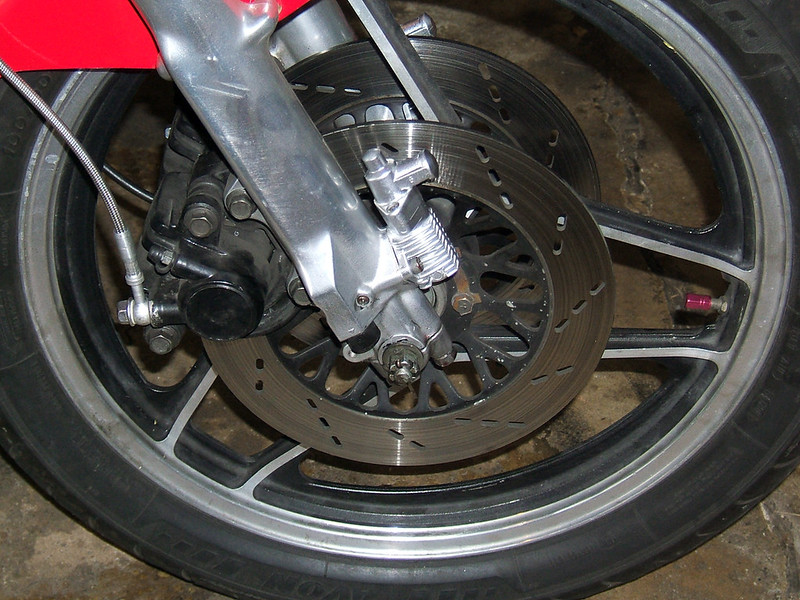
Hey, all - I purchased a 1984 GS 750 EF (GS700ES, GSX750 EF) that had been sitting unused for 5 years. I'm going through the process of bringing it back to life. While removing the front wheel, something seemed to be missing. The manual showed the brake hoses from the front calipers to the anti-dive system, but they're not there on mine!. So I'm wondering if there would have been a reason for this back in the day? If the master cylinder is calibrated for the additional hoses, now removed, would that mean more braking power?
I'm wondering if I should replace the missing fittings and hoses, or just leave it the way it is.
Thoughts?
Thanks, Rory
 
Hey Rory, Welcome to the fun house. The anti dives were said to reduce brake feel on the braking end, and potentially unpredictable (while braking) fork damping on the suspension end, so many people simply took them out of the equation.
 
Last edited:
To add... a simple change to straight rate fork springs (Sonic Springs is a great company to deal with ) sized for your weight / riding preference eliminates the need for such sorcery.
Cartridge emulators make it even better, but can be a bit spendy.
 
Agreed. :encouragement:

The master cylinder was not "calibrated" for the system any more than the fact that it had to feed two disks. As I understand the "problem", when you first started to squeeze the brake lever, the first bit of travel would move a piston in the forks to stiffen up the damping to prevent diving. That delay in actual braking action was apparently the main gripe. Removing the anti-dive hose (and installing the necessary bypass) would apply ALL of the lever action directly to the disks.

As dorkburger mentioned, an upgrade to Sonic Springs (<-- click link) will keep the front from diving with spring pressure, rather than hydraulic resistance. Note that the original anti-dive mecanism did not keep the forks from compressing while braking, it merely slowed down the action.

.
 
Seeing as though this thread has popped up, I am planning to bypass the anti-dive on my gsx750ef - have just ordered braided steel brake lines minus the anti-dive lines. 2 quick Qs (yes, I've searched but found conflicting info)
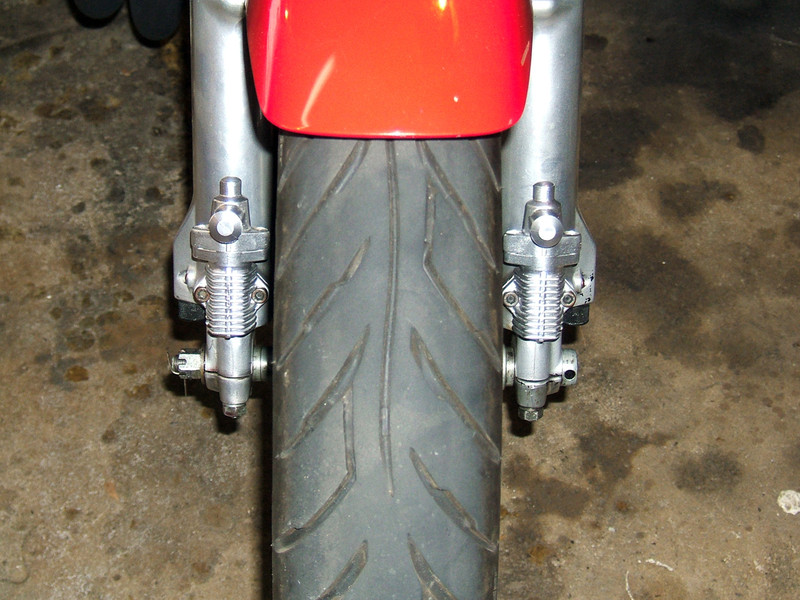
1) Will leaving the units on and just disconnecting the lines work, it seems it would still allow passage between the 2 holes the same way a block off plate would?
2) Why the recommendation on straight rate springs? The suspension specialist I spoke to said for road riding that progressive springs would be better, with the benefits of straight rate only really beneficial on the track (or only riding ideal surfaces).
 
Also, congrats on the purchase Rory, in the same situation myself, picked it up last year and finally getting around to putting the work in. Is yours the same blue on white colour scheme?
 
2) Why the recommendation on straight rate springs? The suspension specialist I spoke to said for road riding that progressive springs would be better, with the benefits of straight rate only really beneficial on the track (or only riding ideal surfaces).
We used to think that, too, until we tried them. :-k

If you think about it, the lighter-rate portion of the springs are are what is going to be compressed first with the initial preload when you assemble the forks. There will be precious little of the lightweight spring left. Then, when you get on the bike and the bike settles an inch or so, you will take up the rest of the lightweight springs and you are left with the heavier-weight springs, anyway, which will essentially leave you with straight-rate springs.
dunno.gif


It just makes more sense to start with straight-rate springs and enjoy the comfort that results from having the full range of fork travel available. One other distinct advantage is the choice of different spring rates, so you can tailor the rate to your bike, riding style and your personal "gravitational attraction". :oops:

Two of our three GSes here have Progressive (brand) springs, which happen to be progressively-wound springs. They do OK. When I changed the springs on my bike, I chose to go with Sonic straight-rate springs. Because I started with the heaviest GS (an 850) and had added full touring luggage, I chose the heaviest spring rate available, 1.1 kg/cm. I can't say enough about the improvement in ride and handling. It is certainly better than my son's 1000G, which is essentially the same bike with a larger engine. I have recently also added Racetech emulators, but have not yet had the time to fine-tune them.

By the way, your suspension specialist is giving you conflicting information. Tracks are hardly an "ideal surface", so which one is better for straight-rate springs? :-k

Quite some time ago, I read a paper that was written by the suspension specialist on a professional race team. Unfortunately, I don't remember which team, but it was one of the well-known teams. His advice on fork oil viscosity was to ignore the common theory of using heavier-weight oil to firm up the suspension for control. What he did for his race bike was to choose the spring rate for the rider and track, then use the thinnest oil that would keep the wheel on the track. Anything thinner would not provide enough damping to keep the wheel from flying up after a bump, anthing thicker would lock up the forks to the point that they would not absorb the bumps in the track. Following that advice, I have found that 10w oil works very well. :encouragement:

.
 
Interesting, thanks for the insights. I think I probably misquoted the suspension guy (btw, he is from Ikon based here in Aus - I was hoping to buy locally which is hard when it comes to niche moto stuff). Rather than 'ideal surfaces', he probably meant that it is a controlled environment - as in each track has its characteristics that suspension can be tuned for compared to road environments where you might ride super smooth blacktop, bumpy c-roads, potholes and dirt roads in any one day.

I've actually just ordered a copy of the suspension bible to educate myself (I ride offroad a bunch and keen to improve my understanding), so I'm sure I'll get a clearer understanding as time goes on. Anyway suspension work is on the backburner for now, I've had to blow my budget on a new exhaust system. Figure I'll ride the stock suspension for a while so I really appreciate the change when I upgrade!

...and sorry again for hijacking the thread!
 
1) Will leaving the units on and just disconnecting the lines work, it seems it would still allow passage between the 2 holes the same way a block off plate would?
Yes, this works fine.
If you want to clean it up a little, just get a couple plastic panel plugs at the auto parts or hardware store, paint 'em silver and stick 'em in the holes.


Last edited:
Also, if you consider that as the fork compresses against the air inside the unit, it becomes progressively harder to compress. So even with a straight rate spring, the forks are already "progressive" as they compress. Go with straight rate springs.
 
Also, if you consider that as the fork compresses against the air inside the unit, it becomes progressively harder to compress. So even with a straight rate spring, the forks are already "progressive" as they compress. Go with straight rate springs.
Add the progression curve of compressed air to the progression curve of variable-rate springs and things can get ... interesting. :-\\\

.
 
Loccoli,
Mine is red and white - so far I've been lucky with the carbs, but had to replace the stator and R/R. Rear brake was not functioning at all, rebuilt caliper and Master Cylinder - replaced dry rotted signal lights with new reproductions, replaced tires and wheel bearings. Just starting on the front end, hence the question in this thread.
Not much choice with tires on these 16 inchers - went with Bridgestone Battlax BT 45.
Good luck with your build!
 
Back
Top