• Required reading for all forum users!!!

    Welcome!
    Register to access the full functionality of the GSResources forum. Until you register and activate your account you will not have full forum access, nor will you be able to post or reply to messages.

    A note to new registrants...
    All new forum registrations must be activated via email before you have full access to the forum.

    A Special Note about Email accounts!
    DO NOT SIGN UP USING hotmail, outlook, gmx, sbcglobal, att, bellsouth or email.com. They delete our forum signup emails.

    A note to old forum members...
    I receive numerous requests from people who can no longer log in because their accounts were deleted. As mentioned in the forum FAQ, user accounts are deleted if you haven't logged in for the past 6 months. If you can't log in, then create a new forum account. If you don't get an error message, then check your email account for an activation message. If you get a message stating that the email address is already in use, then your account still exists so follow the instructions in the forum FAQ for resetting your password.

    Have you forgotten your password or have a new email address? Then read the forum FAQ for details on how to reset it.

    Any email requests for "can't log in anymore" problems or "lost my password" problems will be deleted. Read the forum FAQ and follow the instructions there - that's what we have one for...

  • Returning Visitors

    If you are a returning visitor who never received your confirmation email, then odds are your email provider is blockinig emails from our server. The only thing that can be done to get around this is you will have to try creating another forum account using an email address from another domain.

    If you are a returning visitor to the forum and can't log in using your old forum name and password but used to be able to then chances are your account is deleted. Purges of the databases are done regularly. You will have to create a new forum account and you should be all set.

Battery charge monitor

  • Thread starter Thread starter Matchless
  • Start date Start date
M

Matchless

Guest
Hi,
Here is a diagram that will allow you to mount two small led's on your bike. The first one will shine when the bike is switched on and go out as the battery starts charging. The second will only come on when the alternator starts overcharging. No lights will be on while driving and all is well. You can set the actual trip points of the lights to your own liking or even use a blinking led for the overcharging indication.
Enjoy
 
I like it ! Might fit inside the cluster gauges.

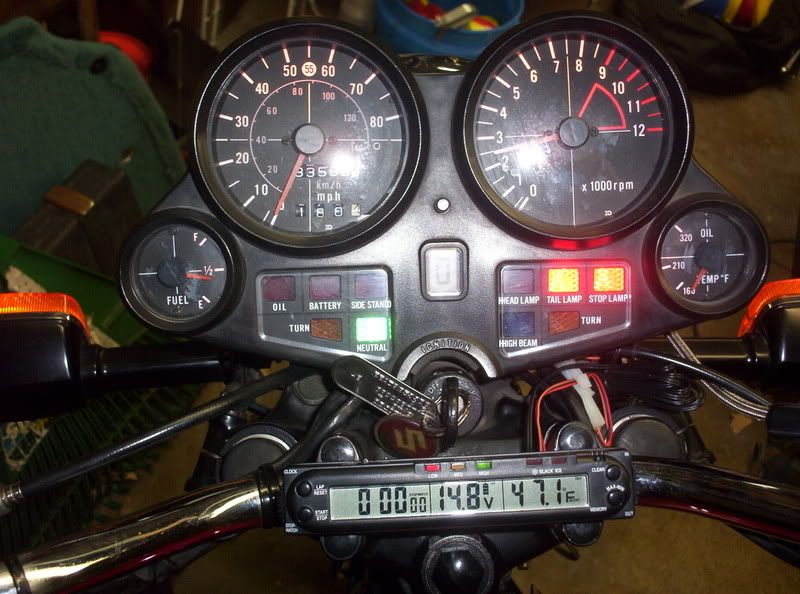
For the Project Challenged crowd this little gizmo is only $25.

2003.jpg
 
I wish that was available over here! I asked around, but no-one has even seen it.
 
THANKS ALOT!! I'll definitely be making one of these units and installing it on my bike. One question though....how would you adjust the trip points?
Willie in TN
 
A quick and dirty way would be to make up a small battery pack, dry cells at 1,5v each and add or use rechargebles at 1.2v each and by adding a rectifier in series you can drop about .6 volt. With a bit of fiddelling you should be able to set up something like 12.8v as a trip point for a full battery voltage just rising as the charge comes in and trip at 14.5 overvoltage. The actual settings can be at your own discretion.
The correct way is to use an adjustable power supply. I have a diagram for the PC board as well, although I have not used it as mine is still on a bit of breadboard.
 
Last edited:
If you use an LM3914 chip you can attach it directly to a 10 stage bar graph, and then monitor how much power fluctuates at particular revs.
 
If you use an LM3914 chip you can attach it directly to a 10 stage bar graph, and then monitor how much power fluctuates at particular revs.

I was seriously looking at that, but decided to go for a simple display where the light is only on if there is a fault, very similar to most vehicles today. This is also very low current drawing and no extra lights glaring at you when driving at night.
 
I was seriously looking at that, but decided to go for a simple display where the light is only on if there is a fault, very similar to most vehicles today. This is also very low current drawing and no extra lights glaring at you when driving at night.

Fair enough, it would also be more compact/discrete than the bar graph.
 
That is a really nice little "gizmo", but be aware of one thing...IT'S NOT WATERPROOF. :shock:

It is, however, possible to increase its water resistance by spraying it with a couple coats of clear polyurethane. If you do several light coats, they will dry without distorting or clouding the screen. The main area you want to concentrate on is the edge around the screen, where water will get in and destroy the display.

About the only other thing that is not quite so good about them is that the backlight for the display is entirely dependant on incoming voltage. When the voltage is around 12, you may not be able to read the display at night. You can still get an approximation of voltage, though, by looking at the colored LEDs at the top. The red one is on all the time, the yellow one comes on at 11.8 volts, the green one comes on at 12.5 volts.

Please don't get the idea I don't care for them. On the contrary, I have one on each of the bikes in my garage except my Wing, which has a VDO voltmeter on the panel. I have also installed several for family and friends. 8-[


.
 
That is a really nice little "gizmo", but be aware of one thing...IT'S NOT WATERPROOF. :shock:

It is, however, possible to increase its water resistance by spraying it with a couple coats of clear polyurethane. If you do several light coats, they will dry without distorting or clouding the screen. The main area you want to concentrate on is the edge around the screen, where water will get in and destroy the display.

About the only other thing that is not quite so good about them is that the backlight for the display is entirely dependant on incoming voltage. When the voltage is around 12, you may not be able to read the display at night. You can still get an approximation of voltage, though, by looking at the colored LEDs at the top. The red one is on all the time, the yellow one comes on at 11.8 volts, the green one comes on at 12.5 volts.

Please don't get the idea I don't care for them. On the contrary, I have one on each of the bikes in my garage except my Wing, which has a VDO voltmeter on the panel. I have also installed several for family and friends. 8-[


.

I bought one last spring, put it on several weeks ago (before the Fennimore Rally), and promptly discovered that my backlight leds don't work at all. Wonder if they'll swap it out for me?

Otherwise I like it! First thing it did was alert me to the fact that my charging system is "funky" right now. It charges, but not as consistently as it should. Already have a Honda R/R on the way, and will do a thorough job of cleaning/upgrading my connectors when it arrives!

Regards,
 
Yeah, I had one without much of a backlight, too, but it's on my wife's 850 right now. It is mounted under a shelf that is attached to the handlebar clamps. The shelf comes back toward the rider and holds the satellite radio and the GPS. I mounted a red LED under the shelf so that it lights up the voltmeter so it can be read at night.

Another way to view the whole backlight situation is this: how much do you ride at night? Do you really need a light? :shock:


.
 
Yeah, I had one without much of a backlight, too, but it's on my wife's 850 right now. It is mounted under a shelf that is attached to the handlebar clamps. The shelf comes back toward the rider and holds the satellite radio and the GPS. I mounted a red LED under the shelf so that it lights up the voltmeter so it can be read at night.

Another way to view the whole backlight situation is this: how much do you ride at night? Do you really need a light? :shock:


.
Not that I disagree with that sentiment, but it's the principle of the thing ... it SHOULD work! Anyway, I was on the phone with customer support, and while they doubt the manufacturer will swap it out he's going to give it a try anyway. Can't help but appreciate the effort and if, at the end of the day, they don't exchange it I'll survive...

BTW, my brain must officially be turning to jello. I looked up the order history and discovered that I bought it almost exactly a year ago ... not last spring! :shock::lol:;-)

Regards,
 
Last edited:
You are quite correct, it should work.

Fortunately, in our case, we had a viable alternative with an exterior LED shining on it.


.
 
For waterproofing consider a sheet of clear laminate from office supply. It also serves to protect the lens from scratches somewhat. If it gets scuffed or discolored you can peel it off and replace it.
 
If you use an LM3914 chip you can attach it directly to a 10 stage bar graph, and then monitor how much power fluctuates at particular revs.

I did one with 2 of the 3914s cascaded for a 20 segment display, and offered up the plans here
http://http://www.thegsresources.com/_forum/showthread.php?t=107610
If anyone is interested, I still have them.

I couldn't get the files small enough to post here, so I have to send them via email ...


Some time after that, Duanage and I were talking about stuff and he mentioned doing a single LED display using a red/green bicolor LED.
He was thinking of using comparaters and 555s and such.
I was just starting to experiment with microprocessors, and thought that would be much better done with a PIC.

Using a PIC, it would be easy to get all the following colors out of ONE led as the voltage goes from say 8 to 17 volts:
fast red flashing, red flashing, solid red, yellow flashing, solid yellow, green flashing, solid green, red-yellow-green alternating, red-yellow-green-yellow-red fading.

I have the pics, and bought one of the LEDs to experiment with.
The circuit should be pathetically simple: the PIC, the LED, three or four resistors, and a capacitor.
I'll probably play with it as time permits.

Would there be any interest in this when I get it done.
 
Would there be any interest in this when I get it done.
Yes please.
I have been looking at a ciruit with a voltage reference and a couple of compartors etc. But really it does not need to be that accurate just an indication when something is bad.
 
I did one with 2 of the 3914s cascaded for a 20 segment display, and offered up the plans here
http://http://www.thegsresources.com/_forum/showthread.php?t=107610
If anyone is interested, I still have them.

I couldn't get the files small enough to post here, so I have to send them via email ...


Some time after that, Duanage and I were talking about stuff and he mentioned doing a single LED display using a red/green bicolor LED.
He was thinking of using comparaters and 555s and such.
I was just starting to experiment with microprocessors, and thought that would be much better done with a PIC.

Using a PIC, it would be easy to get all the following colors out of ONE led as the voltage goes from say 8 to 17 volts:
fast red flashing, red flashing, solid red, yellow flashing, solid yellow, green flashing, solid green, red-yellow-green alternating, red-yellow-green-yellow-red fading.

I have the pics, and bought one of the LEDs to experiment with.
The circuit should be pathetically simple: the PIC, the LED, three or four resistors, and a capacitor.
I'll probably play with it as time permits.

Would there be any interest in this when I get it done.

Tri-color LED's (RGB) make it easier to do this.
 
Back
Top