• Required reading for all forum users!!!

    Welcome!
    Register to access the full functionality of the GSResources forum. Until you register and activate your account you will not have full forum access, nor will you be able to post or reply to messages.

    A note to new registrants...
    All new forum registrations must be activated via email before you have full access to the forum.

    A Special Note about Email accounts!
    DO NOT SIGN UP USING hotmail, outlook, gmx, sbcglobal, att, bellsouth or email.com. They delete our forum signup emails.

    A note to old forum members...
    I receive numerous requests from people who can no longer log in because their accounts were deleted. As mentioned in the forum FAQ, user accounts are deleted if you haven't logged in for the past 6 months. If you can't log in, then create a new forum account. If you don't get an error message, then check your email account for an activation message. If you get a message stating that the email address is already in use, then your account still exists so follow the instructions in the forum FAQ for resetting your password.

    Have you forgotten your password or have a new email address? Then read the forum FAQ for details on how to reset it.

    Any email requests for "can't log in anymore" problems or "lost my password" problems will be deleted. Read the forum FAQ and follow the instructions there - that's what we have one for...

  • Returning Visitors

    If you are a returning visitor who never received your confirmation email, then odds are your email provider is blockinig emails from our server. The only thing that can be done to get around this is you will have to try creating another forum account using an email address from another domain.

    If you are a returning visitor to the forum and can't log in using your old forum name and password but used to be able to then chances are your account is deleted. Purges of the databases are done regularly. You will have to create a new forum account and you should be all set.

Big bore GS(X) 400

GregT

Forum Sage
I recently pulled down a customer GSX400 motor for a freshen up. On examining the pistons it was found that the top ring grooves on both pistons were worn beyond reuse.
Costing out the options it was immediately apparent that Wiseco pistons were the cheapest option. Remember, I'm in New Zealand...
A pair of Wiseco big bore GS(X) 750 pistons were ordered - Wiseco part no 4188MO7000 which are for the later 16v GS750. There are at least three ebay suppliers who will sell individual pistons so a set of four is not required. This means the bore goes from 67mm to 70mm, quite a safe overbore in standard liners.

On receipt of them, comparison to OE showed they have 1.00mm more compression height - or deck height if you prefer. Not a problem as base gaskets can be juggled. Valve cutaways matched OE400 nicely, and of course the pin is the same.

Once the barrels were bored and a mockup performed, it was necessary to make up an aluminium base gasket from 1.2mm - or 18G - sheet stock.In conjunction with the gaskets I had here, that gave me a squish clearance (piston to head) of .039in which is right where I wanted it.

The engine is on final assembly now including dialling the cams to allow for the slightly taller barrel. Amusingly, the aftermarket head gasket I'm using (customer supplied) is right on 70mm bore....what were they thinking ?

Mechanix asked me how the piston weights compared, I jokingly answered the wisecos are probably lighter...Ha, yes they are..
Both with rings, pin and one circlip. OE 278 grams Wiseco 262 grams....shouldn't be any balance problems.

Once it's running and carburation sorted, I'll tell how it goes.
 
Last edited:
Head's already on sorry - i'm not pulling it down just for pics. Too busy at present anyway, three more race motors on the bench...

Hopefully the only relevant pic is the smiling owner anyway....
 
Sounds interesting Greg. We didn't get the GS(X)400 in the states....darn!

cg
 
Sounds interesting Greg. We didn't get the GS(X)400 in the states....darn!

cg


Well your Canadian neighbours certainly did. Plenty of threads from them.

Anyway - cams dialled in. The difference from the taller barrel was only 3 - 4 degrees. Frankly if I was doing this on a road bike I wouldn't bother dialling them in.
This one however gets raced - in a gentlemanly fashion...So I moved them to where I wanted them. To complete the story, it's been lightly ported,new stem seals,valves refaced, stripped and cleaned out. Bearings all good, new camchain. New clutch plates. It'd been apart before at least once - i suspect it damaged a gearbox as the bearings are all original codes. The clutch nut was not tight when i stripped it - found out why when i reassembled it - it locked up on the shaft...I'd guess a gearbox swap in the past using the original primary gear/basket. Obviously the shimming was out with a different mainshaft hence the nut not done up tight....All sorted now and nut tight.
The only visible tell of the overbore is the edge of the base gasket
 

Attachments

  • Alloy base gasket.JPG
    Alloy base gasket.JPG
    72.8 KB · Views: 0
Last edited:
Maybe I'm missing something, but isn't this the bike called GS400 here? One of the first of the GS series? Or, is this the 4 valve engine?
Ray
 
Last edited:
It's the 4 valve per cylinder 400 twin...all the 4v motors are called GSX outside the US but were marketed as GS inside the US. Hence the GS(X) in the title of the thread....I don't know if the US got the 4V 400 but Canada certainly did - and they were very popular around the world too.
 
Thanks for clearing that up in my fuzzy mind. I don't think we ever had any 4 valve twins available, at least I've never seen any. Ray
 
i haven't bothered to work out the capacity as it runs in a class where the top limit is 600cc - and it's well under that.

it's turned out very well. The owner is very happy with the performance increase. Carburation took a little while to sort out as he lives some hours away from me. As you might expect with something this age there's also been some electrical problems - which seem to have been a faulty battery.
He's now budgeting for a better set of carbs - probably Keihin CR's. His aim was to do all the South Island street race meetings in one season. He's done Greymouth and Wyndham, both of which had filthy weather. Looking forward to Nelson on New Years day and Methven at Easter.

So yes, worth doing. Not particularly difficult and the parts were cheaper than a rebore with OE pistons - at least here in NZ anyway.
 
Well this thread is very reassuring! I was wanting to eventually build a 2 valve per cylinder gs1000/1100 resleeved big bore gs425 at somewhere around 6-7mm overbore, and was worried about piston weights & finding a competent machine shop that could rebalance a balance shaft engine like the twins. Sounds like you could go several millimeters further in a lightweight aftermarket CNC machined piston before you get to the same weight as stock. I could even possibly specify to Wiseco or JE when ordering the custom pistons, that they keep them within 5% or so of the weight of the stock slugs. There's probably a fair margin of tolerance there, as I bet the engineers designed the balance shaft to deal with future factory +1mm o.s. replacement pistons, which despite a slightly lower dome to keep compression the same with bigger bore, would still likely be heavier due to the added diameter.
 
Greg's build would be a bump from 399cc stock c.r. to 436cc 10.25:1

I'm really hoping to be able to pull off a gs1100 sleeve (72mm stock bore) shortened & bored into a GS425 block. If that's doable, then 516cc's at 74mm would be very doable, & maybe 75mm at 530cc to go all out. 76mm max overbore would probably be pushing it for heat dissipation with minimal cylinder walls and also near the reasonable limit of what even a ported head with oversized valves could support. The GS500 sleeves are 74mm stock, but that would really be pushing the 425's block as far as sleeve boring capacity.

Thanks for sharing your experience on the gsx Greg!
 
In my experience, a replacement piston weight within 10% of the original will be fine as far as vibration goes. I certainly wouldn't rebalance for anything less than 10% difference.
There are two 450's with 500 pistons local to me and this GSX400. None have been rebalanced. all are quite acceptably smooth.
 
Hi,

The bike Greg is talking about is mine, I'm a newbie to the GS forum and chuffed to find this thread.

Since the last posts in here the bike has been raced, finally got it to like it's stock CV carbs, crashed it at Nelson, and now have fitted a pair of Mikuni VM34mm Roundslide carbs to it, still trying to get it to like them, It fired straight up when I fitted them but first time I tried it at the track it ran poorly and I put it down to teething problems with the new carbs. At home earlier this week I was having a jetting session and it dropped a cylinder, I found a loose plug in the wiring to a coil, hopefully got that sorted so back to square one with the tuning. If anyone has fitted VM34's and has any tuning tips it would be much appreciated, I'm no carb expert but am learning as I go, and pestering Greg when I see him :) we live on opposite sides of the South Island and it's a 500km round trip for me race at Ruapuna in Christchurch.
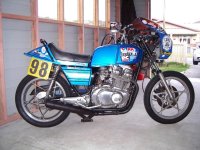

IMGP3556.jpg

Cheers
Muzza
 
Hi Muz - wondered when you'd find this...post one of the horizontal pics from nelson for a giggle.

as owner/user any comments about vibration ?
 
Please correct me if I'm wrong, but I would think that VM34's would seem a bit large for that unless you intend to run only at very high race rpm's. Lower & mid rpm's & you wouldn't have enough air velocity for an unrestricted (no CV butterflies) venturi. I would think a pair of VM28's would be more appropriate, or vm29 smoothbores - both would probably need to be custom fit since I only know of factory four cylinder applications, where the #1&#4 carbs would need to be used.
Unless this bike sees only 5500-13000 rpm's, it doesn't seem to me that you'd have enough air velocity to make the jets function as intended. I suppose this could be adjusted to much larger jets to make up for lack of velocity, but the needle & needle jet selection seem like they would take a high degree of experimentation.

Bikes that ran vm22 & vm26 carbs in the 70's jumped up to bs32's in 1980, & that was with basically no other changes to the engines on many models, implying that a 26mm unrestricted venturi is equivalent or thereabouts to a 32mm with a butterfly throttle valve blocking the middle of it.


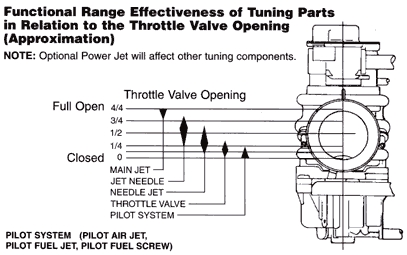
If other racers run vm34's, then the key is that you need to run a much larger jetting than the much smaller bs32 or bs34 ran. Bigger carb @similar displacement = lower air velocity than smaller carb, therefore less siphoning or venturi effect to pick up fuel from the fuel bowl, hence larger jets needed. The needle jet & jet needle selection is a whole separate challenge, the main & pilot jetting only goes for idle to 1/8 throttle, & 4/4 to full throttle. Mid throttle is all in the needle jet bore & jet needle initial diameter (1/8-1/4) & taper (1/4-3/4).

Also, unless you are running fairly rich, a VM carb bike requires you to do the thinking that the CV carb vacuum diaphragm/spring/slide/orifice did on the CV carb. Just whacking the throttle wide open will kill all air velocity & the bike will bog. You have to roll on the throttle to keep the air velocity at optimal levels to enable the jets to meter properly. Look up carb tuning tips. I know I've re-posted some good charts on here & links to great tuning sources.

Some will tell you that you should be able to hold wide open throttle fully open from a roll on off idle & have the bike run very well to redline. I have read and experienced otherwise, as that way of thinks ng only works for cv's since they raise the diaphragm throughout the rev range to keep optimum air velocity to keel the jets in their proper metering conditions.
 
Ever tried tuning with a wideband o2 sensor and AFR gauge? I use the Gunson Colortune for idle and off idle transitions, and then the WBo2 "UEGO" sensor setup to tune the rest, and verify plug readings now and again in tuning to verify that all cylinders are running the same. The air fuel ratio for various throttle positions and rpm ranges varies from high e11's up to mid 12's. you don't want to touch 14+ on an air cooled engine. I think if I recall (read my posts), low 13's was the leanest you want to go on an air cooled engine. I'd have to reference my previous posts. high 12's to 13.2 was peak hp, and peak torque was high 12's. idle may need to be a bit more rich on these bikes if I recall. It;s been many many months since I had been fluent with this data in using mine to tune.
attachment.php

attachment.php

REVIEW: http://www.thegsresources.com/_foru...d-engines&highlight=wideband+carb+tuning+tips

Also, read all of these. One in particular caught my attention when it verified the various rpm's and what throttle range you should and shouldn't be testing for at vertain rpm's when tuning manual slide or direct action slide carbs.


I found a REALLY REALLY USEFUL diagram and some more supporting info that spelled out something that the other 10+ tutorials and personal instructions hadn't - you are looking for a mere 2mm or so coloration ring on the WOT plug chops, less is obviously lean, more is rich, 2mm hershey bar brown is too rich, tan-brown is good. This diagram really was something I thought belonged on here for reference:


Plugtip2.gif


I also read on a Pontiac musclecar website (that failed to mention the importance of plug chops!) that you can read the jetting to some degree from the base ring of the spark plug, as shown in the above diagram as well. It said however that the jetting cannot be read from the insulator! Well, maybe that should have read "cannot be read from the insulator without cutting the threads off that shroud the insulator base."

Also, I read a CV carb tuning page on the FactoryPro website that had some useful info that I had never learned. It was geared more towards the newer carbs like the Mikuni BST GSXR style, and the float height actually is the last thing they adjust on those type of CV carbs,and is considered part of the idle or low speed adjustment tuning?!? I was boggled at first, but then read more on gixxer.com about these carbs and that is to some extent true for the later CV's. I also realized from this that on CV's, rpm range is really critical more so than your throttle grip position, because the true throttle position is controlled by the engine's air velocity through the carb which can only be manipulated by your wrist movement. So it says for main jet tuning on CV's, you need to be at 8000+ rpm's. I think there is some merit to that, and my interpretation of that is - "for WOT mains plug chops, ride it up a big long hill like a drag racer and only shift at redline, and then kill it and do the chop" for any CV carb. Some people here would say to do a WOT chop starting at low speed at 2000 rpm at WOT and hit the kill switch at redline. I don't think that's long enough in the actual range we are testing for to give a good reading in my opinion.

Here are some very useful links that I thought I'd add to this post that I have been dropping elsewhere in a thread or two:


http://jetsrus.com/FAQs/FAQ_spark_plugs.htm

http://www.xs11.com/xs11-info/tech-...arbs-by-reading-spark-plugsthrottle-chop.html

http://jetsrus.com/FAQs/FAQ_rejetting_101_how_to_rejet.htm

http://www.strappe.com/plugs.html

http://www.dragstuff.com/techarticles/reading-spark-plugs.html


http://www.factorypro.com/tech_tuning_procedures/tuning_carbtune,CV,high_rpm_engines.html (for newer cv's, but lacks the plug chop method)


I'm not sure if the exact link I was referring to is in those, that may be more for plug chops, but I will try and dig up the chart that I was referring to for VM style carbs that mentioned certain rpm ranges at certain throttle positions where the chart specifically said "do not tune for this rpm range at this throttle position."

gen_tuning.JPG
 
Last edited:
Back
Top