• Required reading for all forum users!!!

    Welcome!
    Register to access the full functionality of the GSResources forum. Until you register and activate your account you will not have full forum access, nor will you be able to post or reply to messages.

    A note to new registrants...
    All new forum registrations must be activated via email before you have full access to the forum.

    A Special Note about Email accounts!
    DO NOT SIGN UP USING hotmail, outlook, gmx, sbcglobal, att, bellsouth or email.com. They delete our forum signup emails.

    A note to old forum members...
    I receive numerous requests from people who can no longer log in because their accounts were deleted. As mentioned in the forum FAQ, user accounts are deleted if you haven't logged in for the past 6 months. If you can't log in, then create a new forum account. If you don't get an error message, then check your email account for an activation message. If you get a message stating that the email address is already in use, then your account still exists so follow the instructions in the forum FAQ for resetting your password.

    Have you forgotten your password or have a new email address? Then read the forum FAQ for details on how to reset it.

    Any email requests for "can't log in anymore" problems or "lost my password" problems will be deleted. Read the forum FAQ and follow the instructions there - that's what we have one for...

  • Returning Visitors

    If you are a returning visitor who never received your confirmation email, then odds are your email provider is blockinig emails from our server. The only thing that can be done to get around this is you will have to try creating another forum account using an email address from another domain.

    If you are a returning visitor to the forum and can't log in using your old forum name and password but used to be able to then chances are your account is deleted. Purges of the databases are done regularly. You will have to create a new forum account and you should be all set.

Carb PSI Settings (EMGO carb synchro)

  • Thread starter Thread starter GMSKEE
  • Start date Start date
G

GMSKEE

Guest
I have a 78 GS 750 and just bought an EMGO Carb synchronizer to ballance my carbs. My question is how much pressure should my dials read in pounds. Any help would be appreciated.
 
First of all, any "pressure" would be negative, as you will be reading vacuum.

Second, numbers don't mean a thing. Some of the best gauges for synchronizing carbs don't even have numbers.
It's the balance across the carbs that matters.

Since numbers don't matter, it becomes obvious that units don't matter, either. "Pounds", "inches", "millimeters", whatever, you won't be using those terms.

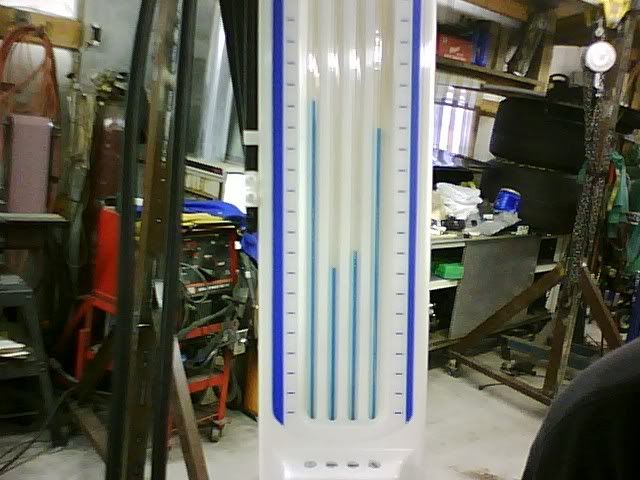
This is before the sync:
0105081133.jpg


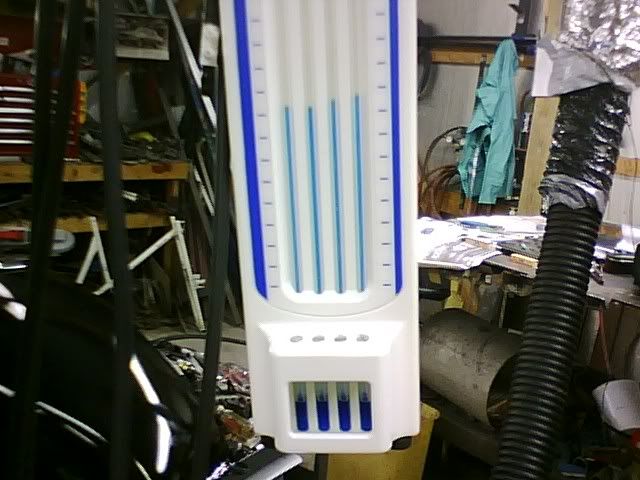
This is after the sync:
0105081158.jpg


Did you see the numbers on the gauge? :-k

No? That's OK, I didn't either. :D

Hopefully those dial gauges will work for you. You might have to make some restrictors to keep the needles from bouncing.
Did you realize that for about $15 more, you could have had what is regarded as the BEST sync tool? Morgan Carbtune.

.
 
Last edited:
I have a 78 GS 750 and just bought an EMGO Carb synchronizer to ballance my carbs. My question is how much pressure should my dials read in pounds. Any help would be appreciated.

with slide carbs you can set them at any level you prefer. I think you might want to try a couple of different heights.

10 ~ 15 inches will bring the best performance. usually

that last post is crap "best sync gauges have no numbers" HA what an idiot. the best calculators have no numbers either.

and the numbered graduations are inches of vacuum pressure (Hg of mercury to be exact)
 
Trip is being overly abrasive, shame on him. :(

Some sync gauges, like the factory Suzuki ones for example, require you to calibrate them using one cylinder to establish the base line. Basically you hook up each gauge to the same cylinder and then tweak a screw or restrictor of some sort to make each gauge read the same. After all the gauges are calibrated then they can be connected to each individual cylinder and you can sync the carbs.

Regarding where to set this baseline, I'm not sure other than somewhere toward the middle of the usable range. If the level is set too high the gauge will be overly sensitive, at the bottom and there will be too much restriction in the vacuum line. Sorry I can't be more definitive. Just play around with it and the answer should present itself.
 
that last post is crap "best sync gauges have no numbers" HA what an idiot. the best calculators have no numbers either.
That would depend on the gauge in question. When synchronizing carbs, the absolute value of the vacuum level does not matter, and it varies from one bike to another. It can not be said that "you must have XX amount of vacuum" because it might not be possible with that bike. When I got my mercury sticks about 30 years ago, it was noted in the instructions that typical levels would vary from one manufacturer to another. I don't remember what the numbers were, but let's say that Suzuki might be 19-20 cm, Kaw might be 22 cm and Honda might be about 16 cm. All those different levels for proper running bikes.

As mentioned to sync your carbs, you are only balancing one carb to another, it does not matter if they are at 16 cm or 22 cm of vacuum. Did you notice the Motion Pro gauge in the picture? I am not saying "it's the best", but it is generally regarded as a decent gauge. NO NUMBERS on it. Works great to sync the carbs.

By the way, the earliest calculators did NOT have numbers, and many of them are still in use.
nanana1.gif
 
Getting back now to see what was posted while I was doing the post above.

Trip is being overly abrasive, shame on him. :(

Some sync gauges, like the factory Suzuki ones for example, require you to calibrate them using one cylinder to establish the base line. Basically you hook up each gauge to the same cylinder and then tweak a screw or restrictor of some sort to make each gauge read the same. After all the gauges are calibrated then they can be connected to each individual cylinder and you can sync the carbs.

Regarding where to set this baseline, I'm not sure other than somewhere toward the middle of the usable range. If the level is set too high the gauge will be overly sensitive, at the bottom and there will be too much restriction in the vacuum line. Sorry I can't be more definitive. Just play around with it and the answer should present itself.
On abrasiveness, I tend to agree, but am not worried about it. :o

On the gauges, has anyone noted that the official Suzuki gauge has no numbers? :-k

I don't think that connecting all the tubes to the same carb is intended to "set a baseline". What if the cylinder you connected them to happens to be the one cylinder that is waayyy off? I think it is intended more to make sure that all of the indicators in the gauge are responding equally to a given vacuum level. That is one reason I stick with my mercury sticks. No calibration needed. Yeah the mercury is dangerous, but I have had them for 30 years now, and have no immediate plans of giving them up.

this quote is ONLY TRUE for vacuum slide (CV) carbs

NOT TRUE on mechanical carbs!!!!!!!!!!!
Then why is it part of the required maintenance in the Suzuki shop manual?
As a matter of fact, the vacuum slides have nothing to do with balancing the carbs. You could actually prop the slides wide open and do a proper job of balancing the carbs. The vacuum slides are there to maintain air flow across the jets if you happen to open the throttle butterflies too quickly.

.
 
I don't think that connecting all the tubes to the same carb is intended to "set a baseline". What if the cylinder you connected them to happens to be the one cylinder that is waayyy off? I think it is intended more to make sure that all of the indicators in the gauge are responding equally to a given vacuum level. That is one reason I stick with my mercury sticks. No calibration needed. Yeah the mercury is dangerous, but I have had them for 30 years now, and have no immediate plans of giving them up.


.

Yes, this is what I meant; Calibrate the gauge would have been a better term to use.
 
slides are there to maintain air flow across the jets if you happen to open the throttle butterflies too quickly.

.

Not meaning to hijack the thread, but I will, :). Just a question for understanding, is it the air flow comming across the jets forming a vacuum sucking the gas thru the jets? I think thats what we (in my biz) call a venturi system:-k
 
Here are some tuning tips from the Carbtune website. If you are running a stock pipe with the crossover your outer readings should be slightly higher than you inner readings per the second link step # 6. If you have a 4 into 1 or a pipe with no crossover you keep the readings at the same level for all 4 cylinders. It is a very slight difference in tuning adjustment but it does smooth out the motor a bit more than the four readings the same position IMHO.

http://www.carbtune.com/

Link to the GS tuning tips from the Carbtune website, note step # 6, I did not realize our very own BWringer was "world famous" :) but I must say I agree. ;)

http://www.bwringer.com/gs/carbsync.html
 
Not meaning to hijack the thread, but I will, :). Just a question for understanding, is it the air flow comming across the jets forming a vacuum sucking the gas thru the jets? I think thats what we (in my biz) call a venturi system:-k
Well our bikes also have a venturi system, but it's not created by the vacuum slides.
The actual venturi system is caused by a slightly-smaller area in the throat that speeds up the air flow.
Faster-moving air has less pressure, that is what draws the fuel through the jets.

Since you seem to understand car carburetors, do you understand the difference between mechanical and vacuum-operated secondaries in a four-barrel carb? If you open up all four barrels on a mechanical carb too fast, the engine just bogs because there is no air flow through it. (The accelerator pump helps, but we don't have one of those.) The vacuum-operated secondaries are opened by vacuum in the intake manifold that is created when the primary side of the carb can no longer supply all the air that is needed and is now a restriction. That vacuum will open the secondaries, allowing more air, more power.

In the case of the CV carbs on our bikes, the vacuum slides are like the secondaries, but they feed the primary. :eek:
If you open the throttle too quickly, the slide is still down, restricting the throat to ensure that there is air moving across the jets. As the engine speed increases, the air moving under the slides increases, which creates a vacuum above the diaphragm. This lifts the slide, allowing more air through the carb.

The slides don't lift so much based on engine vacuum as they do air flow. The amount of vacuum that the slides 'see' will be affected by your choice of air filter, which is why you might have to modify the hole in the bottom of the slide to enhance that signal.

.
 
Last edited:
Thanks Steve I actually understood all of that. (yeah for me, yeah for me)
 
Thanks guys,

This is the gauge that I bought. I though I ordered the Motion Pro Mercury gauge but this is what came in. Im sure I can do the same thing with this gauge. See attached
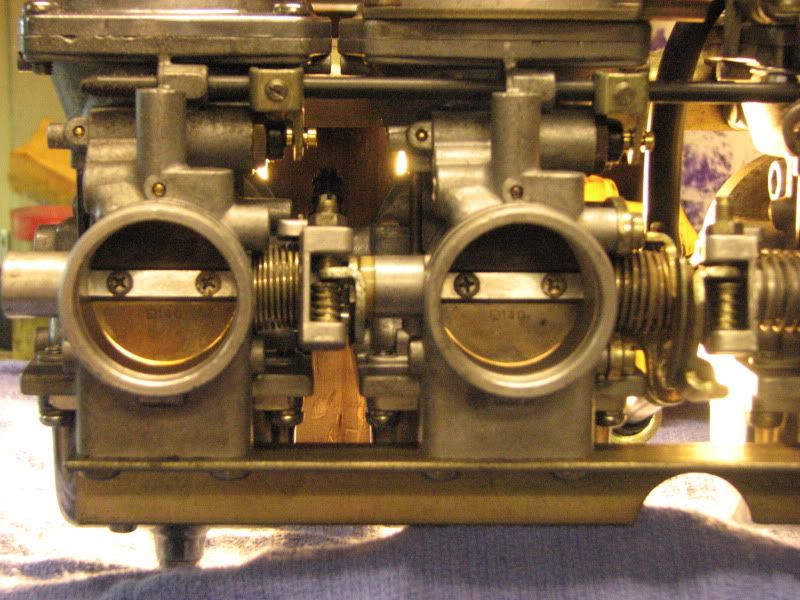
 
If those gauges have readings based on "hg" then there is mercury in it. If i'm not mistaken (i'll be corrected if I am:twistedevil:) the pressure going thru those tubes pushes the mercury which in turn is moving the needles in the gauges. As Steve has mentioned, don't get caught up with actual numbers of measurement just make sure the needles are pointing in the same direction.:)
 
Last edited:
Scott,

thank you for your expertise. I will be doing this project once I do my valve clearances. Prolly this weekend.

Have a good one and thanks to everyone who gave their input too.
 
If those gauges have readings based on "hg" then there is mercury in it. If i'm not mistaken (i'll be corrected if I am:twistedevil:) the pressure going thru those tubes pushes the mercury which in turn is moving the needles in the gauges. As Steve has mentioned, don't get caught up with actual numbers of measurement just make sure the needles are pointing in the same direction.:)

There is no mercury in those gauges. Inches of Mercury is a common pressure measurement unit based on old style gauges that used actual mercury, like our sync gauges.
 
I will be doing this project once I do my valve clearances. Prolly this weekend.
I see you are going to do your valve clearances. Good to do them before the carb sync. :clap:

Be sure to see the last line in my sig. :o

.
 
Thanks guys,

This is the gauge that I bought. I though I ordered the Motion Pro Mercury gauge but this is what came in. Im sure I can do the same thing with this gauge. See attached
I would send them back, tell them it is not what you ordered. Get the Motion Pro. I have the vac gauges and they are very difficult to use, as in it is very hard to get a steady reading without the needles bouncing all over
With the older slid carbs you can get pretty close doing a MECHANICAL Sync
All of the adjustments are based on the #3 carb
Back the idle screw out until you can see the #3 slide close, if it doesn't ? adjust it. Then adjust the idle screw in until you can insert a 1/8 dril bit under the slide from the intake side and adjust 1,2,4 to match. Don't for get to back the idle screw out before you start the bike
 
I have seen that suggestion before, but have had problems getting the idle speed screw to open the carbs far enough to put a 1/8" drill bit in. I have even had problems getting a 1/16" bit in at times. I have since resorted to just using my eyeball and adjusting the size of the sliver of light under the slide on VM carbs or the butterfly on the BS carbs.

IMG_3451.jpg


.
 
Back
Top